Alpine A110: the original Berlinette and the modern revival
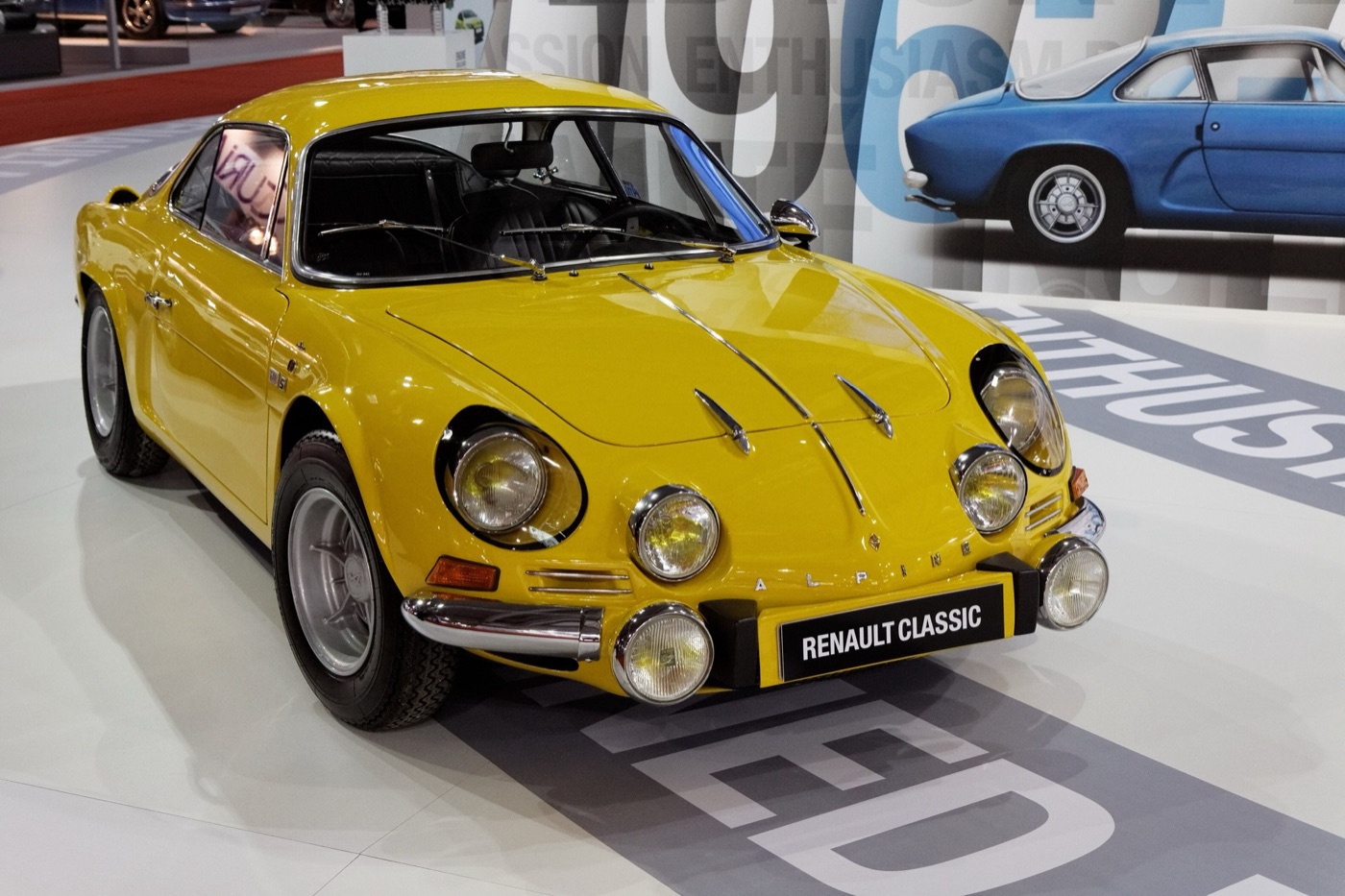
The Alpine A110 is the name of two rear-wheel-drive sports cars from the French manufacturer Alpine, part of Renault, both built at Dieppe in Normandy, France. The first, the glassfibre-bodied A110 Berlinette of 1962 to 1977, carried a rear-mounted Renault engine and won the first World Rally Championship for manufacturers in 1973; 7,176 were made. The second, launched at the Geneva Motor Show in March 2017, revived the name and the shape around an aluminium body and a mid-mounted 1.8-litre turbocharged petrol engine, and 28,701 were built before the last one left the line on 1 July 2026.
People look the A110 up for that rally record, for what the two cars are worth now, and for the story of how Renault brought the name back: a 2012 concept car, a joint venture with Caterham that ended in 2014, and a revival that outsold every earlier Alpine. An electric third-generation A110, also to be built at Dieppe, ran in public for the first time at the Goodwood Festival of Speed in July 2026.
The modern Alpine A110: design and engineering
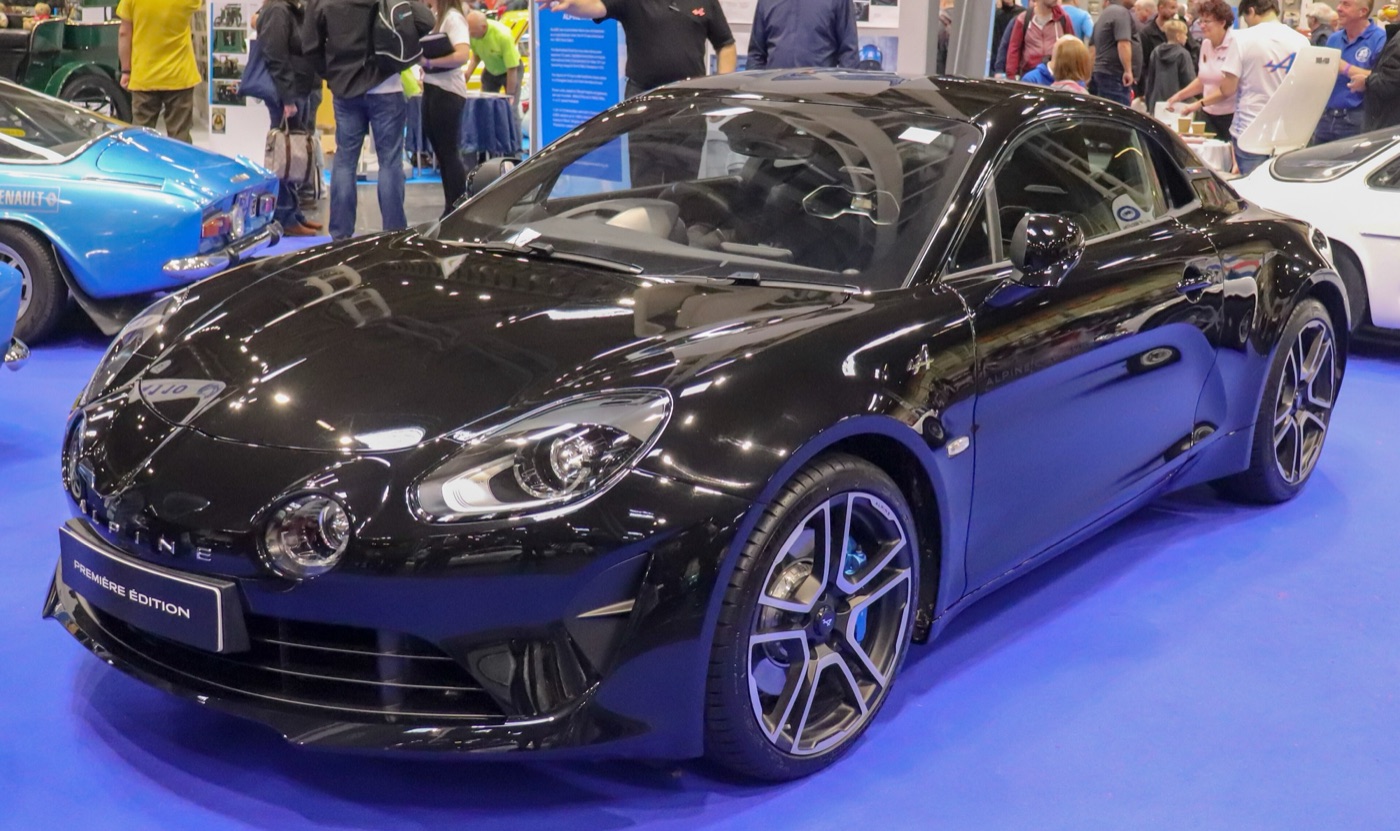
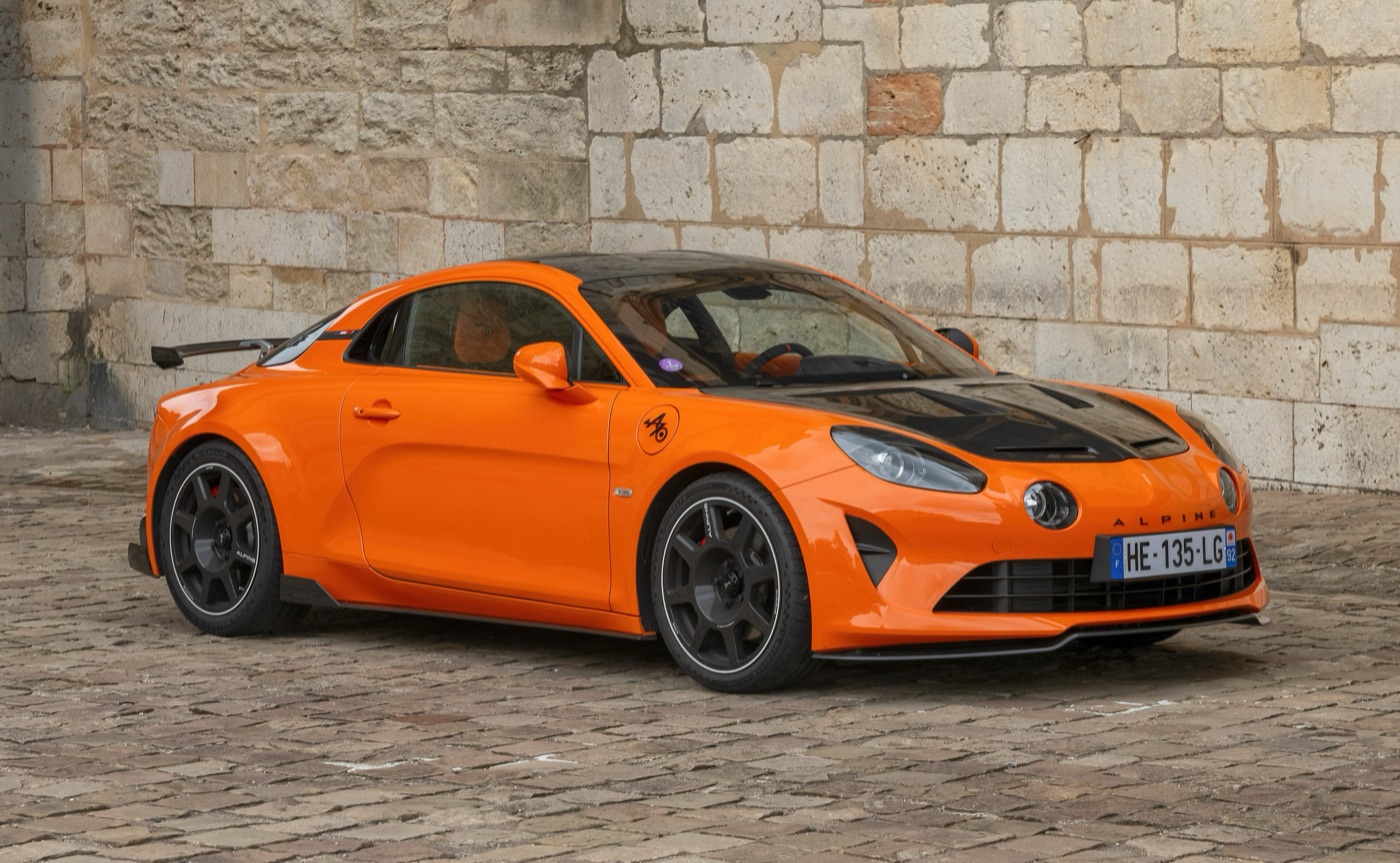
The 2017 A110 is a two-seat coupé with a 1.8-litre turbocharged four-cylinder engine mounted behind the cabin, a seven-speed dual-clutch gearbox and an aluminium chassis and body, unveiled at the Geneva Motor Show on 7 March 2017. In Groupe Renault's launch story the body and chassis are 96 per cent aluminium and the car weighs 1,080kg without options, with 44 per cent of the weight on the front wheels and 56 per cent on the rear; the fuel tank sits behind the front axle.
The engine, developed by the Renault-Nissan Alliance, was reworked by engineers from Alpine and Renault Sport with their own intake, turbocharging, exhaust and engine mapping, and made 252PS and 320Nm. Drive goes through a Getrag gearbox; there was never a manual gearbox option. The suspension uses double wishbones at both ends, and the car has no limited-slip differential, only a brake-based electronic one. A flat floor and a working diffuser let it reach 250km/h without a rear wing. Its dimensions: 4,180mm long, 1,798mm wide and 1,248mm high.
Antony Villain led the design. The twin headlights, the sculpted flanks, the spine down the bonnet and the wraparound rear window come from the Berlinette, while the X-shaped LED tail lights are new, according to Alpine's June 2019 press kit.
Production began at Dieppe on 1 December 2017. Renault spent more than €35 million on the factory, including a line for all-aluminium bodies, and hired 151 people, raising the workforce by 60 per cent, it said when Carlos Ghosn and Bruno Le Maire opened the line on 14 December 2017. Deliveries began in continental Europe at the end of 2017, and in the UK and Japan in 2018.
Alpine A110 specification and performance
Every second-generation A110 uses the same 1.8-litre turbocharged engine and seven-speed dual-clutch transmission. The Alpine A110 S, from 2019, had 40PS more from 0.4 bar more boost from the turbocharger, peaking at 6,400rpm, a lower ride height, and its springs were 50 per cent stiffer and its anti-roll bars 100 per cent stiffer than the standard car's.
| Version | Launched | Power output | Torque | Acceleration, 0–100km/h | Weight | Top speed |
|---|---|---|---|---|---|---|
| Première Édition, Pure, Légende, A110 | 2017 | 252PS | 320Nm | 4.5sec | 1,080kg without options | 250km/h |
| A110 S | 2019 | 292PS | 320Nm | 4.4sec | 1,114kg | 260km/h |
| A110 R | 2022 | 300hp | 340Nm | 3.9sec | 1,082kg | 285km/h |
| A110 R Ultime | 2024 | 345hp | 420Nm | 3.8sec | about 1,100kg | not published |
| A110 GTS | 2025 | 300hp | 340Nm | 4.2sec (0–62mph) | not published | 259km/h (161mph, Auto Express) |
Sources: Groupe Renault (2017), Alpine press releases of June 2019, December 2022, October 2024, February 2025 and January 2026; the A110 R's top speed is from Les Alpinistes and the GTS's figures from Auto Express. PistonHeads quotes weights of 1,098kg for the Pure and 1,123kg for the Légende.
What is the Alpine A110 like to drive?
The modern A110 is light, softly sprung and quick to turn, and for most owners its handling is the reason they bought one, PistonHeads' buying guide says. The centre of gravity sits under the driver, and Alpine calls ride comfort "a particular strength" of the car. Top Gear's judges wrote of "its poise and balance" and its "precision and delicacy", adding that the A110 "doesn't need lots of power, fat tyres or big brakes".
Handling, ride and steering
The engine pulls from 2,000rpm and revs to a 7,000rpm redline, and the transmission is quickest in manual mode, using the paddles behind the steering wheel. Reviewers often picked out the steering as the weak point of the chassis, PistonHeads notes, and in Sport and Track modes the S's steering grew heavier in a less natural way. Alpine said the earlier versions were "playful and fun to drive", like the 1970s car, and pitched the S as more focused. For many drivers the S's stiffer suspension took away some of the standard car's delicacy on B-roads, and some UK owners who chose 18in wheels for a Pure wished they had kept the 17s. The braking, even with the Pure's 296mm discs, the guide calls terrific. The S runs on Michelin Pilot Sport 4 tyres with a construction and compound made for it, 215mm wide at the front and 245mm at the rear, which Alpine says give it more mechanical grip; the Pure came on 17in alloy wheels.
Interior, infotainment and practicality
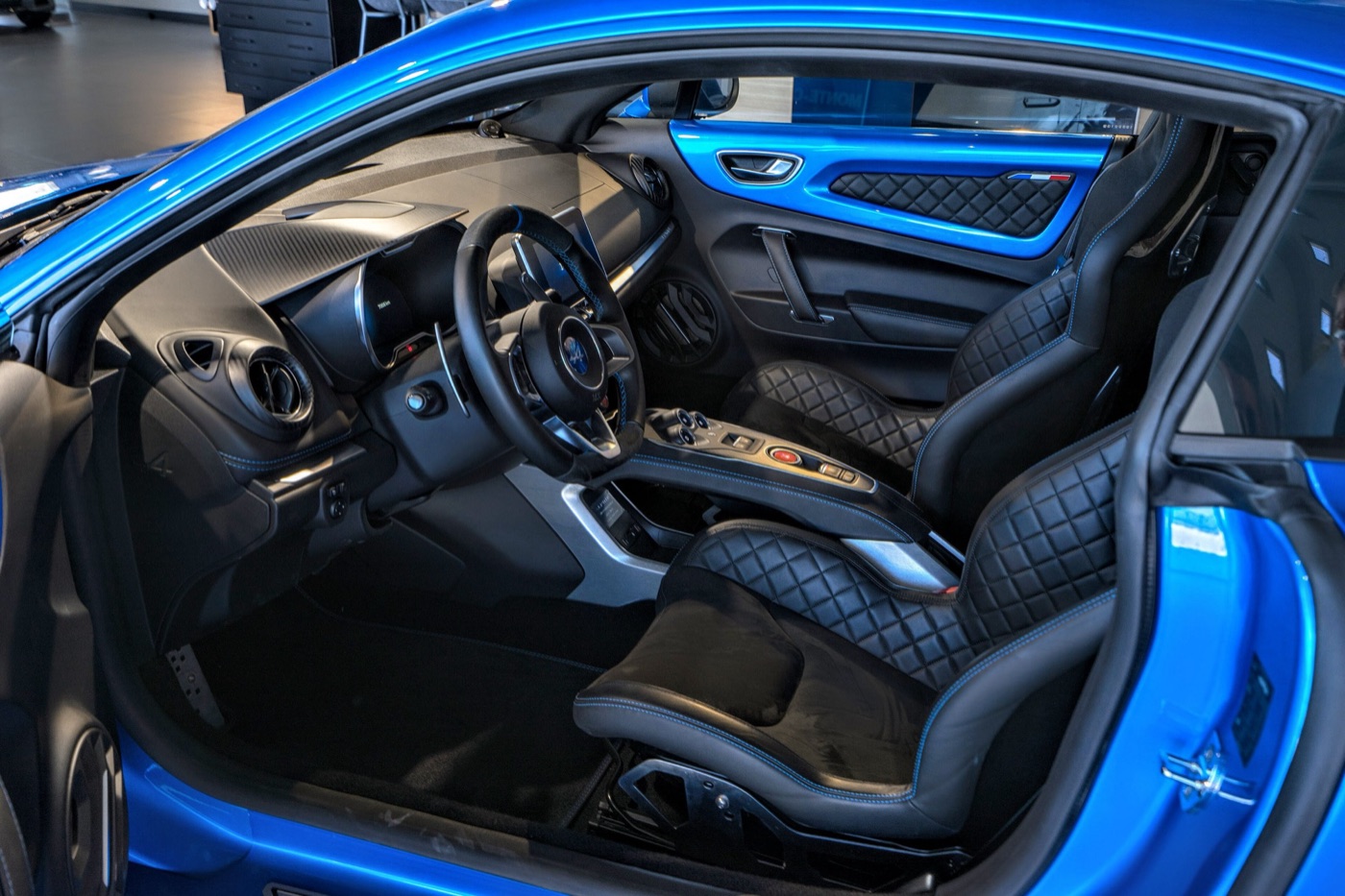
Inside, the A110 has Sabelt bucket seats (13.1kg each in the S), a floating centre console and carbon trim. Early cars had a touchscreen infotainment system, 7in across, with no Apple CarPlay or Android Auto, which arrived with a new multimedia system in 2022, and Auto Express found hard plastics in some editions. There is room for tall drivers: one 6ft 6in owner quoted by Auto Express found the cabin roomy, and Alpine designed it to take a driver in a helmet. Boot space is split between a front boot of 96 litres and a rear compartment of 100 litres, luggage space enough for two full-face helmets and an overnight bag.
Alpine A110 versions and special editions
In March 2022 the range was cut to the A110, A110 GT and A110 S, the last two with the 300PS engine, and in 2025 the GTS replaced the GT and the S.
Première Édition, Pure and Légende
The first A110s were the Première Édition, limited to 1,955 cars for the year Alpine was founded, which sold out within five days of order books opening. The Première Édition was provisionally priced at €58,500 in France; in the UK it cost £51,805. Alpine showed the Pure and the Légende at Geneva in February 2018: the Pure light and plain, with fixed Sabelt seats, "destined to live its life on winding mountain roads" in Alpine's words, and the Légende a grand tourer for everyday use and long journeys, with six-way adjustable seats, full leather and gloss carbon trim.
A110 S, GT and GTS
The A110 S, announced on 13 June 2019 at €66,500, was the first A110 with a more powerful engine and its own chassis settings, with orange brake calipers, Dinamica trim and 320mm Brembo brakes as standard. The GTS, launched for Alpine's 70th anniversary at €79,500 in France, combined the S's chassis with the GT's comfort, as Alpine's February 2025 release put it.
A110 R, R Turini, R 70 and R Ultime
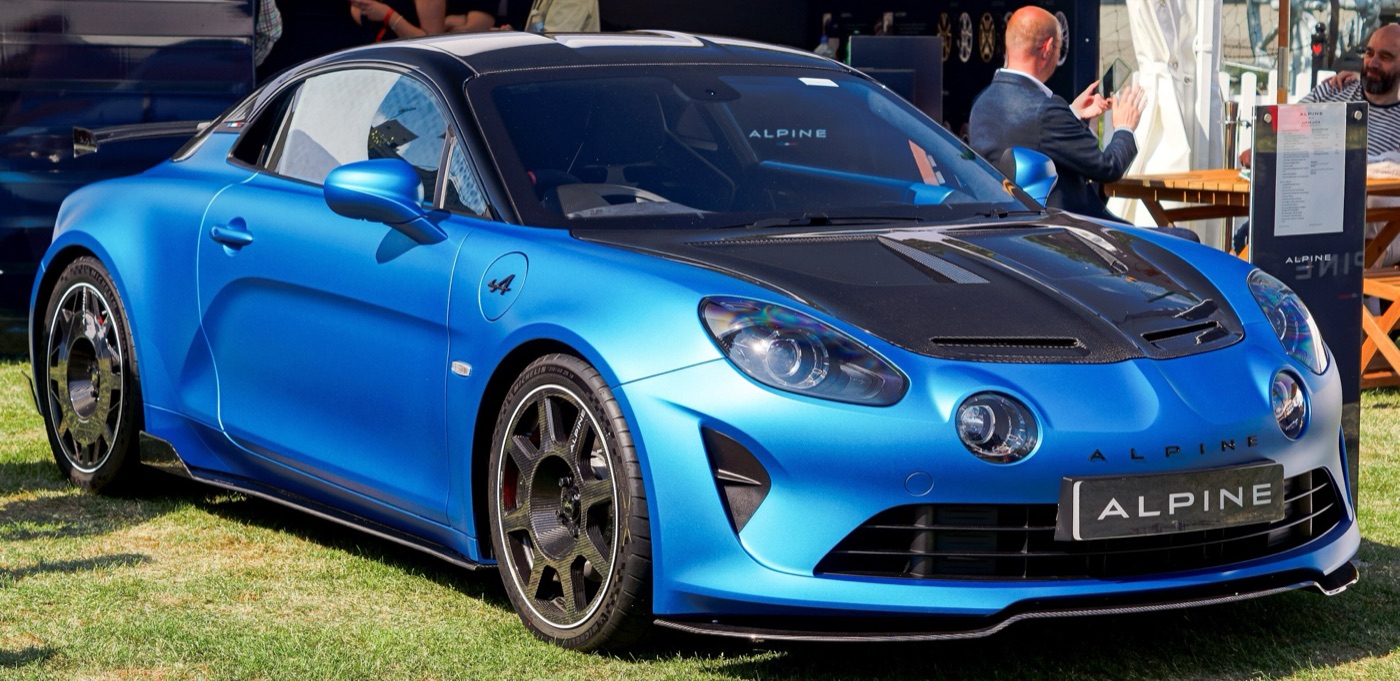
The Alpine A110 R, revealed on 4 October 2022, is 34kg lighter than the A110 S at 1,082kg, with its own bonnet, rear window and diffuser, and it cost €105,000 in France. The A110 R and the A110 R Turini made up 35 per cent of A110 sales in 2024. The R 70 of 2025, limited to 770 cars at €122,500, marked Alpine's 70th year and the last R versions; 70 each are in Bleu Caddy, Blanc Glacier and Rouge Sismique, the French tricolour. The R Ultime, shown at the Paris Motor Show in October 2024, is limited to 110 cars from €265,000, with an uprated turbo, a stronger gearbox, Öhlins dampers and AP Racing brakes, in Alpine's Paris show release.
Limited editions
Three limited editions of 2022, the A110 GT J. Rédélé, the A110 Tour de Corse 75 and the A110 R Fernando Alonso, all sold within thirty minutes, Alpine said. The Tour de Corse 75 (150 cars, €80,000 in France) wears the yellow and black of the No. 7 Berlinette from the 1975 rally, and the San Remo 73 (200 cars, €89,000, on sale from 17 March 2023) the blue, white and red of the 1973 winner. The A110 R Fernando Alonso was a run of 32 cars at €148,000, and the A110 R Le Mans a run of 100 for the race's centenary in 2023. The A110 E-ternité, an all-electric, open-roofed prototype, appeared at the French Grand Prix in July 2022 for the A110's 60th anniversary.
The modern A110 in motorsport
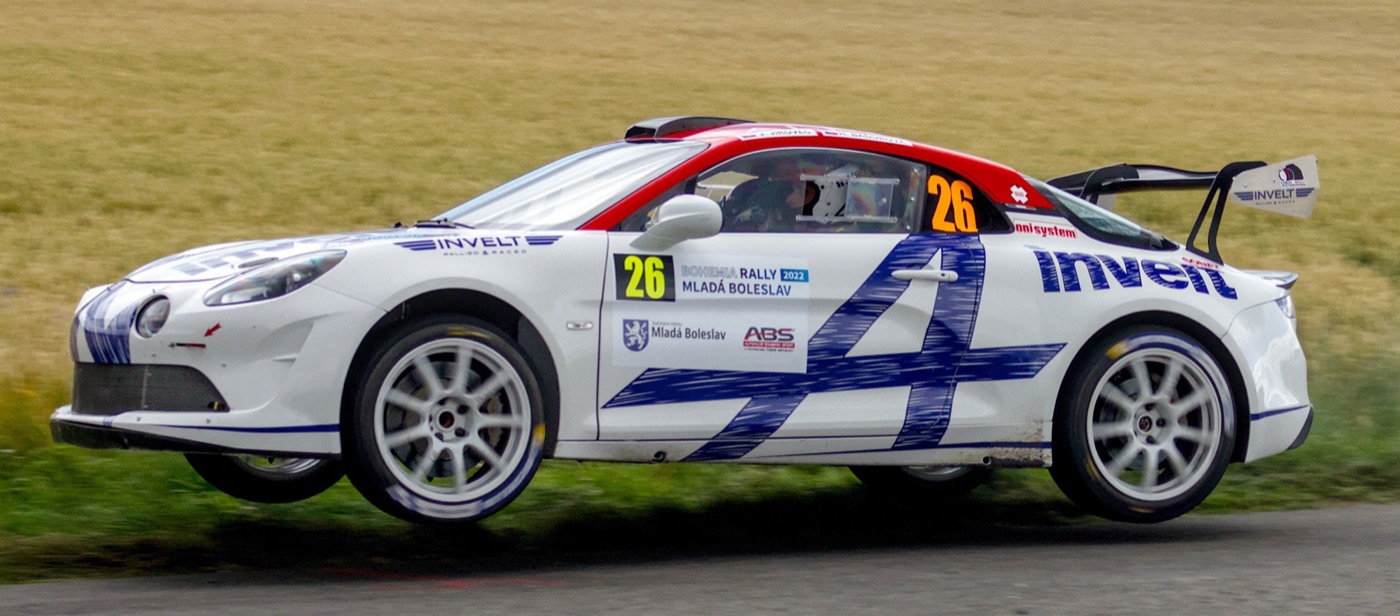
The 2017 A110 races in three forms: the A110 Cup, the A110 GT4 and the A110 Rally, the first and last designed by Alpine's partner Signatech. The Cup, presented in October 2017 as "a genuine race car", has 270hp, a six-speed sequential gearbox and a 1,050kg weight, and cost €100,000 before tax for the six-round Alpine Europa Cup of 2018, according to Alpine's launch release. The A110 GT4 won the GT4 International Cup in Bahrain in 2018 and, as the GT4 Evo, the French FFSA GT Am title in 2023 and the Am Cup of the GT4 European Series in 2024, with seven wins from 12 races for Laurent Hurgon and Pascal Huteau, in Alpine's December 2024 release.
The A110 Rally is built to the FIA's R-GT rules for two-wheel-drive GT cars. Pierre Ragues won the FIA R-GT Cup with it in 2021 and Raphaël Astier in 2022, and by the end of 2022 the car had won 11 rallies and 151 stages in the series in a row, in Alpine's October 2022 report. On the Monte Carlo Rally, A110 Rallys won the R-GT class in 2021, 2022 and 2023, the last with Loïc Panagiotis.
How much is an Alpine A110? New and used prices
On final UK pricing, the base model, the 252PS A110, cost from £55,000 new, the 300PS GTS £70,000 and the A110 R £107,000, Autocar reported in October 2025. Used, Auto Express put values between £42,000 and about £70,000.
An original Berlinette costs more. Sales of A110 1600 models recorded by The Classic Valuer since 2020 have a median of £99,350, from £44,167 for a Spanish-built car to £129,464 for a 1974 1600 VD at RM Sotheby's in October 2020. A 1972 Group 4 car made £254,546 at Artcurial in February 2017, and RM Sotheby's sold a non-running, highly original 1971 1600 S from the Petitjean collection for €104,500.
Is the Alpine A110 reliable? Running costs and faults
The 2017 A110 has had few serious faults. Auto Express lists three recalls, all in 2019: front luggage-compartment bolts left loose on 206 cars, which could let the bonnet open on the move; a wiring loom that could chafe on the exhaust on 166 cars; and an oil pressure fault on 240 cars, fixed with a software update. The engine has a timing chain, not a belt.
Auto Express lists official fuel economy of 42.2mpg and 153g/km of CO2 for the 252PS car, 40.4mpg for the GTS and 41.5mpg for the A110 R, and averaged 34.8mpg over 12,000 miles with its own long-term car. The insurance group is 47 for the A110, 49 for the GTS and 50 for the A110 R, the top of the scale. Euro NCAP has never tested the A110.
Servicing costs £538 a time at Alpine dealers, with £178 for brake fluid every three years, £242 for gearbox oil every fourth service and £384 for coolant every five years, according to the same review. The warranty is three years, with unlimited mileage for two years and a 60,000-mile cap at three. PistonHeads' buying guide adds that a weak battery stops cars running and that parking sensors can drop back into the bodywork.
Alpine A110 rivals
The 2017 A110's closest rival is the Porsche Cayman, sold as the Porsche 718 Cayman since 2016; the others are Lotus's Elise, Exige and Emira and the Audi TT RS. Auto Express made the A110 its Coupé of the Year in 2019, 2020 and 2021, while in its tests the A110 S lost to the 718 Cayman GTS and beat the BMW M2 CS. The A110 has only a dual-clutch gearbox, where the Cayman was offered with a manual.
Alpine A110 reception and awards
The 2017 A110 collected 18 awards in its first two years, Groupe Renault listed in 2019, among them Top Gear magazine's Performance Car of the Year (October 2018) and Sports Car of the Year (November 2018), Motor Sport's Car of the Year (June 2018), evo's Coupé of the Year (December 2018) and What Car?'s Sports Car of the Year (January 2019). In the 2019 European Car of the Year it tied for first with the Jaguar I-Pace on 250 points from the 60 judges, then lost the deciding round, Alpine reported in March 2019.
Top Gear's six judges were unanimous. "It's got air-conditioning, satnav and electric windows, yet thanks to a ground-up design that obsesses over the details, it weighs almost 25 per cent less than the equivalent Porsche or Audi," the magazine wrote in its award story. Readers of the German magazine Auto Motor und Sport voted it the best imported sports car in their Best Cars poll for the eighth time in 2026.
The next Alpine A110: the electric third generation
The third-generation A110 is an electric sports car on Alpine's new Alpine Performance Platform (APP), to be built at Dieppe. Its development mule, the A110 FUTURE, made its first public run at the Goodwood Festival of Speed on 9 July 2026, driven by Pierre Gasly of the Alpine Formula One team, which has raced under the Alpine name since 2021, with the Duke of Richmond as passenger. Alpine's Goodwood release describes an 800V battery split 25 per cent front and 75 per cent rear so that the car can be as low as today's A110, and twin rear motors with torque vectoring.
Les Alpinistes reports a target weight of about 1,500kg and a range of about 550km for the coupé, and expects the car on sale in late 2026 or 2027.
Alpine A110 history: the original Berlinette
The original A110 was the third model of Alpine, the company Jean Rédélé founded in June 1955, and it went on sale in 1962 as a development of the A108. Its parts came from the rear-engined Renault 8 saloon, as the 4CV had supplied the A106 and the Dauphine the A108, according to Alpine's 60th-anniversary history, published in February 2015.
Jean Rédélé, the A106 and the A108
Rédélé was born on 17 May 1922, the eldest son of a Renault dealer in Dieppe, and became the youngest car dealer in France at 24. He raced and rallied a Renault 4CV from 1950, ordered an aluminium-bodied 4CV special from the Italian designer Giovanni Michelotti, and won his class in the Mille Miglia three times with his co-driver Louis Pons. Success in the 1954 Coupe des Alpes gave him the name: "I thoroughly enjoyed crossing the Alps in my Renault 4CV, and that gave me the idea of calling my future cars 'Alpines'," he later said.
The first Alpine, the A106 coach, used the 4CV's chassis, suspension and 747cc engine under a polyester body; 251 were built between 1955 and 1960. The A108 followed at the 1957 Paris Motor Show with the Dauphine's 845cc engine, and 236 were built up to 1965. Two things on the A108 shaped the A110. Philippe Charles, then 17, restyled the Michelotti-designed cabriolet with faired-in headlights and a longer tail, and that body, called the Berlinette, ran in the 1960 Tour de France Automobile. In 1961 every Alpine moved to a steel backbone chassis: a central beam with side rails carrying the front and rear subframes.
The A110 arrives
The A110 took the A108's Berlinette shape and backbone chassis and fitted the Renault 8's engine and running gear in 1962. Alpine's history lists engines of 1108cc, then 1255cc, 1565cc and 1605cc, and the company changed the body often in small ways: a grille with four headlights, wider wheel arches, a front-mounted radiator and a removable rear apron. From 1967 every car carried the Renault name as well as Alpine's.
Rally wins pushed up demand. Alpine's history and Renault's November 2012 press release describe how production was shared between the avenue Pasteur workshop in Paris, the original Dieppe factory and a new plant at Thiron-Gardais (Eure-et-Loir), until Rédélé opened the present Dieppe factory in 1969.
Licence-built A110s
Short of money for an export network, Rédélé licensed his cars to other makers. In Brazil, Willys-Overland built the Interlagos from 1960, first as an A108 and then as an A110, and made 1,500 coupés, Berlinettes and cabriolets up to 1966. The same arrangement followed in Mexico (Dinalpin), Spain (FASA) and Bulgaria (Bulgaralpine), and Alpine puts the share of its cars built abroad under licence at nearly 15 per cent.
Renault takes over, and the end of the Berlinette
Renault, the French manufacturer whose parts every Alpine used, had backed Alpine from the start and gave it the job of representing Renault in motorsport. It then took control of the company in the early 1970s: PistonHeads' A110 buying guide dates the acquisition to 1971 and Auto Express's used A110 review to 1973. The 1973 oil crisis cut sales of the A310 that was meant to follow the A110, and the Berlinette stayed in production in France until 1977. Its last version was the 1600 SX with a 1647cc engine.
One of the last Berlinettes built at Dieppe, a green 1600 SX delivered in 1977 and kept by its first owner, went on show at Rétromobile in January 2026, Alpine's press release for the show giving the car 95hp, 790kg and a top speed of 195km/h.
Design and engineering of the original A110
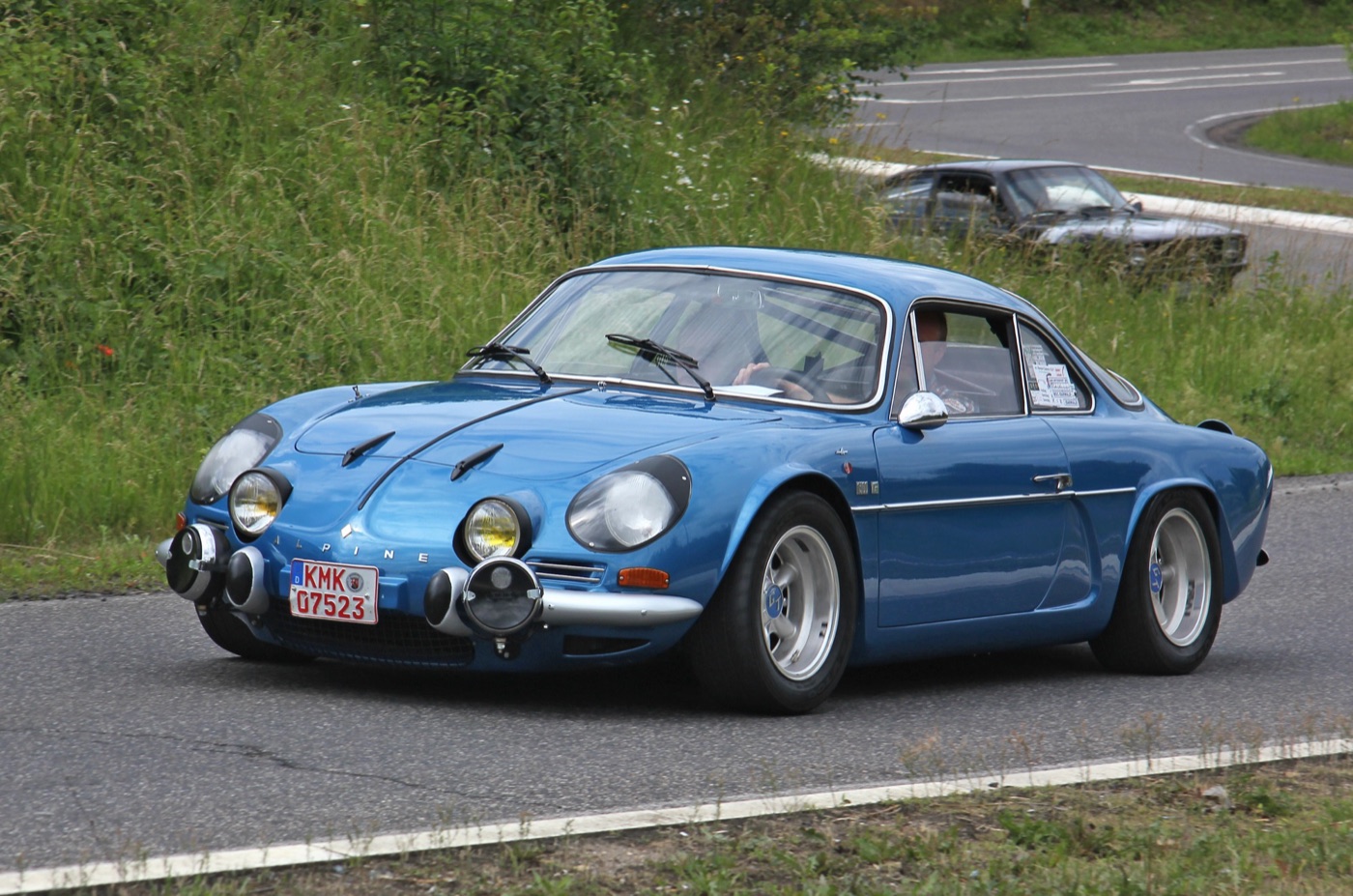
The original A110 is a small two-seat coupé with a glassfibre and polyester body bonded to a steel backbone chassis, a Renault four-cylinder engine mounted lengthways behind the rear axle and a manual gearbox. Alpine's principles, as its 2015 history puts them, were simple mechanicals, as many production parts as possible, and a light, good-looking body.
A reader's letter in Motor Sport in May 2002, correcting an earlier article, gave the early A110 Berlinette Tour de France a homologated weight of 565kg with 70hp, and the 1970 1600S 650kg with 138bhp. The same letter put the works team's lightweight body shells at about 50kg, half the weight of a Group 3 shell. With only a thin glassfibre panel between the engine and the cabin, the letter called the car "a very live and involving experience".
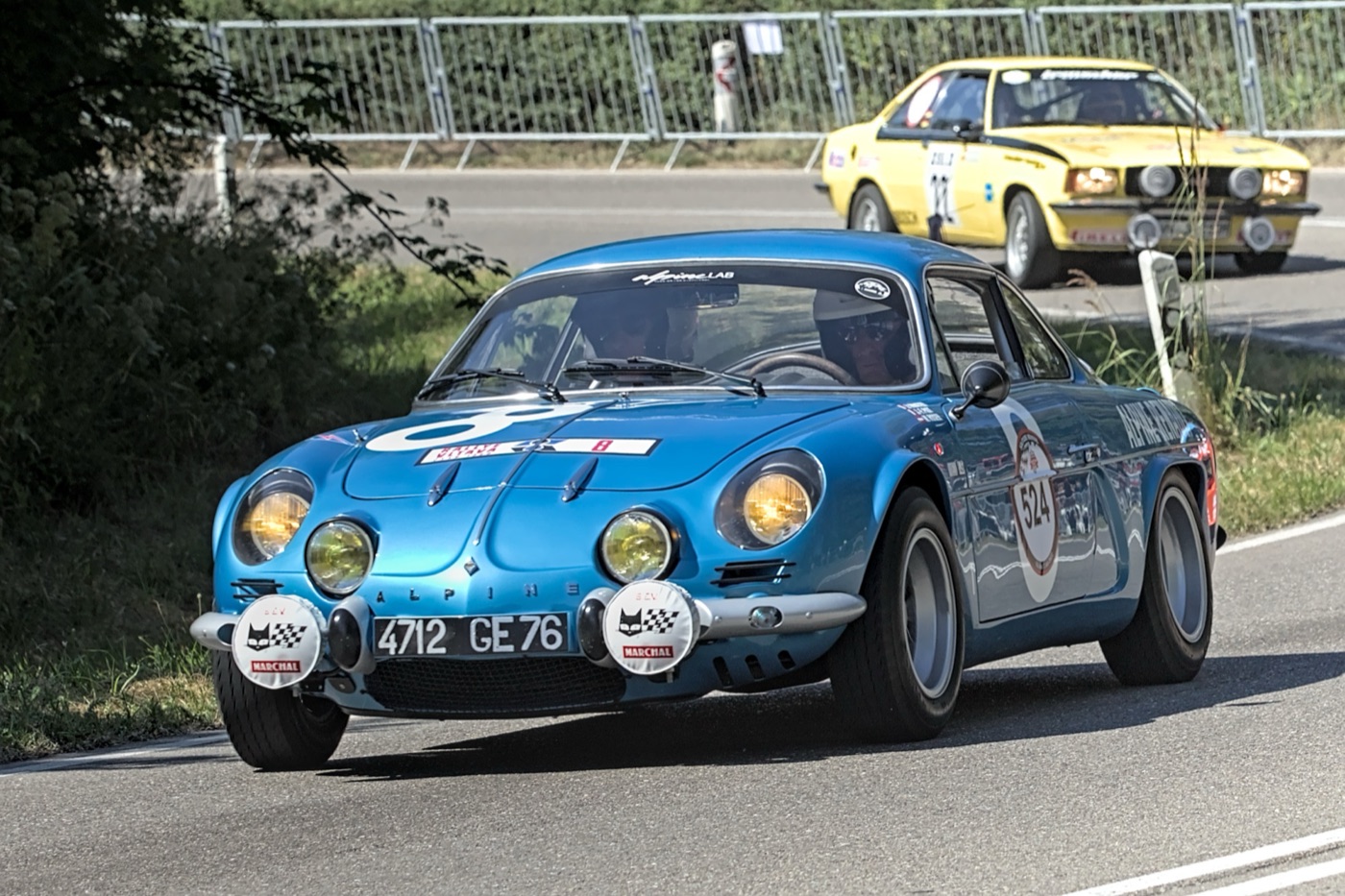
In the early 1960s a customer asked for his Alpine in a metallic blue; the shade was taken up as colour code 331, "Bleu Alpine", and Alpine says more than 58 per cent of all the A110s built at Dieppe, old and new, have been ordered in a shade of blue, and 33 per cent in Bleu Alpine itself.
Original A110 engines and versions
The A110 grew from about 70hp to 170hp and more across its life, always with Renault four-cylinder engines, which Marc Mignotet tuned for the works rally cars. The 1605cc 1600S was homologated for Group 3 on 1 July 1972, which moved it into the class up to 2,000cc and let Alpine enlarge the competition engine to 1.8 litres.
| Version | Engine | Output | Weight | Source |
|---|---|---|---|---|
| Berlinette Tour de France (early) | Renault 8 four-cylinder | 70hp | 565kg homologated | Motor Sport, May 2002 |
| 1600S (1970) | 1.6-litre four-cylinder | 138bhp | 650kg homologated | Motor Sport, May 2002 |
| 1800S Group 4 works car (1975) | 1,796cc, built by Mignotet | 170hp | 710kg | Alpine, January 2026 |
| 1600 SX (1976–77) | 1,647cc | 95hp | 790kg | Alpine, January 2026 |
The 1800S Group 4 in the table, built for the works team in September 1975, finished second overall in the 1975 Tour de Corse with Jean-Pierre Nicolas and Vincent Laverne and won the 1976 Tour Auto of Réunion Island with Jean Ragnotti.
The Alpine A110 in rallying
The A110 won the Monte Carlo Rally in 1971 and 1973 and gave Alpine the first World Rally Championship for manufacturers in 1973. Alpine's sporting director Jacques Cheinisse built the team around four French drivers known as the Musketeers: Jean-Pierre Nicolas, Jean-Claude Andruet, Bernard Darniche and Jean-Luc Thérier. Gérard Larrousse came close to winning the Monte in an A110 in 1968.
Winning the Monte Carlo Rally
Alpine entered two three-car teams for the 1971 Monte Carlo Rally, but its Swedish driver Ove Andersson, with David Stone navigating, led from the first test and won. Motor Sport's March 1971 report recorded that Andersson had joined Alpine only for the previous November's RAC Rally after being dropped from Ford's Boreham team, and that Björn Waldegård's Porsche 914/6 got up to equal third. Alpine's own history calls the result a podium it monopolised.
The first World Rally Championship
The 1973 season was the first World Rally Championship, run for manufacturers only, and Alpine won six of its 13 rounds with the A110 1800, on every type of surface: snow and tarmac in Monte Carlo, gravel in Morocco, mixed tarmac and gravel in Portugal, Greece and Sanremo, and tarmac in Corsica. It opened with a one-two-three on the Monte Carlo Rally (Andruet, Andersson, Nicolas), the first podium of each man's World Rally Championship career, as Jonkka's World Rally Archive records. Thérier's win in Sanremo in October sealed the title; Alpine's 2023 account of the rally says the No. 1 Alpine won by more than six minutes.
| Round | Rally | Dates | Winner |
|---|---|---|---|
| 1 | Monte Carlo | 19–26 January | Jean-Claude Andruet |
| 3 | Portugal | 13–18 March | Jean-Luc Thérier |
| 5 | Morocco | 8–13 May | Bernard Darniche |
| 6 | Acropolis | 23–27 May | Jean-Luc Thérier |
| 10 | Sanremo | 10–13 October | Jean-Luc Thérier |
| 13 | Tour de Corse | 1–2 December | Jean-Pierre Nicolas |
The Tour de Corse ended the year with another Alpine one-two-three. Alpine took the title ahead of Fiat and Ford. The two official accounts differ on the total: the World Rally Championship's season archive gives Alpine-Renault 147 points, 63 clear of Fiat, while Alpine's 2023 anniversary release gives 143 points, also 63 ahead of the runner-up.
The turbo Berlinette and the Lancia Stratos
In 1972 Cheinisse had Mignotet build a 200bhp turbocharged 1600cc engine for Thérier to use on the Critérium des Cévennes, "the first time that a turbocharged engine was used in competition", in the words of the Motor Sport letter. By 1975 the A110 was racing the mid-engined Lancia Stratos: on that year's Tour de Corse an A110 and a Stratos set identical times on the final stage, and the Alpine finished 32 seconds short of the win, as Alpine's 2022 Tour de Corse 75 release recalls. The A110 still races in historic events: Alpine entered five for the 2013 Rallye Monte-Carlo Historique, 40 years after the 1973 win.
How many Alpine A110s were made?
Alpine built 7,176 original A110s and 28,701 of the second generation, which ended on 1 July 2026.
The original Berlinette
Alpine gives the production of the original A110 Berlinette as 7,176 cars between 1961 and 1977, in its December 2023 release on the 20,000th new A110. Some sources date the start to 1962, the year the car was shown and went on sale. The A310 that followed reached 11,616 cars between 1971 and 1984, and held the record for the most-produced Alpine model until the new A110 passed it.
When did Alpine A110 production end?
Production of the second-generation A110 ended at Dieppe on 1 July 2026, when the last car, an A110 R 70 in Alpine blue with a black roof, left the line. Alpine had said in January 2026 that orders would close at the end of March and production would end in June. In all, 28,701 second-generation A110s were built in nine years, which took the number of A110s assembled at the Dieppe factory since it opened in 1969 to 35,450, according to Alpine's release on the last car.
The 10,000th new A110 was built in June 2021, Les Alpinistes records, and the 20,000th, an A110 R Le Mans, in December 2023. Alpine sold 4,408 A110s in 2024, 1.8 per cent more than in 2023, more than 85 per cent of them in the top versions, and claimed 44.7 per cent of the European market for two-seat sports coupés, its 2024 sales results showed. Nearly 80 per cent of A110 sales were in France, Germany and the UK.
Reviving the A110: A110-50, Alpine Caterham, Vision
Renault brought the Alpine name back between 2012 and 2017, 17 years after the A610 went out of production in 1995: a concept car in 2012, a joint venture with Caterham from 2012 to 2014, a show car in 2016 and the production A110 in 2017. In the meantime the Dieppe factory built Renault Sport models, from the Renault Sport Spider and Clio V6 to the Clio R.S.
The A110-50 concept
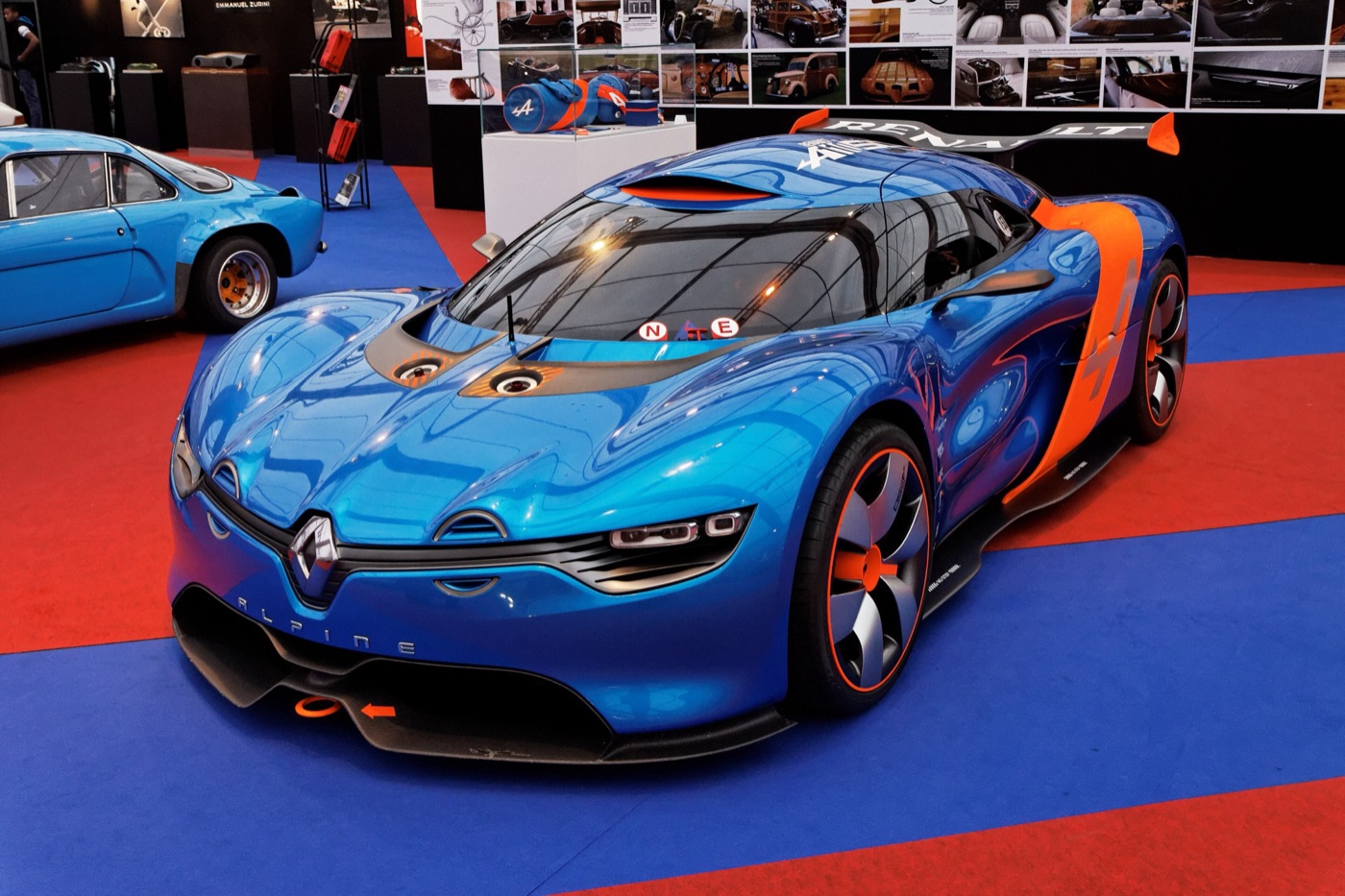
The A110-50 is the concept car Renault built to mark the Berlinette's 50th anniversary and showed at the Monaco Grand Prix in May 2012. Underneath it is a Mégane Trophy racing car: the tubular chassis, the 2,625mm wheelbase and the mid-mounted 3.5-litre 24-valve V6, the Renault V4Y, rated at 400hp in Renault Sport's press release of 25 May 2012. A six-speed sequential gearbox sits behind the engine, and the car has no ABS or traction control. Renault Sport put 47.8 per cent of its mass over the front wheels.
Yann Jarsalle designed it, with Axel Breun as concept car director, from the DeZir concept of the 2010 Paris Motor Show. The carbon-fibre body, made by Faster, has scissor doors, yellow LED auxiliary lamps and side intakes placed like the ducts on the original's rear arches; the right-hand one cools the gearbox. "We wanted to make a Berlinette that was of our time," Breun said. SkiddMark's report of the reveal gave its kerb weight as 880kg, with 318lb ft of torque.
The A110-50 ran up the hill at the Goodwood Festival of Speed at the end of June 2012, and Renault then released a film of it driven alongside a classic A110 rally car, with Jean Ragnotti and Erik Comas among the drivers, a 2012 SkiddMark report recorded. Renault never put the A110-50 into production.
Renault and Caterham's joint venture
On 5 November 2012 Renault and Caterham Group announced Société des Automobiles Alpine Caterham, a company owned 50:50 to design and build sports cars at Dieppe, with Bernard Ollivier, a former head of Renault Sport Technologies, as its chief executive. Each partner was to launch its own car within three to four years from a shared engineering department, according to the companies' joint press release. Carlos Tavares, then Renault's chief operating officer, said that "our ambitions of reviving Alpine depended on our ability to find a partner in order to ensure the economic profitability of such an adventure" and spoke of "a vehicle that will embody the very essence of Alpine".
The two firms already worked together in Formula One, where the Caterham team used Renault engines. A 2012 SkiddMark report on the collaboration noted that the cars were to be rear-drive two-seaters priced under €50,000, and Caterham's technical chief Mike Gascoyne said on the day that Caterham's share of the design would be done in Norfolk. In June 2014 Renault bought Caterham Group's half, the company became Société des Automobiles Alpine, and Renault said it would launch its own Alpine sports car in 2016, as planned, in the press release ending the partnership. Caterham's side of the story, and the C120 it planned on the shared car, is on our Caterham Cars page.
After the split, Ollivier set the brief that the A110 followed: a kerb weight of about 1,100kg, aluminium in place of the costlier carbon fibre for the chassis and body, and agility before power. The go-ahead for production came in 2015, according to Les Alpinistes' July 2026 account, and Ollivier told the story in his book Alpine, la renaissance (Solar, 2019).
Alpine Vision
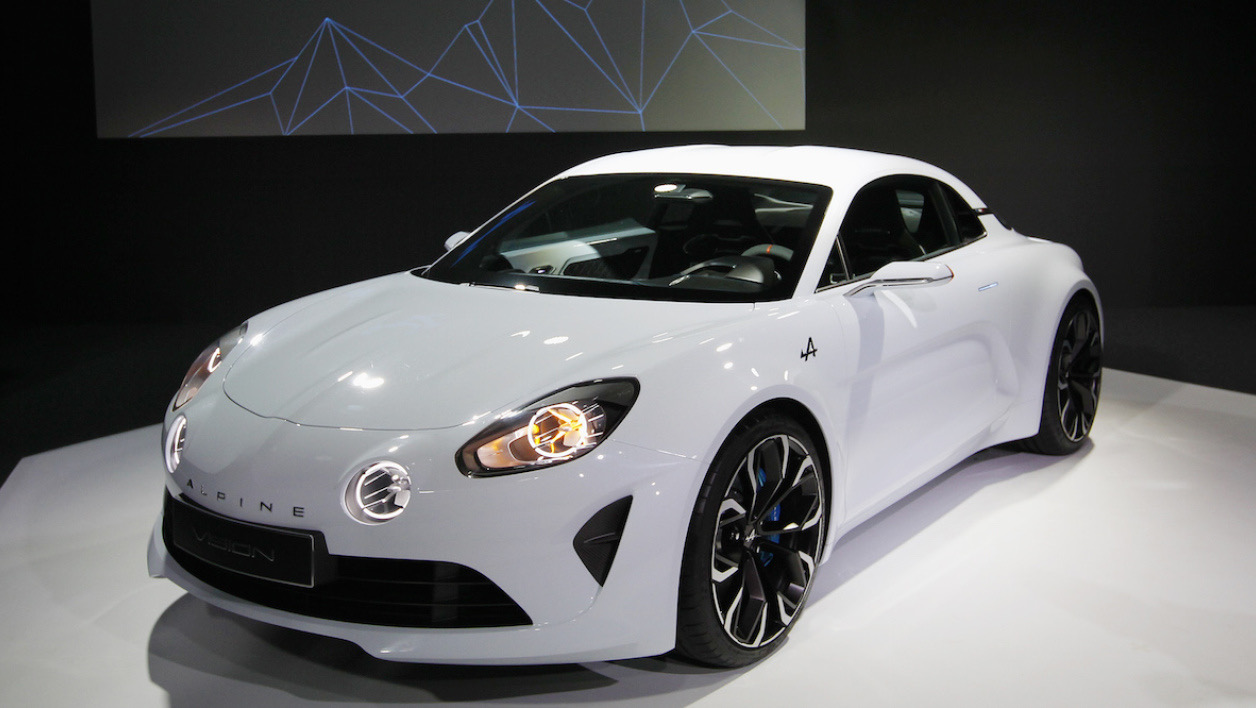
The Alpine Vision is the show car, first shown in Monaco in 2016, that previewed almost the whole shape of the production A110. It went on to the Geneva Motor Show in March 2016.
Questions
Is the Alpine A110 a Renault?
Alpine is a Renault Group brand, and has been since Renault took control of the company in the 1970s. The original A110 used Renault 8 parts and Renault engines, and the 2017 car's 1.8-litre engine came from the Renault-Nissan Alliance.
Does the Alpine A110 have a manual gearbox?
The original A110 does. The 2017 A110 was sold only with a seven-speed Getrag dual-clutch gearbox; Alpine never offered a manual.
What does Berlinette mean on an Alpine?
Berlinette is the name Alpine gave the closed coupé body that Philippe Charles drew for the A108 in 1960. The A110 kept the shape, and Berlinette became the original A110's nickname.
Is the Alpine A110 mid-engined or rear-engined?
The original A110 is rear-engined, with its engine behind the rear axle. The 2017 A110 is mid-engined, with the engine ahead of the rear axle and behind the cabin.
How fast is the Alpine A110?
The 252PS A110 reaches 100km/h in 4.5 seconds and has a top speed of 250km/h. The A110 R does 0 to 100km/h in 3.9 seconds and 285km/h, and the R Ultime does 0 to 100km/h in 3.8 seconds.
Why are Alpines blue?
A customer in the early 1960s asked for his Alpine in metallic blue, and the colour became Bleu Alpine, code 331. More than 58 per cent of the A110s built at Dieppe have been ordered in a shade of blue.
Where is the Alpine A110 made?
At Alpine's factory in Dieppe, Normandy, opened by Jean Rédélé in 1969 and now called the Manufacture Alpine Dieppe Jean Rédélé. The electric third-generation A110 will be built there too.
Did Caterham build a version of the Alpine A110?
No. The Alpine Caterham joint venture of 2012 planned a car for each brand, but Renault bought Caterham's half in June 2014, and the A110 that went on sale in 2017 is Alpine's alone.
Sources
- Alpine, "Alpine celebrates its 60th anniversary at France's Rétromobile show", 3 February 2015: Rédélé's life, the A106, A108 and A110, licence production, the backbone chassis, the 1973 season.
- Renault and Caterham Group, "Renault and Caterham group announce a partnership to design and build sports vehicles", 5 November 2012: the joint venture, the quotes, the Dieppe factory.
- Renault Group, "Renault has acquired Caterham Group's stake in Société des Automobiles Alpine Caterham", June 2014: the end of the joint venture.
- Renault Sport, "Renault Alpine A110-50", 25 May 2012 (archived copy): the concept's design and specification.
- Groupe Renault, "GIMS 2017: Alpine A110, a sports coupé à la française", March 2017 (archived copy): weight, weight distribution, engine, Première Édition price.
- Groupe Renault, "Groupe Renault inaugurates new Alpine A110 production line in Dieppe, France", 14 December 2017: the factory investment and staff.
- Alpine, "Alpine unveils new Alpine A110S", 13 June 2019: the S's specification, dimensions, design, luggage space, Première Édition sales.
- Alpine, "Two new versions for the Alpine A110 at the Geneva International Motorshow", 27 February 2018: Pure and Légende.
- Alpine, "Alpine A110 R: opening of orders and prices (France)", 1 December 2022: the A110 R and Fernando Alonso edition.
- Alpine, "Alpine A110 R Ultime, the most high-performance production car A110 ever created by Alpine", 14 October 2024: the R Ultime.
- Alpine, "Alpine to celebrate its 70th anniversary with a limited edition A110 R 70 and a revamp of its A110 range", 26 February 2025: R 70 and GTS.
- Alpine, "Alpine A110 Tour de Corse 75: a limited-edition rally icon", 16 June 2022: the edition and the 1975 rally.
- Alpine, "Alpine A110 San Remo 73: a new edition to celebrate the passion of rallying", 16 March 2023: the edition and the 1973 Sanremo Rally.
- Alpine, "2022 sales results: Alpine increases the pace again", 18 January 2023: the 2022 limited editions.
- Alpine, "The Alpine family reunites in Dieppe to celebrate the 50th anniversary of its rally title", 22 February 2023: the 1973 points total.
- Alpine, "Alpine celebrates the 50th anniversary of its Monte-Carlo victory in style", 23 January 2023: R-GT class wins on the Monte Carlo Rally.
- Alpine, "20,000th Alpine A110 produced at Manufacture Alpine Dieppe Jean Rédélé", 14 December 2023: production of the original A110 and A310.
- Alpine, "2024 sales results", 16 January 2025: A110 sales and market share.
- Alpine, Rétromobile 2026 release, 22 January 2026: the 1600 SX and the 1800S Group 4, the end-of-production timetable.
- Alpine, "Alpine A110 continues to win awards even as it enters final months of production", 2 March 2026: the Auto Motor und Sport readers' award.
- Alpine, "Over 35,000 Alpine A110 produced at the Alpine Dieppe manufacture", 1 July 2026: the last car and production totals, Bleu Alpine.
- Alpine, "Alpine A110 FUTURE conquers Goodwood hill on global dynamic debut", 9 July 2026: the third-generation car.
- Alpine, "Alpine A110 Cup: a genuine race car made for Europe's greatest racetracks", 26 October 2017: the Cup car.
- Alpine, "Alpine scores another FIA R-GT Cup clean sweep in 2022", 24 October 2022: the A110 Rally's R-GT titles.
- Groupe Renault, "The Alpine A110 accumulates rewards", 2019 (archived copy): the list of 18 awards.
- Motor Sport, "The Monte Carlo Rally", March 1971: the 1971 result.
- Motor Sport, "Swerving Berlinette" (reader's letter), May 2002: homologated weights, the 1972 turbo engine, Group 3 homologation.
- World Rally Championship, season archive: the 1973 points total.
- Alpine, "Alpine adds GT4 European Series title to its resume", 3 December 2024: the A110 GT4's titles.
- Auto Express, Alpine A110 review, May 2026: official economy and CO2, insurance groups, Euro NCAP status, GTS performance.
- Jonkka's World Rally Archive, 1973 WRC calendar and Monte Carlo 1973: rounds, dates and winners.
- Top Gear, "Alpine A110: TG mag's Performance Car of the Year", 2018: the award and quote.
- Autocar, "Collectors take note: just six months left to order an Alpine A110", 24 October 2025: final UK prices and production plans.
- Auto Express, "Used Alpine A110 (2017-date) review": used values, recalls, servicing costs, warranty, rivals.
- PistonHeads, Alpine A110 buying guide: UK launch price, version weights, known faults.
- Les Alpinistes, "Alpine A110: 35,000 cars later, Dieppe turns the page", 3 July 2026: Ollivier's brief, the 2015 go-ahead, production milestones, the next A110.
- The Classic Valuer, Alpine A110 1600 price guide: auction results since 2017.
- RM Sotheby's, 1971 Alpine-Renault A110 1600 S, The European Sale, 2020: the Petitjean car.
- SkiddMark, "Renault Alpine A110-50 Concept revealed" and "Official: Introducing the Renault Alpine A110-50 in motion", 24–25 May 2012; "Renault Alpine A110-50 – The movie with Jean Ragnotti", 2 July 2012; "Renault and Caterham announce partnership to design and build Alpine Caterham sports cars", 5 November 2012.