Audi Quattro: history, Sport quattro, rally wins, specs and values
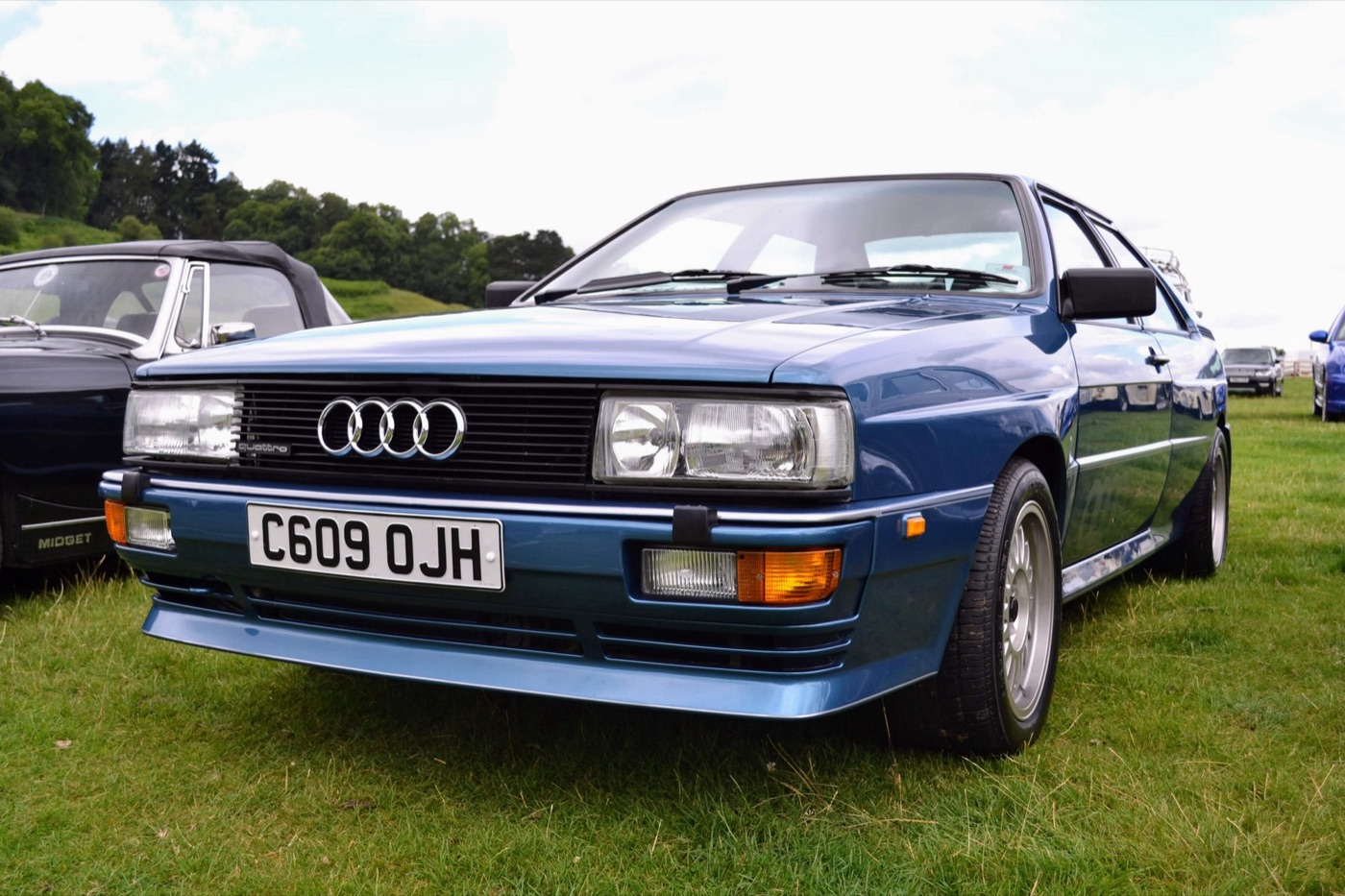
The Audi Quattro is the turbocharged, four-wheel-drive coupé that Audi showed at the Geneva Motor Show on 3 March 1980 and built at Ingolstadt until 1991: 11,452 cars, where only 400 had been planned, according to Audi’s “40 Jahre, 40 Zahlen” release of 2020. Works Quattros won 23 World Rally Championship rounds between 1981 and 1985, two makes’ titles and two drivers’ titles, and Audi has since built nearly 11 million cars with quattro four-wheel drive (to September 2020).
Its short-wheelbase offshoot, the Sport quattro of 1984, was built 214 times. In the two years to 28 October 2026 standard 10-valve cars sold at UK auctions for between £9,488 and £47,000, a 20-valve car made £77,063, and Sport quattros changed hands in America for $643,000 and $758,500. German enthusiasts call the original car the Ur-quattro (“original quattro”), to tell it apart from the later Audis with quattro all-wheel drive.
History of the Audi Quattro
The Audi Quattro began with a military car. In 1976 Audi’s research and development department was asked to design the Iltis, a four-wheel-drive vehicle to be built at Ingolstadt and badged as a Volkswagen, and testing in 1976 and 1977 showed how well it handled on poor surfaces, John Davenport wrote in “Quantum leap”, Motor Sport, August 2000. The company dates the idea to tests in Scandinavia in the winter of 1976–77, where an Iltis ran on snow-covered roads alongside the road cars.
Who invented the Audi Quattro?
Jörg Bensinger, Audi’s chief chassis engineer, had the idea of four-wheel drive in an ordinary road car. With Walter Treser, newly in charge of advanced development, he put an informal proposal to Ferdinand Piëch, the board member for research and development, who with Dr Wolfgang Habbel let them build an Audi 80 with the Iltis transmission (Motor Sport, 2000). Twelve engineers worked under Treser as project leader from February 1977 (“40 Jahre”, 2020). The motor came from the Audi 200 then in development, a 2.1-litre five-cylinder with a turbocharger, and the Iltis gearbox could not take it, so the engineers adapted gearboxes and final drives from its bigger cars.
The prototype became project EA 262 shortly before the company’s board saw it in November 1977. In January 1978 it climbed the Turracher Höhe pass in Styria on snow, on ordinary road tyres, in front of the Volkswagen supervisory board; later that year Bensinger and Treser drove it at Hockenheim against a Porsche 928 with half as much power again, and the board approved both a production car and a world championship rally programme (Motor Sport, 2000). Rallying needed one more change. World championship rules then said “Four-wheel drive cars will not be admitted”, and Audi’s Jürgen Stockmar asked the manufacturers’ sporting committee to drop the sentence on 4 September 1979. It was gone from the 1980 regulations.
Launch and production, 1980 to 1991
The Audi Quattro was shown on 3 March 1980; its internal name was Typ 85. Motor Sport drove it on mountain roads during the show and found that “on dry tarmac there is no loss of grip, however hard the acceleration”; its report ended: “the 4WD Quattro knows no peers” (“Driving the Quattro”, Motor Sport, April 1980). In Germany it cost DM 49,900 at launch, the same as a Porsche 911 SC (“40 Jahre”, 2020). Volkswagen’s British importer expected to sell 3,000 in its first three years, Bill Boddy reported in Motor Sport in July 1980, and by the end of 1981 production had passed 2,000 (Motor Sport, 2000).
The last of the 11,452 was built in 1991. Its replacement was the S2 version of the smaller Audi Coupé, which a Motor Sport road test of May 1991 described as replacing “the 1980-90 model”.
Design and engineering
The Quattro’s main idea was permanent four-wheel drive with a centre differential but no separate transfer box. The gearbox’s output shaft was hollow: it carried the drive to the centre differential, and a second shaft turning inside it took the share for the rear axle (Motor Sport, 2000). Gordon Cruickshank, reviewing Jeremy Walton’s history of the car in Motor Sport in February 2021, credits the designer Martin Smith with turning the Audi 80 coupé into the Quattro’s shape “with some glassfibre add-ons”.
Engine, differentials and chassis
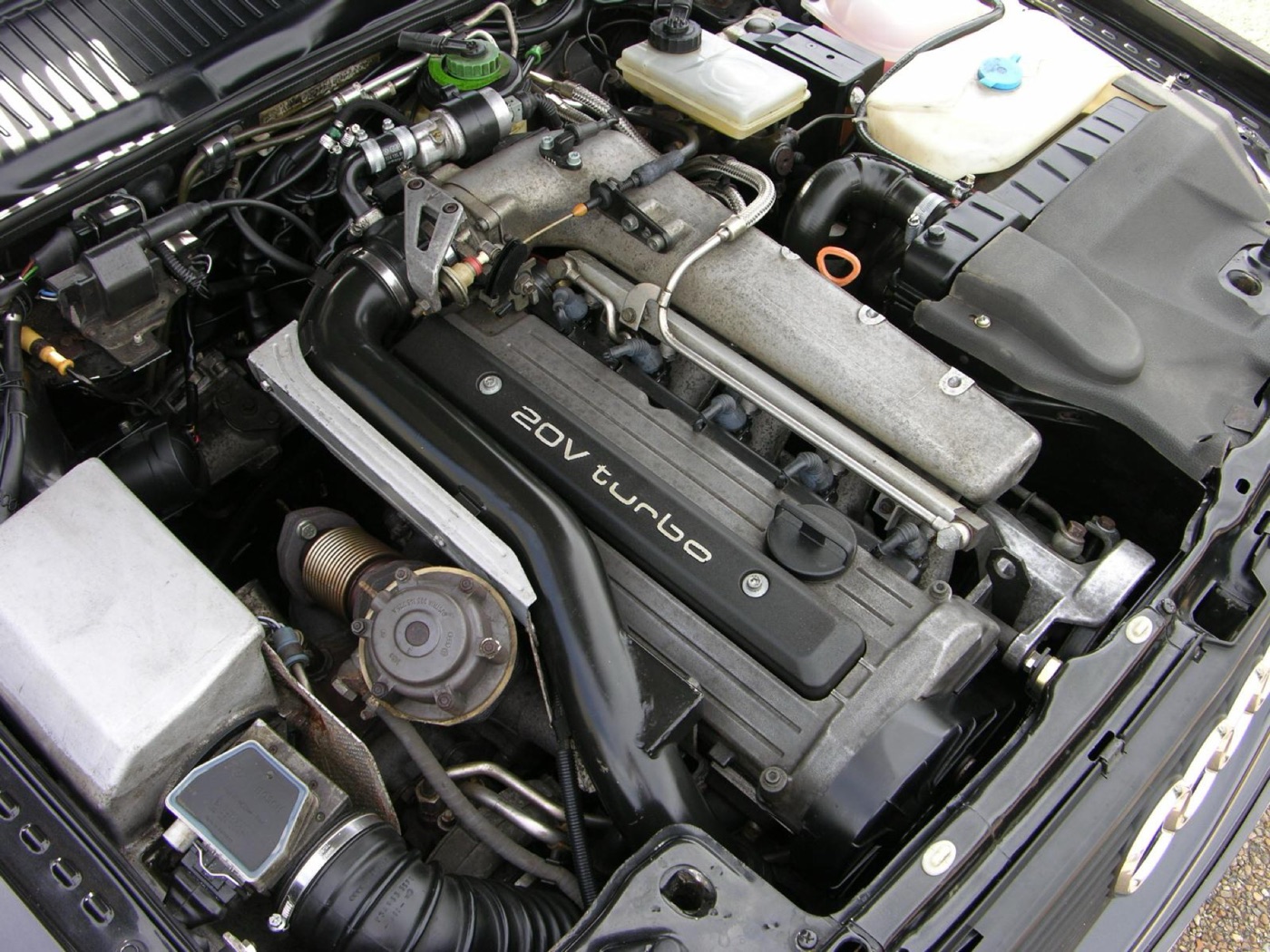
The engine was a 2,144 cc in-line five, mounted lengthways at the front, with a toothed-belt camshaft drive, a compression ratio of 7.0:1, a turbocharger and an intercooler; it gave 200 PS (147 kW) and 285 Nm at 3,500 rpm, with a five-speed manual gearbox and MacPherson struts at both ends, according to auto motor und sport’s data sheet and the maker. The first cars had two T-handles beside the handbrake that locked the centre and rear differentials, and no anti-lock brakes (Motor Sport, April 1980).
The lockable centre differential later gave way to a self-locking Torsen differential that split the drive 50:50 front to rear. The sources differ on the date: Audi’s “40 Jahre” release puts the first Torsen centre differential in the Ur-quattro in 1986 and gives its weight as about 5 kg, while Motor Sport’s road test of May 1991 dates the system to the quattro variants of September 1987. The Goodwood Classic Solutions buyer’s guide says digital instruments and revised switchgear followed the 1983 change of headlights, and dates galvanised bodies to 1985.
Audi Quattro specifications and performance
A standard Quattro had 200 PS from 2.1 litres at launch and weighed about 1,300 kg; the last 20-valve cars had 220 bhp from 2.2 litres. Audi’s “Fahrzeug-Quartett” cards of 2021 give the 1980 car a top speed of 222 km/h (138 mph) and 0 to 100 km/h in 7.1 seconds; Motor Sport’s launch report of April 1980 called it a “140 m.p.h.” car. Motor Sport worked out 156 bhp per ton on the launch car and saw an indicated 220 km/h on the drive at Geneva, and Audi claimed that the 0 to 100 km/h time was only 0.4 seconds slower in wet conditions than in dry.
| Figure | Quattro, 10-valve (WR) | Quattro 20V (RR) | Sport quattro |
|---|---|---|---|
| Engine | 2,144 cc five-cylinder, turbo, 10 valves | 2,226 cc five-cylinder, turbo, 20 valves | 2,133 cc five-cylinder, turbo, 20 valves, aluminium block |
| Power | 200 PS (147 kW) | 220 bhp | 306 PS (225 kW) |
| Torque | 285 Nm at 3,500 rpm | – | 258 lb ft |
| Gearbox | Five-speed manual | Five-speed manual | – |
| Centre differential | Lockable by hand | Torsen (from September 1987) | – |
| Length × width × height | 4,404 × 1,723 × 1,344 mm | – | – |
| Wheelbase | 2,524 mm | 2,524 mm | 86.7 in (about 2,200 mm) |
| Top speed | 222 km/h (Audi); 140 mph (Motor Sport, 1980) | – | 250 km/h, claimed (Motor Sport, 1984) |
| 0 to 100 km/h | 7.1 s (Audi) | – | – |
| Weight | 1,300 kg (Audi) | – | Road car: about 1,300 kg (Audi, 2010); 990 kg kerb (Motor Sport, 1984). Group B rally car of 1984: 1,050 kg (Audi) |
| Price new | DM 49,900 (1980); £17,722 in Britain with ABS (1984) | £33,590 in Britain (1990–91) | DM 195,000 (1984) |
How much horsepower does an Audi Quattro have?
The road car had 200 PS (197 bhp) from its launch in 1980, which the maker notes was four PS less than a Porsche 911 SC of the same year. The 20-valve RR of 1989 to 1991 had 220 bhp according to Iconic Auctioneers’ lot description and Motor Sport (Iconic’s 2025 Stoneleigh catalogue gives 217bhp). The Sport quattro had 306 PS on the road, and the works rally cars went from about 320 bhp in 1981 (Motor Sport, 2000) to 350 kW (476 PS) for the 1985 Sport quattro S1 in the factory’s figure, and up to 590 bhp depending on boost in the S1 E2, according to Richard Heseltine in “How to make a monster”, Motor Sport, December 2016.
Audi Quattro versions: WR, MB and RR
The coupé came in three engine versions, known by their engine codes: the 2.1-litre 10-valve WR from 1980, the 2.2-litre 10-valve MB of 1987 to 1989 and the 2.2-litre 20-valve RR of 1989 to 1991. Sellers’ advertisements still use the codes, Goodwood’s guide notes.
WR (1980 to 1987)
The first cars had four separate headlights; single combined headlights came in 1983. A sloping grille, wider wheels and suspension changes followed in 1984 and 1985 (Goodwood). In Britain a right-hand-drive car cost £17,722 with ABS in 1984. Cars for the United States, from the 1983 model year, had a turbocharged 2.1-litre five with locking centre and rear differentials; Bring a Trailer’s lot descriptions call one 1983 car “one of a claimed 664 produced for the US market” and a 1985 car one of 73 delivered there that model year (Bring a Trailer, lot 208,074, September 2025). The tuner Walter Treser, who had led the project at Ingolstadt, sold a conversion through Central Garage of Cobham that raised the 2,144 cc engine from 200 to 250 bhp, reviewed in Motor Sport in April 1984.
MB (1987 to 1989)
The MB had the 2.2-litre 10-valve engine and the Torsen centre differential, and the boot lid changed from steel to plastic at about this time (Goodwood).
RR 20V (1989 to 1991)
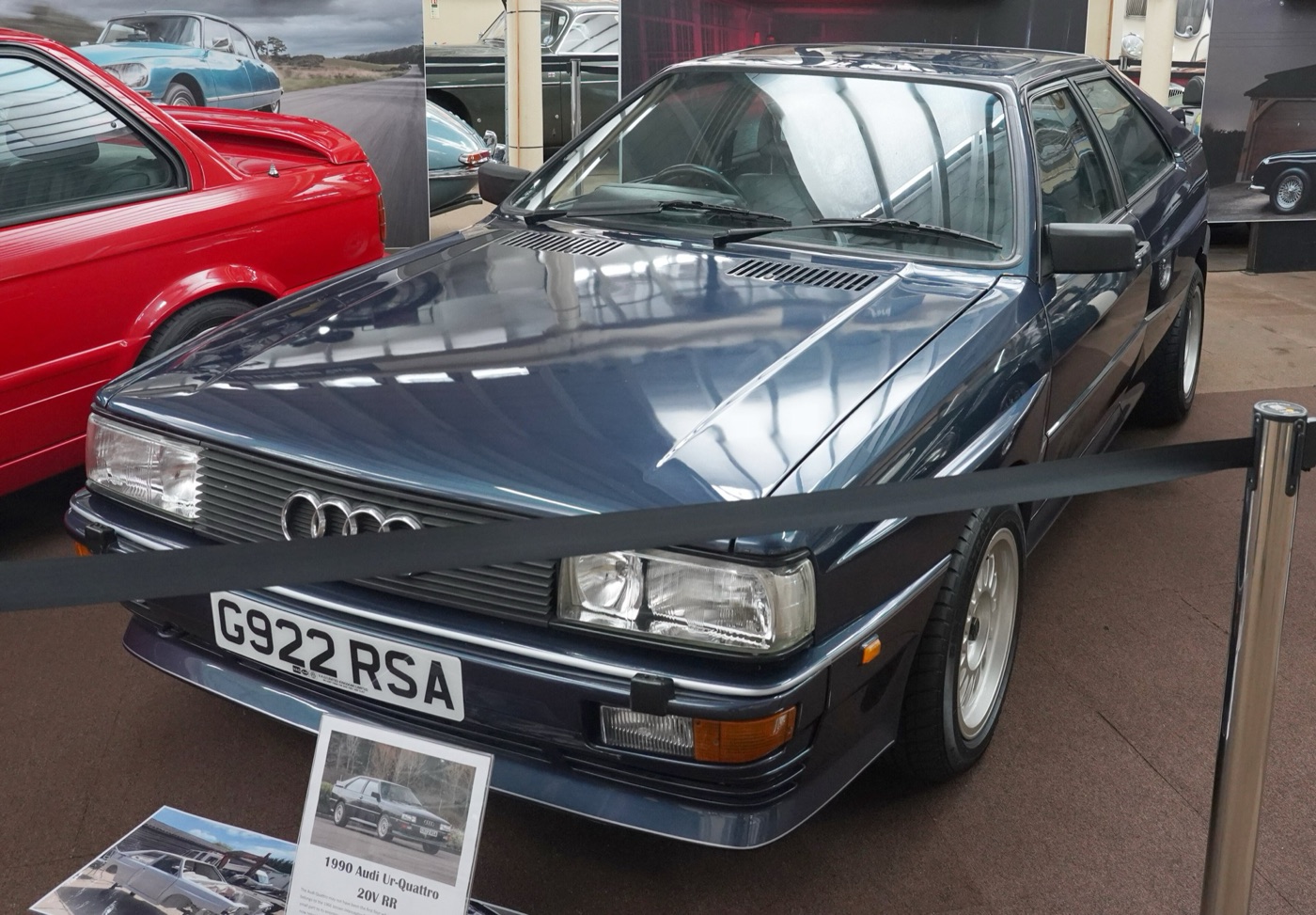
The RR was the last version: twin overhead camshafts and 20 valves on the 2,226 cc engine, the Torsen differential and 220 bhp. Iconic Auctioneers’ catalogue for March 2025 says that 295 right-hand-drive RRs were built. In Britain its list price reached £33,590 (Motor Sport, May 1991).
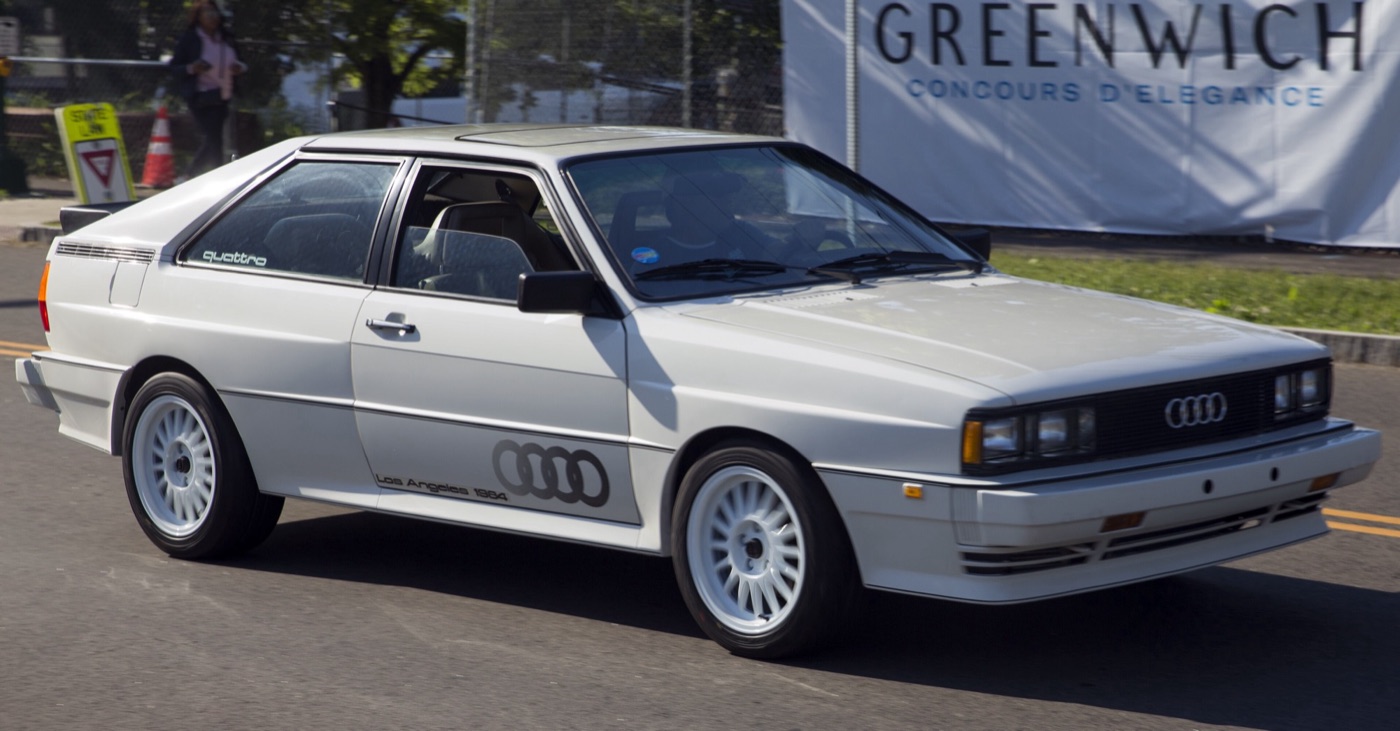
Quattro or quattro?
Quattro is Italian for four, after the four driven wheels. In Audi’s own usage of the 1980s, “Quattro” with a capital Q meant only the turbocharged coupé, and the rest of the four-wheel-drive range took a small q, Motor Sport noted in “Audi completes quattro range”, February 1985. That magazine’s 1988 test of the smaller Coupé quattro warned readers not to confuse it with “the bulkier and brawnier Quattro coupe”. The name nearly went another way: for a while the car might have been called Carat (Cruickshank).
Audi Sport quattro: the short-wheelbase car
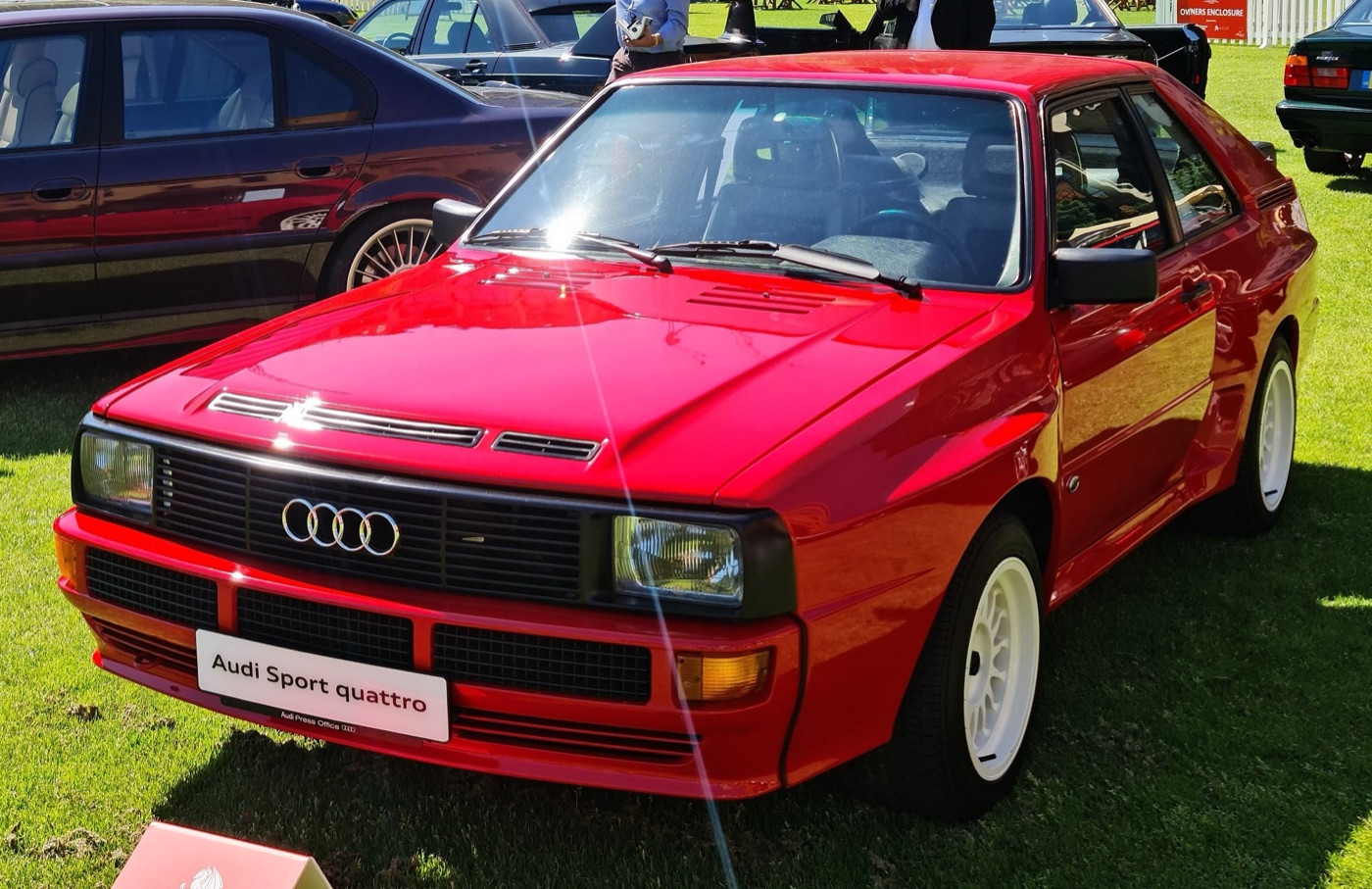
The Sport quattro is the short-wheelbase version Audi built in 1984 so that its rally car could be approved in Group B, and 214 were built. The long Audi Quattro was heavy and nose-biased, Bonhams’ catalogue notes, and its lengthways engine spoiled its weight distribution (RM Sotheby’s); the shorter car was meant to answer that. In April 1984 the factory lined up 200 road cars and 20 evolution cars for inspection by FISA, the sport’s governing body, and the type was homologated on 2 May 1984 (form B-264 in the FIA Historic Database).
The engineers cut 12.6 inches (320 mm) out of the wheelbase between the B and C pillars, and the coachbuilder Baur cut the bodyshells and fitted a roof, wheel arches, bonnet and boot lid of Kevlar; the doors stayed steel to meet side-impact rules (“Quattro Sport, for short”, Motor Sport, May 1984). The engine had an aluminium block and a crossflow 20-valve head, the brakes were rally-size ventilated discs all round, the steering was power-assisted rack and pinion, and the factory claimed a top speed of 250 km/h (155 mph). The Sport quattro’s wheelbase of 86.7 inches was shorter than an Austin Metro’s. Inside were heavy Recaro seats in leather, a suede roof lining and a stereo, the ABS could be switched off for loose surfaces, and the tyres were 225/50 Michelin X tarmac rally tyres on 9J × 15 alloy wheels.
How many Audi Sport quattros were made?
The maker gives 214. The figure that FISA inspected in April 1984 was 220 (200 road cars and 20 evolutions), and RM Sotheby’s describes its cars as “one of only 214 built”. A new one cost DM 195,000 in Germany in 1984, and 20 British buyers were waiting to pay close to £60,000 each (Motor Sport, May 1984).
The Audi Quattro in rallying
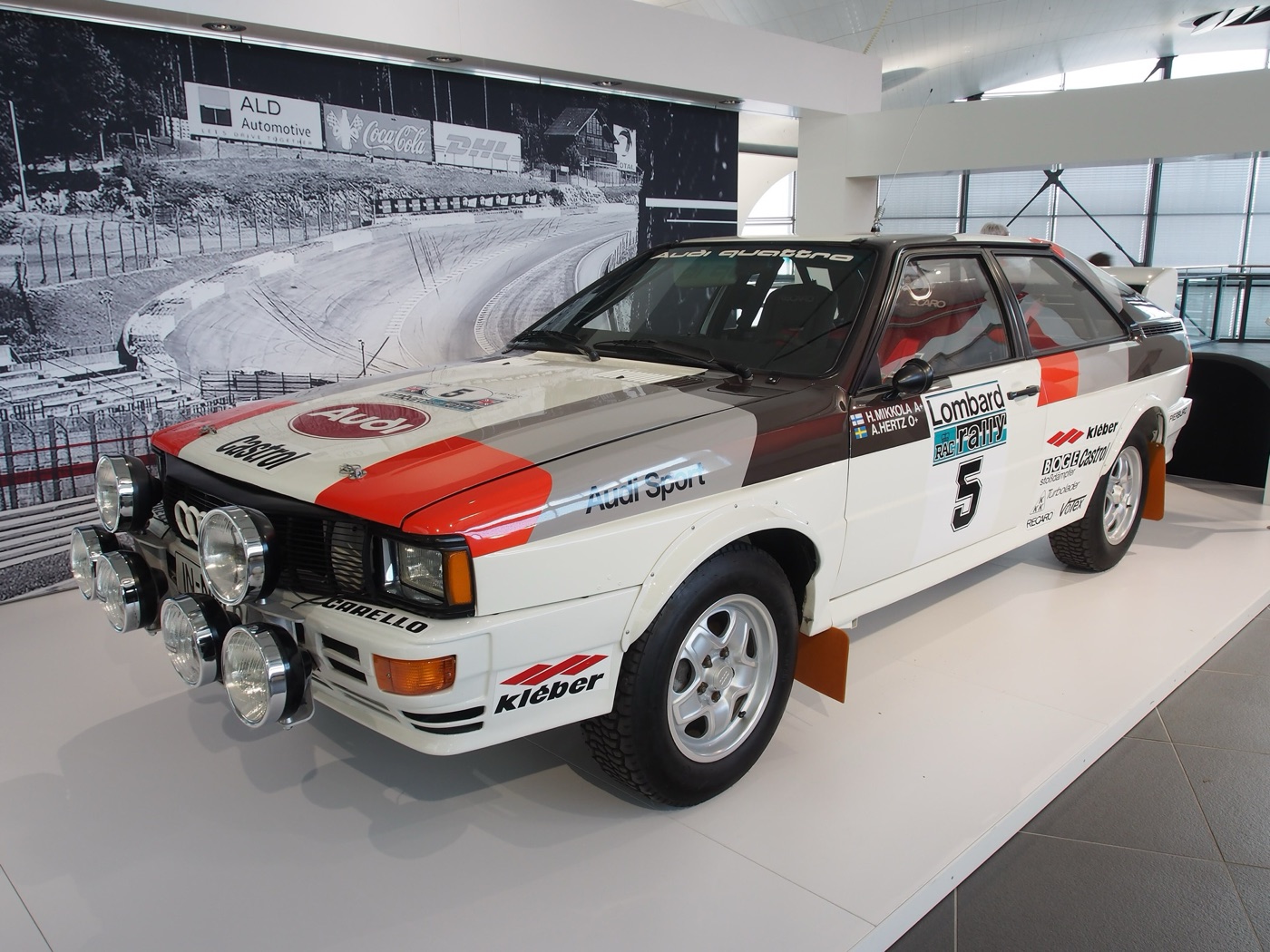
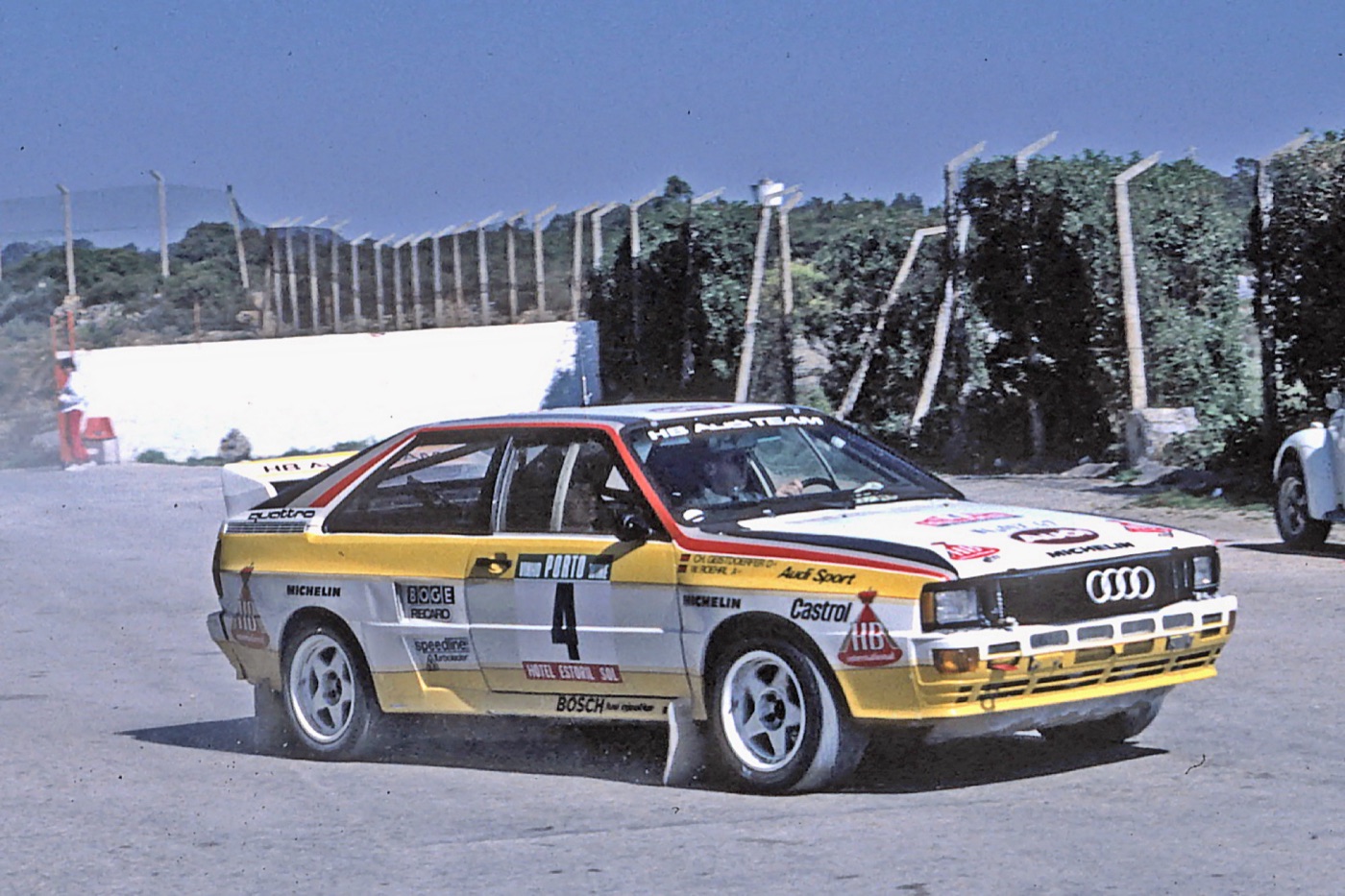
In motorsport, works Audi Quattros won 23 World Rally Championship rounds from 1981 to 1985 with four drivers: Hannu Mikkola, Michèle Mouton, Stig Blomqvist and Walter Röhrl. Audi won the makes’ title in 1982 and 1984, Mikkola the drivers’ title in 1983 and Blomqvist in 1984, according to the championship tables at juwra.com. The car won every world championship rally except the Safari and Corsica at least once (Motor Sport, 2000).
1980 and 1981: the first wins
A Quattro ran as a timed but unclassified course car on the Algarve Rally in Portugal in November 1980. On its first official event, Austria’s Jänner Rally of January 1981, a round of the European Rally Championship, Franz Wittmann won by about 21 minutes and set the fastest time on all 31 stages (“40 Jahre”, 2020). On its world championship debut, the 1981 Monte Carlo Rally, Mikkola led by six minutes after six stages (Motor Sport, 2000). Mikkola then won the Swedish Rally, the first world championship win for a four-wheel-drive car, and the RAC Rally; Mouton won the Sanremo Rally, the first world championship win by a woman (juwra.com).
1982 to 1984: two makes’ titles
The Quattro was first approved in Group 4 on the basis of 400 cars, from 1 January 1981 according to Motor Sport (2000); the FIA Historic Database dates form 671 to 2 January 1981. When Group B replaced the old groups, the team re-homologated it as the A1 in January 1983, after building more than 200 with aluminium cylinder blocks, and as the A2 in May 1983, with the engine cut from 2,145 to 2,135 cc, plastic panels and titanium suspension parts (Motor Sport, 2000; FIA forms B-229 and B-243). The Group B rally years were the Quattro’s best: seven wins in 1982, five in 1983 and seven in 1984. Lancia’s 037 took the 1983 makes’ title by two points, 118 to 116; each marque won five rounds, but the Swedish Rally that Audi won was not a round of the makes’ series that year, juwra.com notes.
Sport quattro S1 and S1 E2
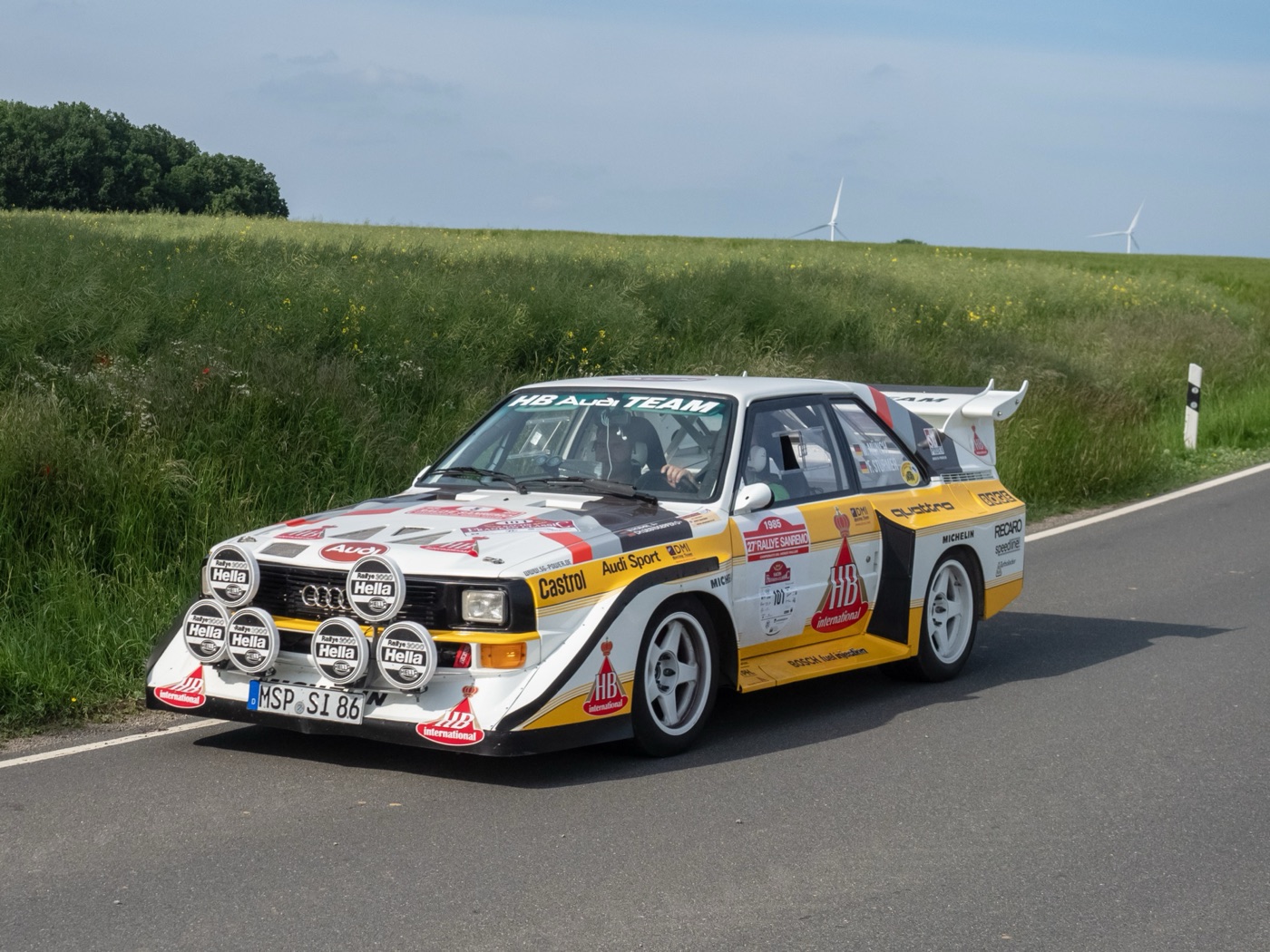
The Sport quattro was due to make its debut on the 1984 Tour de Corse (Motor Sport, May 1984), and Blomqvist won the Ivory Coast Rally in it that year. Its second evolution, the S1 E2, was approved on 1 July 1985, with large wings and its radiators moved to the rear (Motor Sport, 2000; Bonhams). The factory gives the S1 rally car it first ran in 1985 a weight of 1,090 kg and a time of 3.1 seconds from 0 to 100 km/h with the medium gearing. Röhrl won the 1985 Sanremo Rally in the S1 by 6 minutes 29 seconds, Audi’s only world championship win of 1985, and on the RAC Rally that autumn he had a pneumatically shifted double-clutch gearbox (“40 Jahre”, 2020). The works built 20 S1 E2s for competition, of which about 15 survive, Bonhams’ catalogue says, and the E2 started only six world championship rounds before Audi withdrew from rallying after the Rally of Portugal in March 1986 (Heseltine), where spectators had been killed and the works teams pulled out, as Motor Sport reported in April 1986.
Pikes Peak
The works took the Sport quattro to the Pikes Peak hill climb in Colorado. Mouton won outright in 1985 and set a course record; Bobby Unser won in 1986, aged 52, in the same car, according to “Race to the clouds”, Motor Sport, July 2018. Röhrl won in 1987 in 10 minutes 47.85 seconds, and was timed at 196 km/h at the fastest point of the 20 km course, Audi records.
How many rallies did the Audi Quattro win?
| Season | Wins | Winners | Best driver in the championship | Audi in the makes’ championship |
|---|---|---|---|---|
| 1981 | 3 | Mikkola (Sweden, RAC), Mouton (Sanremo) | Mikkola 3rd, 62 points | 5th, 63 points |
| 1982 | 7 | Mouton (Portugal, Acropolis, Brazil), Mikkola (Finland, RAC), Blomqvist (Sweden, Sanremo) | Mouton 2nd, 97 points | Champions, 116 points |
| 1983 | 5 | Mikkola (Sweden, Portugal, Argentina, Finland), Blomqvist (RAC) | Mikkola champion, 125 points | 2nd, 116 points |
| 1984 | 7 | Blomqvist (Sweden, Acropolis, New Zealand, Argentina, Ivory Coast), Röhrl (Monte Carlo), Mikkola (Portugal) | Blomqvist champion, 125 points | Champions, 120 points |
| 1985 | 1 | Röhrl (Sanremo) | Blomqvist 2nd, 75 points | 2nd, 126 points |
How many Audi Quattros were made?
Ingolstadt built 11,452 Audi Quattro coupés between 1980 and 1991, plus 214 Sport quattros. Of the standard cars, 295 were right-hand-drive 20-valve RRs (Iconic Auctioneers).
How many Audi Quattros are left in the UK?
At the end of June 2026 the Department for Transport’s licensing statistics listed 1,560 cars under the model name Audi Quattro: 508 taxed and 1,052 declared off the road (SORN), according to table VEH0120. The table files later Audis with quattro drive under their own model names (80, Coupé, A4 and so on), but the group still holds a few records that cannot be the coupé: 9 diesel or gas and 4 automatic, leaving 1,547 petrol manual cars. The total was 1,424 at the end of 2014.
| Date | Licensed | SORN | Total |
|---|---|---|---|
| December 2014 | 492 | 932 | 1,424 |
| December 2016 | 445 | 1,007 | 1,452 |
| December 2018 | 374 | 1,104 | 1,478 |
| December 2020 | 318 | 1,186 | 1,504 |
| December 2022 | 307 | 1,205 | 1,512 |
| December 2024 | 334 | 1,175 | 1,509 |
| December 2025 | 374 | 1,159 | 1,533 |
| June 2026 | 508 | 1,052 | 1,560 |
Audi Quattro prices and values today
In OUTLAW 8’s auction records, ten standard 10-valve Quattros sold at British auctions priced in pounds between 28 October 2024 and 28 October 2026, at a median of £27,750; the cheapest made £9,488 and the dearest £47,000. Three 20-valve RRs sold for £45,000 to £77,063 in 2025, and Sport quattros sell for hundreds of thousands of dollars.
How much is an Audi Quattro worth?
| Car | Sold | Price | Where |
|---|---|---|---|
| 1983 Quattro 10V | July 2026 | £9,488 | Manor Park Classics |
| 1984 Quattro 10V (WR) | August 2026 | £9,563 | Iconic Auctioneers |
| 1982 Quattro 10V | August 2026 | £10,125 | Iconic Auctioneers |
| 1988 Quattro 10V | February 2025 | £22,500 | Car & Classic |
| 1989 Quattro 10V (MB) | March 2026 | £27,750 | Iconic Auctioneers |
| 1984 Quattro Turbo | July 2026 | £31,500 | Car & Classic |
| 1989 Quattro 10V (MB) | September 2026 | £32,000 | The Market |
| 1985 Quattro 10V | August 2026 | £42,000 | Car & Classic |
| 1987 Quattro 2.1 10V | January 2026 | £43,250 | Car & Classic |
| 1986 Quattro | October 2025 | £47,000 | Car & Classic |
| 1990 Quattro 20V (RR), Pearlescent White | March 2025 | £45,000 | Iconic Auctioneers, NEC |
| 1990 Quattro 20V, ex-Jay Kay | July 2025 | £59,360 | Iconic Auctioneers, online |
| 1990 Quattro 20V (RR), Nautic Blue, restored | February 2025 | £77,063 | Iconic Auctioneers, Stoneleigh |
The March 2025 car had its original Platinum Grey interior with quattro script and an Audi Sport steering wheel. The dearest 20V had just finished a four-year bare-metal restoration (Iconic Auctioneers, lot catalogue, February 2025), and the £59,360 car was a 20V once owned by the singer Jay Kay. In America, 12 standard Quattros sold at a median of $53,500 in the same two years, from $14,125 for a project car to $120,000 (OUTLAW 8’s auction records, mostly Bring a Trailer).
What does a Sport quattro or an S1 cost?
RM Sotheby’s sold road-going Sport quattros for $758,500 at Arizona in January 2025 and $643,000 at Monterey in August 2025, against $401,500 for one in Arizona in 2015 (RM Sotheby’s, lot r0077, Arizona 2025). The maker records €486,000 paid for one at a London auction in 2016. The works S1 E2 rally cars cost more: in 2021 £1,771,434 for a Sport quattro S1 from the Manoir de l’Automobile collection was a world record for a rally car at auction (Motor Sport, April 2021), and in August 2025 Bonhams sold chassis RE10, which Mikkola led the 1985 RAC Rally in, for $1,765,000 at The Quail (Bonhams, lot 164).
Buying and owning an Audi Quattro
Rust and poor accident repairs are the biggest risks with a Quattro, followed by parts supply; the drivetrain is generally strong. Cars built before the galvanised bodies of 1985 need the closest look, according to Goodwood’s guide.
Known faults
Goodwood lists rust in the sills, wheel arches, lower doors, front wings, floor pan, boot floor, suspension mounts, windscreen surround and bulkhead, and on the steel boot lids of earlier cars. Exhaust manifolds crack, often because the engine mounts have failed; the pneumatic differential locks of earlier cars and the rear differentials leak; and the digital dashboards, windows and older wiring give electrical faults. Goodwood also warns of smoky turbochargers and of rear differentials that leak.
Parts and running
Service parts are generally available, but body panels, trim, electrical parts and Quattro-specific components can be scarce and costly; Audi Tradition, the maker’s heritage department, and independent specialists supply some of them (Goodwood). Originality counts for much of a car’s value, and many insurers now treat the Quattro as a classic (Goodwood).
Audi Quattro rivals
On the road the Quattro’s price rival was the Porsche 911 SC: both cost DM 49,900 in 1980 and the Porsche had four PS more. In 1978 the company had set its prototype against a Porsche 928 at Hockenheim (Motor Sport, 2000). BMW was slower to follow: at the launch of the E30 3 Series in 1982, Motor Sport came away with “the feeling BMW feel it is a fad” (Motor Sport, December 1982), and by February 1985 the magazine reported that BMW was developing a four-wheel-drive car. Four-wheel drive itself was not new on a fast car: Jensen’s FF had it at its launch at the Earls Court Motor Show in October 1966, according to the Jensen Museum. In rallying the Quattro’s rivals were Lancia’s rear-drive 037, which beat Audi to the 1983 makes’ title, then the four-wheel-drive Peugeot 205 Turbo 16 and Lancia Delta S4; Peugeot won the makes’ titles of 1985 and 1986 (juwra.com).
Reception and the Quattro in British culture
Motor Sport’s Clive Richardson found the launch car “almost beyond belief in its combination of roadholding, handling, traction and performance” in 1980. He found the braking on tarmac “magnificent”, the stability better once the differential locks were engaged on snow, and the ride “most comfortable thanks to long suspension travel”, though he thought the gap between second and third gears too wide and the exhaust note harsh. Motor Sport’s tester in 1991 spent his 1990–91 Christmas holiday in a 20-valve Quattro and “enjoyed the car as much as ever”.
In Britain the car is also Gene Hunt’s in the BBC series Ashes to Ashes (2008–10). In April 2010 Labour put the Conservative leader David Cameron on a poster as Hunt; the Conservatives answered with the same picture and the words “Fire up the Quattro. It’s time for change.” (BBC News, 3 April 2010).
The quattro four-wheel-drive system after the Quattro
After the coupé, quattro became the name of Audi’s four-wheel drive system on both axles across its range, from saloons and estates to sports cars and SUVs. By December 1984 the company claimed to be the first maker to offer four-wheel drive at every level of its range, with the 100 and 200 Avant estates and the Coupé quattro joining the 80 quattro (Motor Sport, February 1985). It had sold more than five million cars with quattro drive by 2013, and had built nearly 11 million by 30 September 2020, when it gave these milestones in its anniversary release:
- 1994: the RS 2 Avant, Audi’s first RS model, with an electromechanically locking rear differential.
- 1999: quattro drive in a compact car for the first time, the A3 with the 150 PS 1.8 T engine.
- 2005: the RS 4 and the first centre differential with an asymmetric, dynamic torque split.
- 2007: the first R8, with a propeller shaft from the rear-mounted gearbox to a viscous coupling at the front axle.
- 2012 to 2014: three Le Mans 24 Hours wins for the R18 e-tron quattro, a diesel hybrid with electric motors driving the front axle.
- 2020: the e-tron S, an electric SUV with three electric motors, two of them on the rear axle.
The self-locking Torsen centre differential in today’s cars with longitudinal engines weighs about 3 kg and splits the torque 40:60 front to rear, sending up to 70% to the front or 85% to the rear when needed. Some longitudinal-engined models use “quattro with ultra technology”, in which two clutches let the car run in front-wheel drive and bring in the rear axle when needed. In 2019, 45.3% of Audi’s customers worldwide chose a quattro, and all 32 of Audi’s S, RS and R models had it as standard (“40 Jahre”, 2020).
quattro in circuit racing
The company also raced the system on circuits: an Audi 200 won the drivers’ and makes’ titles in the American Trans-Am series in 1988, and in 1989 the IMSA GTO Audi 90 quattro, with about 720 PS from its 2.2-litre 20-valve five, won nearly every second race for Hurley Haywood and Hans-Joachim Stuck (“40 Jahre”, 2020).
The quattro concept cars of 2010 and 2013
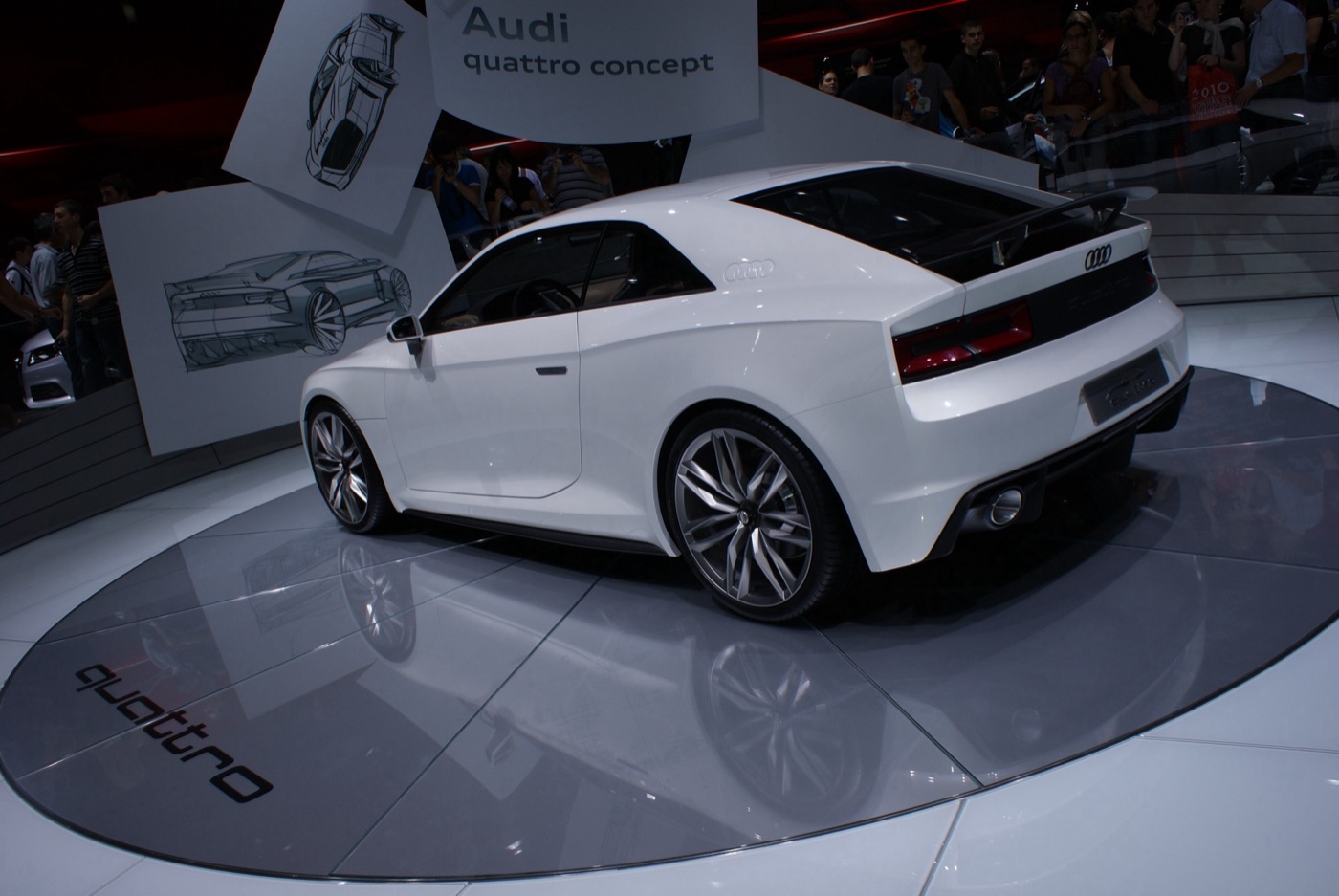
For the Audi Quattro’s 30th anniversary the company showed the quattro concept at the Paris Motor Show in September 2010, a two-seater built on a shortened RS 5, the high-performance version of the A5 coupé, and a SkiddMark report from the show recorded the same figures. Audi’s press release gave the wheelbase as 150 mm shorter and the roof about 40 mm lower than the RS 5’s, an aluminium body with a carbon bonnet and tailgate, and a weight of 1,300 kg, which Audi said was almost exactly that of the 1984 Sport quattro road car. Audi placed it in the sports car class by size: 4.28 m long, 1.86 m wide and 1.33 m high on a 2.60 m wheelbase. The engine was a turbocharged five-cylinder from the TT RS with 300 kW (408 hp); the claimed time from 0 to 100 km/h was 3.9 seconds, through a six-speed manual gearbox.
Three years later, for the Sport quattro’s 30th birthday, the company showed the Sport quattro concept at the 2013 Frankfurt show: a plug-in hybrid coupé with a system output of 515 kW (700 hp), according to Audi’s 2013 release. A SkiddMark report in August 2013 expected it to use the twin-turbocharged 4.0-litre V8 of the RS 6.
Questions
When did the Audi Quattro come out?
Audi showed the Quattro at the Geneva Motor Show on 3 March 1980. Production at Ingolstadt started that year and ended in 1991, and the car made its rally debut on Austria’s Jänner Rally in January 1981.
What engine does the Audi Quattro have?
A turbocharged in-line five-cylinder, mounted lengthways: 2,144 cc and 10 valves at first, 2.2 litres from 1987, and 2,226 cc with 20 valves and 220 bhp in the last RR cars of 1989 to 1991.
Is the Audi Quattro four-wheel drive all the time?
Yes. The Quattro has permanent four-wheel drive through a centre differential. Early cars had hand-operated locks for the centre and rear differentials; later cars had a Torsen centre differential splitting the drive 50:50 front to rear, from 1986 by Audi’s account or September 1987 by Motor Sport’s.
Who drove the Audi Quattro in the World Rally Championship?
Hannu Mikkola, Michèle Mouton, Stig Blomqvist and Walter Röhrl won world championship rounds in it between 1981 and 1985. Mikkola was champion in 1983 and Blomqvist in 1984.
How fast is the Audi Sport quattro S1?
Audi gives the 1985 Sport quattro S1 rally car 350 kW (476 PS), 1,090 kg and 0 to 100 km/h in 3.1 seconds. Röhrl was timed at 196 km/h at the fastest point of Pikes Peak when he won there in 1987.
What car did Gene Hunt drive in Ashes to Ashes?
An Audi Quattro. BBC News reported that in April 2010 the Conservatives put the character on a poster with the words “Fire up the Quattro. It’s time for change.”
What replaced the Audi Quattro?
The S2 version of the Audi Coupé, with a 220 bhp 20-valve turbocharged five-cylinder, replaced the original Quattro in 1991.
Sources
- Audi MediaCenter, “40 Jahre, 40 Zahlen, 40 Bilder: Fakten und Buntes zur quattro-Technologie von Audi”, 2020 (archived copy): the Geneva debut and Typ 85, 11,452 built against 400 planned, the launch price, 200 PS, Treser’s team, the Scandinavian tests, 23 world championship wins, the Sport quattro’s 214 cars and prices, the S1’s figures, Sanremo and Pikes Peak 1985–87, the Torsen differential, the Jänner and Algarve rallies.
- John Davenport, “Quantum leap”, Motor Sport, August 2000: the Iltis, Bensinger, Treser, Piëch, EA 262, the 1978 demonstrations, the rule change of 1979, Mikkola’s signing, production by 1981 and the Group 4, A1, A2 and Sport homologations.
- Clive Richardson, “Driving the Quattro”, Motor Sport, April 1980: the Geneva drive, differential locks, 156 bhp per ton and the verdict.
- Bill Boddy, “Volkswagen/Audi in Britain”, Motor Sport, July 1980: the importer’s expected sales.
- “Treser Quattro”, Motor Sport, April 1984: the British price of a right-hand-drive Quattro and the Treser conversion.
- “Quattro Sport, for short”, Motor Sport, May 1984: the Sport quattro’s homologation inspection, construction, weight, price and British orders.
- “Audi completes quattro range”, Motor Sport, February 1985: Quattro with a capital Q.
- “Road impressions”, Motor Sport, January 1988: the Coupé quattro against “the bulkier and brawnier Quattro coupe”.
- “The Motor Sport road test: Audi Coupé S2”, Motor Sport, May 1991: the S2 as replacement, the 20-valve engine, the last list price and the Torsen date.
- Richard Heseltine, “How to make a monster”, Motor Sport, December 2016: the S1 E2’s power, its six world championship starts and Audi’s withdrawal.
- “Disastrous Portuguese Rally”, Motor Sport, April 1986: spectators killed and the works teams’ withdrawal.
- “Race to the clouds”, Motor Sport, July 2018: Mouton’s and Unser’s Pikes Peak wins.
- Gordon Cruickshank, review of Jeremy Walton’s Quattro history, Motor Sport, February 2021: Martin Smith’s design, the name Carat, the first win in Sweden.
- Motor Sport, “There has been an outbreak of Group B rally car fever”, April 2021: the £1,771,434 Sport quattro S1.
- auto motor und sport, Audi quattro (1980–1991) technical data: capacity, compression, torque, dimensions, wheelbase, gearbox and suspension.
- FIA Historic Database, homologation records for the Audi quattro (form 671), quattro A1 (B-229), A2 (B-243) and Sport quattro S1 (B-264): approval dates and capacities.
- Audi MediaCenter, “The quattro rally cars” (25 years of quattro, archived copy): Audi’s season record for 1981, 1982 and 1984, the Sport quattro and Pikes Peak.
- AUDI AG, “Fahrzeug-Quartett”, 09/2021 (archived copy): top speed, 0 to 100 km/h and weight of the 1980 quattro; the 1984 Sport quattro rally car’s weight.
- Bring a Trailer, 1983 Audi Quattro, lot 208,074, and 1985 Audi Quattro, lot 243,291: US-market numbers and specification.
- The Jensen Museum, “Jensen’s CV8 Replacement”: the FF at the October 1966 Motor Show.
- juwra.com, World Rally Championship results and standings, 1981 to 1985: every Audi win, points and positions in the table.
- Goodwood Classic Solutions, “Audi Quattro buyer’s guide”, read 28 October 2026: the WR, MB and RR versions, the model-year changes, rust, faults and parts.
- Iconic Auctioneers, lot pages for 1990 Quattro 20V cars sold in February, March and July 2025: prices, 295 right-hand-drive RRs, 220 bhp and the restored and ex-Jay Kay cars.
- RM Sotheby’s, 1984 Audi Sport quattro lots at Arizona 2015 and 2025 and Monterey 2025: prices, 214 built, the 2,133 cc engine and road-car outputs.
- Bonhams, The Quail Auction, 15 August 2025, lot 164: the S1 E2 RE10, its 1985 RAC Rally history, the 20 built and the price.
- Department for Transport, vehicle licensing statistics, table VEH0120, to June 2026: Audi Quattros licensed and SORN in the UK.
- OUTLAW 8’s auction records, read 28 October 2026: British sales priced in pounds and American sales of the Quattro, 28 October 2024 to 28 October 2026.
- BBC News, “Gene Hunt poster sparks propaganda battle”, 3 April 2010: the Ashes to Ashes posters.
- Audi MediaCenter, “Audi quattro concept”, September 2010 (archived copy): the 2010 concept’s figures.
- Audi MediaCenter, “Audi Sport quattro concept”, 2013 (archived copy): the 2013 concept and the Sport quattro’s history.
- SkiddMark, “PARIS: Audi revives an old name with the Quattro Concept”, September 2010, and “The Audi quattro is back”, August 2013: reports of the two concepts.