Caterham F1: the team’s history, results and collapse
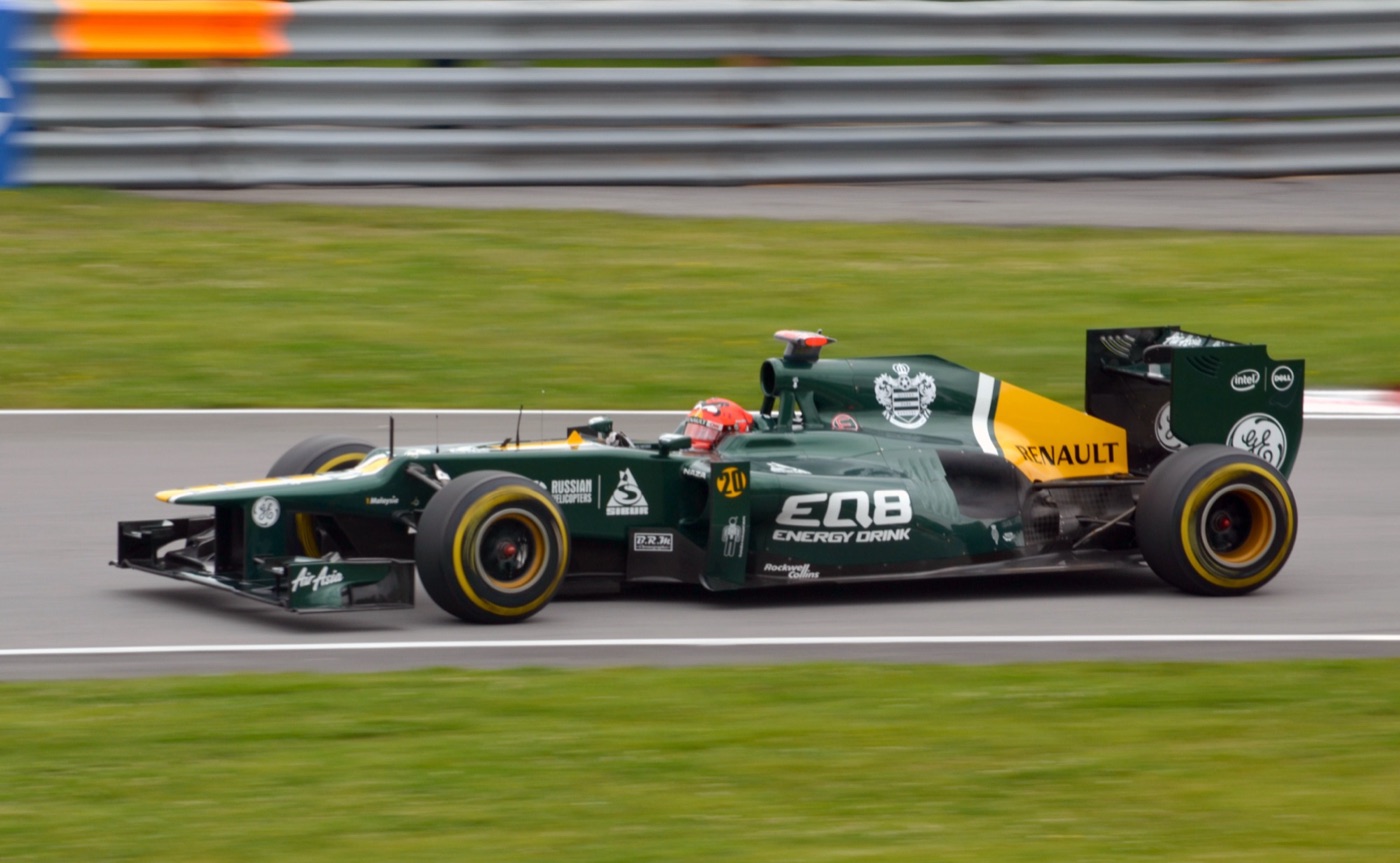
Caterham F1 Team was the Formula 1 team of the AirAsia founder Tony Fernandes and his Malaysian business partners. It raced as Caterham from 2012 to 2014, after starting out as Lotus Racing in 2010 and Team Lotus in 2011, and in five seasons under those three names it never scored a championship point: its best finish was 11th, by Vitaly Petrov in Brazil in 2012 and by Marcus Ericsson at Monaco in 2014. Fernandes sold the team in July 2014, the company that built its cars went into administration that October, and after one crowdfunded last race in Abu Dhabi the administrators began auctioning its cars and factory equipment on 11 March 2015.
SkiddMark reported on the team from its first driver announcement in December 2009 to that auction. This page keeps that reporting, including Steve Hindle’s report of 21 October 2014 on the administration, which it replaces, and an interview with Caterham Cars’ chief executive Graham Macdonald in April 2015 about what the Formula 1 collapse cost the Caterham name.
Caterham F1 results by season
The team finished tenth in the constructors’ championship three times and 11th twice, with no points in any season. The table gives each season’s name, car, engine and best race finish.
| Season | Entered as | Car | Engine | Race drivers | Best finish | Constructors’ place |
|---|---|---|---|---|---|---|
| 2010 | Lotus Racing | T127 | Cosworth | Jarno Trulli, Heikki Kovalainen | 12th (Kovalainen, Japan) | 10th of 12 |
| 2011 | Team Lotus | T128 | Renault | Jarno Trulli, Heikki Kovalainen | 13th (Trulli, Australia and Monaco; Kovalainen, Italy) | 10th of 12 |
| 2012 | Caterham | CT01 | Renault | Heikki Kovalainen, Vitaly Petrov | 11th (Petrov, Brazil) | 10th of 12 |
| 2013 | Caterham | CT03 | Renault | Charles Pic, Giedo van der Garde | 14th (Pic, Malaysia and South Korea; van der Garde, Hungary) | 11th of 11 |
| 2014 | Caterham | CT05 | Renault | Kamui Kobayashi, Marcus Ericsson, André Lotterer, Will Stevens | 11th (Ericsson, Monaco) | 11th of 11 |
Standings from Formula1.com’s constructors’ results for each year; best finishes from StatsF1’s team records and Formula1.com race results. Caterham F1 scored 0 points in every season, with no race victories and no podiums; in its three seasons as Caterham F1 it took no pole positions or fastest laps either, StatsF1 records.
How the team began as Lotus Racing
Caterham F1 began as a Malaysian entry for the 2010 season, granted by the FIA on 15 September 2009, that raced under the Lotus name on a licence from the road-car maker.
The 1Malaysia entry for 2010
On 15 September 2009 the FIA gave the 13th entry on the 2010 grid to the “Lotus F1 Team”, a partnership between the Malaysian government and a group of Malaysian entrepreneurs with Tony Fernandes as team principal, as GrandPrix.com reported that day. The same day in Putrajaya the prime minister, Najib Razak, announced the “1Malaysia F1 Team” and named Proton, Lotus, the Sepang circuit, the Motorsports Association of Malaysia, Naza and AirAsia as its backers (The Star, 15 September 2009). Mike Gascoyne was technical director, and the team signed for Cosworth engines and Xtrac gearboxes.
The company holding the entry was 1Malaysia Racing Team, registered in Malaysia as 1Malaysia Racing Team Sdn Bhd (1MRT). Its licence to race as “Lotus Racing” was signed on 21 December 2009, backdated to 1 October 2009, and ran for five years, according to the High Court judgment of 27 May 2011. The licence barred 1MRT from using the Lotus roundel or the words “Team Lotus”.
SkiddMark reported the first driver line-up in December 2009: Jarno Trulli and Heikki Kovalainen as race drivers and Fairuz Fauzy as the Malaysian test driver. Fernandes announced it on Twitter (“We are serious”) and said of the new green and yellow logo: “We are not pretending to be the Lotus of the past, but we are honoured to be able to bring the name back into Formula 1.” Trulli, whose previous team had withdrawn from Formula 1 that November, set the target of “making progress towards the top ten by Abu Dhabi”.
Hingham and the T127
The team started work in the Racing Technology Norfolk factory at Hingham, a 50,000 sq ft building ten miles from the Lotus factory at Hethel that Toyota had built for its first Formula 1 programme and Bentley had used for Le Mans. It planned to employ more than 200 people there by the start of 2010, with a permanent technical centre to follow on an eight-hectare site at Sepang.
Lotus Racing unveiled the Lotus Cosworth T127 at the Royal Horticultural Hall in London in February 2010, five months after it got its entry, in front of an audience of 500. At the launch, which SkiddMark covered, Fernandes spoke of “a team that five months ago didn’t even exist”.
The first season
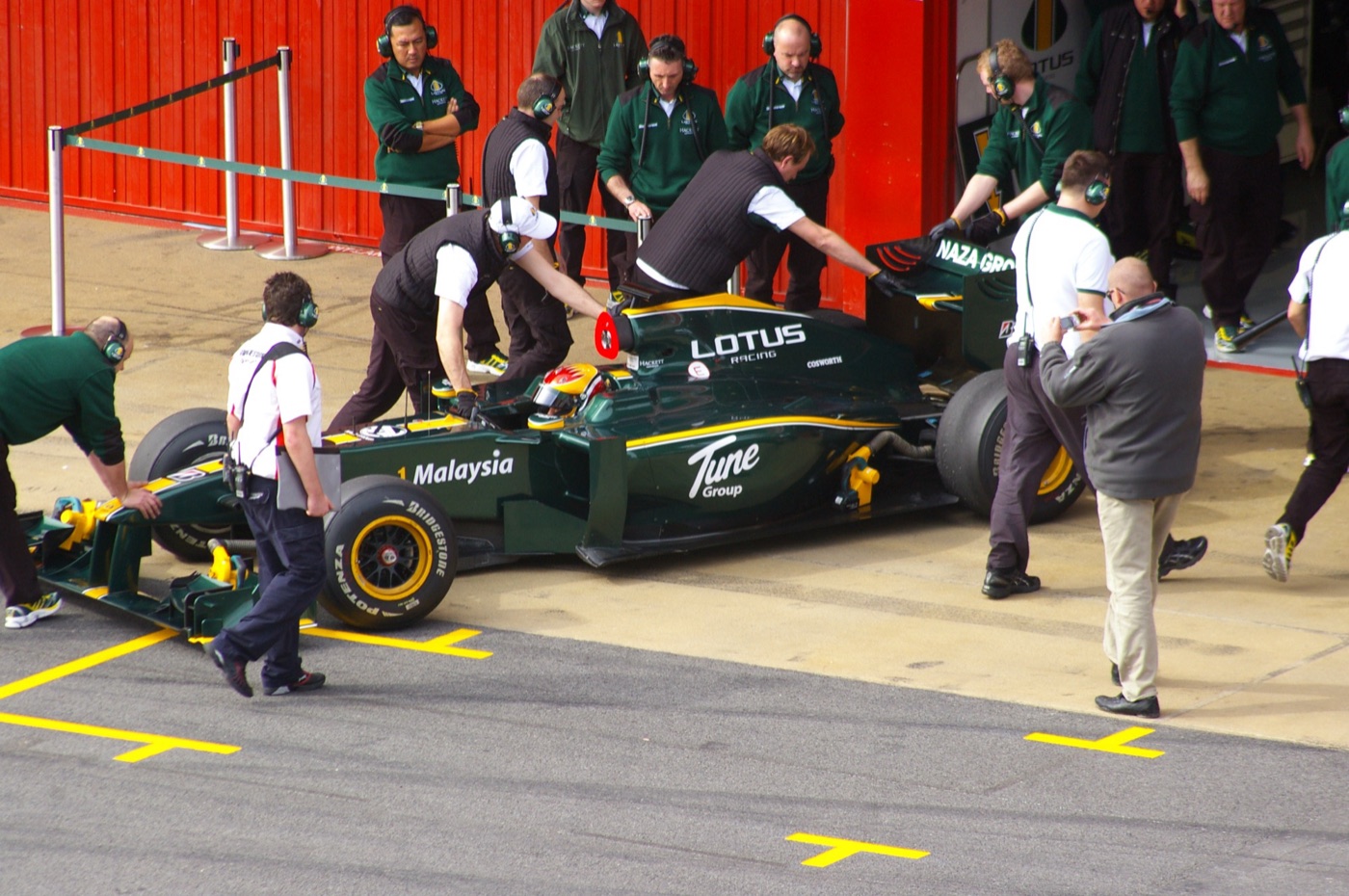
Lotus Racing was one of three new teams in 2010, with Virgin and HRT, all three on Cosworth engines. At the first race, in Bahrain, Kovalainen finished 15th and Trulli was classified 17th; at Suzuka in October Kovalainen finished 12th, the team’s best result of the year, with Trulli 13th (Formula1.com, 2010 Japanese Grand Prix). The team was tenth of 12 in the constructors’ championship, ahead of Virgin and HRT. Gascoyne later called the first half of that season “just an exercise in survival”.
Team Lotus and the fight over the Lotus name
The Proton-owned Group Lotus ended the licence in September 2010, so Fernandes raced 2011 under the separate, historic “Team Lotus” name, which he had bought, and the two sides took the dispute to the High Court.
The licence ends
The licensor served a final notice on 31 August 2010 over breaches of the licence’s merchandising rules, and the judge found the licence ended on 23 September 2010. In September 2010 Fernandes bought the rights to the Team Lotus name, the name Colin Chapman’s works team had raced under until 1994, from David Hunt, SkiddMark reported, and on 30 November 2010 the FIA’s 2011 entry list accepted the change of name from Lotus Racing to Team Lotus. Proton’s company answered in December 2010 by buying into the Renault team, which raced in 2011 as Lotus Renault GP in black and gold, the colours Fernandes had announced for his own 2011 car a month earlier. Its chief executive, Dany Bahar, said: “We are Lotus and we are back.”
The High Court case
Mr Justice Peter Smith gave judgment on 27 May 2011. He found that the goodwill in the Team Lotus name and roundel had passed to Team Lotus Ventures, the company Fernandes’s side had bought, although its trade marks were revoked for non-use; that the road-car company was free to race in Formula 1 as “Lotus” with its own roundel; and that it had been entitled to end the licence and was owed damages for the merchandising breaches only. Both sides claimed victory, and SkiddMark printed both statements in full. In his last paragraph the judge wrote that F1 followers “would be interested to see which of the two Lotus cars was more successful and which then might possibly be better placed to claim to be successors to the Colin Chapman mantle”. In June 2011 SkiddMark reported, citing Fernandes, that the judge had refused Group Lotus leave to appeal and ordered it to pay interim costs.
The 2011 season and the T128
Team Lotus switched to Renault engines for 2011, with Red Bull Technology gearboxes, and kept green and yellow on the T128 while Lotus Renault GP raced in black and gold. At the T128’s launch, SkiddMark reported, Gascoyne said there was “almost no carry-over of parts” from the T127. In June 2011 the team signed a deal to use one of Williams’s two wind tunnels at Grove from that September, alongside the Aerolab tunnel in Italy, and General Electric became a sponsor from the British Grand Prix. Trulli finished 13th in Australia and Monaco and Kovalainen 13th at Monza, and the team was again tenth of 12.
Why did Team Lotus become Caterham?
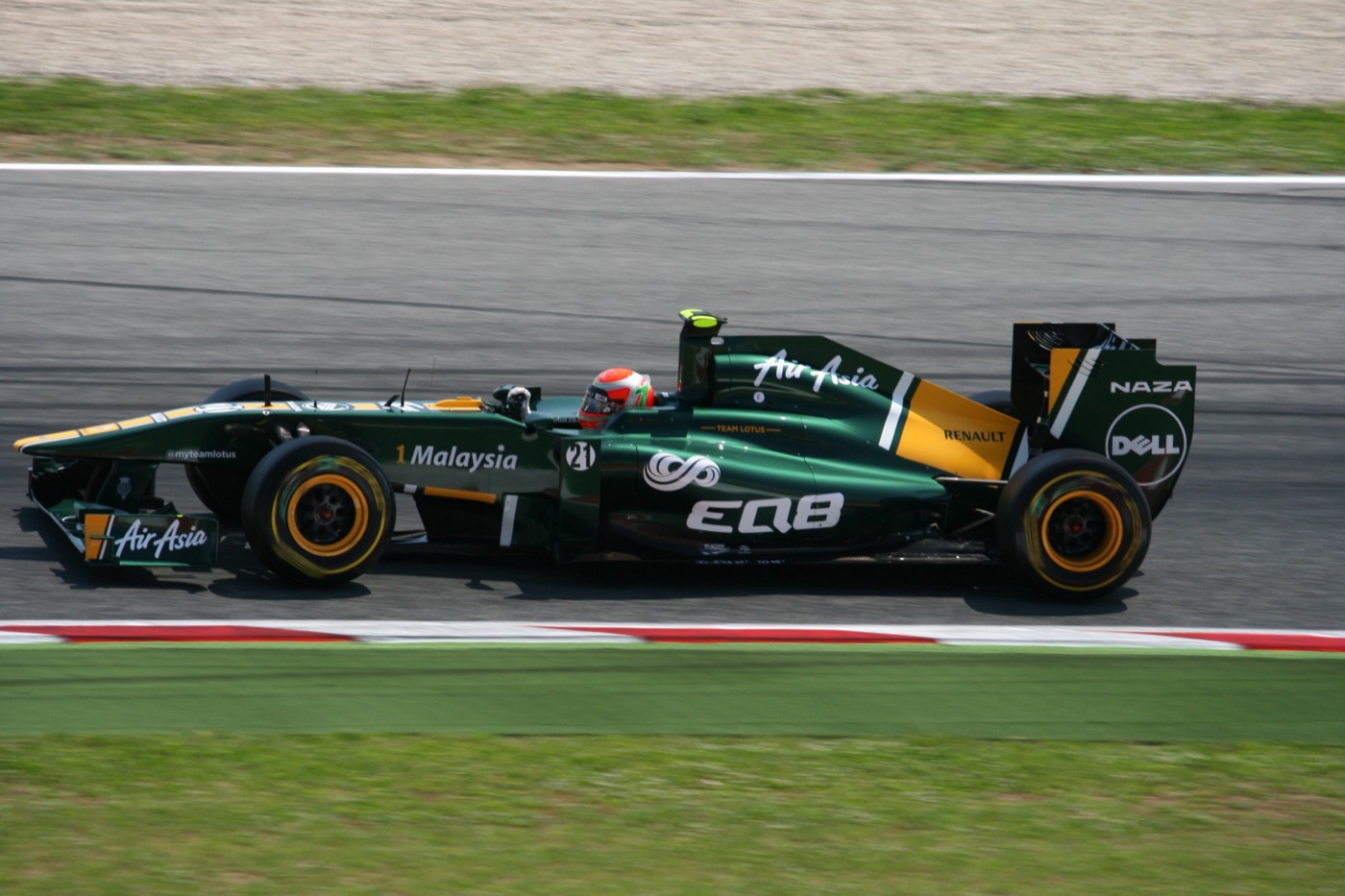
Team Lotus became Caterham F1 because Fernandes and his partners bought Caterham Cars, the Dartford firm that had built Colin Chapman’s Seven since 1973, in April 2011, and from 2012 gave the racing team the car company’s name in place of the Lotus name it had spent a year fighting over.
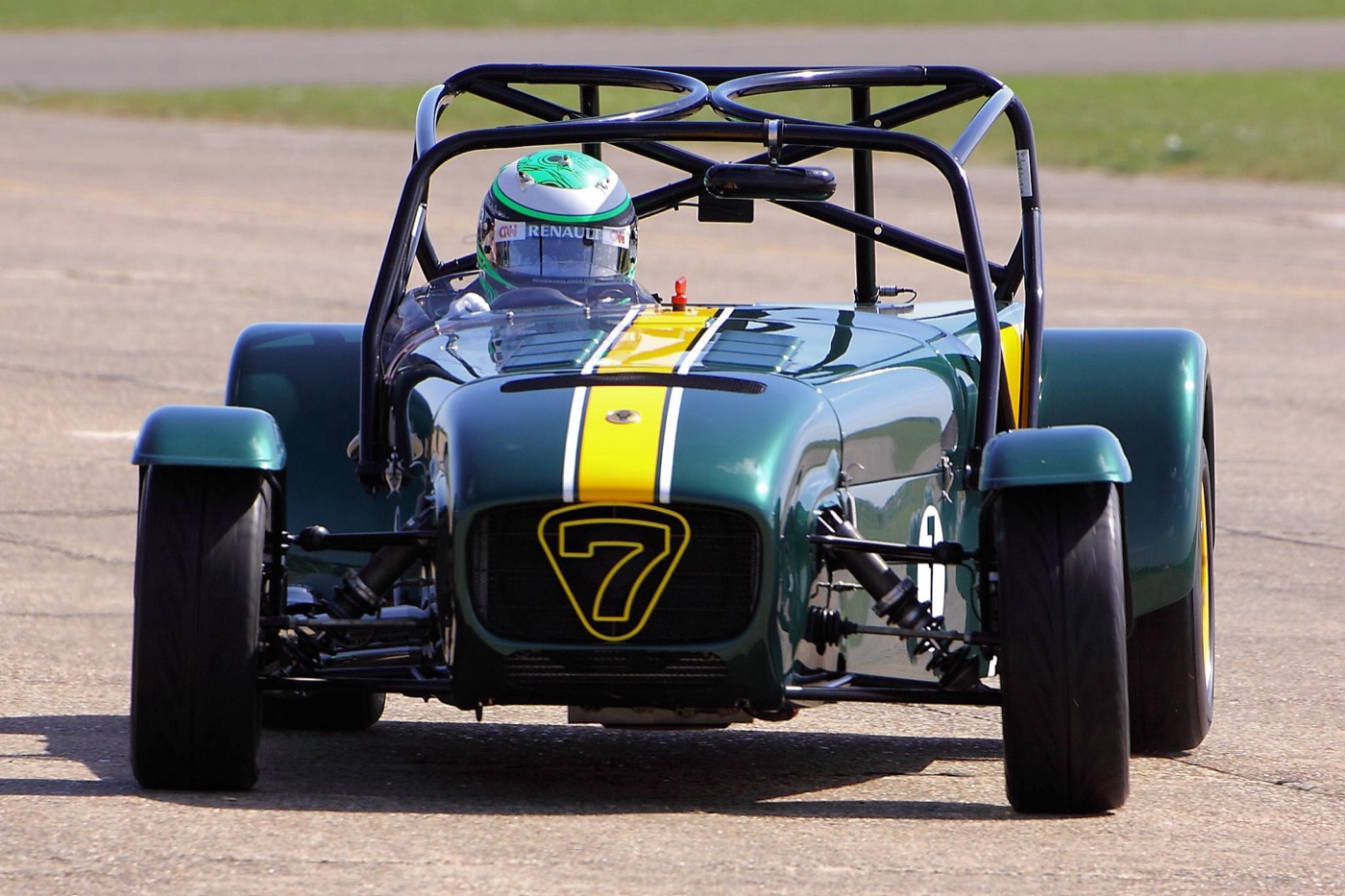
Team Lotus Enterprise, the group that held the racing team, announced its acquisition of Caterham Cars from a consortium led by Corven Ventures on 27 April 2011 (Formula1.com, “Team Lotus purchase Caterham Cars”). The price was not announced. In April 2011 SkiddMark’s Steve Hindle put it at a reputed £3 million; in May 2014 SkiddMark reported from a leaked information memorandum that Fernandes had paid £9 million for the car company in 2011. The launch was at Duxford, where Hindle noticed “just how at ease Fernandes and Ali were with each other”, meaning Caterham’s managing director, Ansar Ali, a former general manager of Lotus Cars.
The F1 Commission approved the change of chassis name from Lotus to Caterham on 3 November 2011, the same day it let Renault race as Lotus and Virgin as Marussia (Adam Cooper’s F1 blog). Fernandes told Cooper: “Caterham has racing pedigree, it races … My forte is building brands.” The FIA’s 2012 entry list, issued on 30 November 2011, named the entrant “Caterham F1 Team (MAL)”, its cars Caterhams with Renault engines (FIA entry list): it was still a Malaysian entry, held by 1MRT.
Caterham F1 season by season
As Caterham the team was entered in 56 Grands Prix over three seasons, from the 2012 Australian Grand Prix to Abu Dhabi in 2014, with a best finish of 11th and a best grid place of 14th, and it fell from tenth in the championship to 11th and last once Marussia overtook it.
2012: tenth with the CT01
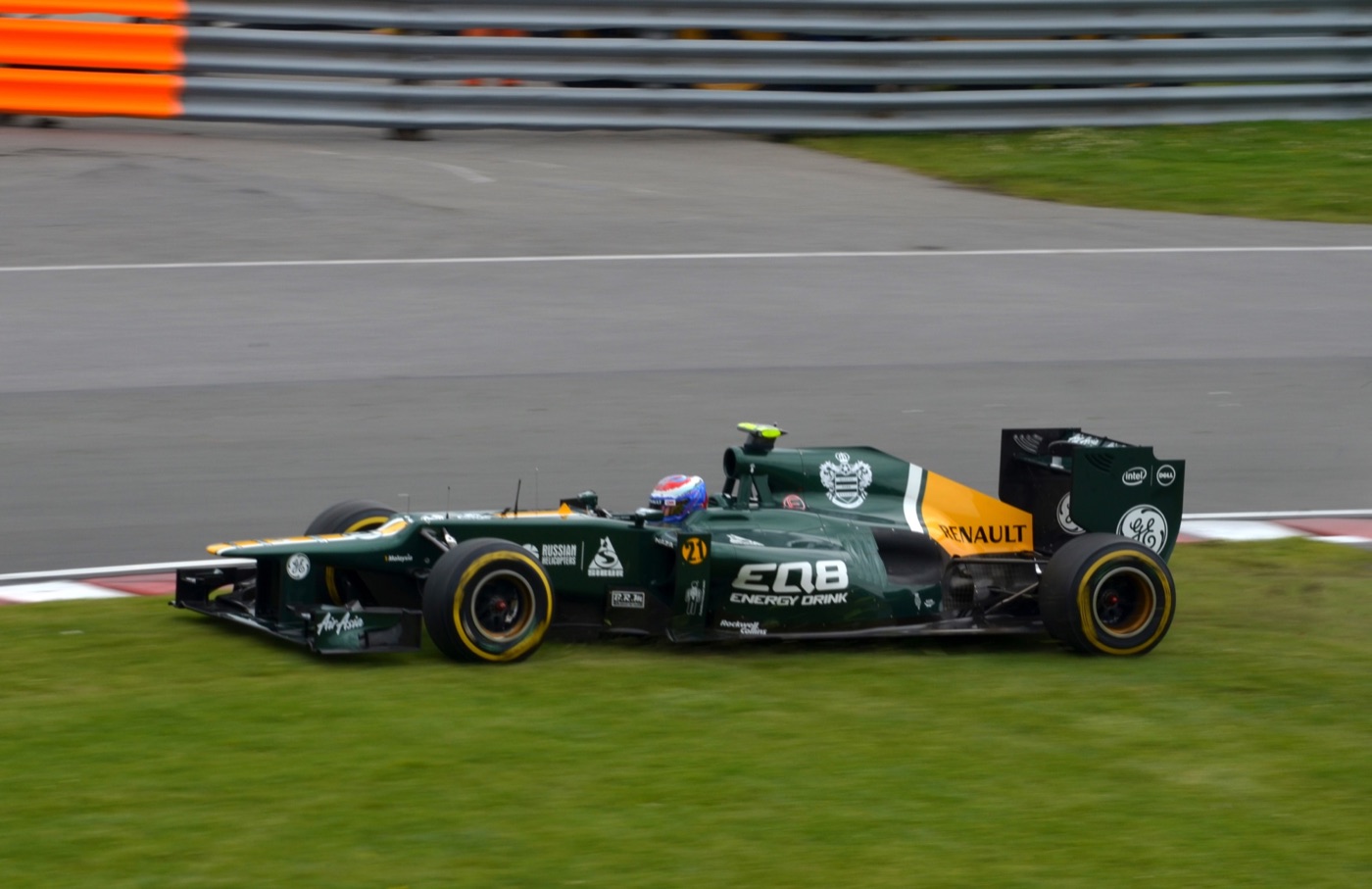
The Caterham CT01 was the team’s first car with KERS and kept the Renault engine and Red Bull Technology gearbox, giving it “the first year of real stability for us on the technical side”, Gascoyne said in the team interview SkiddMark published in January 2012. Its stepped “platypus” nose answered a new rule limiting nose height, and Gascoyne said it was “stirring up a lot of debate” because the CT01 was the first 2012 car shown. In February 2012 Vitaly Petrov replaced Trulli with immediate effect. Petrov’s 11th place at the last race of the year, in Brazil, one place ahead of Marussia’s Charles Pic, kept Caterham F1 tenth in the championship (Formula1.com, 2012 Brazilian Grand Prix).
2013: beaten to tenth by Marussia
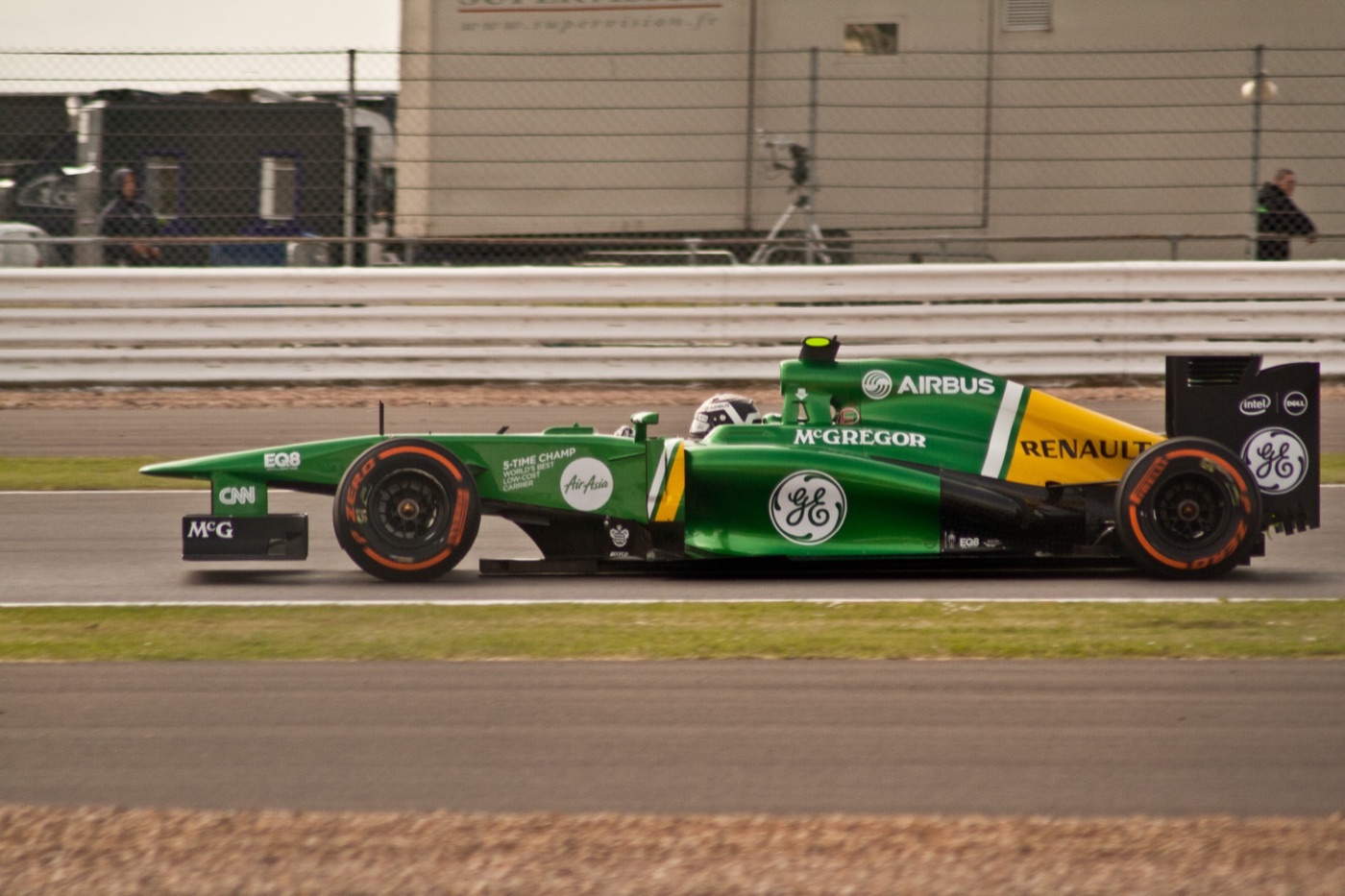
Cyril Abiteboul, who had come from Renault, was team principal by November 2012, when Caterham F1 signed Pic from Marussia; Giedo van der Garde joined him. Neither Kovalainen nor Petrov kept his seat. On 1 March 2013 the team named Alexander Rossi and Ma Qinghua its reserve drivers (Caterham F1 Team, 1 March 2013), and in April it brought Kovalainen back as reserve driver to test the first 2013 development parts, with Ma dropped and Rossi moved to the GP2 team. SkiddMark reported that Fernandes had announced his return at a dinner for Caterham executives during the Malaysian Grand Prix, when one race had been run. Van der Garde qualified 14th at Spa, the team’s best grid place. The CT03’s best finish was 14th, and Jules Bianchi’s 13th for Marussia in Malaysia was enough to put Marussia tenth and Caterham F1 11th and last (Formula1.com, 2013 Malaysian Grand Prix).
2014: the CT05 and the last chance
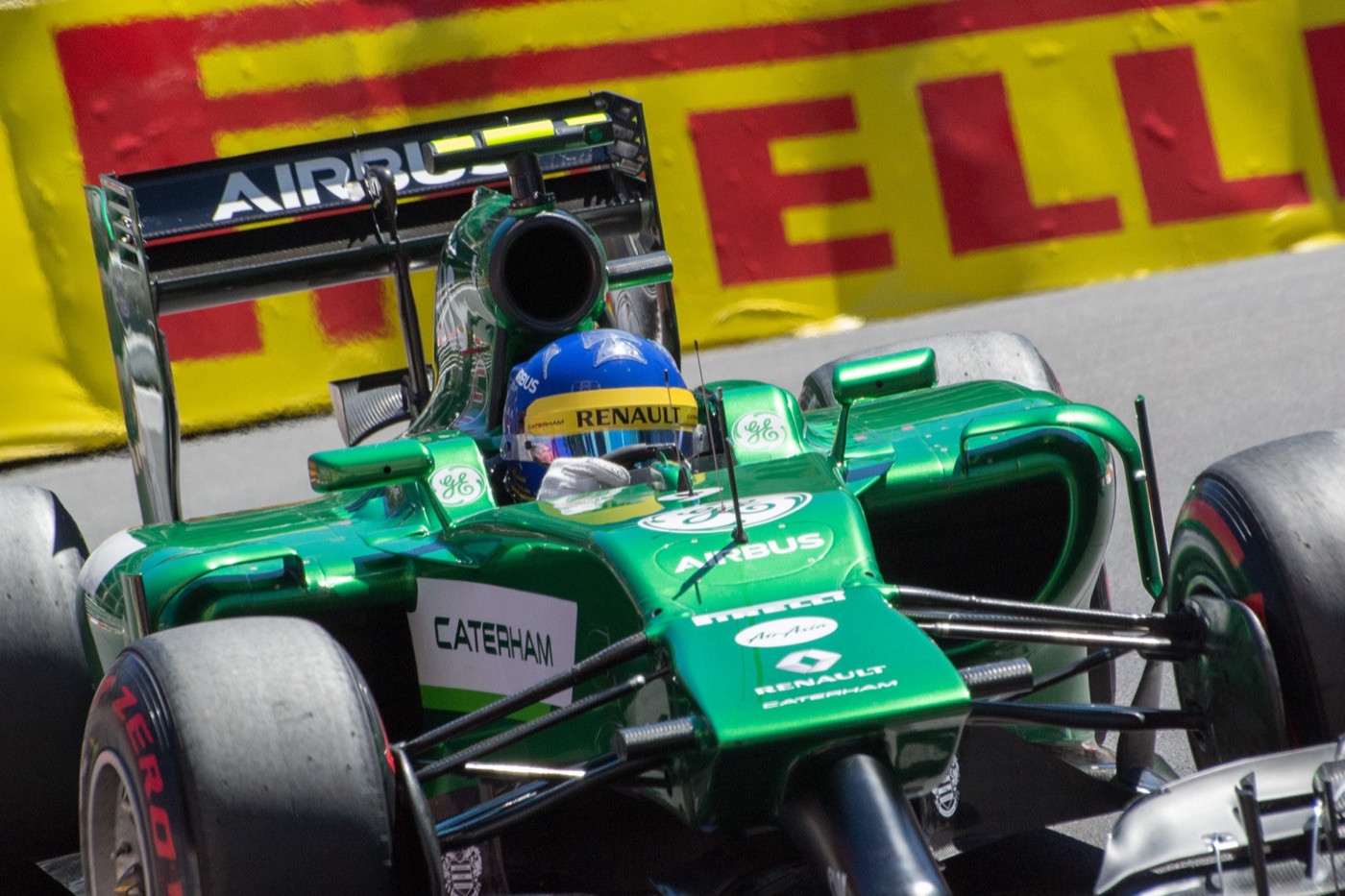
On 21 January 2014 at Leafield the team’s owner, Fernandes, named a new pair, Kamui Kobayashi and the rookie Marcus Ericsson, and told the 250 staff: “If we’re at the back I don’t think I’m going to carry on. Nothing is set in stone, but after five years with no points there is a limit to one’s patience, money and motivation” (BBC Sport, 21 January 2014). The team had then gone 77 Grands Prix without a point. At Monaco in May Ericsson finished 11th and Kobayashi 13th, but Bianchi’s ninth place gave Marussia its first two points (Formula1.com, 2014 Monaco Grand Prix), and SkiddMark called Caterham “(officially) the least successful current team in Formula One”.
Under its new owners from July, the sports-car driver André Lotterer took Kobayashi’s car at Spa and retired after one lap. In Singapore Kobayashi did not start because of low oil pressure. Ericsson ended his contract with immediate effect in November, so the last race, in Abu Dhabi, had Kobayashi and the British driver Will Stevens.
Who drove for Caterham F1?
Eight drivers started Grands Prix for Caterham F1 between 2012 and 2014, led by Heikki Kovalainen with 20, and one more, Jarno Trulli, raced for it as Lotus Racing and Team Lotus in 2010 and 2011, alongside Kovalainen in both seasons.
| Driver | Nationality | Seasons | Grands Prix for Caterham |
|---|---|---|---|
| Heikki Kovalainen | Finnish | 2012 | 20 |
| Vitaly Petrov | Russian | 2012 | 19 |
| Charles Pic | French | 2013 | 19 |
| Giedo van der Garde | Dutch | 2013 | 19 |
| Marcus Ericsson | Swedish | 2014 | 16 |
| Kamui Kobayashi | Japanese | 2014 | 15 |
| André Lotterer | German | 2014 | 1 |
| Will Stevens | British | 2014 | 1 |
Grands Prix as counted by StatsF1’s Caterham driver list. StatsF1 also lists Alexander Rossi, Ma Qinghua, Roberto Merhi and Robin Frijns, none of whom started a race for the team; Ma ran in first practice in China in 2013. Stevens moved to Manor for 2015.
Who owned and ran Caterham F1?
Tony Fernandes, Kamarudin Meranun and SM Nasarudin owned the team until 2 July 2014, when they sold it to a consortium of Swiss and Middle Eastern investors advised by Colin Kolles.
Owners and companies
Fernandes, the founder of AirAsia, also owned Queens Park Rangers football club. By 2013 the team was one part of Caterham Group, which also held Caterham Cars, the engineering firm Caterham Technology & Innovation, Caterham Composites and the Caterham Racing GP2 team. The entry stayed with 1MRT, the Malaysian company, while a British company, Caterham Sports Limited (CSL, first named 1Malaysia Racing Team (UK) Ltd), built the cars and ran the factory, SkiddMark explained in October 2014. Fernandes was the team principal until Abiteboul took over in 2012.
Team principals and engineers
Mike Gascoyne led the technical side from the start as chief technical officer, later becoming Caterham Group’s chief technical officer, and by January 2012 Mark Smith was the team’s technical director, Gascoyne said in the CT01 interview; in October 2012 SkiddMark noted that Gascoyne’s name had gone from the group’s websites. After the 2014 sale, the former Dutch Formula 1 driver Christijan Albers ran the team day to day with Manfredi Ravetto, and Abiteboul returned to Renault. Albers left after the Italian Grand Prix in September 2014 “due to private reasons”, and Ravetto took over (Formula1.com, September 2014). From 24 October 2014 the administrator Finbarr O’Connell ran it.
Hingham and Leafield
On 18 January 2012 the team announced a move from Hingham to the Leafield Technical Centre in Oxfordshire, the former Arrows and Super Aguri base, so that the racing team and the car company could share one site (Autosport, 18 January 2012). Hingham stayed open for Caterham Composites. Caterham Cars stayed at Dartford, and in 2015 opened a 25,000 sq ft showroom in Crawley, known as Caterham South.
What happened to Caterham F1?
Caterham F1 collapsed in its first season under new owners: unpaid bills led bailiffs to its factory, the company that built its cars went into administration on 17 October 2014, the team missed two races, raced once more in Abu Dhabi on crowdfunded money, and was left off the 2015 entry list while its assets were auctioned.
The sale in July 2014
On 2 July 2014 the team announced that “Tony Fernandes and his partners have sold the team to a consortium of Swiss and Middle Eastern investors, advised by former F1 Team Principal Colin Kolles”, and that the new ownership took charge “with immediate effect”, keeping the Caterham name and the Leafield base (Caterham F1 Team statement). Fernandes closed his Twitter account with the message “F1 hasn’t worked, but love Caterham Cars”, SkiddMark reported on 3 July. Within weeks more than 40 laid-off staff were preparing claims for unfair dismissal (BBC Sport, 25 July 2014).
Bailiffs and the share dispute
Early in October 2014 bailiffs took items from Leafield, among them a 2013 test car. Caterham Group said on 3 October that it had “no affiliation with Caterham F1 Team” and that the team was using the Caterham name under licence (Caterham Group statement). On 22 October the new owners accused Fernandes of not transferring the shares, leaving them “funding the team without having legal title to the team it had bought”; Fernandes replied on Twitter: “If you buy something you should pay for it. Quite simple.” Bernie Ecclestone told The Sun, “I think it’s better they go” (GrandPrix.com, 23 October 2014).
Administration
On Friday 17 October 2014 Finbarr O’Connell, Henry Shinners and Anthony Spicer of Smith & Williamson were appointed joint administrators of Caterham Sports Limited, the Leafield company that built the cars. Their statement, which SkiddMark printed in its report of 21 October, updated the next day, said that CSL’s sole director and shareholder, the former footballer Constantin Cojocar, had told the court that his associates were to provide funding of £2 million a week to pay the company’s creditors, and that the money had not arrived. The administration was announced on 21 October, with 200 jobs at risk and up to £20 million owed to suppliers (BBC News, 21 October 2014). An insider told SkiddMark: “It’s messier than a pit full of sh*te.”
The administrators held on to the cars at Leafield, and on 24 October the Kolles-led management handed control of the team to O’Connell, who became team principal (GrandPrix.com, 24 October 2014). The administrators’ statement of 24 October, which SkiddMark printed, said Ecclestone had agreed that Caterham F1 could miss the United States and Brazilian Grands Prix.
Crowdfunding and the Abu Dhabi finale
In November 2014 the administrators launched a crowdfunding campaign, #RefuelCaterhamF1, on Crowdcube to raise £2.35 million by 14 November, offering rewards from team kit to parts of the 2012 and 2013 cars. By 14:30 on 14 November it stood at £1.87 million, and O’Connell said sponsors would cover the rest: “In only a week the fans have made the impossible possible” (BBC Sport, 14 November 2014). SkiddMark later put the final sum at £2,354,389, given by nearly 6,500 fans. In Abu Dhabi on 23 November Stevens finished 17th and Kobayashi retired after 42 laps in what was the team’s last race (Formula1.com, 2014 Abu Dhabi Grand Prix).
The auction and the end
The administrators made 230 staff redundant in November 2014, and in December the FIA allowed Caterham F1 to race its 2014 car in 2015 if a buyer came forward (BBC Sport, 1 December 2014). None did. On 5 February 2015 O’Connell put the remaining assets up for sale (BBC Sport, 5 February 2015), and the auctioneers Wyles Hardy scheduled six sales from 11 March to 14 May 2015, starting with the race and pit equipment and the 2014 chassis; the trailers, the race simulator, the autoclaves and a Dell supercomputer were offered for sale by negotiation (Wyles Hardy sale page). The starting bid for the car Kobayashi raced in Abu Dhabi was £18,000 (GrandPrix.com, 27 February 2015). On 27 February 2015 the FIA’s updated entry list confirmed the Manor team and left Caterham F1 off (Autosport, 27 February 2015).
Staff and creditors
On 15 January 2019 the administrators paid the preferential claims of 216 former employees transferred to their control, capped at £800 of unpaid wages each plus holiday pay. Their latest progress report listed 25 unsecured creditors claiming £66.8 million, and fees of £713,502 drawn from November 2014 to August 2018 (Autosport, January 2019).
How the collapse hurt the Caterham name
The collapse damaged the car company because the failing team still carried its name: Caterham Group had sold the team in July 2014 but licensed it the Caterham name until the season ended.
Steve Hindle’s report of 21 October 2014, “How to decimate your brand”, set out why the name was exposed: CSL was “the facilitator of the Caterham team’s Formula One effort; it built the cars and provided the engineering and infrastructure support” to 1MRT, and it was now in administration under the Caterham name. A week later he reported redundancies at Caterham Technology & Innovation, and wrote that the car company’s order book was healthy. Caterham Cars’ own statement of 3 October said its order book was “full until March 2015”.
In April 2015 Graham Macdonald, Caterham Cars’ chief executive, told SkiddMark at the new Crawley showroom: “The sad thing for Caterham is we had to license them (Colin Kolles and Engavest SA) our name, because that effectively brought us into disrepute. We couldn’t get out of that, because they couldn’t change the name mid-season.” He said Kolles “owed us money for the licensing, he owed us money for the property he was renting”. SkiddMark reported that many of the group’s divisions had by then been closed or sold; CTI closed in February 2015. Two former Caterham F1 cars, bought from the administrators, stood in the Crawley showroom.
Caterham F1 and the other 2010 new teams
Caterham F1’s rivals were the two other teams that joined in 2010: Virgin, which became Marussia and then Manor, and HRT. Lotus Racing beat both in 2010, and as Team Lotus and Caterham it stayed tenth ahead of them in 2011 and 2012. HRT was missing from the 2013 standings. Marussia finished ahead in 2013 on Bianchi’s 13th place and again in 2014 on his Monaco points; its ninth place in 2014 was worth about £30 million in prize money, Autosport reported. Marussia stopped trading on 7 November 2014, the day the Caterham F1 crowdfunding began, SkiddMark reported, and it did not race in Abu Dhabi. It came back in 2015 under the Manor name, with Will Stevens as one of its drivers.
Questions
Did Caterham F1 ever score a point?
No. The team scored no championship points in any of its five seasons, as Lotus Racing, Team Lotus or Caterham; its best finishes were 11th places by Vitaly Petrov in Brazil in 2012 and Marcus Ericsson at Monaco in 2014.
Is Caterham F1 the same team as Lotus F1 Team?
No. Lotus F1 Team, which raced from 2012, was the former Renault team at Enstone, renamed after Group Lotus bought into it. Caterham F1 was the team that had raced as Lotus Racing and Team Lotus in 2010 and 2011.
Who bought Caterham F1 from Tony Fernandes?
A consortium of Swiss and Middle Eastern investors, advised by the former team boss Colin Kolles, bought it on 2 July 2014. Caterham Cars’ chief executive Graham Macdonald named the buyer’s company as Engavest SA when he spoke to SkiddMark in 2015.
How much did Caterham’s crowdfunding raise?
The #RefuelCaterhamF1 campaign on Crowdcube had a target of £2.35 million. SkiddMark reported a final total of £2,354,389 from nearly 6,500 fans, which paid for the team to race at Abu Dhabi in November 2014.
Where was Caterham F1 based?
The team started at Hingham in Norfolk in 2009 and moved to the Leafield Technical Centre in Oxfordshire, the old Arrows and Super Aguri factory, in 2012.
Was Caterham F1 part of Caterham Cars?
The two had the same owners in Caterham Group from 2011 until the team was sold in July 2014. After the sale the team used the Caterham name under licence, and Caterham Group said it had no affiliation with it.
What was Caterham F1’s best qualifying position?
14th, by Giedo van der Garde at the 2013 Belgian Grand Prix and Kamui Kobayashi at the 2014 Australian Grand Prix, according to StatsF1.
Sources
- GrandPrix.com, “Team Lotus announced”, 15 September 2009: the FIA’s 13th entry, partners, Hingham base, Gascoyne, Cosworth and Xtrac.
- The Star (Malaysia), “1Malaysia F1 team to be formed”, 15 September 2009: Najib Razak’s announcement and the backers.
- High Court, Group Lotus plc and Lotus Cars Ltd v 1Malaysia Racing Team Sdn Bhd and others [2011] EWHC 1366 (Ch), 27 May 2011: licence dates and terms, termination, goodwill, damages, paragraph 387.
- Formula1.com, constructors’ standings 2010–14: championship places and points for every season.
- Formula1.com, race results: Japan 2010, Brazil 2012, Malaysia 2013, Monaco 2014, Abu Dhabi 2014 (and Bahrain 2010, Belgium 2014): finishing places quoted.
- StatsF1, Caterham team record and driver list: 56 Grands Prix, best result and grid place, models, drivers’ Grand Prix counts, non-starts, Lotus 2010–11 best finishes.
- Formula1.com, “Team Lotus purchase Caterham Cars”, 27 April 2011: the buyers, Corven Ventures, the 2010 result and the switch to Renault.
- Adam Cooper’s F1 Blog, “Caterham, Lotus and Marussia name changes approved”, 3 November 2011: the F1 Commission decision and Fernandes’s quote.
- FIA, 2012 Formula One World Championship entry list, 30 November 2011: Caterham F1 Team (MAL), Caterham Renault; Lotus F1 Team (GBR), Lotus Renault.
- Autosport, Caterham announces move to Leafield, 18 January 2012: the move and Fernandes’s reasons.
- BBC Sport, “Caterham: Owner Tony Fernandes threatens to pull out of Formula 1”, 21 January 2014: the ultimatum, 77 races, 250 staff.
- Caterham F1 Team, “Caterham F1 Team announcement”, 2 July 2014: the sale and the new management.
- BBC Sport, “Caterham face legal action from more than 40 former staff”, 25 July 2014: the dismissal claims.
- Formula1.com, “Albers departs role as Caterham team principal”, September 2014: Albers’s exit and Ravetto.
- Caterham Group, “Caterham Group F1 clarification”, 3 October 2014: no affiliation, name used under licence, order book.
- BBC News, “Caterham F1 manufacturer goes into administration”, 21 October 2014: 200 jobs, up to £20m owed, the bailiffs.
- GrandPrix.com, 23 October 2014 and 24 October 2014: the share dispute, Ecclestone, O’Connell as team principal.
- BBC Sport, “Caterham to race in Abu Dhabi finale after fundraising success”, 14 November 2014: the target and the total on 14 November.
- BBC Sport, “Caterham allowed to run 2014 car in 2015”, 1 December 2014: the dispensation and 230 redundancies.
- BBC Sport, “Caterham hopes fade as team’s remaining assets go up for sale”, 5 February 2015: the sale of assets.
- Wyles Hardy & Co, “The assets of Caterham F1 race team”, February 2015: sale dates and lots.
- GrandPrix.com, 27 February 2015: the £18,000 starting bid.
- Autosport, “FIA approves Manor’s Formula 1 return on new 2015 entry list”, 27 February 2015: Caterham off the list, Marussia’s prize money.
- Autosport, “Ex-Caterham F1 employees finally get some small sum”, January 2019: payments to 216 staff, creditors, fees.
- SkiddMark reports, 2009–15: Lotus F1 Racing drivers and Q&A (December 2009); the T127 launch (February 2010); black and gold livery (11 November 2010); Team Lotus confirmed (30 November 2010); Lotus Renault GP (December 2010); the T128 (January 2011); “The Fernandes Files” and “Beyond the green & yellow” by Steve Hindle (April and May 2011); the High Court judgment and appeal (May and June 2011); Williams wind tunnel and GE (June 2011); the CT01 and Gascoyne’s interview (January 2012); Petrov for Trulli (February 2012); Gascoyne’s departure (October 2012); Pic signs (November 2012); Kovalainen returns (17 April 2013); “Tony Fernandes calls time out” (27 May 2014); “Caterham quits F1” (3 July 2014); “How to decimate your brand” by Steve Hindle (21 October 2014); the administrators’ statements (24 October 2014); “Has Caterham finally met its iceberg?” (29 October 2014); the crowdfunding campaign (7 November 2014); “Caterham rebuilds for a new future”, interview with Graham Macdonald and David Ridley (20 April 2015).
This article was written in October 2026 to replace SkiddMark’s report “How to decimate your brand – a case study by Caterham” by Steve Hindle, of 21 October 2014, whose account of the administration it keeps.