Ford Sierra RS Cosworth: RS500, Sapphire, 4x4, racing and values
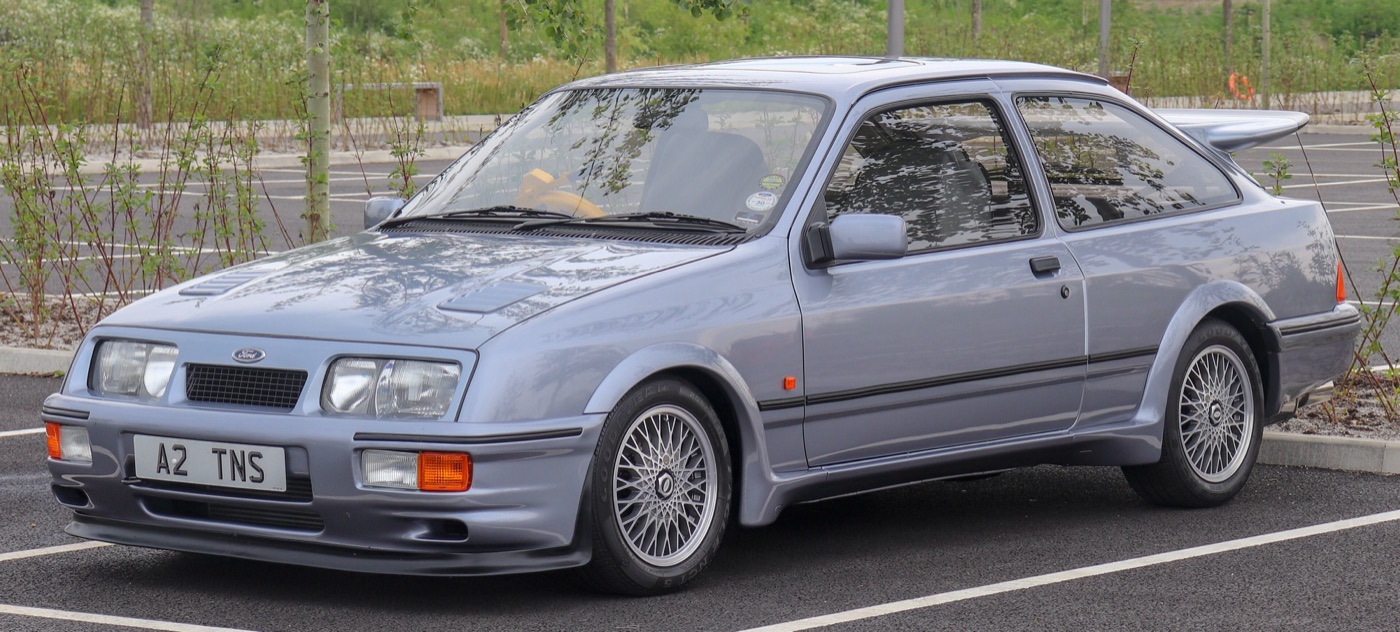
The Ford Sierra RS Cosworth is the turbocharged, rear-wheel-drive Sierra that Ford built so it could win Group A touring car races, nicknamed the Cossie: a three-door hatchback with a 2-litre engine with a Cosworth cylinder head, rated at 204 PS, and a tall rear wing, shown at the Geneva Motor Show in March 1985 and sold in Britain for £15,950. Ford needed 5,000 to homologate it, and in 1987 Tickford turned 500 more into the RS500, the evolution model that won 40 British Touring Car Championship races in a row.
In the two years to 28 October 2026 three-door cars sold at British auctions for £36,250 to £50,500, two RS500s made £85,500 and £87,188, and running four-doors made £18,750 to £32,063. In February 2023 a 5,192-mile RS500 sold for £596,250, a record for the model. About 30,900 Sierra RS Cosworths of all kinds were built between 1986 and 1992, according to Malcolm McKay’s buyer’s guide in Classic & Sports Car (2019).
History of the Ford Sierra RS Cosworth
Ford built the Sierra RS Cosworth to win touring car races outright again: since the Capri, its cars in Britain had been fighting for class places. Planning of the project began in early 1983, when Ford weighed the 2-litre Pinto engine against the 2.3-litre turbocharged unit of the American Merkur XR4Ti, Richard Heseltine wrote in “Ford Sierra Cosworth”, Motor Sport, May 2010. The Merkur, badged as a Sierra turbo, won Andy Rouse the British Saloon Car Championship in 1985 as a stop-gap (Touring Car Racing.net, 1985 British Saloon Car Championship); the long-term answer was a Cosworth 16-valve cylinder head on the Pinto block, with a turbocharger and fuel injection. The Sierra was chosen as the base because it was rear-wheel drive and had a drag coefficient of 0.34, “aerodynamic for its era” in Heseltine’s words.
Why Ford needed 5,000 cars
Ford Motorsport, then run by Stuart Turner, wanted a Group A saloon to replace the Capri, McKay writes. The homologation rules of Group A required 5,000 identical road cars a year before a model could race, and once those were built a further 10 per cent could be made as an “evolution” with changes for competition (Jeremy Walton, “Tickford’s time trial”, Motor Sport, September 1987). Ford’s dealers reacted poorly at first, and McKay records that the company adjusted the price and cut the specification to one trim and three paint colours: Diamond White, Black and Moonstone Blue.
Launch and production, 1985 to 1986
Ford unveiled the car at the Geneva Motor Show in March 1985 and planned sales for that September, but problems with the Borg-Warner gearboxes delayed production (Heseltine). Production ran at Ford’s plant at Genk in Belgium through 1986, with 5,000 built by December. The Motor Sport road test of October 1986 priced it at £15,950 and noted that the car was “not yet homologated”; Group A homologation came in January 1987.
The RS500, the Sapphire and the end in 1992
The RS500 evolution followed in the summer of 1987. In January 1988 the three-door gave way to a four-door version built on the Sapphire saloon shell, and in January 1990 Ford announced the four-wheel-drive Sierra RS Cosworth 4x4, with deliveries from April (McKay). Motor Sport still listed the 4x4 in July 1992, when its successor, the Escort RS Cosworth, was being launched on the same engine and four-wheel-drive layout under a shorter body; McKay dates the end of manufacture to 1992.
Design and engineering
Under the skin the Sierra RS Cosworth is a standard Sierra with a new engine, stiffer suspension and bigger brakes; Ford listed 92 detail modifications to the body. The development work was split between Cosworth, which developed the engine at Northampton, and Ford’s Special Vehicle Engineering department under Rod Mansfield, which set up the chassis (Mike Lawrence, “Road test: Ford Sierra RS Cosworth”, Motor Sport, October 1986).
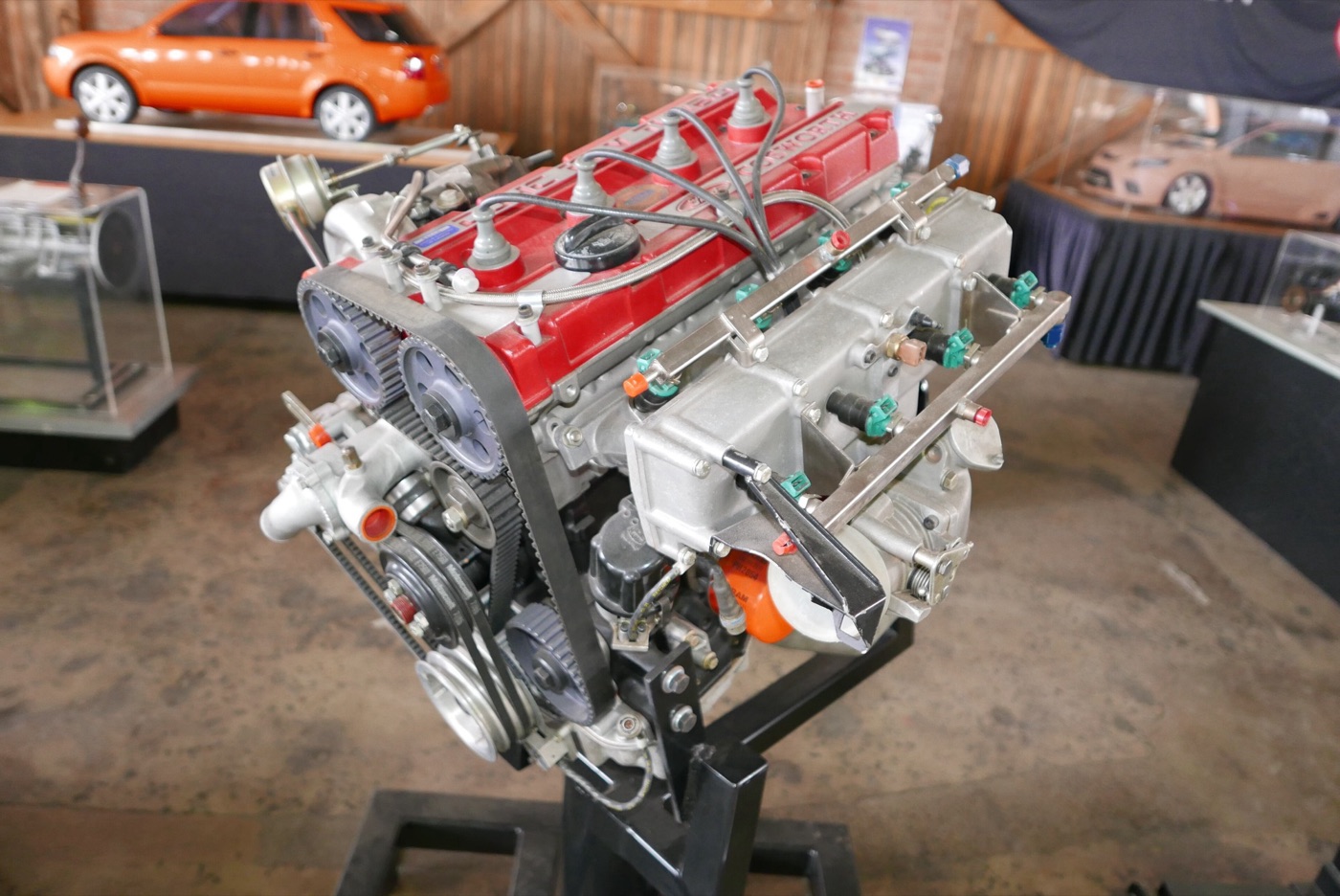
The Cosworth YB engine
The engine, known as the YB, starts from Ford’s cast-iron 1,993 cc T88 block (Lawrence), which the National Motor Museum at Beaulieu describes as the existing Pinto cylinder block. Cosworth added a light-alloy head with twin belt-driven camshafts and four valves per cylinder (35 mm inlet, 31 mm sodium-filled exhaust), a Garrett AiResearch T3 turbocharger at 8 psi, an intercooler and Weber-Marelli injection and ignition. Apart from the block, the auxiliary shaft and the water pump it shares no major part with the ordinary engine (Lawrence). The heads were cast by Cosworth Castings in Worcester alongside those for the Mercedes-Benz 190E 2.3-16. The compression ratio is 8:1.
In road form it makes 204 PS (201 bhp) at 6,000 rpm, and Motor Sport recorded that over 80 per cent of its torque was available from 2,300 rpm.
Chassis, brakes and gearbox
The suspension keeps the Sierra’s layout of MacPherson struts at the front and semi-trailing arms at the rear, which Mansfield’s team “adjusted and refined beyond recognition”, in Lawrence’s words. A Borg-Warner T5 five-speed gearbox (the unit also used in the Mustang) drives a viscous-coupling limited-slip differential taken from the Granada through a two-piece propeller shaft. Brakes are discs all round, 11 in ventilated at the front with four-piston calipers and 10.7 in solid at the rear, with Ford-Teves electronic ABS. The steering is power-assisted and quick, at 2.6 turns from lock to lock, and the wheels are 15 in alloys on Dunlop D40 205/50 VR15 tyres. Ford increased the damper travel after the Spanish launch, and by the October 1986 road test Lawrence called the ride “near-ideal … firm yet comfortable”.
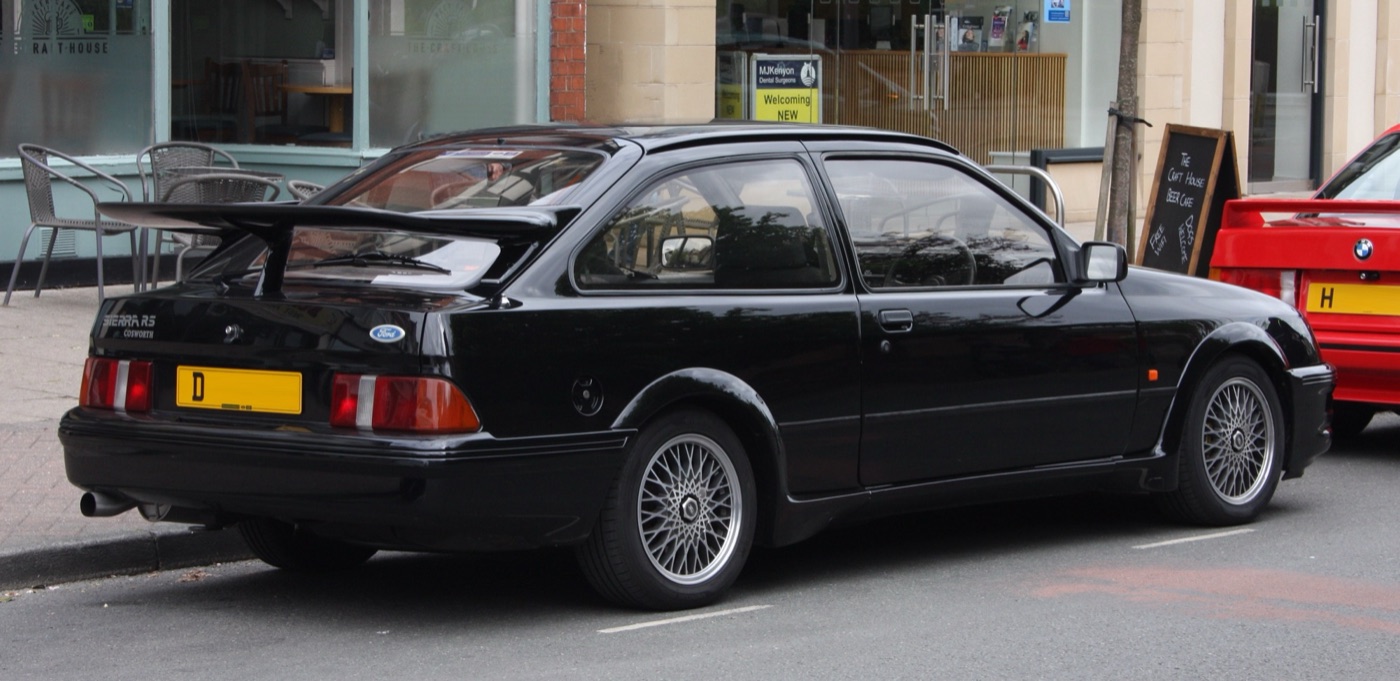
Body and the rear wing
The RS Cosworth uses the three-door Sierra shell with one large rear side window, plus wider wheel arches, a front air dam that gives “negative lift”, an opening for the intercooler, and the rear wing, which Ford said gave up to 45 lb of downforce. Inside it is a Sierra Ghia with Recaro seats, a leather-rimmed steering wheel and a boost gauge, plus central locking and electric windows and mirrors; a glass sunroof was a “mandatory option” on UK cars. Lawrence found the wing “a bit too ‘boy racer’” and passed on Ford engineers’ view that a smaller XR4x4 spoiler would be stable enough “for all save for extreme circumstances”.
Ford Sierra RS Cosworth specifications and performance
All Sierra RS Cosworths have the same 1,993 cc turbocharged four-cylinder; power ranges from 204 PS (201 bhp) in the three-door and 204 bhp in the two-wheel-drive Sapphire to 224 bhp in the RS500, and Ford claimed 150 mph for the three-door, the Sapphire and the 4x4.
| Model | Years | Engine | Power | Drive | 0–60 mph | Top speed | UK price new | Built |
|---|---|---|---|---|---|---|---|---|
| Sierra RS Cosworth (three-door) | 1986–87 | YB, Garrett T3 | 204 PS (201 bhp) at 6,000 rpm | Rear | 6.2 sec (tested) | 150 mph (claimed) | £15,950 (1986) | 5,542, including the 500 RS500s |
| Sierra RS500 Cosworth | 1987 | YBD, Garrett T04 | 224 bhp at 6,000 rpm | Rear | 6.2 sec 0–62 mph (Autocar); 6.2 sec (RS Owners Club) | 153 mph (Autocar); 154 mph (RS Owners Club) | £19,950 (1987) | 500 |
| Sierra Sapphire RS Cosworth (four-door) | 1988–89 | YBB, Garrett T3 | 204 bhp | Rear | 6.1 sec (claimed) | 150 mph (claimed) | £19,000 (1988) | 13,140 |
| Sierra RS Cosworth 4x4 (four-door) | 1990–92 | YBG (catalyst) or YBJ, Garrett T03B | 220 bhp at 6,000 rpm | Four-wheel, 34:66 front to rear | 6.5 sec (tested) | 141.6 mph (tested) | £27,060 (1991) | about 12,250 |
How fast is a Sierra RS Cosworth?
Ford claimed 150 mph for the three-door, and Motor Sport timed 0–60 mph in 6.2 seconds in 1986, “about the same as a Ferrari Berlinetta Boxer”. Motor Sport’s 1991 test of the 4x4 at Millbrook recorded 0–60 mph in 6.5 seconds, 0–100 mph in 16.9 seconds and a sustained 141.6 mph, short of Ford’s claimed 150 mph (Jeremy Walton, “On test: Ford Sierra 4x4 RS 4-door”, Motor Sport, May 1991). Kerb weight is 1,195 to 1,305 kg, depending on version (McKay).
Sierra RS500 Cosworth
The RS500 is the 1987 evolution model: 500 three-door RS Cosworths converted by Tickford at Bedworth, with a bigger turbocharger, a second set of injectors and extra aerodynamic parts so that the racing versions could use them. Sales to the public were set to start on 1 August 1987, at £19,950, with 224 bhp at 6,000 rpm, about 10 per cent more than the standard car (Walton, 1987).
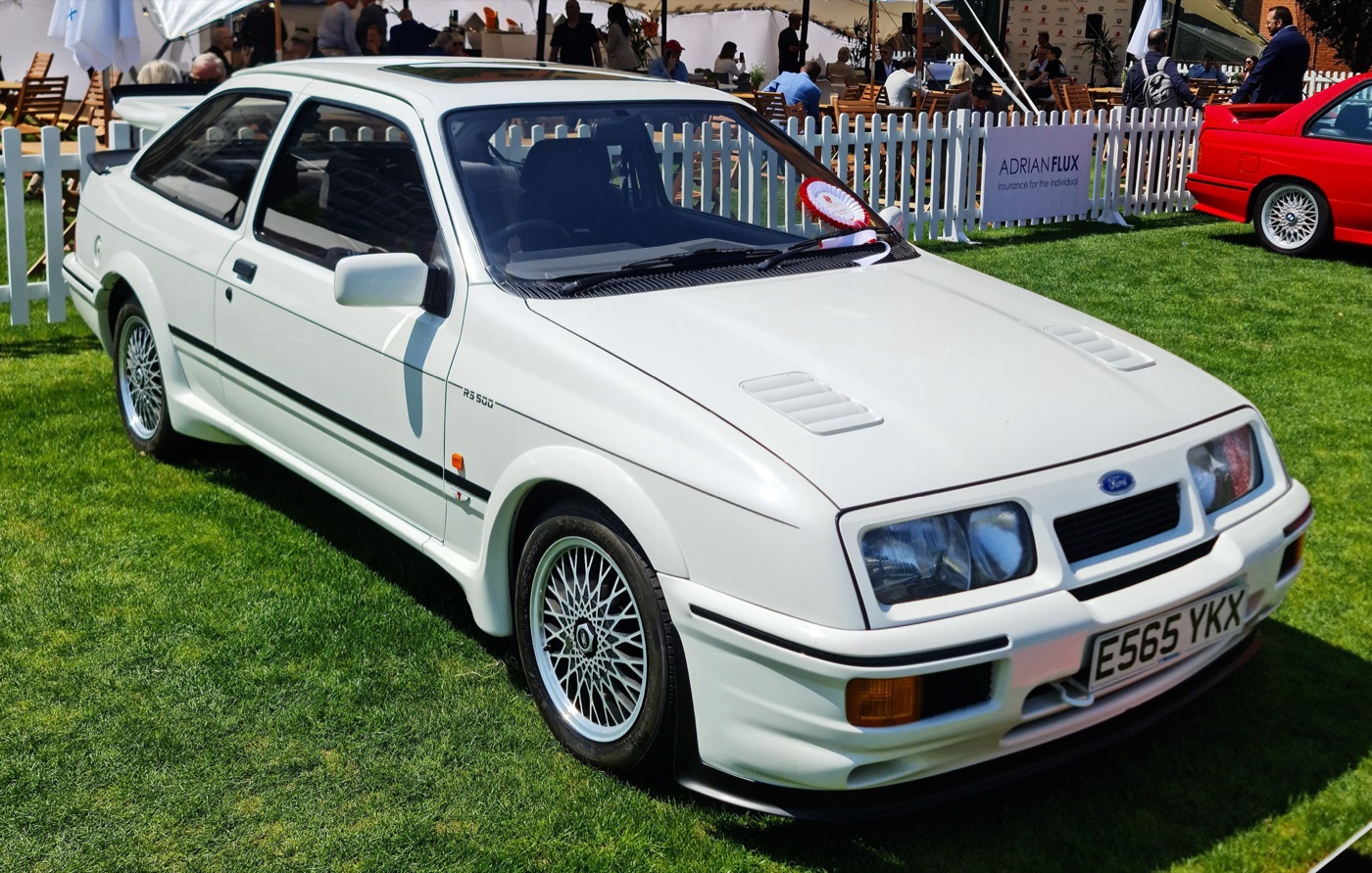
How the RS500 was built
Tickford had been separate from Aston Martin since 1984 and belonged to CH Industrials; it did the work under a contract from Ford worth “more than half-a-million pounds”. Ford set aside 500 of the last cars built at Genk in 1986, shipped them to Britain and stored them in an open compound in Essex. Four white prototypes were delivered in December 1986. Five production lines rebuilt the cars with new engines, front bumpers and spoilers, and Tickford was due to show FISA’s inspectors the 500 cars on 30 July 1987 (Walton, 1987). Andrew Frankel dates the first car into build at 9 April 1987 and the last out at 30 August, in “How the RS500s were created”, Motor Sport, May 2017. Tickford took the cars in random order, so an RS500’s chassis number says nothing about when it was converted.
What changed on the RS500
The YBD engine has a thicker block with smaller core plugs, a Garrett T04 turbocharger in place of the T3, a larger intercooler mounted behind the radiator, a new inlet manifold and eight injectors, of which only four are connected on road cars. The throttle body grew from 52 mm to 76 mm (Andrew Frankel, “Spooling for a fight”, Motor Sport, May 2017). Outside, the front bumper has larger cooling openings and mesh grilles in place of the fog lamps (supplied in the boot), with a splitter beneath; at the back a second, lower spoiler sits under the main wing, which gains a 30 mm Gurney flap. Walton gave the downforce as more than 200 lb at 100 mph. Unused brackets on the rear subframe let racing versions move the suspension pick-up points. Inside, the RS500 is the same as the standard car.
RS500 colours, numbers and identity
All 500 were meant to be black, but Frankel counts 392 black, 52 Moonstone Blue and 56 white, the white total including the four prototypes; Walton’s 1987 report gave 52 white and 52 blue. Every RS500 is right-hand drive, built for the British market. McKay gives the chassis numbers as WFOEXXGBBEGG 38600 to 39099, stamped on the slam panel and beside the driver’s seat, and the engine numbers as YBD 0015 to 0537. Because Tickford swapped the engines without changing the logbooks, every RS500’s registered engine number is the “wrong” one (Frankel), and the numbered plaque many cars carry was added later by the owners’ club.
Sierra Sapphire RS Cosworth and the 4x4
From 1988 the RS Cosworth was a four-door saloon on the Sapphire shell: a rear-wheel-drive model in 1988 and 1989, then the four-wheel-drive Sierra RS Cosworth 4x4 from 1990 to 1992.
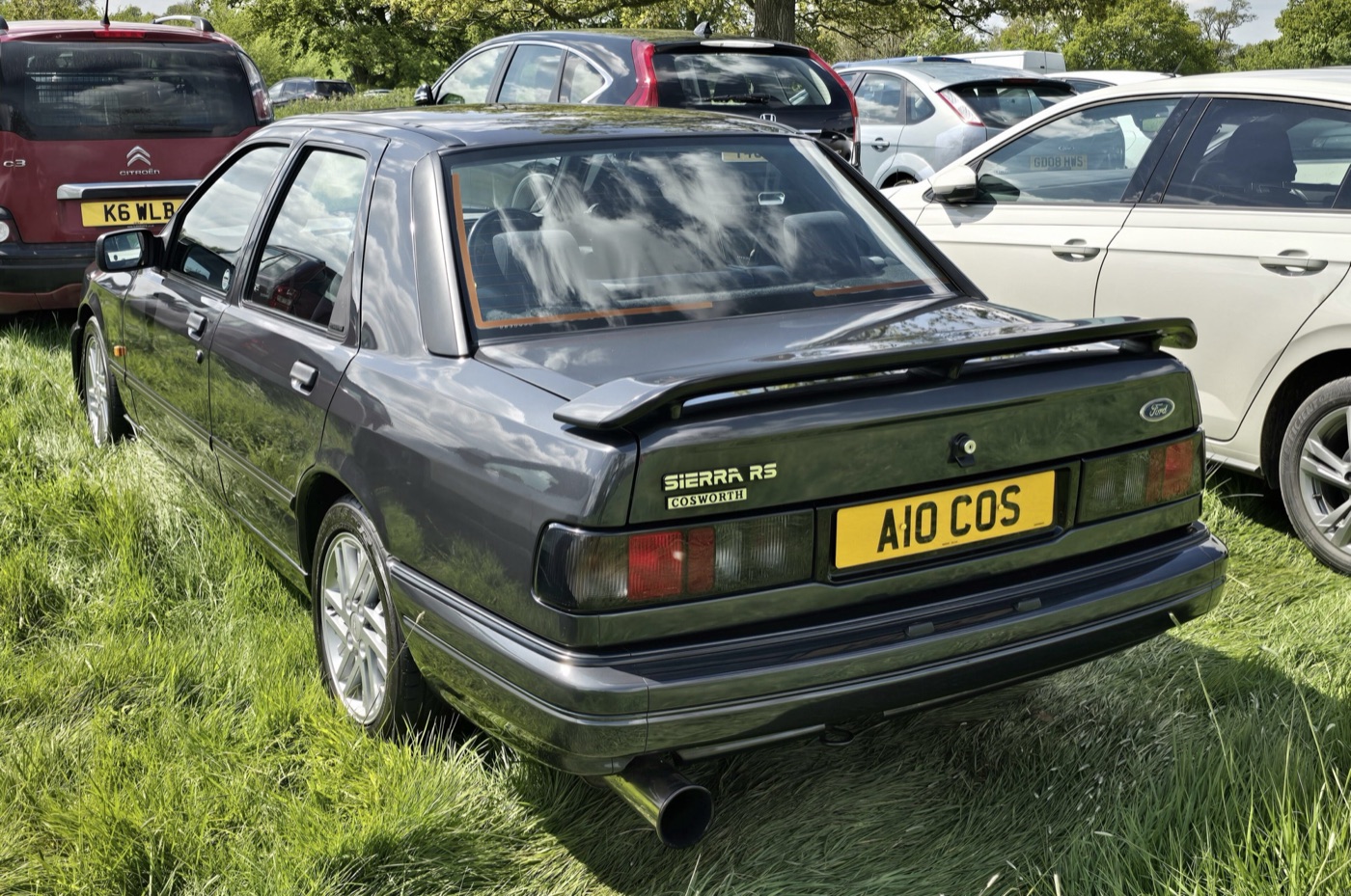
Sapphire RS Cosworth, 1988 to 1989
The four-door arrived in early 1988 at £19,000, with the familiar Sierra dashboard and 170 mph speedometer but no boost gauge, with the 204 bhp YBB engine and a Garrett T3 turbocharger, a small boot spoiler in place of the big wing, a drag coefficient of 0.33, velour trim, a heated windscreen and ABS (“New cars: Ford Sierra RS Cosworth”, Motor Sport, March 1988). Motor Sport called it “a much more relaxing car” and “much more restrained than its biplaned predecessor”. In Britain it was officially the RS Cosworth, and on the Continent simply the Cosworth; unlike the three-door it had no production limit. McKay gives 13,140 built.
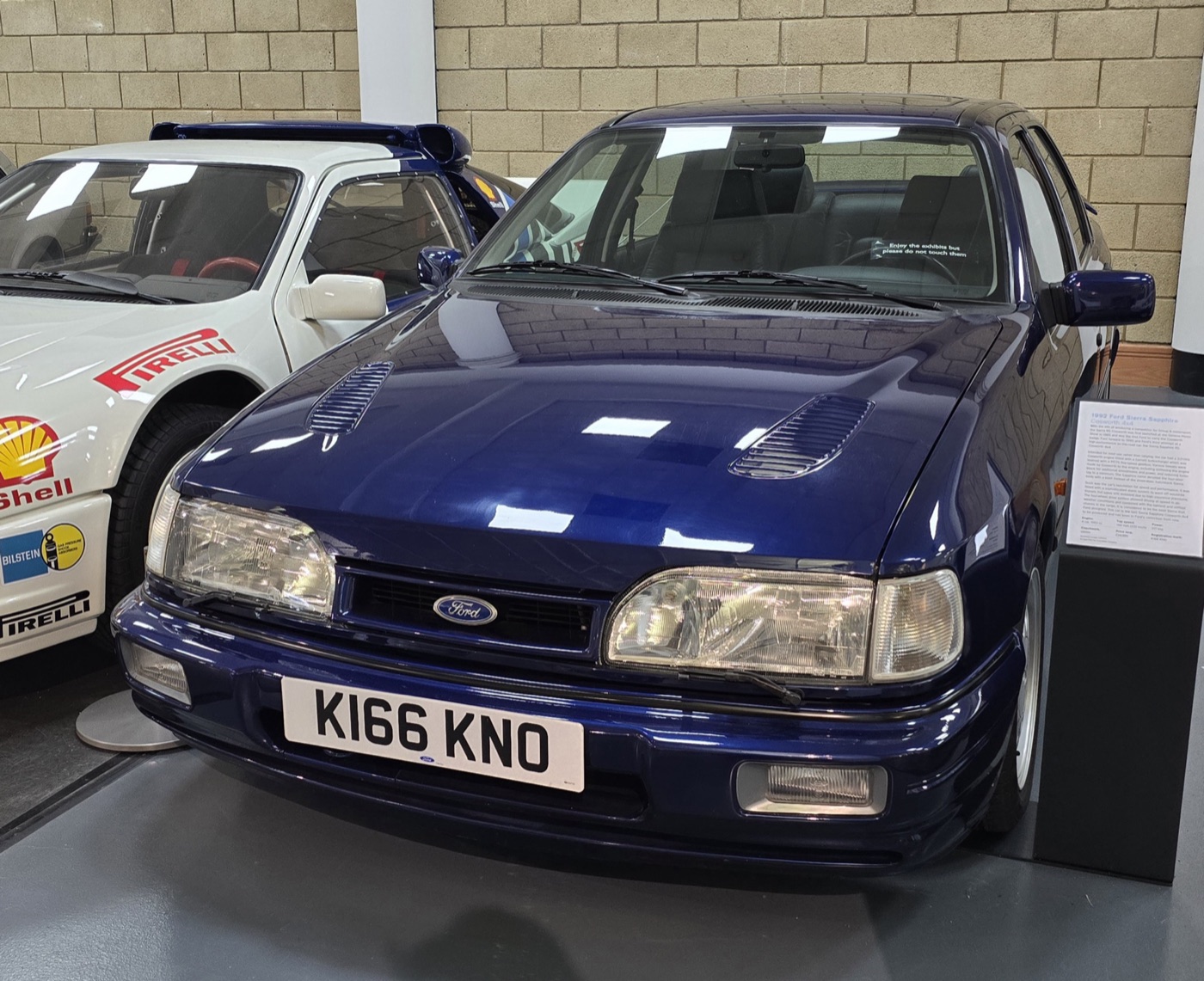
Sierra RS Cosworth 4x4, 1990 to 1992
The 4x4, announced in January 1990 and recognisable by its bonnet louvres, has a stronger block, a revised head and a slightly larger turbo, giving 220 bhp at 6,000 rpm and 214 lb ft at 3,500 rpm to make up for the drag and the extra 210 lb of the four-wheel-drive system (McKay). Drive goes through Ford’s new MT75 five-speed gearbox to Ferguson-patented permanent four-wheel drive, split 34 per cent front and 66 per cent rear by an epicyclic centre differential with viscous couplings. Walton found it “a lot more restrained than the original hatchback”, with wheelspin “almost a memory”, and listed it at £27,060 in 1991. About 12,250 were built.
Ford Sierra RS Cosworth in touring car racing
Sierra RS Cosworths won 40 British Touring Car Championship races in a row from 1987 to 1990, the 1990 BTCC title, the 1988 DTM and Japanese titles and the Bathurst 1000 twice. In race trim the engines made 485 bhp at first and a reliable 525 bhp later, and the cars topped 180 mph at Fuji and Bathurst (Frankel, “How the RS500s were created”).
| Year | Series or race | Result |
|---|---|---|
| 1987 | Nürburgring 24 Hours | Win, Klaus Ludwig and Steve Soper |
| 1987 | World Touring Car Championship | Teams’ prize, Eggenberger number 7 car |
| 1987–90 | British Touring Car Championship | 40 consecutive race wins, 20 September 1987 to 7 October 1990 |
| 1988 | European Touring Car Championship | Teams’ prize |
| 1988 | DTM (German championship) | Drivers’ title, Klaus Ludwig |
| 1988 | Japanese Touring Car Championship | Title, Yokoshima |
| 1988 | Tour de Corse (World Rally Championship) | Win, Didier Auriol |
| 1988 and 1989 | Bathurst 1000 | Wins |
| 1990 | British Touring Car Championship | Drivers’ title, Robb Gravett |
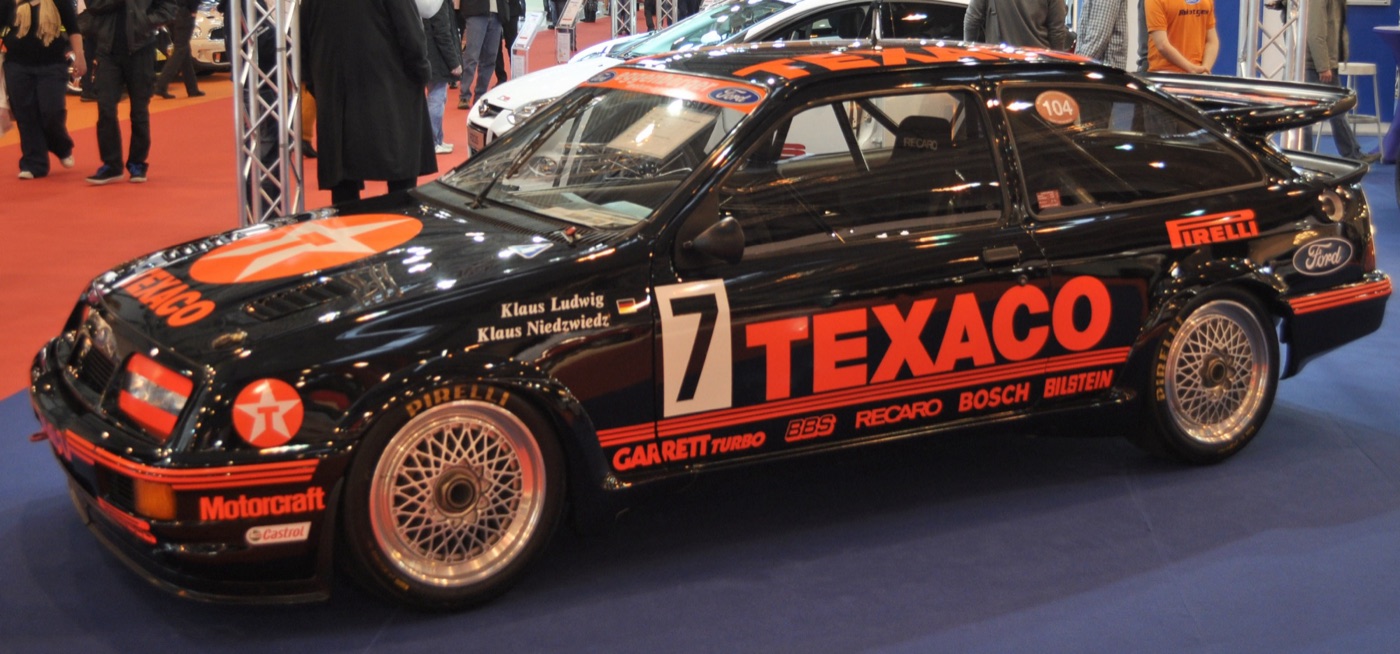
Were the racing RS500s real RS500s?
No. Only 500 RS500s were built and all were road cars; the racers were ordinary Sierra Cosworths, or Ford’s seam-welded 909-series motorsport shells, built up to RS500 specification once it was homologated, which is why many RS500s raced in Germany and elsewhere in Europe were left-hand drive (Frankel, “Spooling for a fight”). Andy Rouse’s team built “something like 28 RS500s” and more than 100 engines, Rouse told Motor Sport in November 2024.
1987 World Touring Car Championship
The RS Cosworth started winning in its first season: Klaus Ludwig and Steve Soper won the 1987 Nürburgring 24 Hours in one (Andrew Frankel, “A Klaus encounter”, Motor Sport, May 2012). In the one-year World Touring Car Championship, Fords won six of the 11 rounds (Heseltine), and after homologation the RS500 won four of the six races it entered (Motor Sport, 2024). The Eggenberger Sierras were disqualified at Monza for using Bosch electronics and at Bathurst over their rear wheel arches, and the drivers’ title went to BMW’s Roberto Ravaglia; Eggenberger’s number 7 car won the teams’ prize (Touring Car Racing.net, 1987 World Touring Car Championship). The pattern repeated in the 1988 European championship: Ford won the teams’ prize and Ravaglia the drivers’ title (Touring Car Racing.net, 1988 European Touring Car Championship).
British Touring Car Championship and the 40-race run
Graham Goode’s RS500 won its class on its BTCC debut at Donington on 16 August 1987, finishing second overall behind Frank Sytner’s BMW M3, and Andy Rouse took the RS500’s first outright win there on 20 September (Touring Car Racing.net, 1987 Donington results). That began a run of 40 consecutive BTCC wins for the Sierras: Pete Hall’s at Silverstone on 4 October 1987, all 12 races held in 1988, all 13 in 1989 and all 13 in 1990, the last of them Gravett’s at Silverstone on 7 October 1990. A 2012 SkiddMark report gave the same span, “between September 1987 and the end of 1990”. Rouse, Soper, Tim Harvey and Gravett were the regular winners. Because the BTCC then gave points by class, the outright winners rarely took the title: in 1988 it went to Sytner’s class B BMW M3, and Rouse finished third in the fastest Sierra (Touring Car Racing.net, 1988 BTCC). The exception was 1990, when Gravett won the championship by 27 points in the Trakstar team’s often plain white RS500; he won nine of 13 races, seven of them in a row, and said the car reached 189 mph on the Conrod Straight at Bathurst in 1989 (Heseltine).
The BTCC moved to a single class of 2-litre cars without turbochargers for 1991, which ended the Cosworths’ run.
Germany, Australia and Japan
Klaus Ludwig won the 1988 DTM, the German championship, in a Sierra (Frankel, 2012), even after the organisers fitted the Sierras with an air restrictor in two steps to slow them (Touring Car Racing.net, 1988 DTM). In the Japanese Touring Car Championship of 1988 (the All-Japan series) Sierras won four races to the new Nissan Skyline’s two, and Yokoshima took the title in a Sierra (Touring Car Racing.net, 1988 All-Japan Touring Car Championship). In Australia RS500s won the Bathurst 1000 in 1988 and 1989, Dick Johnson winning in 1989 (Frankel, “Spooling for a fight”). There the Sierras gave way to Nissan’s four-wheel-drive Skyline GT-R, and the last Group A race between the two there supported the 1992 Australian Grand Prix in Adelaide, SkiddMark recorded in 2009.
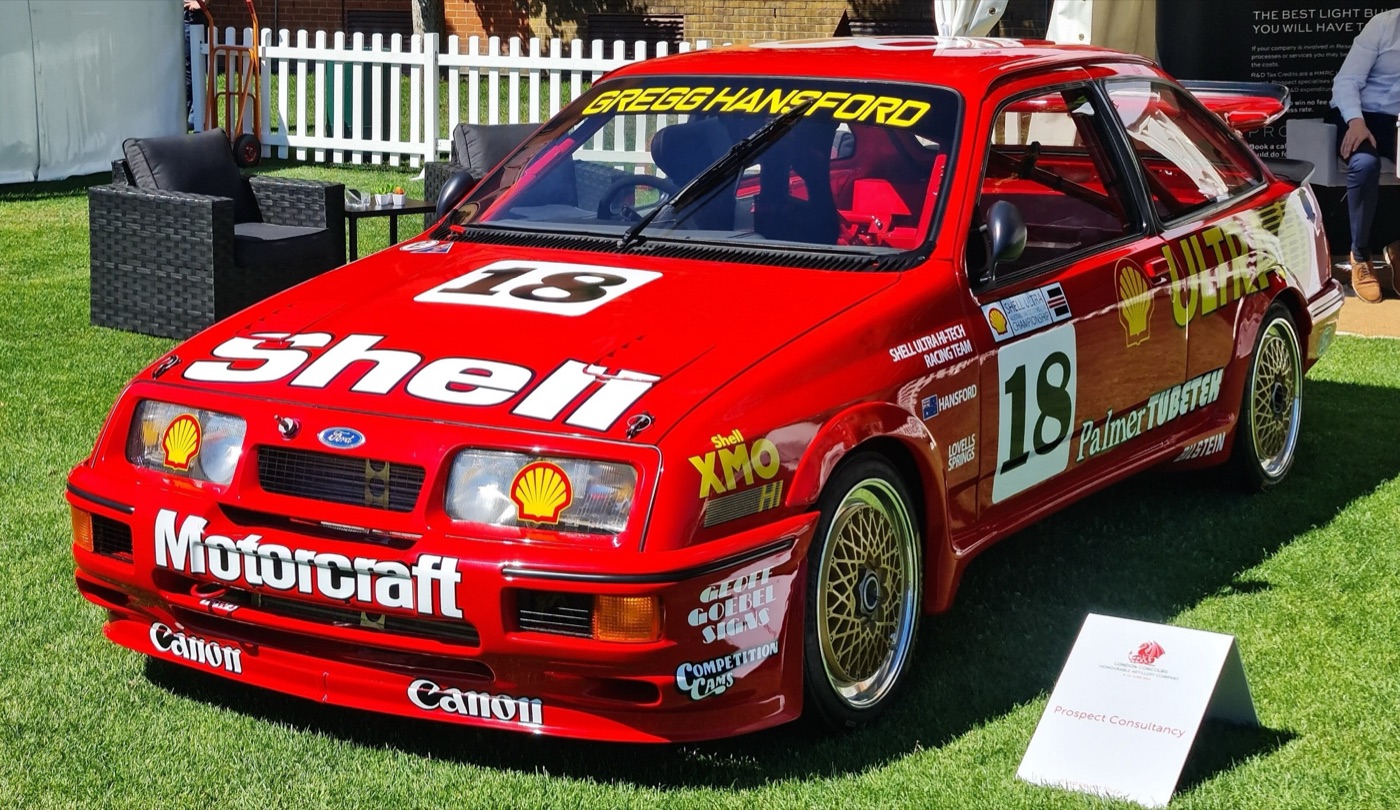
RS500s in historic racing
For the RS500’s 25th anniversary the 2012 Silverstone Classic, on 20 to 22 July, was to run two Fuji Film Touring Car Trophy races; by June five RS500s were entered, including Dave Brodie’s “Run Baby Run” car, and the RS Owners Club planned a display of more than 40 road and racing RS500s, SkiddMark reported on 14 June 2012.
The Sierra Cosworth in rallying
Sierra RS Cosworths won one World Rally Championship round between 1987 and 1992: Didier Auriol’s 1988 Tour de Corse, ahead of Yves Loubet’s Lancia Delta Integrale (Juwra, 1988 World Rally Championship results, and its compilations for 1987 and 1989 to 1992). Jimmy McRae won the 1987 Circuit of Ireland in one, and his son Colin, later world champion, ran a RED Motorsport Sierra in 1989 until he crashed it on the Welsh Rally (Heseltine).
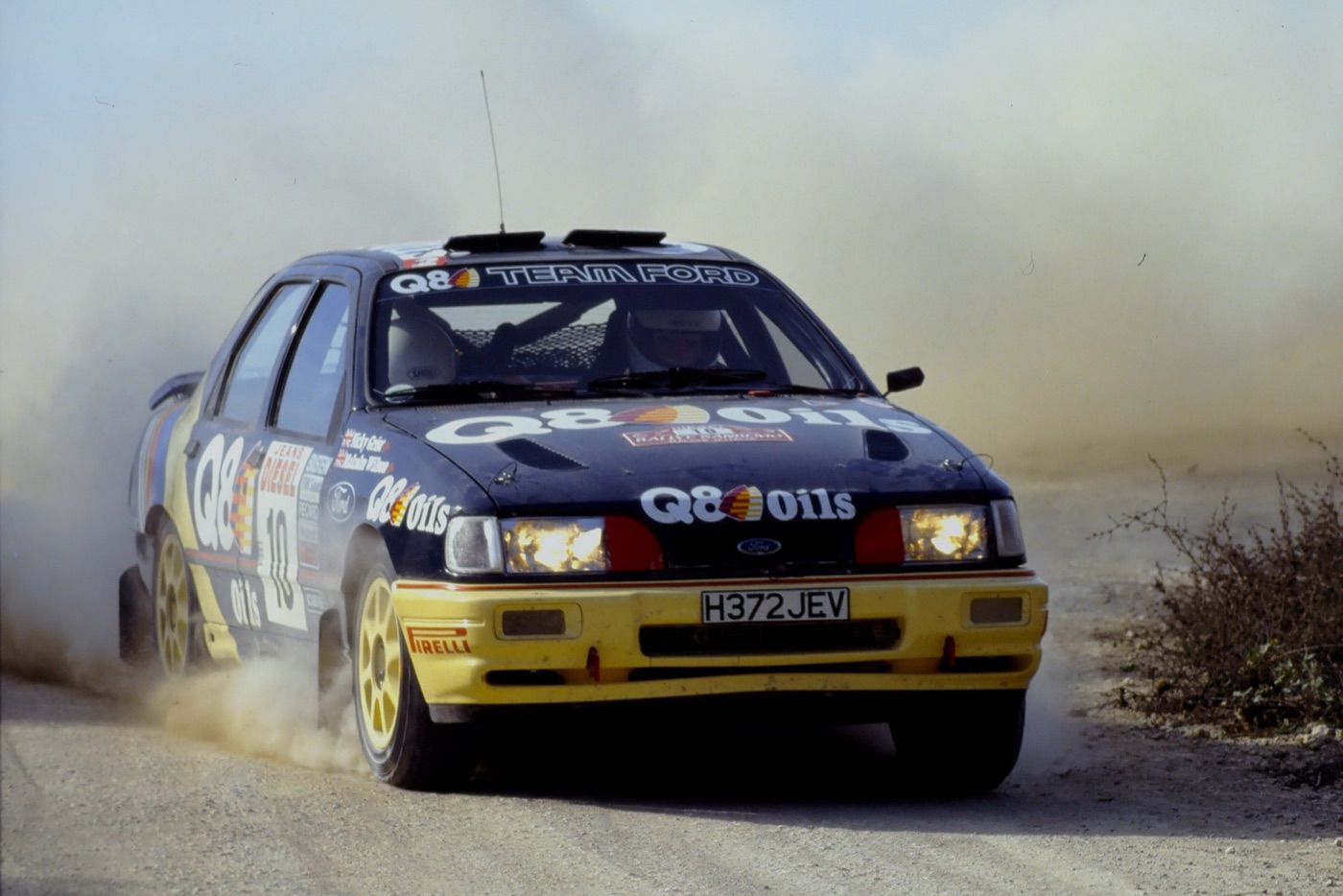
The 4x4 took over as Ford’s works rally car from 1990. The factory rally car of 1991 had a seven-speed gearbox and about 300 bhp; François Delecour led that year’s Monte Carlo Rally in one (Walton, 1991).
How many Sierra RS Cosworths were made?
About 30,900 Sierra RS Cosworths were built from 1986 to 1992, McKay says, and four in five were four-doors: 13,140 rear-wheel-drive Sapphires and about 12,250 4x4s. Sources give four totals for the three-door, from 5,052 to 6,021.
| Source | Three-doors built | Note |
|---|---|---|
| Classic & Sports Car, 2019 | 5,542 | 2,616 for the UK, built by January 1987 |
| Hagerty UK, 2023 | 5,545 | including the 500 RS500s |
| Motor Sport, 2010 | 5,052 | including the 500 RS500s, by the end of 1986 |
| National Motor Museum, Beaulieu | 6,021 | 1,600 sold in the UK |
How many Sierra Cosworths are left in the UK?
At the end of June 2026, 2,872 cars were on UK records as “Sierra RS Cosworth” (704 licensed, 2,168 declared off the road) and 1,481 as “Sierra Sapphire Cosworth” (369 licensed), according to the Department for Transport’s licensing table VEH0120. The DVLA’s model names do not split the three-door, the RS500 and the four-doors cleanly, so the two lines together, 4,353 cars, are the best count of surviving Sierra Cosworths of all kinds. The same two lines held 3,942 cars at the end of 2014.
Ford Sierra RS Cosworth prices and values today
In OUTLAW 8’s auction records, four three-door RS Cosworths sold at British auctions between 28 October 2024 and 28 October 2026 for £36,250 to £50,500, two RS500s made £85,500 and £87,188, and nine running four-doors sold for £18,750 to £32,063, at a median of £25,500. The cheapest four-door, at £9,600, was a restoration project.
How much is a Sierra Cosworth worth?
| Car | Sold | Price | Where |
|---|---|---|---|
| 1986 RS Cosworth three-door | October 2026 | £36,250 | Car & Classic |
| 1986 RS Cosworth three-door | June 2025 | £42,000 | Car & Classic |
| 1986 RS Cosworth three-door, left-hand drive | February 2026 | £49,417 | Iconic Auctioneers |
| 1987 RS Cosworth three-door | December 2025 | £50,500 | Car & Classic |
| 1987 RS500 Cosworth, number 470 | July 2026 | £85,500 | Iconic Auctioneers |
| 1987 RS500 Cosworth, number 195 | July 2026 | £87,188 | Iconic Auctioneers |
| 1990 Sapphire Cosworth, restoration project | December 2024 | £9,600 | Car & Classic |
| 1992 Sapphire Cosworth | September 2026 | £18,750 | Mathewsons |
| 1991 Sapphire RS Cosworth | August 2026 | £20,700 | Manor Park Classics |
| 1989 Sapphire RS Cosworth | March 2025 | £20,750 | Car & Classic |
| 1991 Sapphire Cosworth 4x4 | May 2026 | £24,750 | Iconic Auctioneers |
| 1989 Sapphire RS Cosworth | October 2026 | £25,500 | Car & Classic |
| 1993 Sapphire Cosworth 4x4 | November 2024 | £25,500 | Car & Classic |
| 1990 Sapphire RS Cosworth 4x4 | May 2026 | £26,750 | Car & Classic |
| 1991 RS Cosworth 4x4 Rouse Sport 304R | September 2026 | £31,000 | Car & Classic |
| 1991 Sapphire Cosworth Rouse Sport 304-R, number 47 of 100 | February 2026 | £32,063 | Iconic Auctioneers |
What is the most expensive Sierra RS500?
A black 1987 RS500 with 5,192 miles sold at the Race Retro sale at Stoneleigh Park on 25 February 2023 for a hammer price of £530,000, or £596,250 with fees (Goodwood Road & Racing, March 2023). Hagerty UK names the car as E378 TKN and the auctioneer as Silverstone Auctions, gives the estimate as £150,000 to £180,000, printed the total as £592,250 and put it at more than five times its concours value of £115,000 for the model. Goodwood gives the previous RS500 record as £135,700, in 2022; Hagerty gives the previous record for any Sierra Cosworth as £132,750, paid that year for an 8,795-mile standard car. The two RS500s sold in July 2026 made less than a sixth of the record.
Ex-works racing cars have proved harder to sell. Silverstone Auctions offered an ex-Tim Harvey car in 2017 and an Andy Rouse car in 2018, both with top estimates of £220,000, and neither sold; another Group A BTCC car made £182,250 in February 2018 (Hagerty).
Buying and owning a Sierra Cosworth
The main risks are rust, abused or modified engines and cars that are not what they claim to be. McKay’s advice is that “originality, meticulous servicing and lack of rot” matter most, that “most original Cosworths have been modified”, and that copies of the RS500 “are common”, since Ford sold a large range of development parts (part numbers beginning 909) with which a standard car could be uprated to RS500 specification.
Common faults and checks
McKay lists these checks. The cam belt should be changed every 30,000 miles or five years. Listen for piston slap from cold and have a compression test done; misfires can mean a holed piston, and an engine rebuild costs £3,000 to £5,000. Internal corrosion leads to head gasket failure, so look for coolant leaks on the exhaust side and make sure the fans run at full speed. Turbo impellers should have no fore-and-aft play; blue smoke points to valve seals, white to turbo wear. Cheap “uprating” chips over-fuel the engine and dilute the oil. The Borg-Warner gearbox is strong but notchy when cold, with second and third synchromesh the ones to check, and the suspension bushes, dampers and the plastic dashboard top all wear; discs warp with heavy use. Standard engines should stay under 330 bhp.
Theft and insurance
Cosworths were crashed often, demand for parts grew, and cars were stolen to order, Nick Trott wrote in “Long live the king”, Motor Sport, May 2017, quoting Simon Arron: “It became such valuable currency for low-lifes.” The 4x4’s traction appealed to ram-raiders. By July 1992 Walton reported that insurers had decided Cosworths were “economically uninsurable”, with quotes of £1,200 to £3,000 common. McKay (2019) advises a full history check because many cars have been stolen or crashed.
Sierra RS Cosworth rivals
In period the Sierra’s rivals were the BMW M3 and the Mercedes-Benz 190E 2.3-16; by 1991 Motor Sport set the 4x4 against the Lancia Delta Integrale and the Audi S2, which cost just under £30,000. Lawrence found the Mercedes “more competent in the handling department” but beaten by the Ford on flexibility, gearchange, steering, practicality and price, and the Lancia was sold only in left-hand drive (Walton, 1991). On the track the M3 ran in BTCC class B, below the Sierras’ class A.
| Car | Years sold | Built | UK price new |
|---|---|---|---|
| Ford Sierra RS Cosworth (three-door) | 1986–87 | 5,542 | £15,950 (1986) |
| BMW M3 (E30) | 1986–91 | 17,970 | £22,750 (1987) |
| Mercedes-Benz 190E 2.3-16 and 2.5-16 | 1983–92 | 26,128 | £24,670 (1987) |
| Ford Sierra RS Cosworth 4x4 | 1990–92 | about 12,250 | £27,060 (1991) |
Reception
Motor Sport’s road test of October 1986 called the RS Cosworth “sensational” as a road car and said that “for the price there is nothing else available which combines so much performance and driving appeal while being sufficiently practical to use as a family’s main vehicle”. The National Motor Museum at Beaulieu calls it “one of the most sought after Ford road cars”.
Trott, in 2017, put the three-door alongside the Porsche 911 Turbo: it “matched the 911’s performance”, dominated on the track as Porsche did, and cost half as much. In the 1990s the car became a symbol of joyriding and ram-raiding; Max Power magazine put it on a cover as “King”, and a Sapphire had a starring role in the detective series Spender (Trott). Owners drifted to the Subaru Impreza and Mitsubishi Lancer Evolution as insurance renewals “began to match the value of the car”.
Questions
What does RS stand for on the Sierra Cosworth?
Rallye Sport, the badge Ford used for its fast, competition-linked models such as the RS Escorts. The Cosworth name comes from Cosworth Engineering of Northampton, which developed the engine.
Is the Sierra Cosworth rear-wheel drive?
The three-door RS Cosworth, the RS500 and the 1988–89 Sapphire RS Cosworth are rear-wheel drive, with a viscous limited-slip differential. The Sierra RS Cosworth 4x4 of 1990–92 has permanent four-wheel drive, split 34:66 front to rear.
How can you tell an RS500 from a standard Sierra Cosworth?
An RS500 has a second, lower rear spoiler under the main wing, a front bumper with larger openings and mesh grilles where the fog lamps were, RS500 badges, a chassis number between WFOEXXGBBEGG 38600 and 39099 and a YBD engine. Classic & Sports Car warns that copies are common, so check the numbers and the history.
Was the RS500 sold outside the UK?
No. All 500 road cars were right-hand drive and built for the British market. The left-hand-drive “RS500s” that raced in Germany and Europe were standard Sierra Cosworths built up to RS500 specification.
How much did a Sierra Cosworth cost new?
£15,950 for the three-door in 1986, £19,950 for the RS500 in 1987, £19,000 for the four-door Sapphire in 1988 and £27,060 for the 4x4 in 1991, according to Motor Sport.
What replaced the Sierra RS Cosworth?
The Escort RS Cosworth of 1992, which used the Sierra 4x4’s Cosworth engine and four-wheel-drive layout under a shorter body built by Karmann.
Why are Sierra Cosworths expensive to insure?
In period they were stolen to order for their parts and often crashed, and by July 1992 Motor Sport reported that insurers considered Cosworths “economically uninsurable”, with quotes of £1,200 to £3,000.
Sources
- Mike Lawrence, “Road test: Ford Sierra RS Cosworth”, Motor Sport, October 1986, p. 46: engine, gearbox, brakes, body changes, price, performance, the Spanish launch and the verdict.
- Jeremy Walton, “Tickford’s time trial”, Motor Sport, September 1987, p. 20: the RS500’s conversion at Bedworth, its price, power, colours, prototypes and the FISA inspection.
- “New cars: Ford Sierra RS Cosworth”, Motor Sport, March 1988, p. 38: the four-door Sapphire, its price, engine and suspension.
- Jeremy Walton, “On test: Ford Sierra 4x4 RS 4-door”, Motor Sport, May 1991, p. 25: the 4x4’s specification, price and measured performance, and the works rally car.
- Jeremy Walton, “Let’s twist again”, Motor Sport, July 1992, p. 53: the 4x4’s 1992 price, insurance and the Escort RS Cosworth.
- Richard Heseltine, “Ford Sierra Cosworth”, Motor Sport, May 2010, p. 122: the project’s origins, production and homologation, the WTCC and BTCC, Goode, Gravett and McRae.
- Andrew Frankel, “A Klaus encounter”, Motor Sport, May 2012, p. 86: Ludwig’s 1987 Nürburgring 24 Hours win and 1988 DTM title.
- Andrew Frankel, “How the RS500s were created”, Motor Sport, May 2017, p. 74: build dates, engine numbers, colours and race power.
- Andrew Frankel, “Spooling for a fight”, Motor Sport, May 2017, p. 76: the RS500’s engine changes, the racing cars, the 40-race run and Bathurst.
- Nick Trott, “Long live the king”, Motor Sport, May 2017, p. 79: theft, insurance and the car’s reputation.
- “‘The RS500 era was best’: why drivers loved Ford’s 200mph touring car”, Motor Sport, November 2024: the 1987 WTCC record after homologation, Rouse’s cars and Gravett’s speeds.
- Malcolm McKay, “Buyer’s guide: Ford Sierra RS Cosworth”, Classic & Sports Car, 2019: production numbers, the timeline, RS500 chassis and engine numbers, buying checks and rival figures.
- Autocar, “Picture special: 25 years of the Sierra RS500”, 2012: the RS500’s 0–62 mph time and top speed.
- RS Owners Club, “Sierra RS500”: the RS500’s 0–60 mph time and top speed.
- National Motor Museum, Beaulieu, “Ford Sierra RS Cosworth”: its production figure and its car.
- Touring Car Racing.net, “World Touring Car Championship 1987” and “European Touring Car Championship 1988”: disqualifications and titles; also its pages on the 1985 British Saloon Car Championship, the 1988 BTCC, the 1988 DTM and the 1988 All-Japan Touring Car Championship, and its BTCC race pages for 1987 to 1990, including Donington, 16 August 1987, Donington, 20 September 1987 and Silverstone, 7 October 1990: the 40-race run.
- Juwra, “1988 World Rally Championship result compilation”, with the compilations for 1987 and 1989 to 1992: Auriol’s Tour de Corse win, the only world championship win for a Sierra RS Cosworth.
- Goodwood Road & Racing, “This Ford Sierra Cosworth RS500 just sold for nearly £600,000”, March 2023: the record sale.
- Hagerty UK, “Ford Sierra Cosworth RS500 record-breaking £600k”, February 2023: the record sale, earlier records, racing cars at auction and the 5,545 figure.
- Department for Transport, vehicle licensing statistics, table VEH0120, to June 2026: Sierra Cosworths licensed and declared off the road in the UK.
- OUTLAW 8’s auction records, read 28 October 2026: British auction sales of Sierra RS Cosworths priced in pounds, 28 October 2024 to 28 October 2026.
- SkiddMark, “Do you remember the good old days, when men were men and touring cars were Ford RS500s?”, 14 June 2012: the plans for the 2012 Silverstone Classic anniversary races and display, and the run of BTCC wins.
- SkiddMark, “Nissan Skyline GTR vs Ford Sierra RS500”, 2009: the last Group A race between the two in Australia, Adelaide, 1992.