Jaguar C-X75: the concept car, the hybrid prototypes and the Bond car
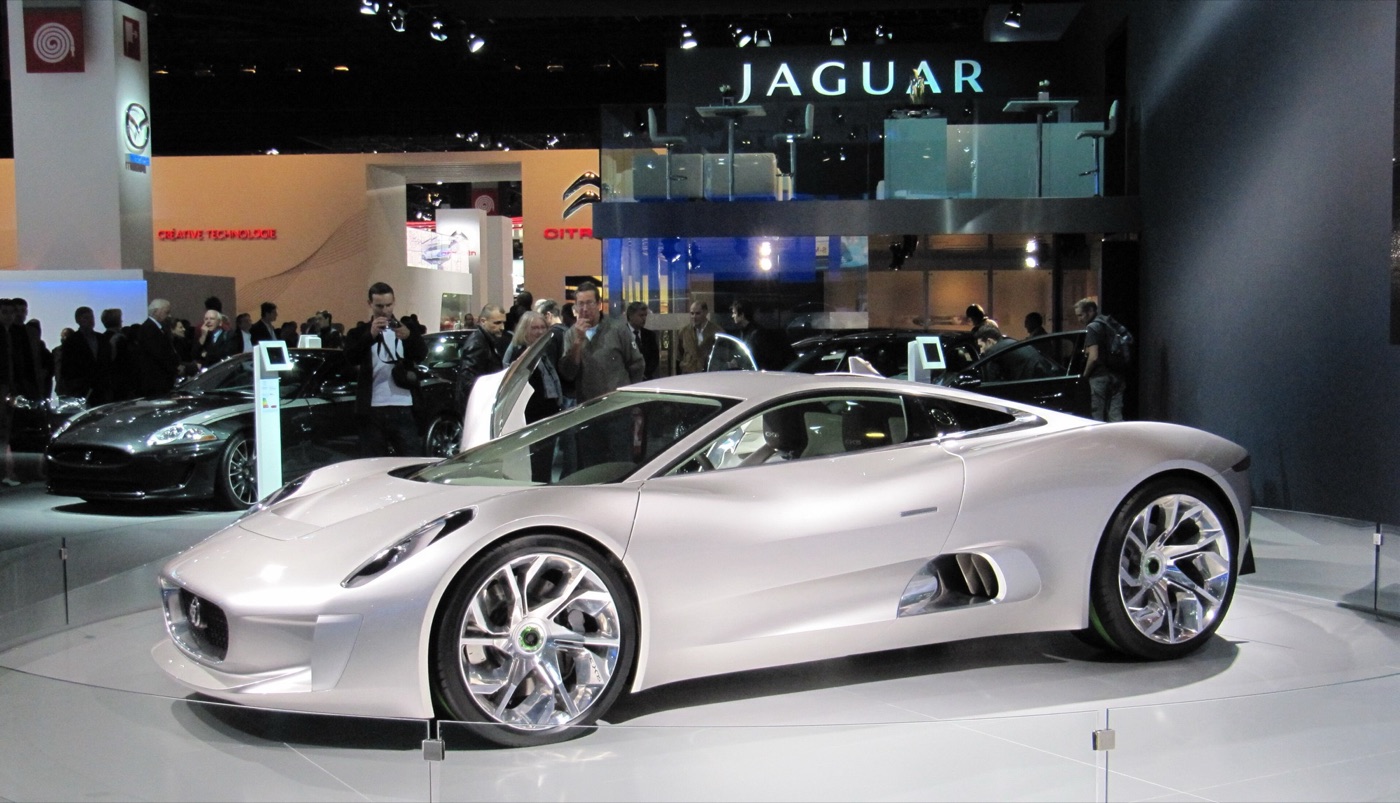
The Jaguar C-X75 is the mid-engined concept car shown at the Paris Motor Show in September 2010 for the marque’s 75th anniversary: four electric motors, one at each wheel, with two diesel-fed micro gas turbines to recharge the battery. In May 2011 Jaguar signed the C-X75 off as a run of up to 250 road cars built with Williams, with a 1.6-litre petrol engine in place of the turbines, and in December 2012 it cancelled the project after five prototypes. People still look it up because of what came after: the orange C-X75 that chases James Bond through Rome in Spectre (2015), the V8 stunt cars Williams built for the film, and the two that Ian Callum’s firm has since made road legal.
The Jaguar C-X75 concept car at the 2010 Paris Motor Show
The Jaguar C-X75 concept car was unveiled on 29 September 2010, the eve of the Paris show, as a design study and not a car for sale. The name, CAR magazine explained in its first report, stood for concept, experimental and 75 years of the marque. The press release said the C-X75 “explores the outer limits of both performance and sustainability”, and managing director Mike O’Driscoll called it “an innovative test-bed for the technologies of tomorrow”, as the New York Times reported on the day.
The New York Times writer judged that the “test-bed” label made production unlikely. CAR said the same in October 2010: “you won’t see it nestling in the corner of your nearest Jaguar dealer any time soon”.
Awards
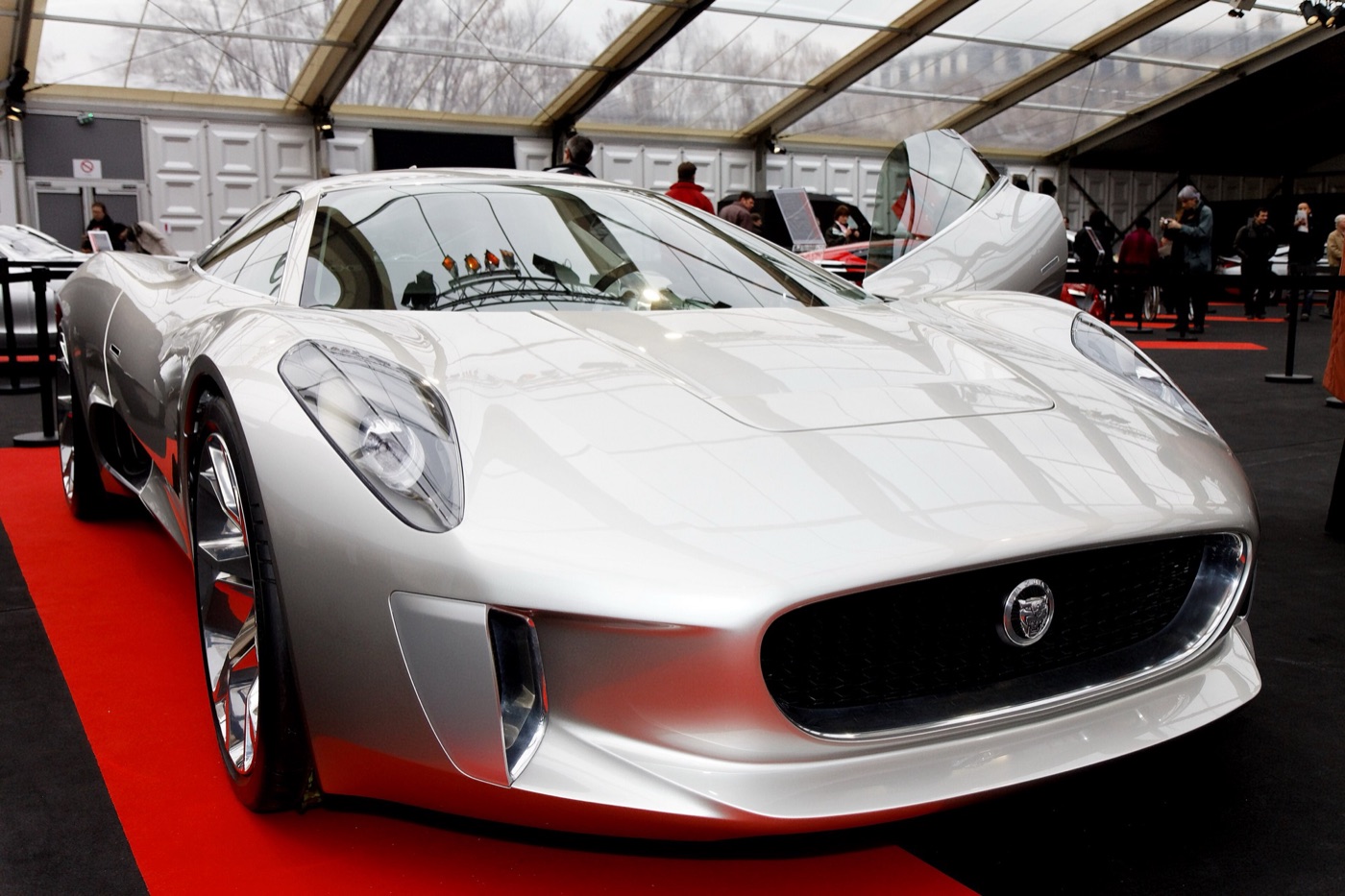
The concept won AutoWeek’s Best in Show at Paris, according to the Jaguar Daimler Heritage Trust’s record of the car. On 1 February 2011 a panel chaired by Christian Philippsen, with Gordon Murray and former Porsche design chief Harm Lagaaij among the judges, gave it the Louis Vuitton Classic Concept Award 2010, Jaguar announced the next day. In June 2011 the North American Concept Vehicle of the Year awards in Detroit named it Concept Car of the Year and Most Significant Concept Vehicle of 2011 (Jaguar release, June 2011).
Jay Leno’s drive in Los Angeles
The car’s next stop was the Los Angeles Auto Show in November 2010. Jaguar’s account of the trip, which SkiddMark published that month, records that Jay Leno drove it on a public street in North Hollywood near his garage, with a man stationed at each end of the street, and became the first person outside Jaguar to drive it on a public highway. The show car moved on battery power alone. “There is no point talking handling and performance. It is just a thrill to even feel it move,” Leno said, after a run up the street and back at urban speeds.
Leno had driven the one-off XJ13 racer at Gaydon in 2009, and told Ian Callum he could see that car in the C-X75 once Callum named it as an inspiration. He also picked out “the detail on the buttress behind the driver’s head that is reminiscent of the new XJ”.
London premiere
The British public first saw the car in December 2010, in the window of the Jaguar Boutique at the Berkeley Hotel in Knightsbridge, where Jaguar’s release of 16 December 2010 said it would stay until New Year’s Eve.
Jaguar C-X75 design: Ian Callum’s mid-engined concept
The C-X75 was the first supercar drawn by Ian Callum, Jaguar’s director of design, and CAR saw it as a new direction after his XF, XJ and XK. Callum’s team took its ideas for the functional parts of the shape from the 1950s C-type and D-type racers and the 1966 XJ13, the heritage trust says. CAR found hints of the E-type at the rear, “in the relationship between the back window and swollen hips”, but called the car “a thoroughly modern aesthetic”.
The body was carbon fibre over an extruded and bonded aluminium chassis, 4,647mm long and about 1,350kg, on 21-inch wheels, with doors that rose like swan wings (CAR, October 2010). The interior had no wood or chrome, only polished and shot-blasted aluminium. The seats were fixed to the bulkhead as in a single-seater racing car, and the steering wheel, controls, binnacle and pedal box moved towards the driver instead. The air for the turbines ran round the seats through channels in the body, and the gauges sat on virtual 3D “gimbals” drawn partly from fighter aircraft instruments (heritage trust).
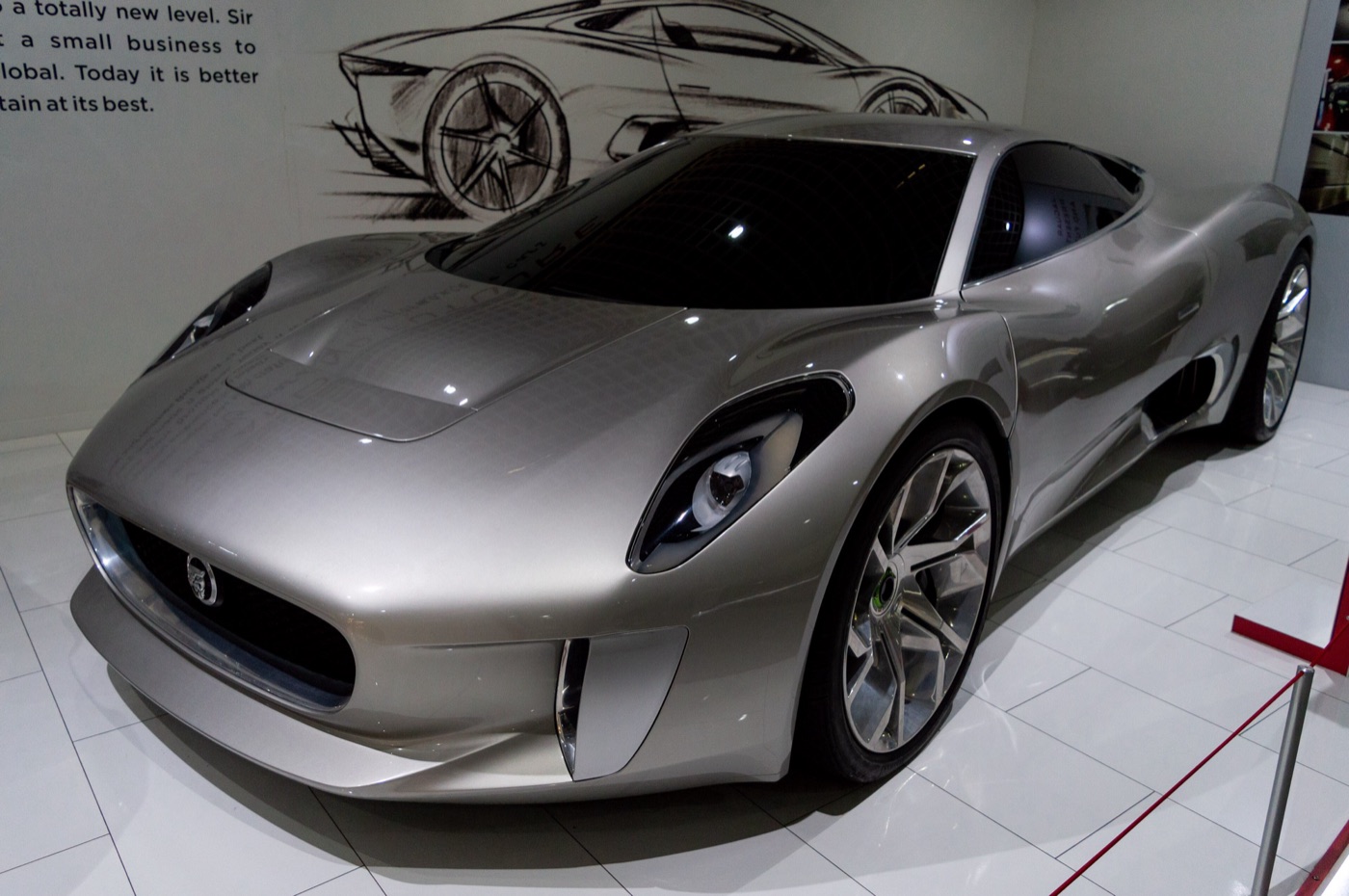
Writing in The Intercooler in 2023, Callum called the C-X75 “one of the most significant cars we created during my time at Jaguar”, and said that had it been built it would have “once more established Jaguar as a true performance car company that builds luxury cars”.
How the Jaguar C-X75’s micro gas turbines worked
The concept was a range-extended electric car: the wheels were driven only by electric motors, and the turbines made electricity. Each of the four motors sat in a wheel hub, weighed 50kg and gave 145kW, for 780bhp in all (CAR, October 2010). Torque figures differ: CAR quoted 1,578lb ft, while SkiddMark’s report from Paris, taken from Jaguar’s release, gave 1,180lb ft. With a motor at each wheel, software could send torque to any one of them, known as torque vectoring.
Behind the cabin sat two micro gas turbines made by Bladon Jets, each giving 70kW (heritage trust). CAR put them at 95bhp each, running alone or together at up to 80,000rpm and drawing up to 40,000 litres of air a minute from the sills; the show car carried a “Beware of Blast” sticker on its rear apron. They ran on diesel, and charged the batteries: a lithium-ion pack that CAR gave as 15kWh and 185kg and the heritage trust as 19kWh.
The claims were 68 miles (110km) on battery power, about 560 miles with the turbines running, and CO2 emissions of 28g/km on the EU test cycle. The engineers told CAR the turbines needed years of development, perhaps a decade, before they could go into a car.
The Jaguar C-X75 production plan with Williams
On 6 May 2011 the Jaguar C-X75 was confirmed for production as a limited-run hybrid supercar, developed with Williams F1, the BBC reported. Each car would cost £700,000 to £900,000 depending on market and local taxes, Jaguar’s release said (the BBC gave £700,000). Production was to run from 2013 to 2015, at a site not yet chosen, and to create more than 100 skilled jobs split between Jaguar and Williams, which is based at Grove in Oxfordshire. The car was part of a £5bn plan Jaguar Land Rover had set out at Geneva that March to launch 40 new products in five years.
The turbines were dropped. PistonHeads, reporting the announcement, said road vibration and airborne debris were still too much for the micro-turbines, and that the car would get a small, highly boosted 1.6-litre four-cylinder engine close to the units then planned for Formula One from 2013, working with electric motors. The targets for the Jaguar C-X75 were 0–60mph in under three seconds, 0–100mph in under six, more than 200mph and less than 99g/km of CO2. Williams would supply its knowledge of aerodynamics, carbon composites and hybrid systems.
“There is a clear business case for this exclusive halo model,” said Jaguar brand director Adrian Hallmark. Ian Callum promised “the finest looking and most innovative Jaguar ever produced”. The build would be capped at 250 cars, and by December 2012 the C-X75 had drawn about 100 expressions of interest, Hallmark later told Autocar.
The five Jaguar C-X75 prototypes
Five working prototypes of the Jaguar C-X75 production car were built with Williams in 2012, with the marque’s first carbon composite monocoque chassis and a plug-in parallel hybrid drive with all-wheel drive (Jaguar release, 27 June 2013). The 1.6-litre four-cylinder had a supercharger for low-rev response and a turbocharger for top-end power, and made 502bhp at 10,000rpm: 313bhp a litre, which the maker called one of the highest specific outputs in the world. An electric motor of 150kW on each axle added 390bhp, for more than 850bhp and 1,000Nm combined.
The internal combustion engine drove the rear wheels through a seven-speed automated manual gearbox that changed gear in under 200 milliseconds; the front motor filled in torque during each shift. A deployable aerofoil and the underfloor made more than 200kg of downforce at 200mph. The first prototype passed 200mph in testing, and the theoretical maximum was 220mph.
The targets: Veyron, Prius and Volt
Programme director Rob Atkin gave his team four targets, he told CAR’s Ben Pulman in June 2013: the look of the concept, the 0–100mph time of a Bugatti Veyron, the CO2 of a Toyota Prius and at least the electric range of a Chevrolet Volt. A V8 would not fit inside the shape, so the engine is a dry-sumped, all-aluminium four that revs to 10,200rpm, flanked by battery packs, with direct and port injection. The June 2013 figures were 60km on electric power and under 89g/km.
The prototypes looked much like the concept, with an F-type-style grille, fuller flanks, door mirrors, a pop-up rear spoiler that worked as an airbrake, and dihedral doors. The predicted kerb weight was just under 1,700kg. Atkin said the project was 50 per cent complete when it was cancelled, and little of that work was on ride and handling. Pulman, allowed a few laps of the Gaydon test track, saw more than 180mph.
Where the prototypes went
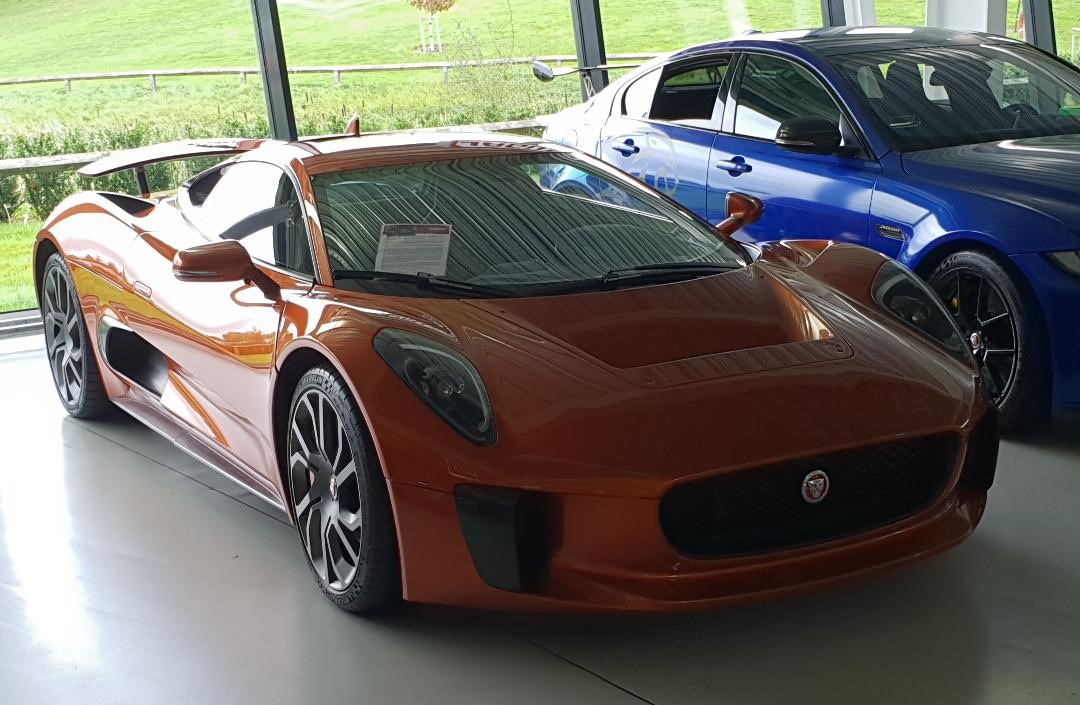
Prototype CX03, built in September 2012, was testing at high speed at Rockingham within a week of its shakedown and spent most of its life at the Gaydon proving ground developing the chassis, the heritage trust’s record of CX03 says. It has worn four colours and is now in the orange the film made famous. A prototype made its public debut on the move in the Michelin Supercar Run at the Goodwood Festival of Speed on 12 July 2013 (Jaguar release), and one was the centrepiece of the Jaguar Classic Parts stand at the Classic Motor Show at the NEC that November.
Why was the Jaguar C-X75 cancelled?
The Jaguar C-X75 was cancelled because the company judged that the economic crisis left no market for a car of its price. Hallmark told journalists on the evening of 10 December 2012, evo’s Harry Metcalfe reported, and said the decision “broke his heart”. To Autocar he said: “We feel we could make the car work, but looking at the global austerity measures in place now, it seems the wrong time to launch an £800,000 to £1 million supercar.” He added that 60 per cent of the car’s technology would reach future Jaguars.
In Motor Sport the next day, Andrew Frankel called it the right decision: Jaguar was selling fewer than 50,000 cars a year against the 1.25 million that each of Audi, BMW and Mercedes managed, and Porsche, Ferrari and McLaren had all announced hybrid hypercars of their own. He compared it with the XJ220, another Jaguar supercar launched in a different form from its concept into a weak economy, which “tanked”.
Reports differ on what was to happen to the five prototypes. Autocar said up to three would be sold at auction, one would go to a future Jaguar museum and one would be kept for demonstrations; evo said Jaguar would keep three in its historic fleet and sell two. Hallmark said the five prototypes would be developed until May 2013, when the work with Williams would end; in June 2013 CAR reported that development would continue for the rest of the year.
Jaguar C-X75 specifications: how fast is it?
The fastest C-X75 is the 2013 hybrid prototype, which passed 200mph in testing and was rated at a theoretical 220mph; the concept claimed 205mph, and the Spectre stunt cars were geared for 20 to 70mph.
| Specification | Concept (2010) | Hybrid prototype (2012–13) | Spectre stunt car (2015) |
|---|---|---|---|
| Power unit | Four in-wheel electric motors; two Bladon Jets micro gas turbines as generators | 1.6-litre turbocharged and supercharged four-cylinder; two electric motors, one per axle | Supercharged 5.0-litre Jaguar V8, dry sump |
| Output | 780bhp (4 × 145kW motors) | 502bhp engine at 10,000rpm plus 390bhp electric; over 850bhp combined | 492hp (RM Sotheby’s) |
| Torque | 1,578lb ft (CAR) or 1,180lb ft (Jaguar release as reported in 2010) | Over 1,000Nm combined | Not published |
| Gearbox | Direct drive from the wheel motors | Seven-speed automated manual, shifts under 200ms | Six-speed sequential racing gearbox from Ricardo |
| Drive | Four-wheel | Four-wheel | Rear-wheel |
| Structure | Extruded and bonded aluminium chassis, carbon-fibre body | Carbon composite monocoque | Steel space frame of 60mm tube, glass-fibre panels |
| Weight | About 1,350kg | Just under 1,700kg (predicted for production) | A little under 1,500kg |
| Battery | 15kWh, 185kg (CAR); 19kWh (heritage trust) | Lithium-ion, over 300kW continuous | None |
| Electric range | 68 miles (110km) | 60km | None |
| 0–62mph / 0–100mph | 3.4sec to 62mph | Under 6.0sec to 100mph | Not published |
| Top speed | 205mph (claimed) | Over 200mph tested; 220mph theoretical | Geared for about 20 to 70mph |
| CO2 | 28g/km | Under 89g/km | Not published |
Other figures for the prototype exist. Autocar gave 888bhp and 590lb ft and 0–60mph in 2.8sec in December 2012, and evo the same 2.8sec.
The Jaguar C-X75 in Spectre
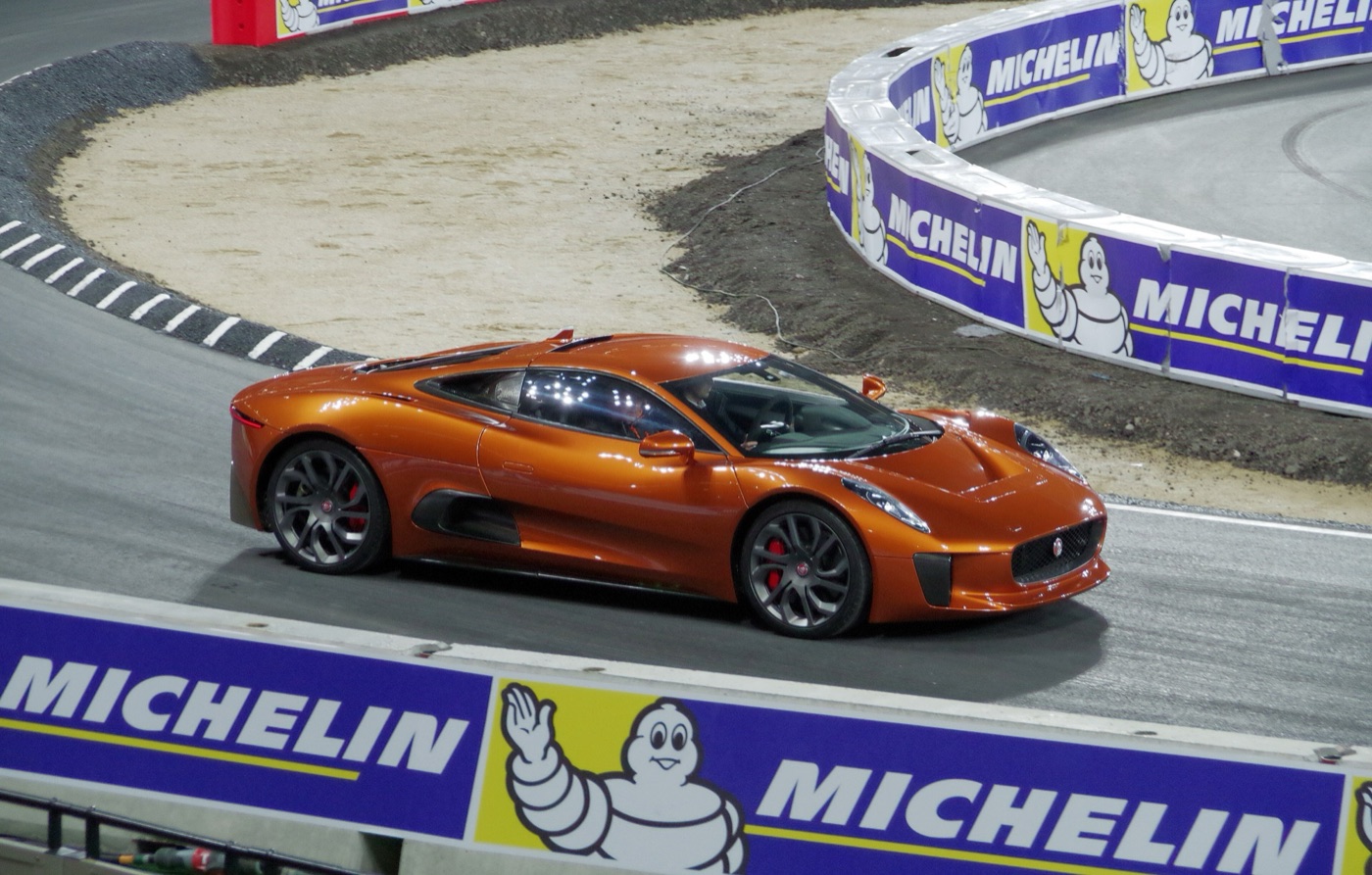
The C-X75 is the car of Mr Hinx, the Spectre organisation’s assassin played by Dave Bautista, who chases Daniel Craig’s Bond and his Aston Martin DB10 through Rome at night in Spectre (2015). Autocar reported the casting on 9 February 2015: the cars came through Jaguar Land Rover’s Special Operations division, alongside a Range Rover Sport SVR and modified Land Rover Defenders, and would use Jaguar’s supercharged 5.0-litre V8 instead of the hybrid drive. Special Operations managing director John Edwards called it “an opportunity to demonstrate the fantastic capabilities of the Special Operations team”.
How Williams built the stunt cars
The company would not risk a real Jaguar C-X75 in the chase, so Williams Advanced Engineering built look-alikes. A team of 12 began in November 2014, Williams’s Wes Partridge told Top Gear’s Ollie Marriage in November 2015: “First thing is, it had to be tough, so we designed a steel frame made from 60mm diameter tubing.” Into it went the V8, a six-speed sequential GT3 gearbox from Ricardo, world rally suspension, carbon shell seats with five-point harnesses, a hydraulic handbrake and glass-fibre panels that could be swapped quickly.
Filming of the night chase ran from 6pm to 6am, leaving the team 8am to 2pm to repair the cars. A new clutch was close to a nightly job, done in under 90 minutes by the end; for the run down a flight of steps the suspension was raised 40mm. The cars went down steps, into the Tiber and over another car, and when they came back to Williams none of the frames had moved on the jig. The stunt driver was Martin Ivanov, who had driven in the Bourne films.
One car, chassis 001, was a “pod car”: a second driver sat in a pod on the roof so that the actor could act below him, which meant it was driven less hard than the others (Kaaimans International’s listing of chassis 001). RM Sotheby’s says Felipe Massa drove it in Mexico before the 2015 Mexican Grand Prix; Kaaimans’s listing says Jaguar sold it in May 2016 to a British collector who had worked as a consultant to the company.
How many Jaguar C-X75s were made?
One Jaguar C-X75 concept and five hybrid prototypes were made, and Williams Advanced Engineering, which built the film cars, says it was commissioned to make six stunt cars for Spectre and built seven from scratch in 16 weeks (Williams Advanced Engineering case study). Other counts differ. Top Gear wrote that Williams built seven, two of them “star cars” with finished interiors and five “grafters” for the action. James Bond Lifestyle, in January 2024, said seven C-X75s were used in filming, two of them genuine hybrid prototypes kept by Jaguar for slow and interior shots, which leaves five Williams cars. Bicester Motion said five cars were used to film the chase, and Kaaimans and RM Sotheby’s describe four stunt cars, and Kaaimans says all four survived the shoot.
The film cars are numbered up to seven: the first one Callum converted is “car number seven” in Autocar’s report and chassis 007 in the dealer’s.
Is the Jaguar C-X75 road legal? Callum’s conversions
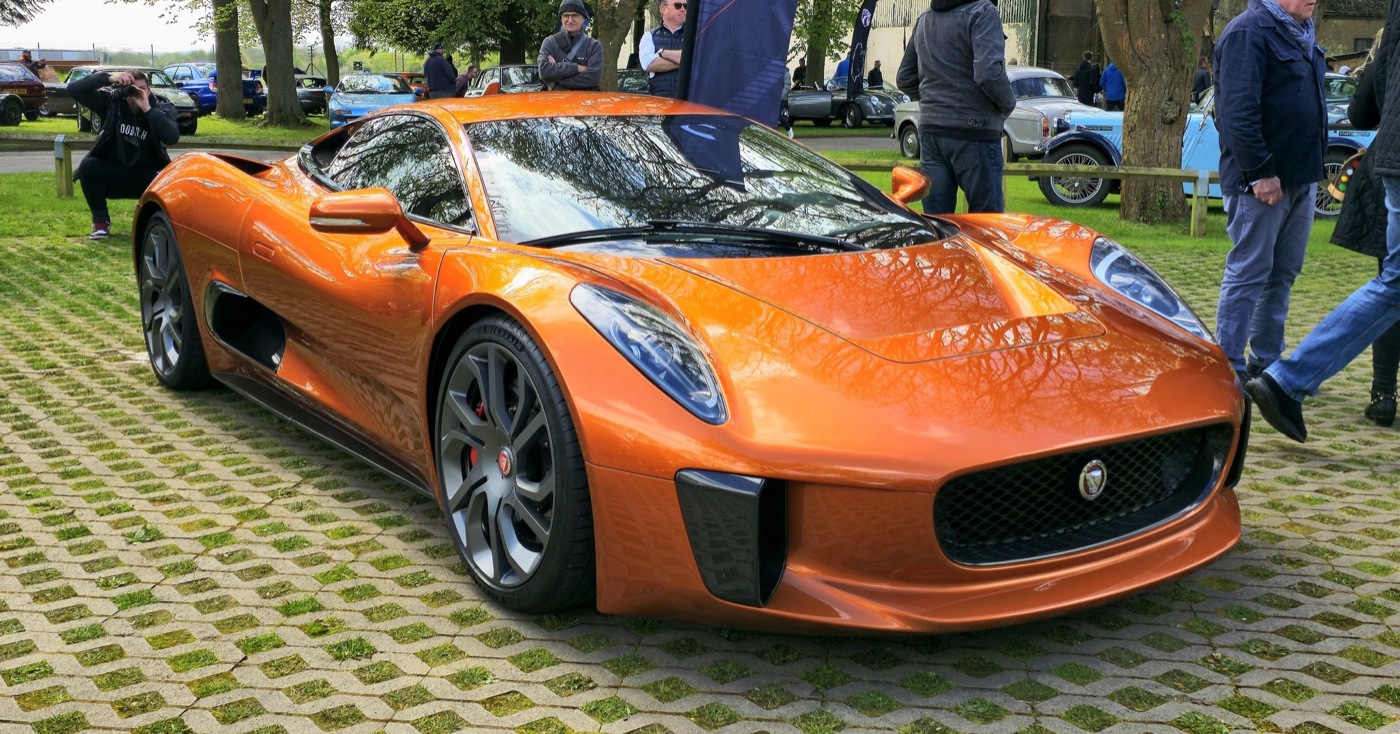
Two of the Spectre cars are road legal in the UK, both converted by Callum, the design firm Ian Callum co-founded in 2019. The first, car 007, gained Individual Vehicle Approval in early 2024, Autocar reported on 29 February 2024, with E-marked glass, a quieter exhaust with catalytic converters, real mirrors in place of the foam dummies used in filming, closer panel gaps, the quick-release latches removed and the carbon finish resurfaced. Its public debut was the Bicester Heritage Scramble on 21 April 2024.
“Stunt cars are arguably the true stars,” said Callum engineering director Adam Donfrancesco. “So few actually survive the rigours of filming, preservation was key whilst meeting the legislation.”
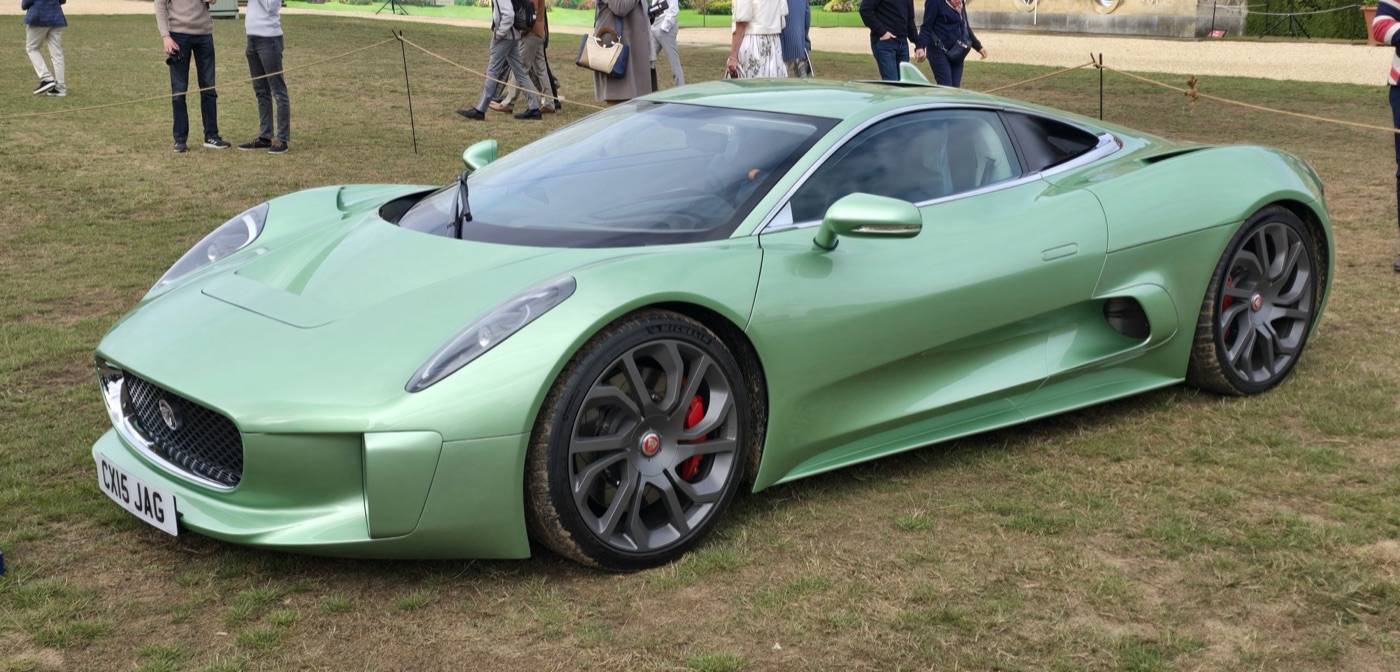
The second, car 001, followed in October 2024 and went further, Motoring Research reported. It kept the supercharged V8 but gained a seven-speed dual-clutch gearbox, active aerodynamics that add downforce above 37mph, a pop-up airbrake and more than 1,000 hours of bodywork, finished in Willow Green. Motor1 added a front-axle lift for speed bumps, a billet aluminium steering wheel, Apple CarPlay and a roof console carrying the start button. Ian Callum called the C-X75 “the one that got away”.
How much is a Jaguar C-X75 worth?
The prices on record are for the planned production car and for Spectre cars, which run from an unsold auction estimate of $800,000 to an asking price of about £2.5m for a road-legal car.
| Date | Car | Price | Source |
|---|---|---|---|
| May 2011 | Planned production car | £700,000 to £900,000 (BBC: £700,000) | Jaguar release via PistonHeads; BBC News, 6 May 2011 |
| December 2012 | Planned production car | £800,000 to £1 million | Adrian Hallmark to Autocar, 11 December 2012 |
| 30 November 2019 | Spectre stunt car, chassis 001, RM Sotheby’s Abu Dhabi | Estimate $800,000 to $1.2m; did not sell | RM Sotheby’s; James Bond Lifestyle; Auto Motor und Sport |
| December 2021 | Spectre car, chassis 007, Simon Drabble Cars | £720,000 plus VAT | Auto Motor und Sport |
| January 2024 | Chassis 007 after road conversion, Kaaimans International | About £2m to £2.5m expected | Gary Tolson of Kaaimans, via James Bond Lifestyle |
Chassis 007 was offered through Simon Drabble Cars and PistonHeads with a note that Jaguar Land Rover had sold it directly to its owner and its classic department had serviced it since, Auto Motor und Sport reported. Gary Tolson of Kaaimans put the cost of a road conversion at about £1m, for work that included new fuel tanks, an emissions-compliant exhaust, a new speedometer, a proper handbrake, new glass and new seats. Kaaimans was listing chassis 001 with its price on application in October 2026.
Jaguar C-X75 rivals: 918 Spyder, P1 and LaFerrari
Had it gone on sale in 2013, the C-X75 would have been the fourth of the hybrid supercars launched that year, with the Porsche 918 Spyder, the McLaren P1 and the LaFerrari. CAR called it an £800,000 rival to all three, and wrote that the C-X75 had “the potential to have the most technically advanced hybrid powertrain” of them; its predicted weight was better than the 918’s like for like but well above the P1’s and LaFerrari’s. Pulman expected the 918, with its rear-wheel steering, and the P1, with its hydraulic suspension, to feel more agile. The concept itself had followed Porsche’s 918 Spyder concept of Geneva 2010, a show CAR said Porsche had stolen.
What the Jaguar C-X75 gave later Jaguars
The June 2013 release said the Jaguar C-X75 prototypes’ hybrid systems, carbon composites and design work would be used in research and future products across Jaguar and Land Rover. The prototypes already shared parts the other way: CAR noted that they used the adaptive dampers of the Jaguar F-type, the sports car Motor Sport had called “forthcoming” in December 2012, and the electric power steering of the Range Rover range. Hallmark told Autocar in 2012 that the hybrid know-how could give a three-cylinder engine six-cylinder power, and that the high-pressure supercharging could serve future four-cylinder performance Jaguars.
Questions
What does C-X75 stand for?
C stands for concept, X for experimental and 75 for the 75 years of the Jaguar name, which the car marked in 2010, CAR magazine reported at the car’s launch.
Did the Jaguar C-X75 have a jet engine?
The 2010 concept had two micro gas turbines by Bladon Jets, which worked as generators to charge the battery; they never drove the wheels. The prototypes and film cars had piston engines instead.
Who designed the Jaguar C-X75?
Jaguar’s design director Ian Callum led the team that designed it. Williams Advanced Engineering worked with Jaguar on the hybrid prototypes and built the Spectre cars.
What car does Mr Hinx drive in Spectre?
Mr Hinx, played by Dave Bautista, drives an orange Jaguar C-X75 in the night chase through Rome against Bond’s Aston Martin DB10. The cars used were V8 stunt cars on a steel space frame, not hybrids.
Is the Jaguar C-X75 electric?
The concept was a range-extended electric car with four wheel motors and 68 miles of battery range. The 2013 prototypes were plug-in hybrids with 60km of electric range, and the Spectre cars have no electric drive at all.
Where can you see a Jaguar C-X75?
The silver concept has been shown at the Coventry Transport Museum, and a hybrid prototype from the Jaguar Daimler Heritage Trust at the British Motor Museum, Gaydon. The road-legal Spectre cars appear at UK events such as the Bicester Heritage Scramble and Salon Privé.
Sources
- The New York Times, Wheels blog, “Paris Auto Show: Jaguar C-X75 Concept Is a 205-M.P.H. Hybrid”, 29 September 2010: the reveal date, Jaguar’s release, O’Driscoll’s words, range figures.
- CAR magazine, Tim Pollard, “Jaguar C-X75 concept car (2010)”, 1 October 2010: the name, design, motors, turbines, battery, dimensions and weight of the concept.
- Jaguar Daimler Heritage Trust, “2010 C-X75 Micro Turbine Hybrid Hyper Car”: Bladon Jets turbines, battery, performance, interior, design inspiration, Best in Show award.
- Jaguar, “The Jaguar C-X75 comes home”, 16 December 2010: the London display at the Berkeley Hotel.
- Jaguar, “Jaguar C-X75 scoops Louis Vuitton award in Paris”, 2 February 2011: the award and its judges.
- Jaguar, “C-X75 hybrid supercar named Most Significant Concept Vehicle of 2011”, June 2011: the North American awards.
- BBC News, Jorn Madslien, “Jaguar to build £700,000 hybrid supercar with Williams”, 6 May 2011: price, jobs, timetable, investment plan.
- PistonHeads, “Jaguar to build the C-X75”, 6 May 2011: why the turbines went, Jaguar’s targets, Hallmark and Callum quotes.
- evo, Harry Metcalfe, “Production Jaguar C-X75 hypercar canned”, 11 December 2012: the announcement and the fate of the prototypes.
- Autocar, Mark Tisshaw, “Jaguar C-X75 axed”, 11 December 2012: Hallmark’s reasons and figures, the 250 cap, expressions of interest.
- Motor Sport, Andrew Frankel, “Jaguar cancels C-X75 programme”, 11 December 2012: sales figures and the XJ220 comparison.
- CAR magazine, Ben Pulman, “Jaguar C-X75 (2013) review”, June 2013: the prototype’s targets, engine, gearbox, weight, drive and rivals.
- Jaguar Land Rover, “Jaguar C-X75 hybrid supercar prototype showcases technology of the future”, 27 June 2013: the prototype’s specification.
- Jaguar Land Rover, “Jaguar set to wow Goodwood crowd with surprise C-X75 dynamic debut”, 12 July 2013: the Goodwood run.
- Jaguar Daimler Heritage Trust, “2012 C-X75 Hybrid Supercar Prototype C-X03 of 5 Prototypes”: the history of CX03.
- Jalopnik, “Jaguar C-X75 prototype makes Lancaster Insurance Classic Motor Show debut with Jaguar Classic Parts”, 1 October 2013: the NEC display.
- Autocar, “Jaguar C-X75 to star in new James Bond film Spectre”, 9 February 2015: the casting, Special Operations, the V8.
- Top Gear, Ollie Marriage, “Bond special: driving Spectre’s very evil Jaguar C-X75”, 8 November 2015: how Williams built the stunt cars, numbers, filming.
- Williams Advanced Engineering, “Spectre: stunt cars”, case study (Wayback Machine copy of 28 May 2024): six stunt cars commissioned, seven built in 16 weeks.
- RM Sotheby’s, “A villainous ride: Jaguar C-X75 stunt car from Bond film Spectre offered at RM Sotheby’s Abu Dhabi auction”, 30 October 2019: chassis 001, its engine and estimate.
- Kaaimans International, “Jaguar C-X75 ‘Spectre’ Chassis 001”, read October 2026: the pod car, Massa’s drive, the 2016 sale.
- Auto Motor und Sport, “Jaguar C-X75 aus 007 Spectre”, updated 20 December 2021: chassis 007 for sale, the unsold 2019 auction.
- James Bond Lifestyle, “Road-legal Jaguar C-X75 for sale”, 24 January 2024: the film cars, the Kaaimans sale and its expected price.
- Autocar, “Jaguar C-X75 supercar finally made road-legal”, 29 February 2024: the first Callum conversion.
- Bicester Motion, “Reworked and road-legal Jaguar hypercar to make Scramble bow”, 28 February 2024: the debut and Donfrancesco’s words.
- Motoring Research, “Callum creates road-legal version of Jaguar C-X75 concept car”, 30 October 2024: the second conversion.
- Motor1, “The Jaguar C-X75 is back (again)”, 30 October 2024: details of the second conversion.
- The Intercooler, Ian Callum, “Creating the Jaguar C-X75: part one”, 2023: Callum’s view of the car.
- SkiddMark, “Jaguar C-X75 Concept points the Big Cat firmly towards the future”, 29 September 2010; “Jay Leno reviews the Jaguar C-X75 Concept”, November 2010 (Jaguar’s words and pictures); “Jaguar C-X75 makes its London premiere”, December 2010: the concept’s torque figure, the Leno drive.