Jensen Interceptor: history, Mark I–III, FF, production and values
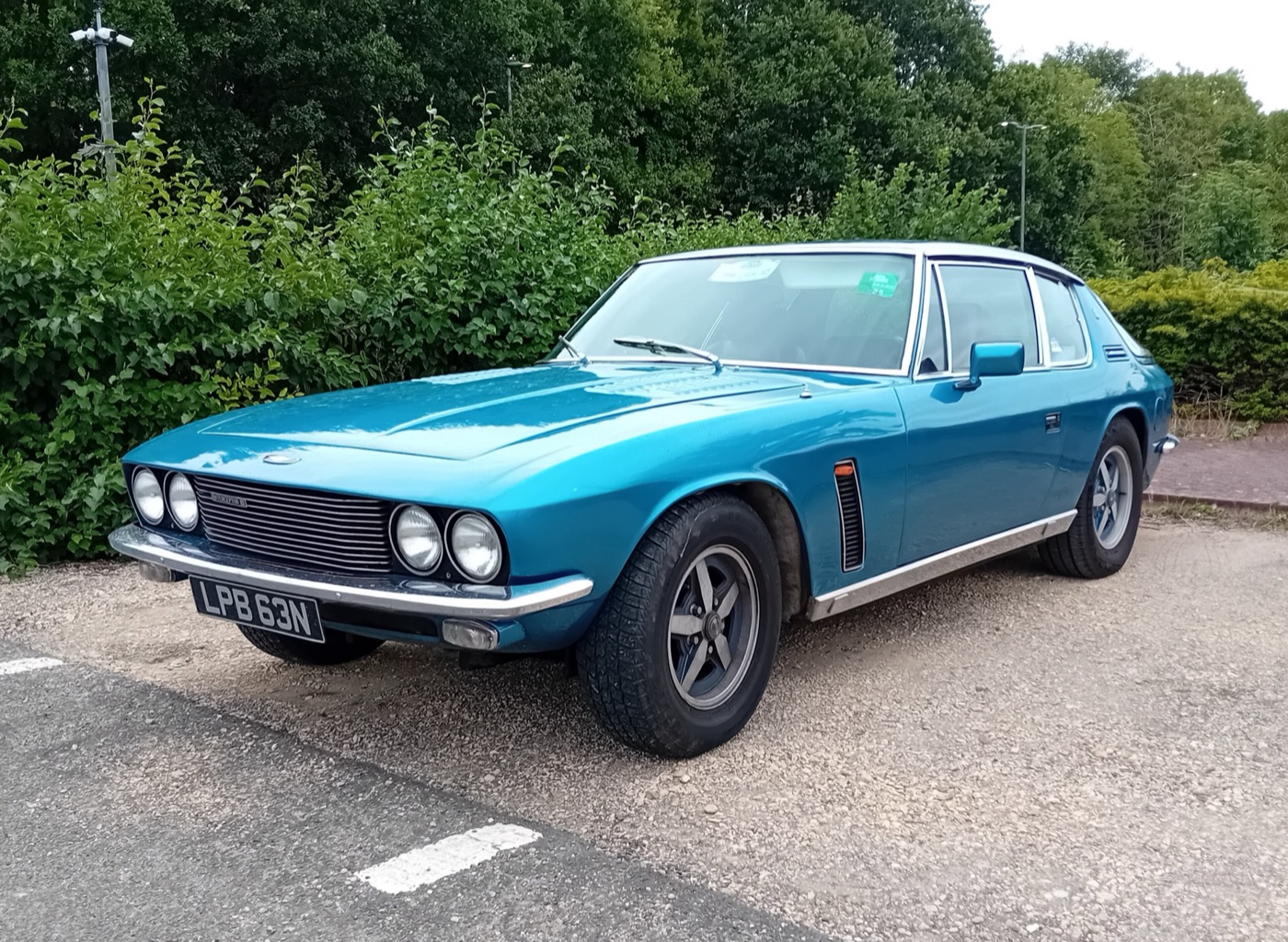
The Jensen Interceptor is a British grand tourer, a four-seater that Jensen Motors built by hand at West Bromwich, near Birmingham, England, from 1966 to 1976: a steel body styled by Carrozzeria Touring of Milan, a Chrysler V8 of 6.3 or 7.2 litres, and a curved glass tailgate that opens over the boot. The Jensen Museum counts 6,407 Interceptors across the Mark I, Mark II and Mark III, plus 320 of the four-wheel-drive FF, and an average Interceptor now sells at auction for between about £26,000 and £37,000 depending on the mark.
History of the Jensen Interceptor
The Interceptor replaced the glassfibre-bodied Jensen C-V8 in October 1966, after a boardroom fight over whether the new car should be styled in Britain or in Italy. Italy won, and the Interceptor stayed in production until Jensen Motors stopped trading in May 1976.
Jensen Motors before the Interceptor
Alan Jensen (born 1906) and his younger brother Richard (born 1909) grew up in Moseley, Birmingham. In 1934 the coachbuilder they had been running, W.J. Smith & Sons, became Jensen Motors Ltd, according to the Jensen Museum's history of the brothers. The firm built commercial vehicles and bodies for other manufacturers, among them the Austin-Healey 100, finished Volvo P1800 coupés from Pressed Steel bodies, and built the Sunbeam Tiger, alongside its own models: the 541 of 1955 and the C-V8, both with glassfibre (glass-reinforced plastic) bodies. The C-V8 was the first Jensen with a Chrysler engine, built in the new Kelvin Way factory at West Bromwich, which the museum says let Jensen build everything under one roof. From 1963 the bank Norcros had a financial stake in the company and appointed its managing directors.
The first Jensen Interceptor, 1950–57
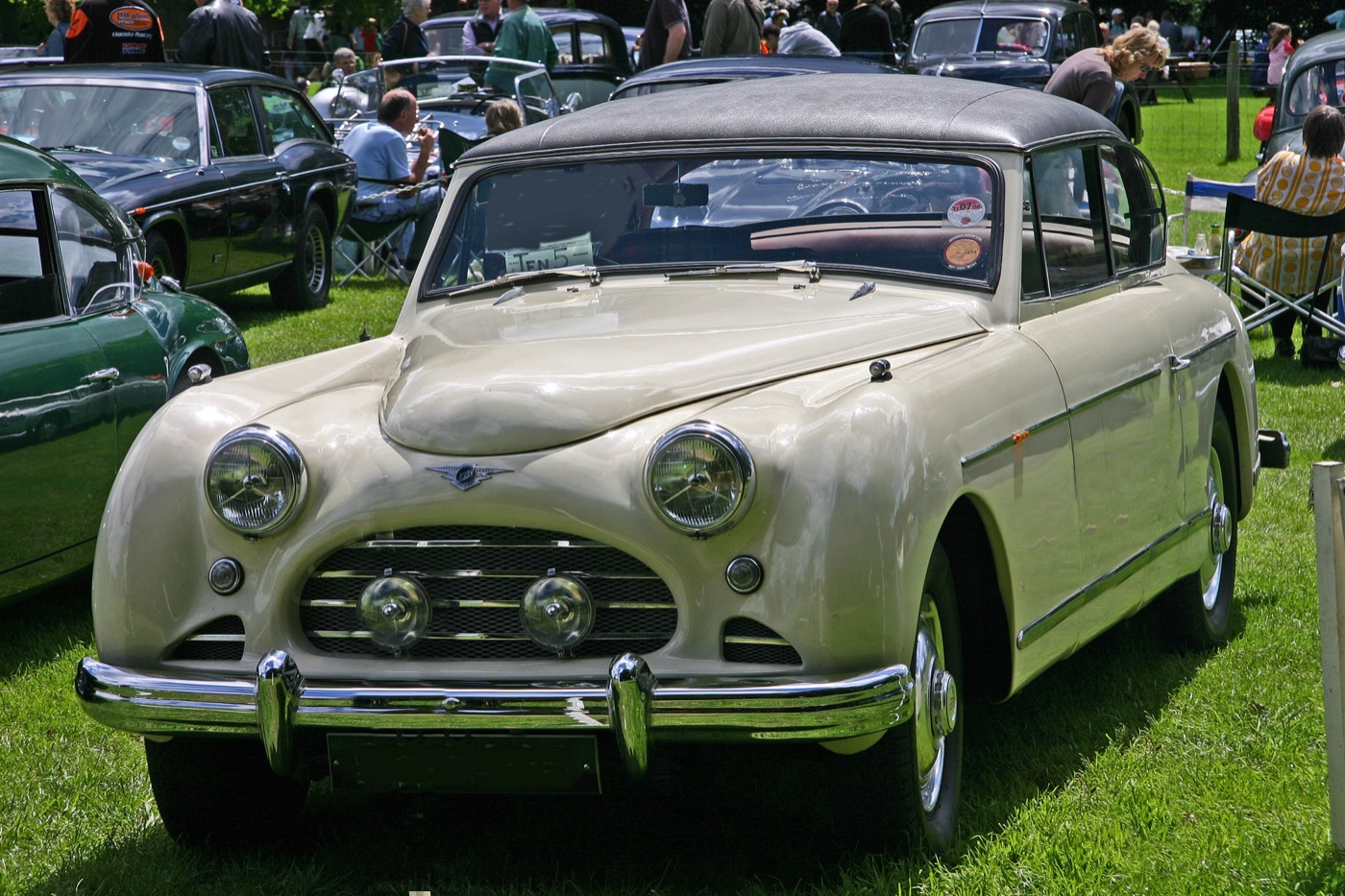
Jensen had used the name before, on the first generation of Interceptor. The first Interceptor, announced as a cabriolet in 1950 and also built as a saloon, used the Austin 4-litre engine, as Jensen's PW saloon did, under a deal Richard Jensen had made with Leonard Lord of Austin. Jensen built 88 of them at its Carters Green factory between 1950 and 1957, on the Jensen Museum's production list. One ran in the 1953 Monte Carlo Rally, driven by Ralph Sleigh with Jensen's workshop supervisor Stan Miller as co-driver (the museum's account of that rally).
Touring, Vignale and the P66
By 1965 the C-V8 needed replacing, and the board split. The Jensen brothers and their chief engineer, Eric Neale, wanted to build the P66, a smaller sports car of their own design; the P66 convertible on the stand at the October 1965 Motor Show was already badged "Interceptor". The managing director, Brian Owen, and the deputy chief engineer, Kevin Beattie, wanted an Italian body on the C-V8 chassis, and Norcros sided with them. In November 1965, as the Jensen Museum's history of the C-V8's replacement tells, Owen and Beattie took the C-V8 drawings to Ghia, Touring and Vignale. They preferred Touring's design, drawn by its stylist Federico Formenti, and bought it outright; Vignale of Turin, which offered a competitive price, would build the bodies in steel. Vignale lowered the roof slightly, enlarged the bonnet opening and the rear quarter windows, and added the stainless sill trims and the grilles in the front wings. The contract was signed in January 1966, the P66 was shelved, and Owen and Beattie took its name for the new car.
Launch at Earls Court in 1966
In June 1966 Beattie drove the first prototype, BEA 693C, across Europe from Turin to West Bromwich for the directors to see. The Interceptor and the FF were shown together at the Earls Court Motor Show in London in October 1966. Motor Sport's road test of February 1974 gives the launch prices as £3,473 for the Interceptor and £5,340 for the FF.
From Turin to West Bromwich
Classic & Sports Car sums the car up as "stunning styling by Touring of Italy, hand-built body by Vignale, American V8 power" and "assembly by English craftsmen coachbuilders". The first bodies came from Vignale, but Jensen soon took construction in-house at the Kelvin Way factory in West Bromwich. Italian-built cars can be told by the wood fillets on their door panels, according to Malcolm McKay's buyer's guide in Classic & Sports Car (5 July 2019). In January 1969 Bill Boddy of Motor Sport reported a rate of about 15 cars a week, three of them FFs. By early 1974 it was 30 a week, most of them for the United States, where the cars were sold by Kjell Qvale, who by then was Jensen's major shareholder.
Qvale, the receiver and the end in 1976
Jensen had five official managing directors between 1963 and 1976, on the museum's account of the company's management, among them Brian Owen, who chose Italy, and the "turnaround man" Carl Duerr (1968 to 1970). Qvale ran it from the United States through Richard Graves, and sacked Graves in May 1975 after Graves opposed moving the whole operation to America. A receiver and manager, John Griffiths, was then appointed; the museum's history of the Convertible dates the receivership to September 1975. Production fell sharply, and Jensen Motors ceased trading in May 1976; a few Convertibles were finished later that year by Jensen Parts & Service against orders the receiver had taken, which is why the museum's production dates run to December 1976.
Design and engineering
Under the Italian body the Interceptor is a conventional front-engined, rear-wheel-drive car: a tubular steel chassis, a live rear axle and an American V8 with an automatic gearbox. Motor Sport's 1974 test found it needed "very little more routine maintenance than an ordinary family saloon".
The steel body and the glass tailgate
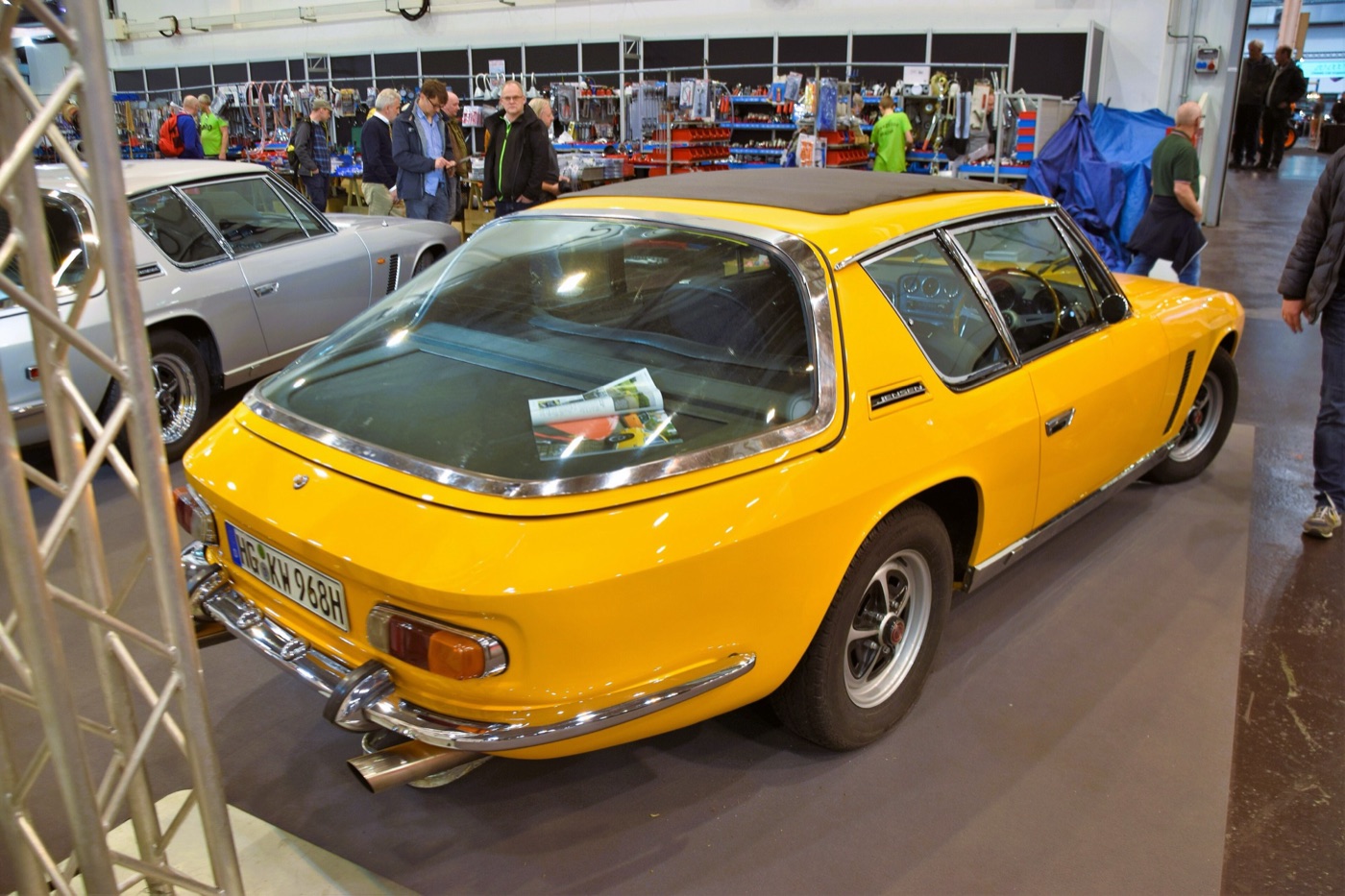
The body has two doors and four seats. It is steel, gas- and CO2-arc-welded to "a massive tubular and boxed pressing chassis structure", and after rust-proofing it was given two coats of primer and three of colour, all rubbed down by hand (Motor Sport, 1974). Four quartz-halogen headlamps sit either side of the grille. At the back is what the magazine called the "glasshouse" boot lid: a curved, heated Sundym glass screen that lifts to reveal a carpeted, fairly shallow 12 cu ft boot. The car is 5ft 9in wide, 3in narrower than the DBS; Classic & Sports Car gives the length as 15ft 8in to 15ft 11in (4,775–4,850mm), the FF being the longer, and the height as 4ft 5in (1,345mm).
Chassis, suspension and brakes
The front suspension uses wishbones, coil springs and an anti-roll bar. The live rear axle sits on semi-elliptic leaf springs, located by a Panhard rod, with Armstrong telescopic dampers and a Powr-Lok limited-slip differential made by Salisbury. Girling ventilated discs are fitted all round, 11⅜in at the front and 10¾in at the rear, with separate front and rear circuits; Adwest power steering was standard by 1974. Early cars used front suspension parts from the Austin Sheerline, which Classic & Sports Car calls "heavily loaded"; later cars were stronger.
Chrysler V8 engines and the TorqueFlite gearbox
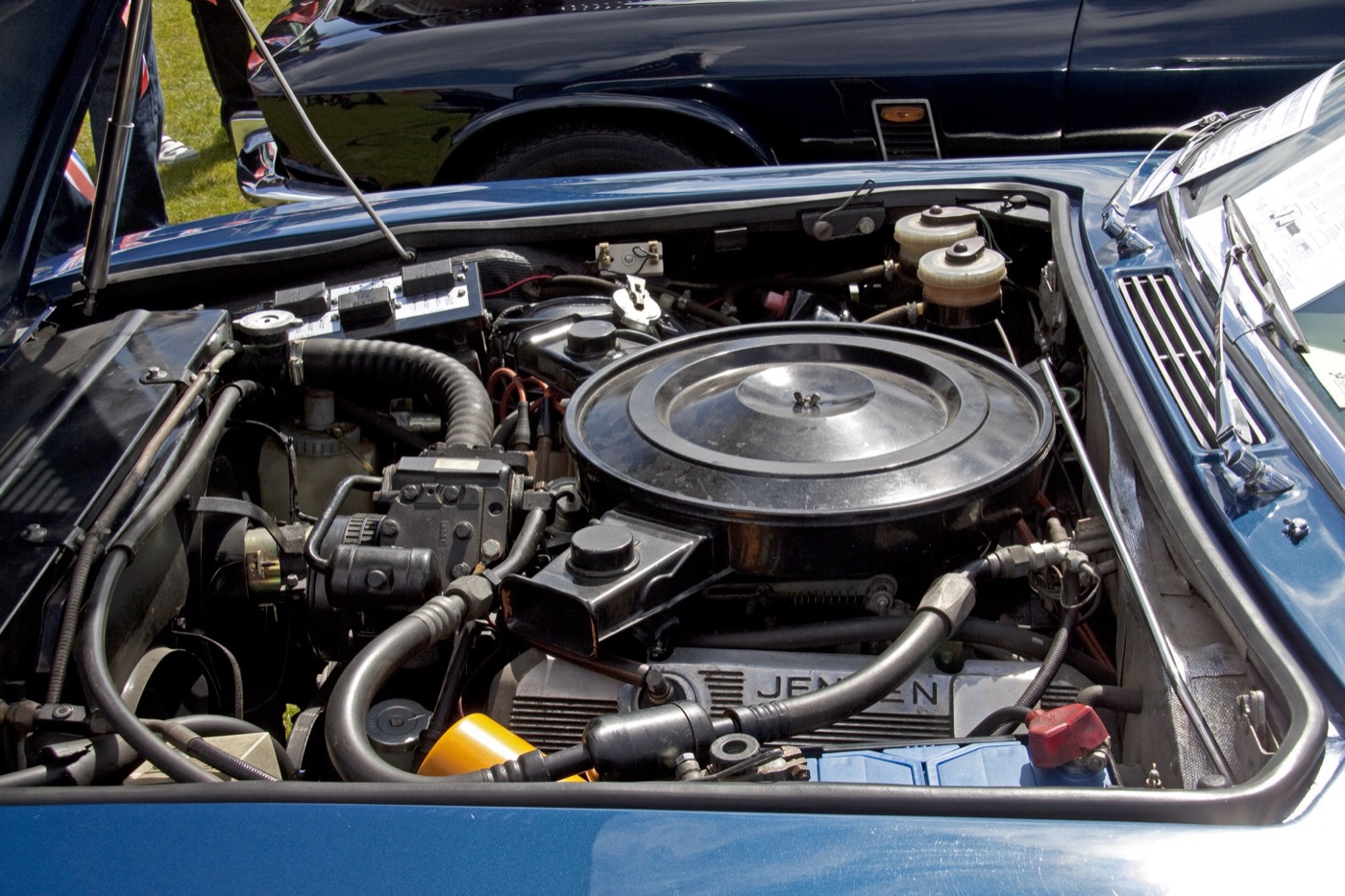
Every Interceptor built from 1966 to 1976 has a Chrysler V8 from the United States. The Mark I and Mark II used the 383 cu in engine of 6,276cc, which Motor Sport gave as 325bhp in January 1969; the lower-compression version fitted to the first Mark IIIs in 1971 made 300bhp. These are gross (SAE) figures. From the revised Mark III of 1972 it was the 440 cu in, 7,212cc engine (bore 109.72mm, stroke 95.25mm), which Classic & Sports Car dates from November 1971 on left-hand-drive cars and May 1972 on right-hand drive. With the US emissions equipment fitted even to British cars it made 284bhp (gross), 16bhp less than the 1971 6.3, but on an 8.2:1 compression ratio it would run on 88-octane two-star petrol. Almost every car has Chrysler's three-speed TorqueFlite automatic; a four-speed manual was offered on the Mark I, and the Mark II of October 1969 was automatic only.
Inside: Connolly leather, instruments and air conditioning
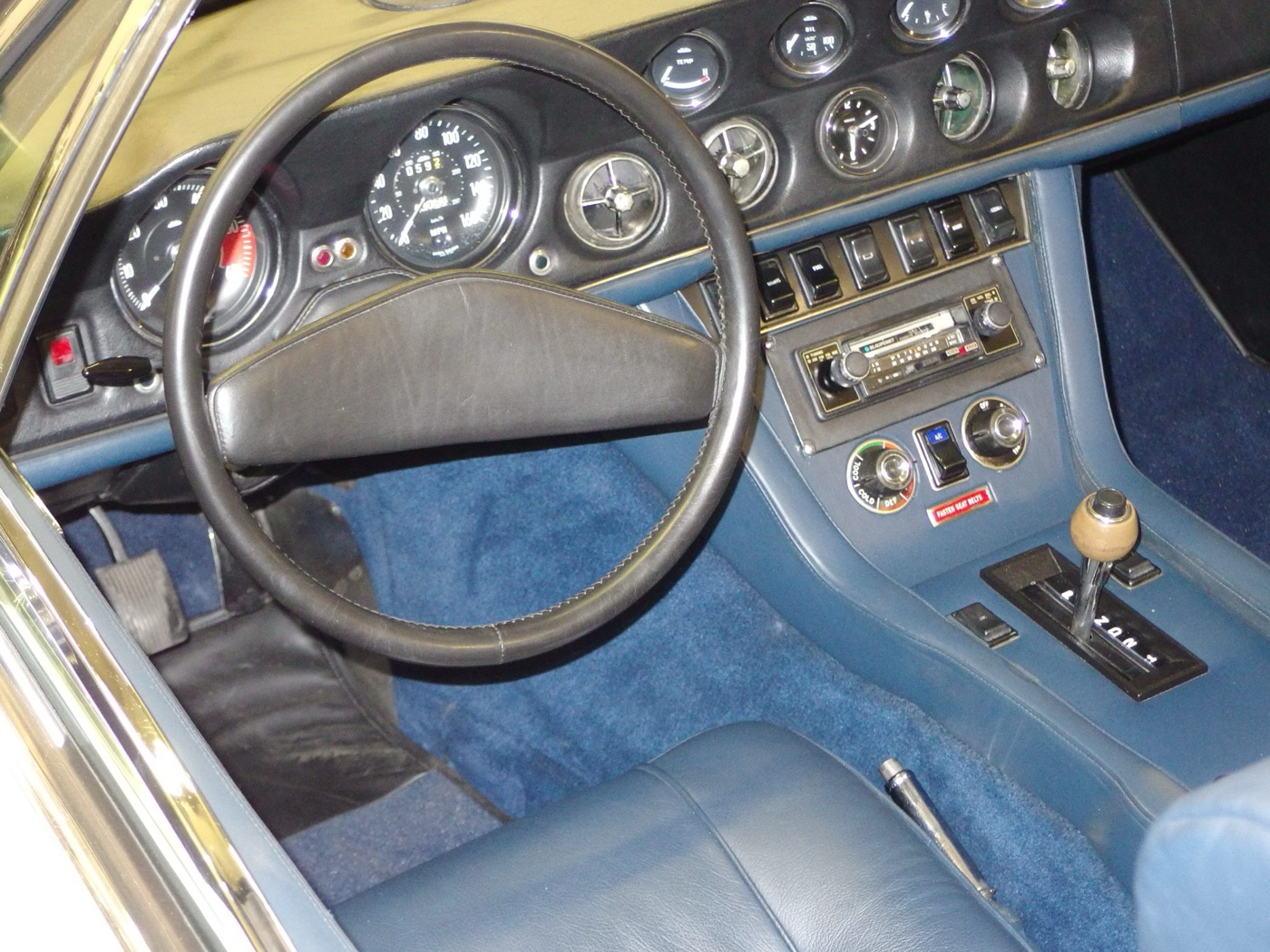
Jensen said it used six Connolly hides in each car by 1974, and the Mark III had air conditioning as standard; Richardson found it better at demisting than at holding a steady temperature. Leather was not always standard: the earliest Interceptors were trimmed in vinyl with hide as an option, so the novelist Harold Robbins specified hide for his Mark I in June 1967 (the museum's page on his cars). A push-button Radiomobile radio was standard, and a Radiomobile stereo radio with eight-track player cost £89.38 extra. The 1974 dashboard has six Smiths instruments and a Kienzle clock.
Jensen Interceptor Mark I, Mark II and Mark III: the differences
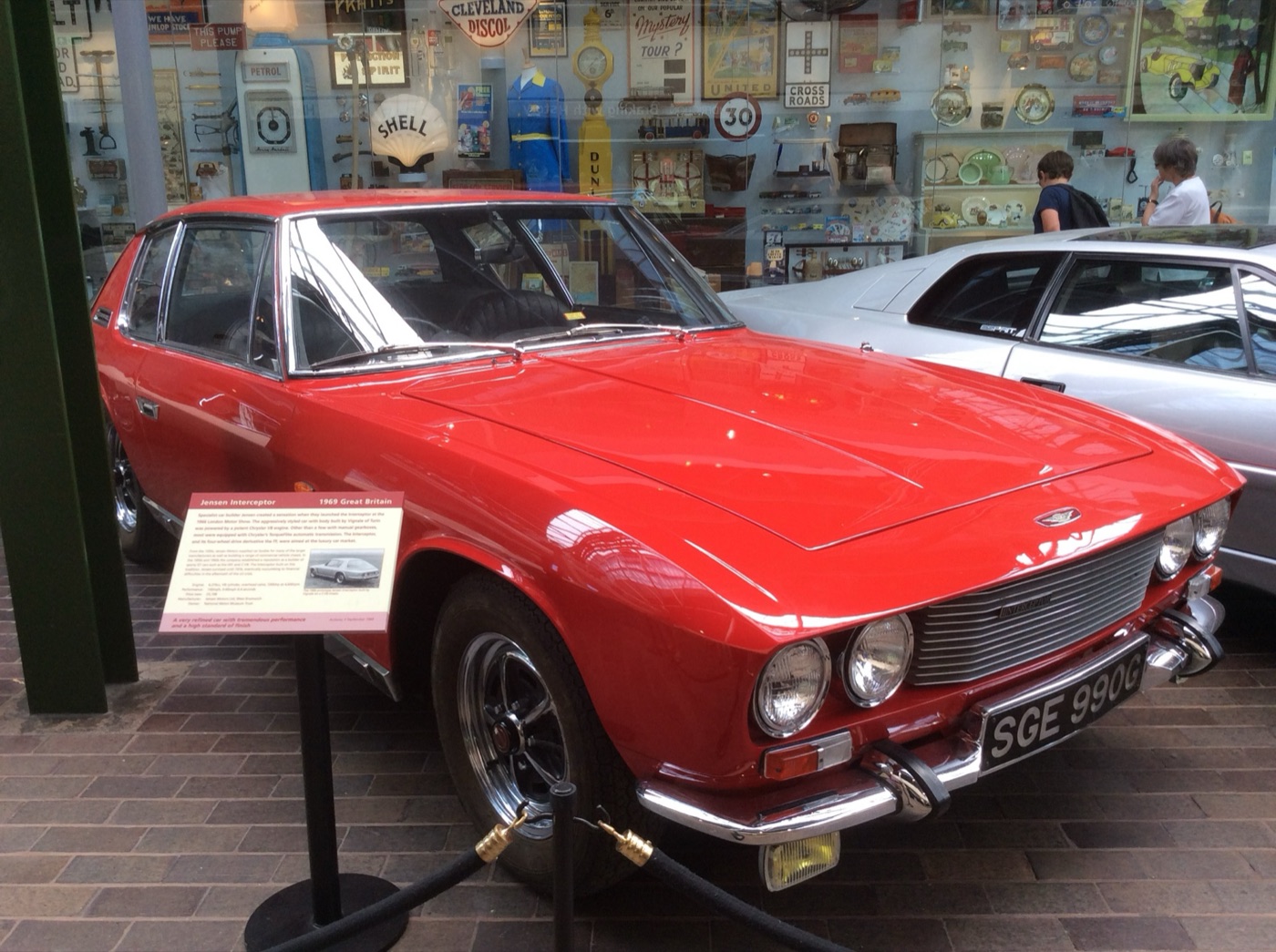
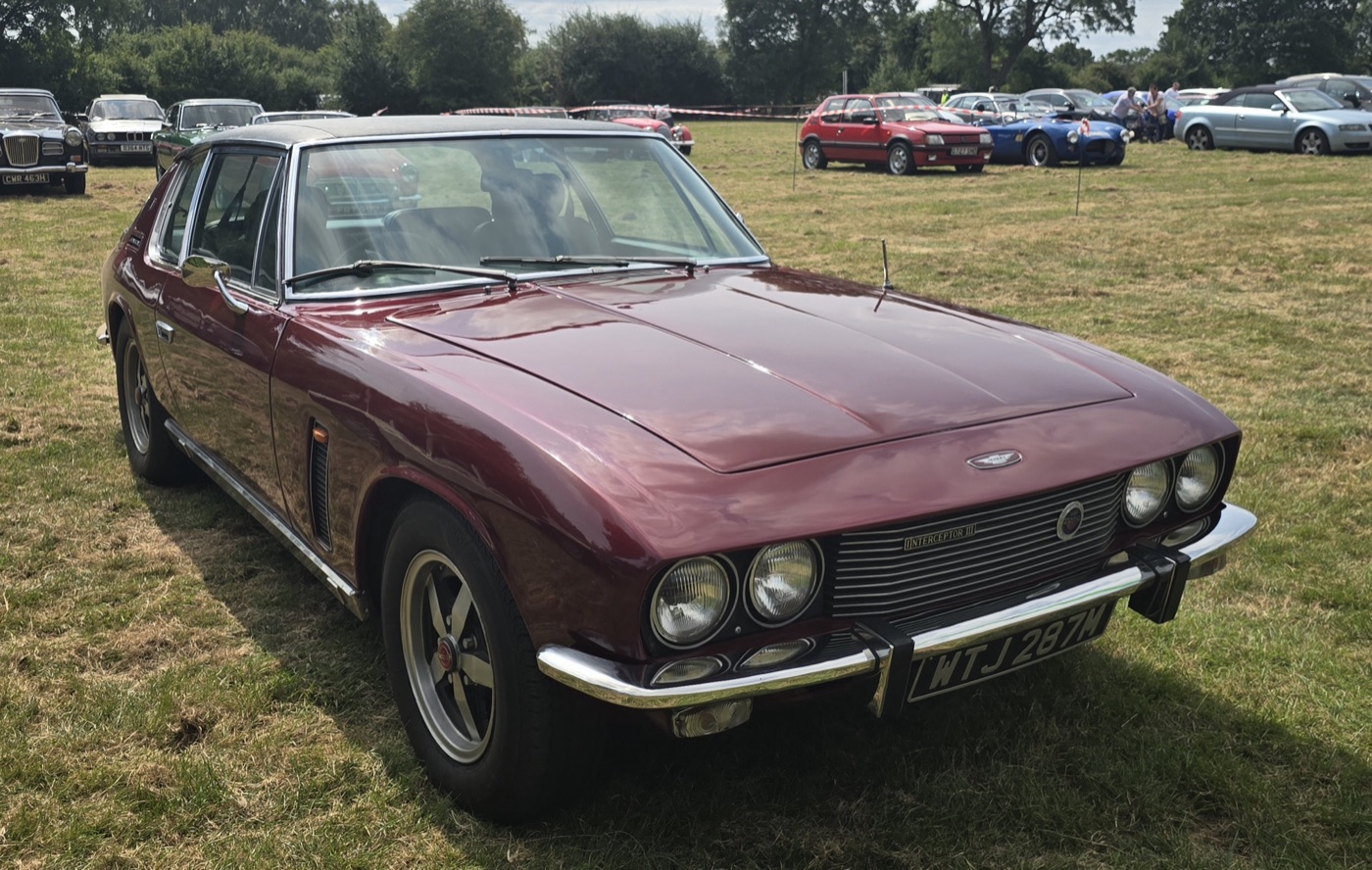
The three marks share the body. The visible changes are a revised front and a new dashboard on the Mark II, and alloy wheels in place of chromed Rostyles on the Mark III, which is also the only mark with the 7.2-litre engine.
Mark I (1966–69)
The Mark I was built from September 1966 to September 1969 (1,024 cars). It has the 6.3-litre engine, chromed Rostyle wheels and a three-spoke wood-rimmed steering wheel, and it is the only mark offered with a choice of transmissions, manual or automatic. Manual cars are rare: 22 were made, according to Classic & Sports Car's report of 18 September 2018, while its 2019 buyer's guide says 24. Power steering became standard in September 1968, according to Iconic Auctioneers' 2014 catalogue.
Mark II (1969–71)
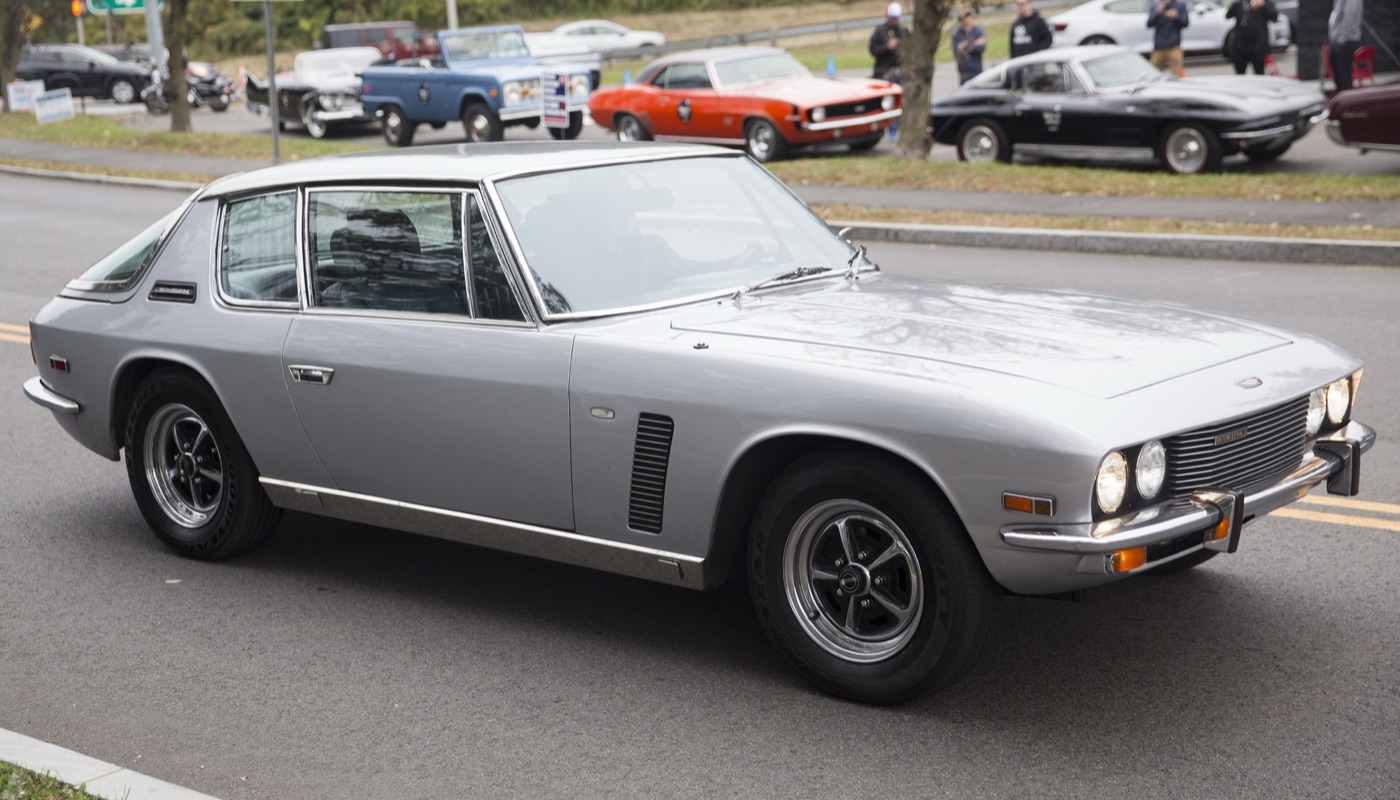
The Mark II was announced in October 1969 and built until September 1971 (1,128 cars). Iconic Auctioneers' catalogue describes "revised frontal styling and ventilated disc brakes", and Classic & Sports Car adds automatic only, power steering, optional air conditioning, and a new dashboard and seats.
Mark III (1971–76)
The Mark III arrived in October 1971 with five-spoke alloy wheels in place of the Rostyles and a revised interior, and was built from August 1971 to December 1976 (4,255 cars, the most numerous). It is the only mark of the standard car with the 7.2-litre engine, fitted to British cars from May 1972, and Classic & Sports Car dates the "Interceptor III Series 4", with trim changes, from October 1973.
6.3 or 7.2: how to tell
Classic & Sports Car's check is to look into a front wheelarch at the exhaust manifold: a manifold-to-downpipe bolt angled towards the wheel means a 7.2, bolts facing front and rear a 6.3. It adds that opinion is divided on which is better: "some prefer the freer-revving 6.3, others the massively torquey 7.2".
Specification and performance
A Jensen Interceptor has 284 to 385bhp (gross) depending on the engine and does about 130 to 143mph, with 0–60mph in a little over eight seconds for the 7.2-litre Mark III.
| Interceptor 6.3 (Mark I to early Mark III) | Interceptor Mark III 7.2 | SP | FF | |
|---|---|---|---|---|
| Engine | Chrysler V8, 6,276cc (383 cu in) | Chrysler V8, 7,212cc (440 cu in) | Chrysler V8, 7,212cc, three twin-choke Holleys | Chrysler V8, 6,276cc |
| Power (gross) | 325bhp (1969); 300bhp (lower-compression 1971 Mark III) | 284bhp | 385bhp | 325bhp |
| Gearbox | Four-speed manual (Mark I) or TorqueFlite three-speed automatic | TorqueFlite automatic | TorqueFlite automatic | TorqueFlite automatic, four-wheel drive |
| Top speed | 133mph (1969); 137mph reached in a Mark II | More than 135mph | 143mph (Autocar) | About 130mph |
| 0–60mph | A little over 8sec | |||
| Fuel consumption | 14.5mpg on a long run | 10–14mpg | 10.9mpg (brief test) | |
| Weight and tank | 35.7cwt (about 1,813kg) as tested; 20 gallons | About 200lb heavier than the Interceptor; 16 gallons | ||
| Price new | £3,473 (1966); £4,728 (1969) | £7,179 (1974) | £6,976.87 (1971) | £5,340 (1966); £7,007 (1969) |
How fast is a Jensen Interceptor?
Bill Boddy gave the Interceptor 133mph in "Two Jensens" (Motor Sport, January 1969), the FF perhaps three mph less because its body is slightly less aerodynamic. Clive Richardson reached 137mph in a Mark II on a run in which a front Dunlop SP threw its tread at 120mph and the car "virtually ran out of brakes". Motor and Autocar both took the SP past 140mph in late 1971.
Variants: FF, SP, Convertible and Coupé
Four versions share the Interceptor's body: the four-wheel-drive FF, the triple-carburettor SP, the Convertible and the notchback Coupé.
Jensen FF
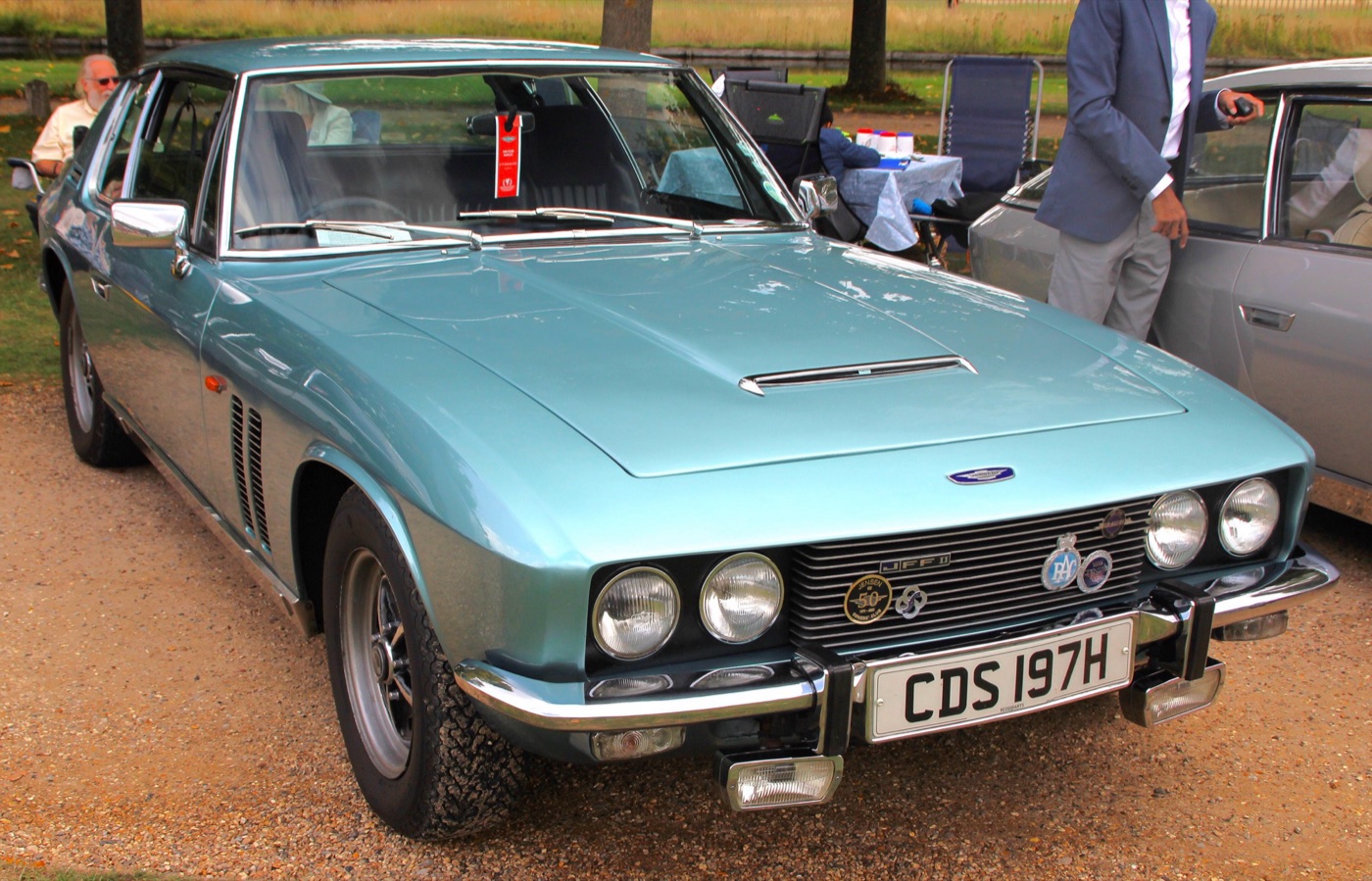
The FF is a longer Interceptor with four-wheel drive and anti-lock brakes. FF stands for Ferguson Formula, the four-wheel-drive system that Tony Rolt and Freddie Dixon conceived and Harry Ferguson's firm financed. The FF's wheelbase is 4in longer, 2,770mm against 2,665mm on Classic & Sports Car's figures, and Vignale gave it a squared-off front, two grilles in each front wing in place of the Interceptor's one, and a bonnet bulge and chrome air intake taken from the Maserati Quattroporte, which Vignale was building.
How the Ferguson four-wheel drive and Maxaret brakes work
In the Jensen Museum's description of the system, a planetary master differential on the TorqueFlite's output shaft sends 37% of the torque to the front wheels and 63% to the rear, with three Morse Hy-Vo chains taking drive to the front. Two one-way clutches limit how far either axle can overrun the other (16.5% front, 5.5% rear). The Dunlop Maxaret unit, driven from the master differential's planet carrier, senses the mean deceleration of the wheels and stops all four locking. Boddy drove an FF on wet roads to the VSCC driving tests at Silverstone and wrote that "the car goes exactly where it is pointed". He found the Maxaret kicked through the pedal, and that dry-road stops "may not be quite so short as with a normal system".
Why the FF stayed rare
The FF cost £1,809 more than the Interceptor in January 1969 (£7,007 against £4,728) and was replaced by the SP as Jensen's flagship in 1971. The last 15 were built between September and December 1971.
Jensen SP
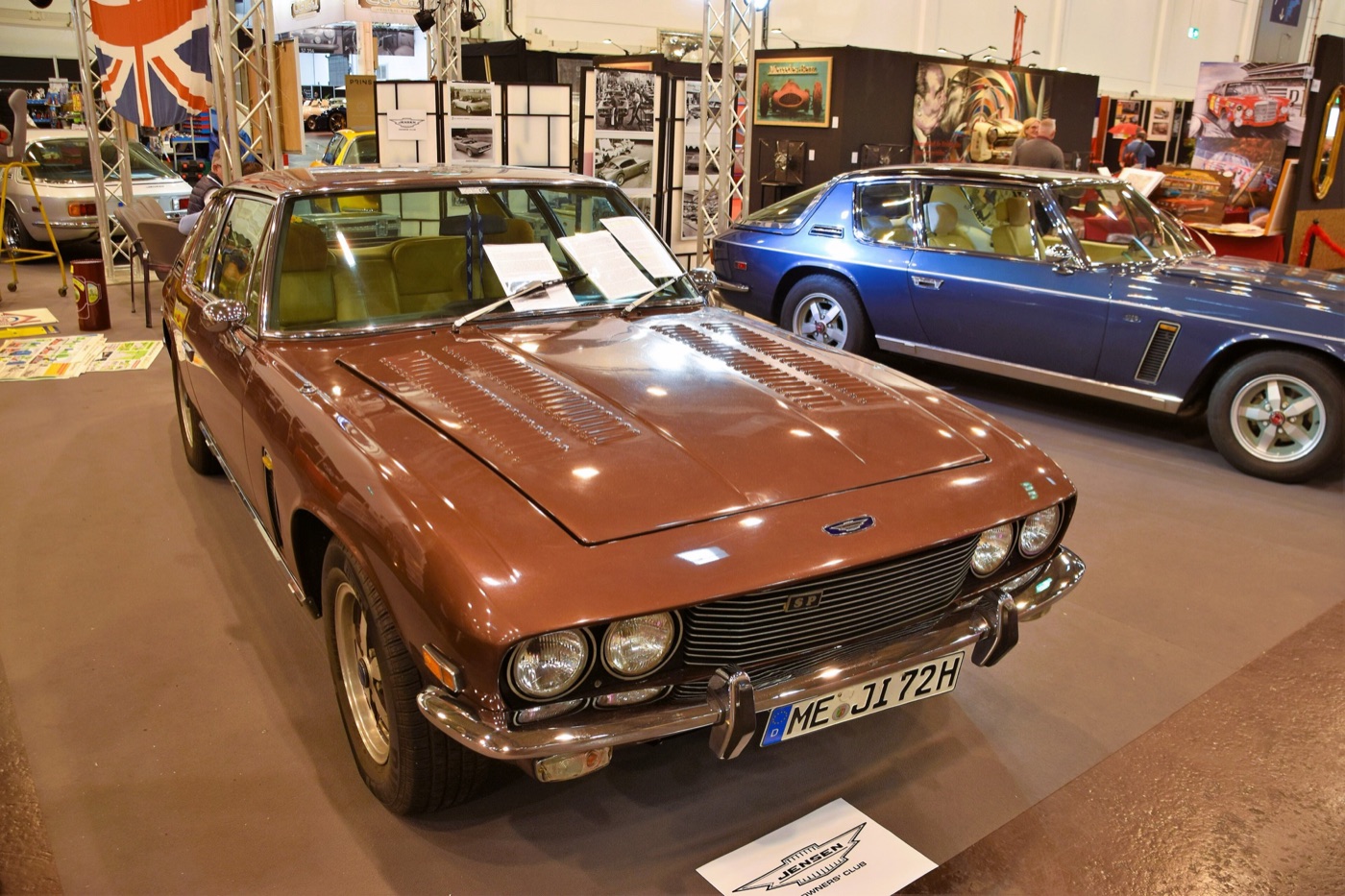
The SP, launched at the October 1971 Motor Show, has the 440 "Six Pack" engine with three twin-choke Holley carburettors and 385bhp. The Jensen Museum's history of the SP says Jensen bought Chrysler's remaining batch of Six Pack engines, which had been sitting in a warehouse in Canada because Chrysler expected to struggle to sell them in the US as rules on emissions tightened, and made a vinyl roof, a Learjet eight-track player and a fully louvred bonnet standard to set the car apart. It cost £6,976.87 with purchase tax, just under £1,000 more than a Mark III. The museum lists 232 built from 1971 to 1973; only 13 were left-hand drive, partly because the SP could not be sold in the United States, and Classic & Sports Car dates the last to October 1973. Part-throttle running was its weak point: Motor's road test of 18 March 1972, quoted by the museum, found the car ran on one carburettor "until about 110 mph" unless pushed, and Jensen's service staff fought erratic idling and flat spots on customer cars.
Jensen Interceptor Convertible
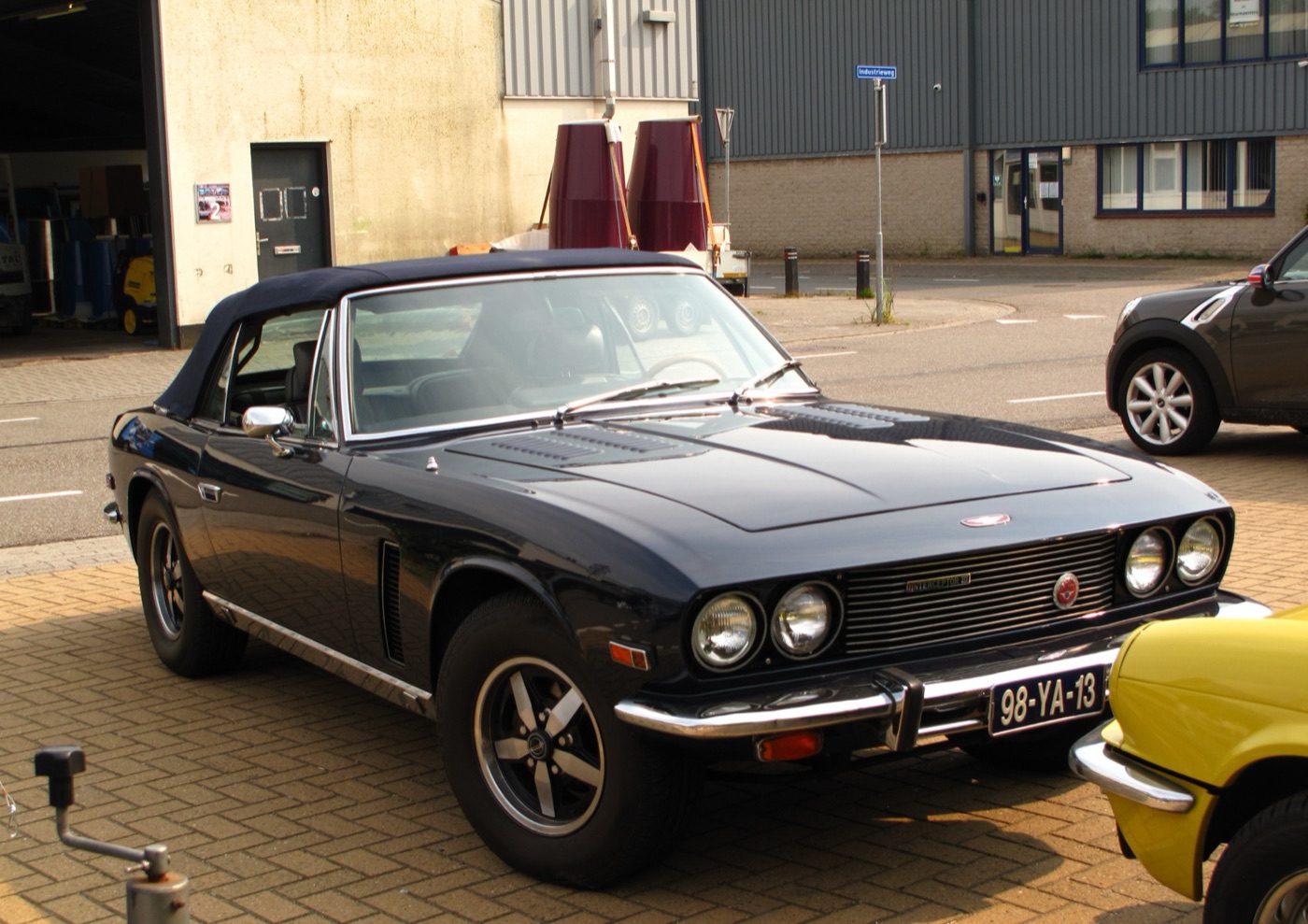
The Convertible was Kjell Qvale's idea and was pitched against the Rolls-Royce Corniche. It was built to meet European, Japanese and US regulations and sold in Europe as well as America. It was launched on 22 March 1974. Its hood frame was adapted from the Ford Mustang convertible's, Qvale's choice. More than 250 were completed in 1975 and just over 50 in the five months of 1976 before the factory closed; the museum's Convertible history puts the total at "just over 500", while its production list gives 456.
Jensen Interceptor Coupé
The Coupé is a notchback coupé built from Convertible bodyshells, so it lacks the glass tailgate. It was launched at the 1975 London Motor Show alongside the Jensen GT, while the receiver was already in charge, on a stand where all four Jensens (Convertible, saloon, Coupé and GT) were painted blue. The Jensen Museum believes 46 were built, and Classic & Sports Car says "around 46". The coupé now attracts a rarity premium, the magazine adds.
How many Jensen Interceptors were made?
Jensen built 6,407 Interceptors in the Mark I, Mark II and Mark III between September 1966 and December 1976, on the Jensen Museum's figures; Classic & Sports Car gives 6,408. The 320 FFs are counted separately.
| Model | Production dates | Built |
|---|---|---|
| Interceptor (first use of the name) | 1950–1957 | 88 |
| Interceptor Mark I | September 1966 – September 1969 | 1,024 |
| Interceptor Mark II | September 1969 – September 1971 | 1,128 |
| Interceptor Mark III | August 1971 – December 1976 | 4,255 |
| SP | 1971–1973 | 232 |
| Interceptor Convertible | 1973–1976 | 456 |
| Coupé | 1975–1976 | About 46 |
| FF Mark I | September 1966 – December 1969 | 195 |
| FF Mark II | October 1969 – August 1971 | 110 |
| FF Mark III | September – December 1971 | 15 |
| Interceptor Series 4 | 1983–1992 | 14 |
Later Interceptors: Series 4, Interceptor R and GTX
The Interceptor has been revived three times since 1976: as the Series 4 of the 1980s, as re-engineered original cars from 2010, and as an all-new car announced in 2026.
Interceptor Series 4
The Series 4 (S4) was built after the company re-emerged as Jensen Cars Ltd, with a smaller 5.9-litre Chrysler V8, according to Classic & Sports Car's timeline. The Jensen Museum counts 14 built between 1983 and 1992.
Interceptor R
The Interceptor R came from Jensen International Automotive (JIA), an Oxfordshire company set up in May 2010; Charles Dunstone, the founder of Carphone Warehouse, joined its board of directors that year. When SkiddMark reported the first deliveries in January 2011, each R was built from an original donor car with General Motors' 6.2-litre LS3 V8 of 429bhp, a claimed 160mph and 0–60mph in under 4.5 seconds, from £105,000 with a five-month build. "We have managed to produce a modern Jensen without compromising on its spirit or heritage," said Tony Banham, JIA's managing director. JIA, now in Banbury, says on its own site that it fits independent rear suspension, AP brakes and new wiring, and offers a supercharged R and a four-wheel-drive version based on the FF.
Interceptor GTX
JIA's next car is the Interceptor GTX, an all-new car with an aluminium chassis and body and a V8 engine. BOAT International (July 2026) gave its expected price as £1 million and reported that Jeff Qvale, son of Kjell Qvale, had joined the project; it put a JIA restomod, with traction control and ABS, at up to £400,000 including the donor car.
Jensen Interceptor values and prices
An Interceptor in average condition sells at auction for about £26,000 (Mark II) to £37,000 (Mark I), and the best cars and rarer versions make far more: £95,625 for a Mark I and £110,400 for an FF.
| Mark | Cars sold | Median price | Highest price |
|---|---|---|---|
| Interceptor I | 34 | £37,250 | £95,625, Silverstone Auctions, 11 November 2017 |
| Interceptor II | 37 | £26,026 | £51,750, Iconic Auctioneers, 11 November 2023 |
| Interceptor III | 213 of 308 offered | £28,000 | £68,100, The Market, 6 May 2026 |
FF, SP and Convertible prices
The highest recorded price for an FF is £110,400, paid at Bonhams' Goodwood Revival sale on 18 September 2021 for a 1971 FF Mark II that had been in one family since late 1971, a record for the model according to The Classic Valuer's record of the sale. A restored 1968 Mark I with the rare manual gearbox made £85,800 at Classic Car Auctions' September sale at the Warwickshire Event Centre on 15 September 2018, more than double its lower estimate. A 1975 Convertible sold new to the United States made €60,000 on The Market in August 2022. Classic & Sports Car wrote in 2019 that an FF or a Convertible "can easily fetch £100k", that the SP heads the standard bodies, and that condition counts for more than specification.
What Interceptors were making in 2011
A December 2011 SkiddMark report, drawing on the V3 monthly report on UK classic car auctions, found that UK auction houses had sold Interceptors worth £163,000 in total in 2011, against £130,000 for the whole of the 1990s. The average price of all cars sold at UK classic auctions had risen from £30,146 in 2009 to £39,161 in 2010 and £41,615 in 2011. Its examples from the classified adverts that month were a re-engineered 1973 Interceptor S, with independent suspension and a Corvette engine, at £85,000, a 1974 Series 3 with 43,000 miles at £24,995 and a 1976 Mark III automatic with 45,342 miles at £44,995. The Federation of British Historic Vehicle Clubs' survey that month put the UK classic vehicle business at £4.3bn a year.
Buying and owning a Jensen Interceptor
Rust is the main risk when buying a Jensen Interceptor. The mechanical parts are simple Chrysler components, which Classic & Sports Car says make the car "a far less daunting prospect to own than an Aston Martin or Ferrari".
Where does a Jensen Interceptor rust?
"The complex bodyshell can rot almost anywhere, especially in the bottom six inches of the structure," McKay writes. Many cars hide filler behind the stainless sill trims; his advice is to take a magnet, study the door shut lines, get underneath and check the restoration history. Steve Hodder, a Mark I owner, told the magazine that his car's good paint hid badly repaired sills, and it needed new inner and outer sills, door skins and a tailgate. Plenty of cars, the guide says, have had more than £50,000 spent on them.
Engine, cooling and gearbox
Overheating, from a silted-up radiator or failing electric fans, is the commonest cause of engine trouble. Rumbling at start-up or a smoky exhaust when warm means a worn V8. Neglect or a diet of short journeys can wear a V8 out in as few as 50,000 miles. The TorqueFlite is cheap to rebuild; its fluid should be pink, not creamy or black. The differential needs bearings at 70,000 to 80,000 miles, and the rear springs sag: two fingers between tyre and wheelarch, unladen, is the right ride height.
Electrics, air conditioning and trim
The electrics and electronics are more complex than on most cars of the period, so expect faults, especially on cars used irregularly. Air conditioning rarely works, and a modern system costs £2,000 or more. Check the leather for splits beside the stitching and for hardening from too much "Connollising".
Parts and specialists
"Get friendly with the Jensen specialists, join the club, and it's easy to source parts," Hodder told Classic & Sports Car. Parts for the TorqueFlite gearbox are relatively cheap because Chrysler built so many.
Is a Jensen Interceptor expensive to run?
Fuel is the main running cost (see the table). Servicing is light: every 4,000 miles with grease points on the chassis, against 2,500 for the Aston Martin DBS V8, and Classic & Sports Car calls a car with a sound body "surprisingly inexpensive to maintain". Hodder used his Mark I as an "everyday classic", bar the fuel consumption.
Rivals of the Jensen Interceptor
The cars the Interceptor was measured against, in period and since, are the Aston Martin DBS V8, the Jaguar E-type V12 and XJ12, and the Rolls-Royce saloons from Crewe. In 1974 Motor Sport found the £7,179 Interceptor almost £2,500 cheaper than the DBS V8 and called it "almost the best value for money on the market, excelled only by Jaguar's unbeatable value". Richardson judged it as quiet and comfortable as the Rolls-Royce, and faster. Classic & Sports Car's 2019 comparison notes that the E-type V12 (£3,474 new) cost half as much and was slightly faster, and that the Aston Martin V8 (£8,749 new) was faster still and dearer to buy, run and restore.
What the press said
Motor Sport's two period tests praised the Interceptor's comfort and pace and found fault with its high-speed handling and its finish. Clive Richardson tested his Mark III in the fuel crisis of winter 1973–74, under the temporary 50mph limit, and closed his Motor Sport test by saying "the Jensen Interceptor remains the epitome of the high-speed executive express", and that the 7.2 had made it "much more obviously a relaxed and effortless luxury car rather than a sports car". He found the tail could "soon lose traction" in fast corners. Boddy, in 1969, listed the FF's "shortcomings which should not be found in a £7,000 car", among them a jerky electric window and an engine that stalled at parking speeds. Classic & Sports Car's 2019 guide says early cars "were far from reliable" and that "most agree that the later cars are more dependable".
Famous Jensen Interceptor owners
The Jensen Museum's pages on owners name the novelist Harold Robbins, who bought one of the first left-hand-drive Mark Is, then a Mark II and a Convertible, and Led Zeppelin's drummer John Bonham, who owned several Interceptors and convertibles and, from 1979, an FF Mark I he bought for £5,000 from Jensen Parts & Service, as the museum's account of his cars tells. Ginger Baker of Cream bought three FFs, and Mitch Mitchell of the Jimi Hendrix Experience bought one new. Roger Moore was among the celebrities who showed an interest in the Convertible, the museum's Convertible history records.
Questions
Who designed the Jensen Interceptor?
Carrozzeria Touring of Milan designed the body; its stylist Federico Formenti drew it, and Jensen bought the design outright in 1965. Vignale of Turin built the first bodies and made small changes, including the stainless sill trims and the side grilles.
Where were Jensen Interceptors built?
At Jensen Motors' factory in West Bromwich, near Birmingham. The first bodies came from Vignale in Turin before Jensen took body construction in-house; Italian-built cars have wood fillets on the door panels.
What does FF stand for on a Jensen?
Ferguson Formula, the four-wheel-drive system developed by Tony Rolt and Freddie Dixon and financed by Harry Ferguson. The Jensen FF also has Dunlop Maxaret anti-lock brakes; 320 were built from 1966 to 1971.
How many manual Jensen Interceptors were made?
About two dozen, all Mark Is: Classic & Sports Car gave 22 in 2018 and 24 in its 2019 buyer's guide. From the Mark II of October 1969 the Interceptor was automatic only.
What engine is in a Jensen Interceptor?
A Chrysler V8: the 6,276cc (383 cu in) engine in the Mark I, Mark II and FF, and the 7,212cc (440 cu in) engine in the Mark III from 1972 and in the SP, which had three twin-choke Holley carburettors and 385bhp.
Is the Jensen Interceptor still made?
Not as a new production car. Jensen International Automotive in Banbury rebuilds original cars as the Interceptor R, and BOAT International reported in July 2026 that the company is developing an all-new Interceptor GTX at an expected £1 million.
Did John Bonham own a Jensen?
Yes. The Jensen Museum records that the Led Zeppelin drummer owned Interceptors and Convertibles, and in 1979 bought an FF Mark I for £5,000 from Jensen Parts & Service in West Bromwich.
Sources
- Clive Richardson, "Road Test: Jensen Interceptor III", Motor Sport, February 1974, pp. 54–56: prices, production rate, engines, construction, suspension, brakes, performance, fuel, comparison with the DBS V8.
- Bill Boddy, "Two Jensens", Motor Sport, January 1969, p. 15: FF and Interceptor test, prices, top speed, fuel, Maxaret, production rate.
- Malcolm McKay, "Buyer's guide: Jensen Interceptor and FF", Classic & Sports Car, 5 July 2019: timeline (including the Series 4), specification, faults and checks, owner's view, rivals, values.
- Classic & Sports Car, "Rare Jensen on top at CCA September Sale", 18 September 2018: the £85,800 manual Mark I and the 22 manual cars.
- The Jensen Museum, "Jensen Production Figures & Dates": production by model and mark.
- The Jensen Museum, "Jensen's CV8 Replacement: From Italy With Love": the P66, Touring, Formenti, Vignale, the prototype and the 1966 show cars.
- The Jensen Museum, "Jensen Motors: Managing A Struggling Company": Norcros, the managing directors, Qvale, Graves, the receiver and closure.
- The Jensen Museum, "Two Brothers with Vision: Alan & Richard Jensen": the brothers, Jensen Motors Ltd, the Austin and Austin-Healey work, the 1950 Interceptor.
- The Jensen Museum, "Monte Carlo Rally 1953: Jensen Interceptors".
- The Jensen Museum, "Ferguson four-wheel drive system": torque split, clutches, Maxaret.
- The Jensen Museum, "Jensen SP: The Inside Story", 19 February 2021: Six Pack engines, specification, price, left-hand-drive count, press tests, service problems.
- The Jensen Museum, "Jensen Interceptor Convertible", 26 June 2019: launch, hood, numbers, receivership, Coupé launch, Roger Moore.
- The Jensen Museum, "Harold Robbins' Jensens" and "John Bonham & His Beloved Jensens": owners, vinyl and leather trim.
- The Classic Valuer, buyer's guides to the Interceptor I, Interceptor II and Interceptor III, and the record of the Bonhams FF sale, all read 27 October 2026: median and highest auction prices.
- Iconic Auctioneers, 1977 Jensen Interceptor Series IV Convertible lot, 21 February 2014: the power steering date and the Mark II's changes.
- The Market, 1975 Jensen Interceptor Convertible lot, sold 17 August 2022.
- Jensen International Automotive, "The Jensen", read 27 October 2026: the Interceptor R's engineering.
- BOAT International, "Jensen Interceptor GTX", July 2026 issue: the GTX, its price, Jeff Qvale, restomod prices.
- SkiddMark, "New Jensen Interceptor R: the original 'bird-puller'", January 2011, and "Intercepting Desire", December 2011, with figures from the V3 report and the Federation of British Historic Vehicle Clubs.