LaFerrari: Ferrari's first hybrid hypercar, Aperta, FXX K and values
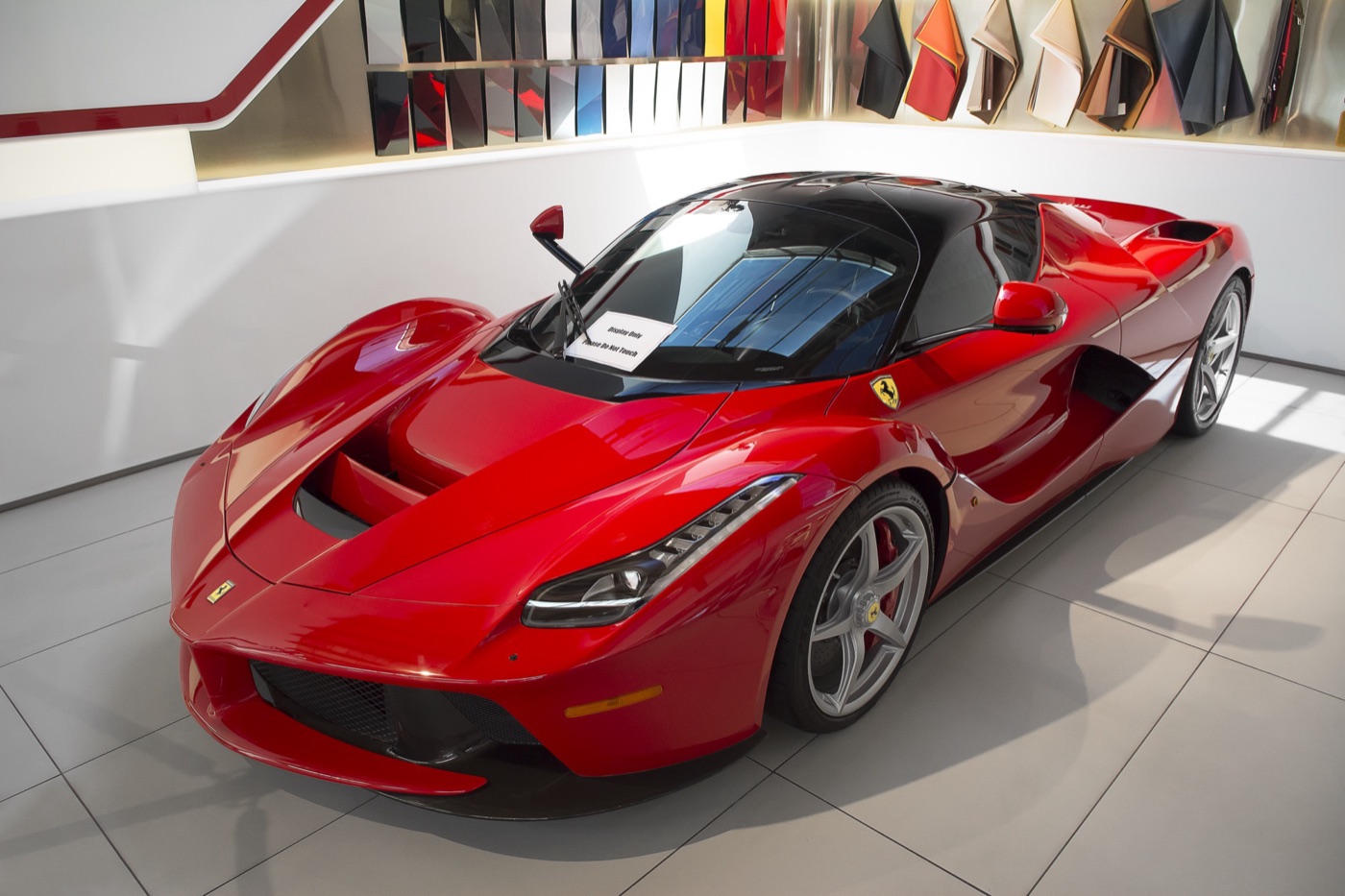
LaFerrari (in full, the Ferrari LaFerrari) is Ferrari's first hybrid road car: a mid-engined, two-seat hypercar that pairs a 6.3-litre V12 of 800cv with a 163cv electric motor for 963cv in all, unveiled at the Geneva motor show on 5 March 2013 as the successor to the Enzo. Ferrari built 499 coupés plus a 500th for charity, then 210 open LaFerrari Apertas, and its track-only FXX K was developed from the same car.
Ferrari claims more than 350km/h and 0–300km/h in 15 seconds; an independent test in 2015 measured 21.99 seconds to 186mph. LaFerrari is one of the three hybrid hypercars of 2013, with the McLaren P1 and the Porsche 918 Spyder, and the best coupés sold at auction in 2025 and 2026 for more than $5 million.
History of LaFerrari
LaFerrari began as a hybrid research programme that Ferrari showed in public from 2010, became the carbon chassis of a car called F70 in the press in 2012, and was named only on its launch day in March 2013. It followed the 288 GTO, F40, F50 and Enzo as Ferrari's limited-series flagship.
The HY-KERS prototype
At the 2010 Geneva show Ferrari displayed a 599 GTB Fiorano fitted with a hybrid drivetrain it called HY-KERS. Ferrari's release described an electric motor of about 40kg, coupled to the back of the seven-speed dual-clutch gearbox, giving more than 100hp, because the aim was to gain at least one horsepower for every kilogram the system added. The flat lithium-ion batteries sat under the floor, and the company claimed a 35 per cent cut in CO2 on the combined cycle.
The carbon chassis: Paris, 2012
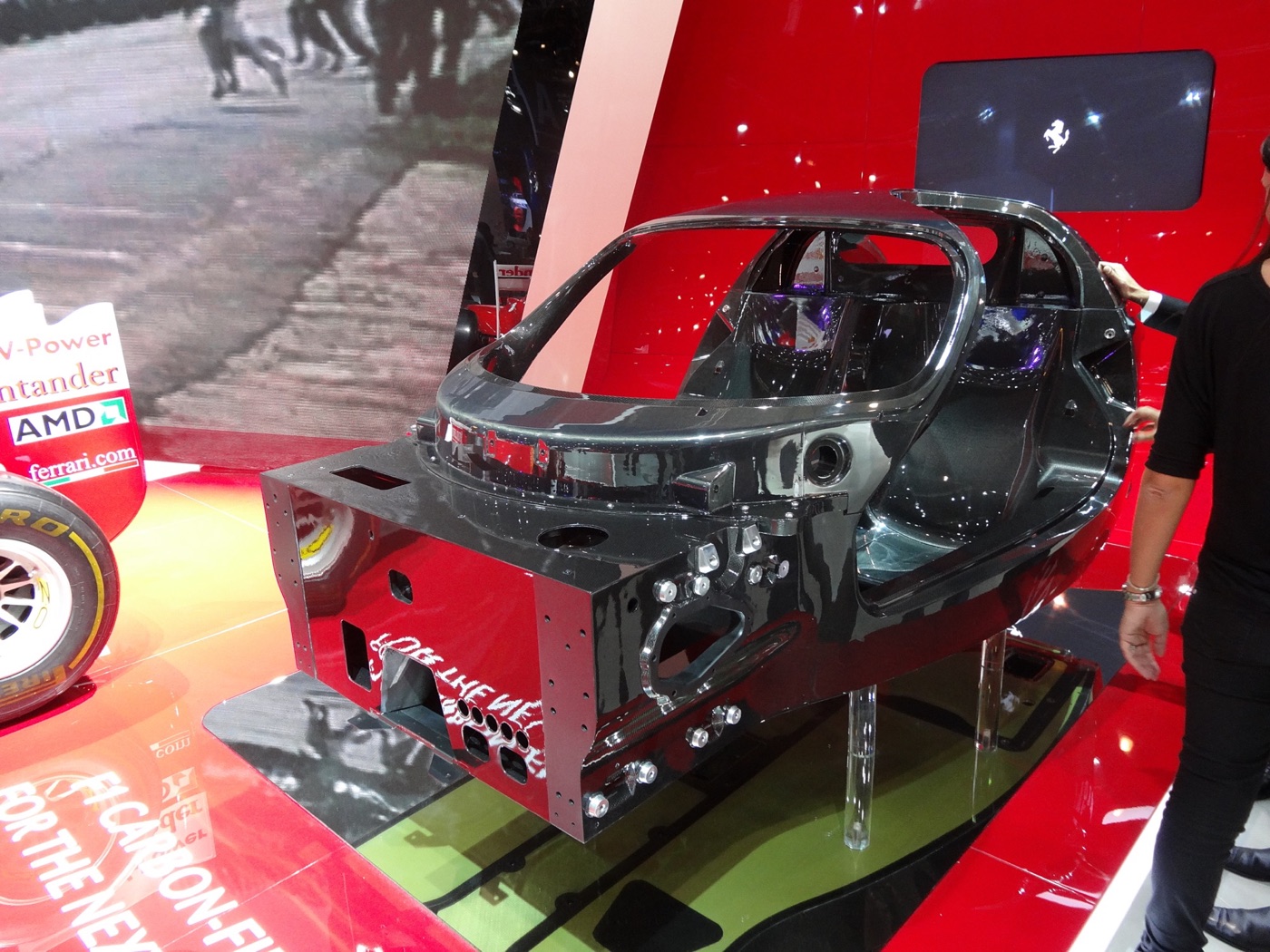
Ferrari showed only the bare tub of its next special series at the 2012 Paris motor show. Ferrari said the chassis was 20 per cent lighter than the Enzo's, despite carrying the hybrid parts and meeting newer regulations, with 27 per cent more torsional rigidity and 22 per cent more beam stiffness. Rory Byrne, designer of the Formula 1 Ferraris behind 11 world titles, helped design it; Ferrari says its GT and F1 engineers worked on the chassis together from the start.
The tub used four kinds of carbon fibre, hand-laid and cured in autoclaves by Scuderia Ferrari's own staff, materials and methods. Ferrari passed over resin transfer moulding, the industrial process used elsewhere in the car industry. The main structure was T800 carbon with local reinforcement in T800UD unidirectional tape; the structural underbody and cross-member were M46J, a high-tensile fibre chosen to save weight; the doors used tougher T1000, a lesson from F1 nose cones; and the undertray combined carbon with Kevlar against stones thrown up from the road. Ferrari said the drivetrain would use an updated HY-KERS with two electric motors, one driving the rear wheels through the gearbox and one running ancillaries such as the power steering, brake servo and air conditioning.
F150 to LaFerrari: Geneva, 2013
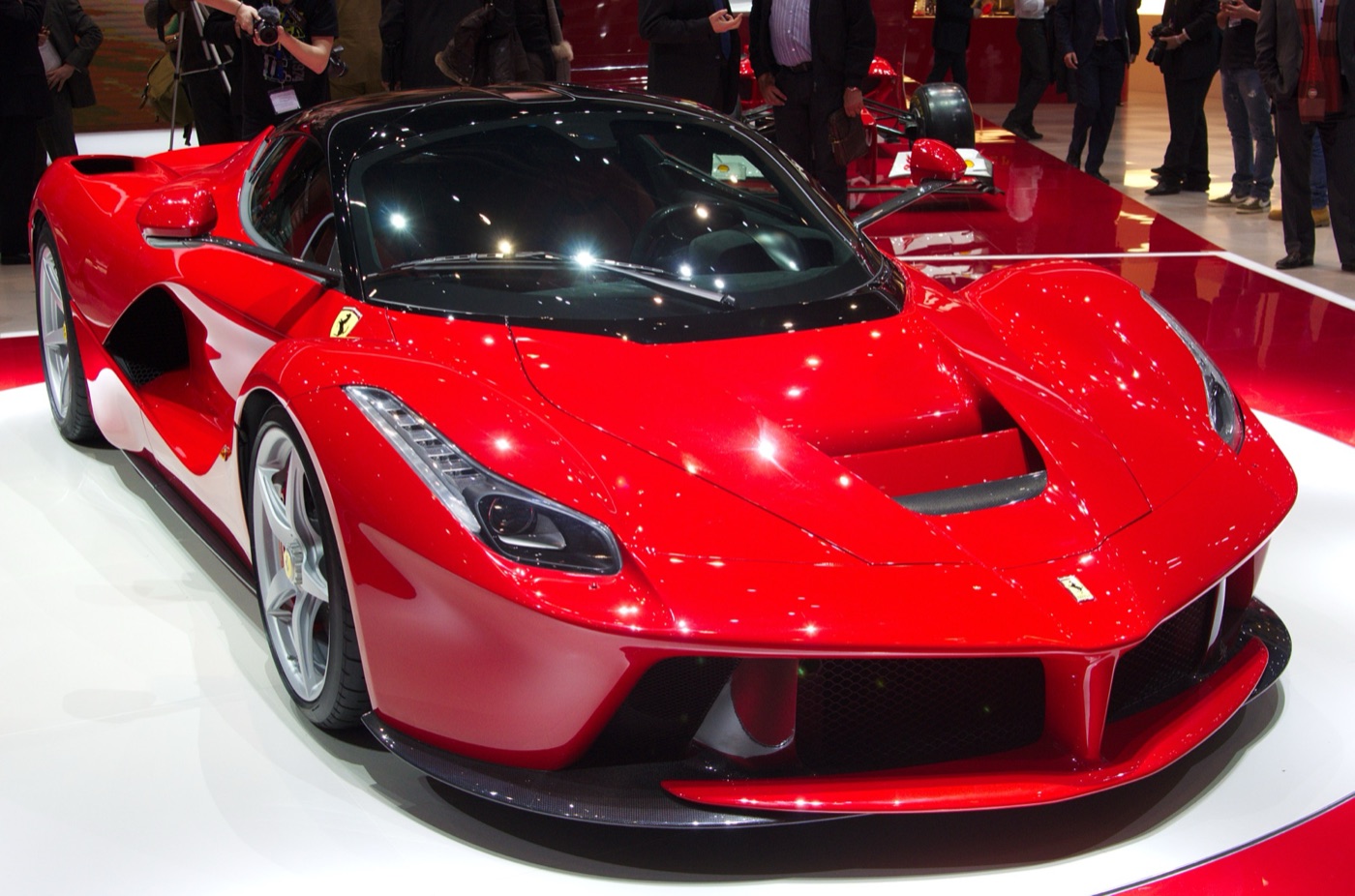
The car's project name was F150, confirmed by a customer preview days before the launch; press guesses had included F70, for Ferrari's 70th anniversary. Two days later, Ferrari's Geneva release of 5 March 2013 gave the name, a run of 499 cars and a quote from its president, Luca di Montezemolo: "We chose to call this model 'LaFerrari' because it is the maximum expression of what defines our company", which he named as excellence. Ferrari's Formula 1 drivers, Fernando Alonso and Felipe Massa, had worked on the car's development and on its driving position.
Who could buy a LaFerrari?
Ferrari chose the buyers. On the show's second day it said more than twice as many requests as cars had already reached Maranello, and its magazine later wrote that all 499 were spoken for before the unveiling. Autocar reported in its road test that, roughly, a buyer needed to have bought at least two recent Ferraris new through a dealer and to have owned six in the past ten years.
The 500th LaFerrari
On 31 August 2016, a week after the earthquake of 24 August in central Italy, Ferrari's chairman and chief executive Sergio Marchionne announced a 500th LaFerrari, to be sold for the people of the region. RM Sotheby's auctioned it at Daytona Beach, Florida, on 3 December 2016 for $7 million, all of it for the National Italian American Foundation's Earthquake Relief Fund, and Ferrari called it a record for a 21st-century car at auction. The car is red with a white stripe over the bonnet and rear screen, a small Italian flag on the bonnet and a commemorative plaque. Ferrari's own magazine later gave the price as $7.5 million.
Design of LaFerrari
Ferrari's own Centro Stile, led by Flavio Manzoni, designed LaFerrari. Its sloping nose and very low bonnet recall the late-1960s Ferrari sports prototypes, and Ferrari's magazine names two of them, the 330 P4 and the 312P. Ferrari kept the mid-engined V12 sports car layout, with the cabin and engine inside the wheelbase, and the car has the Enzo's wheelbase and length, while also housing the hybrid system and the dual-clutch gearbox.
Inside the cabin, the seat is fixed and moulded to its owner, and the pedal box and steering wheel adjust instead. Evo reported that this lowered the centre of gravity by 35mm, and quoted Ferrari's figure that every 10mm off the centre of gravity was worth 0.3 seconds a lap at Fiorano. The car was Ferrari's first with a reconfigurable digital instrument display, and the gearbox buttons sit on a bridge between the seats. It won a Red Dot design award in 2015, the year the FXX K took the competition's top "Best of the Best" prize, as Ferrari announced on 30 March 2015.
Active aerodynamics
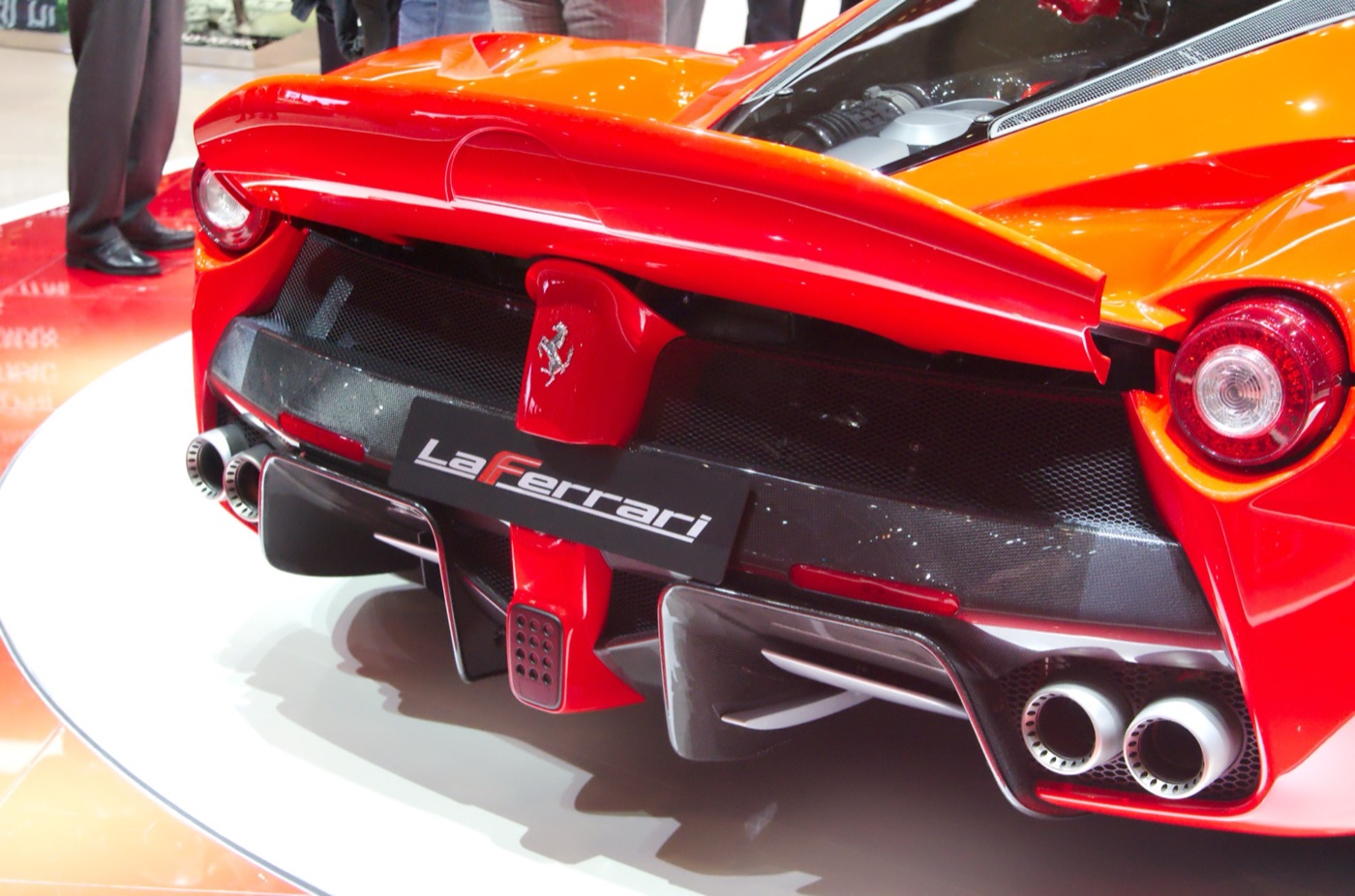
LaFerrari changes its downforce as it drives, using moving flaps in the front and rear diffusers, an underbody guide vane at the front and a rear spoiler, which help cornering and braking. With them, the top of the body needs no fixed wing. The magazines published different figures: Autocar gave a maximum of 360kg at 124mph when cornering and 90kg in a straight line, and CAR gave 50kg in low-drag mode and 230kg at maximum, also at 124mph.
How does LaFerrari's hybrid system work?
An electric motor adds torque to the V12 at all times, and the car has no electric-only mode. Ferrari said HY-KERS made full use of Scuderia Ferrari's know-how with KERS, the kinetic energy recovery system its F1 team first raced in 2009, when Kimi Räikkönen used it to win the Belgian Grand Prix. Ferrari gave CO2 of 330g/km at the launch. CAR found "there is no EV mode", and Ferrari's magazine says the motor "was not designed to run in electric mode".
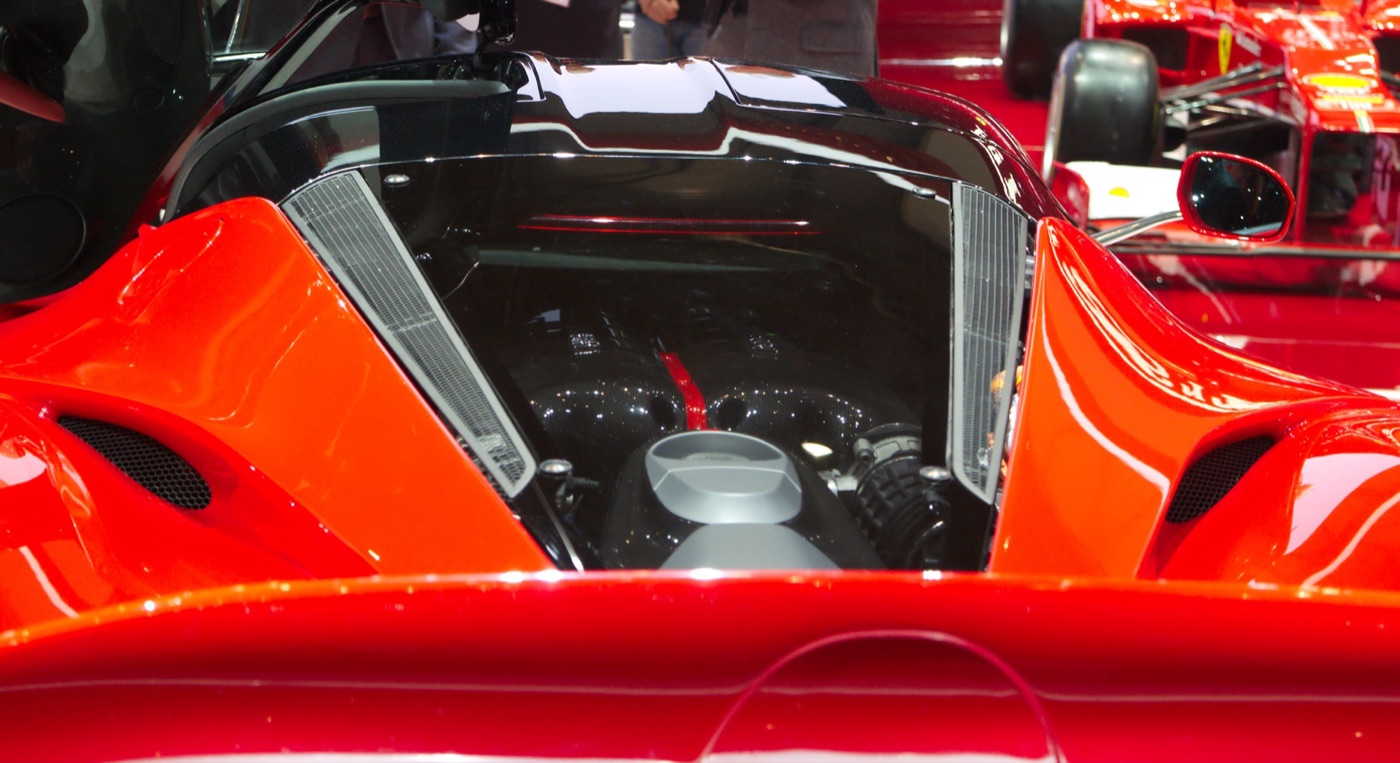
The main motor gives 120kW (163cv) and drives the rear wheels; Autocar reported that it is mounted on the gearbox and drives the final drive through its own gear set; evo added that it spins at up to 16,500rpm and that the whole hybrid system, batteries included, weighs 146kg. Autocar gave 25.7kg for the motor and 60kg for the lithium-ion battery, which sits on the floor behind the seats. A second motor runs the ancillaries and, CAR reported, can work as a generator taking power from the V12. Ferrari said in 2013 that the battery cells are assembled in the department that builds Scuderia Ferrari's F1 KERS units, and that Magneti Marelli helped develop the motors.
The battery charges under braking and whenever the V12 makes more torque than the wheels need, such as in a corner. Evo reported that Ferrari harvests energy even while the ABS is working. The motor fills in the V12's low-rev torque, which let Ferrari tune the engine, after work on its volumetric, mechanical and combustion efficiency, for power at the top of its range: 800cv at 9,000rpm and a limit of 9,250rpm.
The hybrid system is wired into the car's other electronic controls, which Ferrari lists as stability control, high-performance ABS with electronic brake balance, EF1-Trac traction control, the third-generation E-Diff electronic differential and SCM-E magnetorheological dampers with twin solenoids (Al-Ni tube). The brakes are Brembo carbon-ceramic discs.
LaFerrari specification and performance
LaFerrari's V12 engine is a 6,262cc, 65-degree unit of 800cv; with the electric motor the car makes 963cv and more than 900Nm, driving the rear wheels through a seven-speed dual-clutch gearbox. British magazines converted the outputs to 789bhp for the engine, 161bhp for the motor and 950bhp in all.
| Item | Figure |
|---|---|
| Engine | Naturally aspirated 65-degree V12 combustion engine |
| Displacement | 6,262cc; bore and stroke 94 x 75.2mm |
| Compression ratio | 13.5:1 |
| V12 power output | 800cv (789bhp) at 9,000rpm; 700Nm at 6,750rpm; limit 9,250rpm |
| Electric motor | 120kW (163cv, 161bhp) |
| Combined output | 963cv (950bhp); more than 900Nm |
| Gearbox | Seven-speed dual-clutch, rear-wheel drive |
| Suspension | Double wishbones front, multilink rear, magnetorheological dampers |
| Brakes | Brembo carbon-ceramic, 398mm front, 380mm rear |
| Electronic controls | Stability control, ABS/EBD, EF1-Trac traction control, E-Diff 3, SCM-E dampers, active aerodynamics |
| Tyres | 265/30 R19 front, 345/30 R20 rear |
| Length, width, height | 4,702mm, 1,992mm, 1,116mm |
| Wheelbase | 2,650mm |
| Weight distribution | 41 per cent front, 59 per cent rear |
| 0–100km/h, 0–200km/h, 0–300km/h | Under 3 seconds, under 7 seconds, 15 seconds |
| Top speed | More than 350km/h (217mph) |
| CO2 | 330g/km at launch; 340g/km on Ferrari's current page |
How fast is LaFerrari?
Ferrari claims more than 350km/h (217mph), 0–100km/h in under three seconds and 0–300km/h (186mph) in 15 seconds; its magazine now gives 0–200km/h as 6.9 seconds. MotorTrend's instrumented test, published in April 2015, recorded 0–60mph in 2.4 seconds, the quarter mile in 9.7 seconds at 148.5mph and a stop from 60mph in 95ft.
At Fiorano, Ferrari's test track, the factory quoted a lap of about 1min 19.9sec at the launch, against 1min 24.9sec for the Enzo and 1min 23.0sec for the F12berlinetta. Ferrari's magazine puts the gain over the Enzo at 5.2 seconds, and says the SF90 XX Stradale has since lapped 2.4 seconds faster than LaFerrari.
Measured performance: LaFerrari against P1 and 918
In a three-car test published by SkiddMark in January 2016, LaFerrari was timed with VBOX equipment against the McLaren P1 and the Porsche 918 Spyder in autumn 2015; collector Paul Bailey lent his three cars, and at Bruntingthorpe and Santa Pod David Kibbler brought a second 918. BTCC race winner Mat Jackson drove at Silverstone's 1.64-mile National circuit on 18 September 2015, with the manettino in "CT off" and the car on Pirelli Corsa tyres. LaFerrari lapped in 58.58 seconds, 0.33 seconds slower than the P1 on optional Pirelli Trofeo R tyres. "Whereas the P1 corners flat, the LaFerrari has a more pointy front-end and refuses to understeer through the fast corners," Jackson said.
At Bruntingthorpe on 16 October 2015, in race mode with launch control and the best of seven runs, LaFerrari took 21.99 seconds from rest to 186mph against Ferrari's claim of 15.0 seconds. That afternoon at Santa Pod the strip was damp and the air at 7°C, and the car struggled to put its power down.
| Test | LaFerrari, measured |
|---|---|
| Silverstone National, best lap | 58.58 |
| Bruntingthorpe 0–60mph | 3.68 |
| Bruntingthorpe 0–100mph | 6.48 |
| Bruntingthorpe 0–150mph | 12.12 |
| Bruntingthorpe 0–186mph | 21.99 |
| Bruntingthorpe quarter mile | 11.03 at 141.75 |
| Bruntingthorpe standing half mile | 16.71 at 171.77 |
| Santa Pod quarter mile | 11.21 at 142.47 |
The P1 was fastest round Silverstone and to 186mph, and the 918 won both drag-strip distances; the two rivals' times are on the McLaren P1 page. The testers wrote that they "were unable to get close to the factory's performance claims", but that LaFerrari "was the one which most of us would have chosen to drive home in".
How much does a LaFerrari weigh?
MotorTrend weighed its test car at 3,495lb (1,585kg) with a 39/61 front-to-rear split. CAR's 2014 road test gave 1,425kg, more than 200kg less than the Porsche 918 Spyder.
LaFerrari Aperta
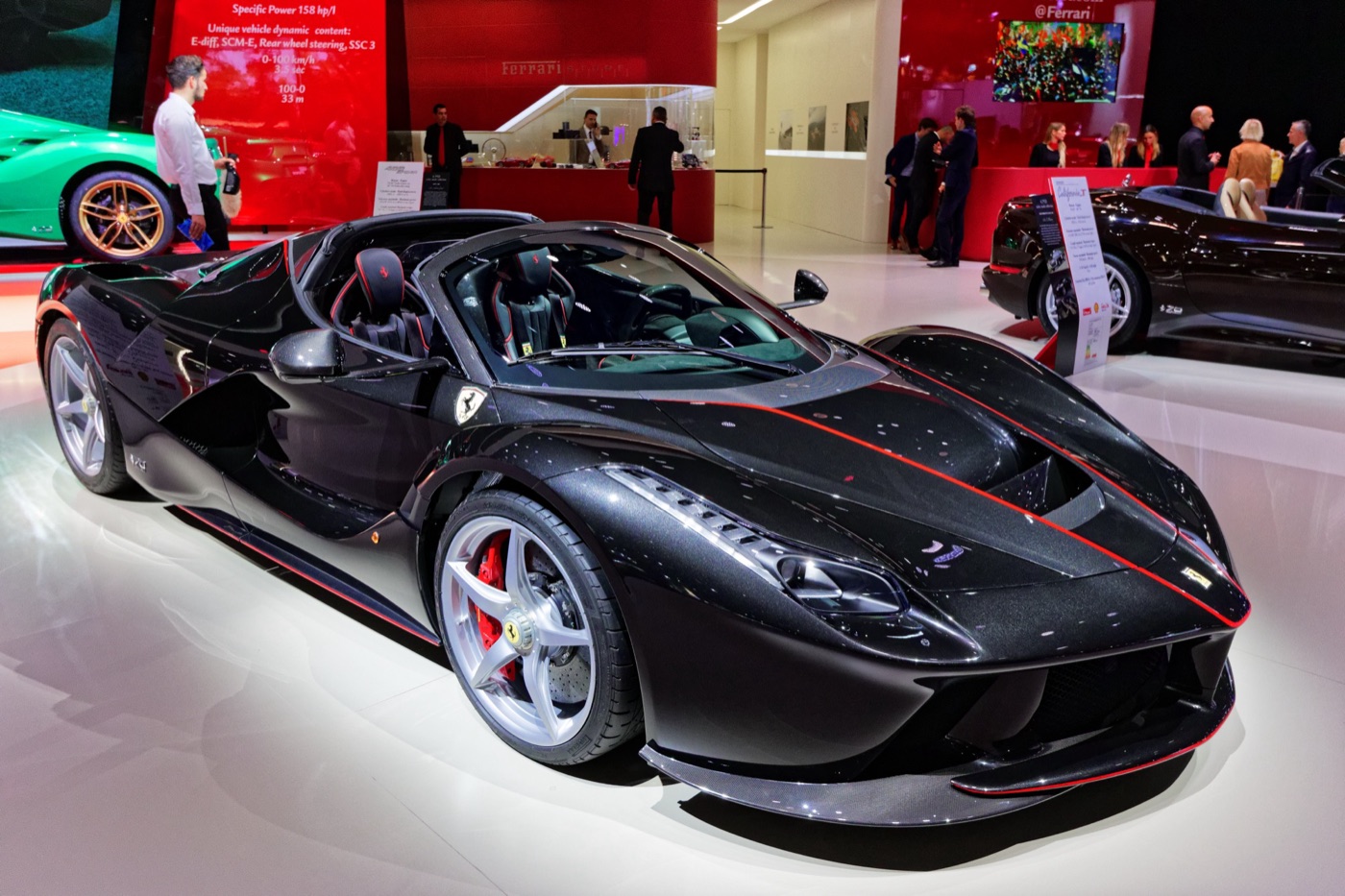
LaFerrari Aperta is the open version, built for Ferrari's 70th anniversary with a removable carbon-fibre hard top and a removable fabric roof. Ferrari published the first photographs on 5 July 2016 and said every car had already been sold after a private preview, before the name and production number were announced at the Paris motor show that autumn.
It has the coupé's 963cv powertrain. Ferrari strengthened the lower part of the tub so that the Aperta matches the coupé's torsional rigidity, beam stiffness and drag, and the doors open at a different angle, with a new carbon insert in each wheel arch. CAR reported radiators angled to send hot air under the car instead of over the bonnet, a longer front air dam, an L-shaped flap on each windscreen pillar and a 0–124mph time of 7.1 seconds. Ferrari's Aperta page gives "209 uncompromising open-top models".
A 210th was sold for charity. RM Sotheby's auctioned it at Fiorano on 9 September 2017 for €8,300,000, free of commission, for Save the Children's education programme; it was to be finished in Rosso Fuoco with a double Bianco Italia stripe. Viewers of the French television programme Auto Moto voted the Aperta their supercar of the year in December 2017.
Ferrari FXX K and FXX K Evo
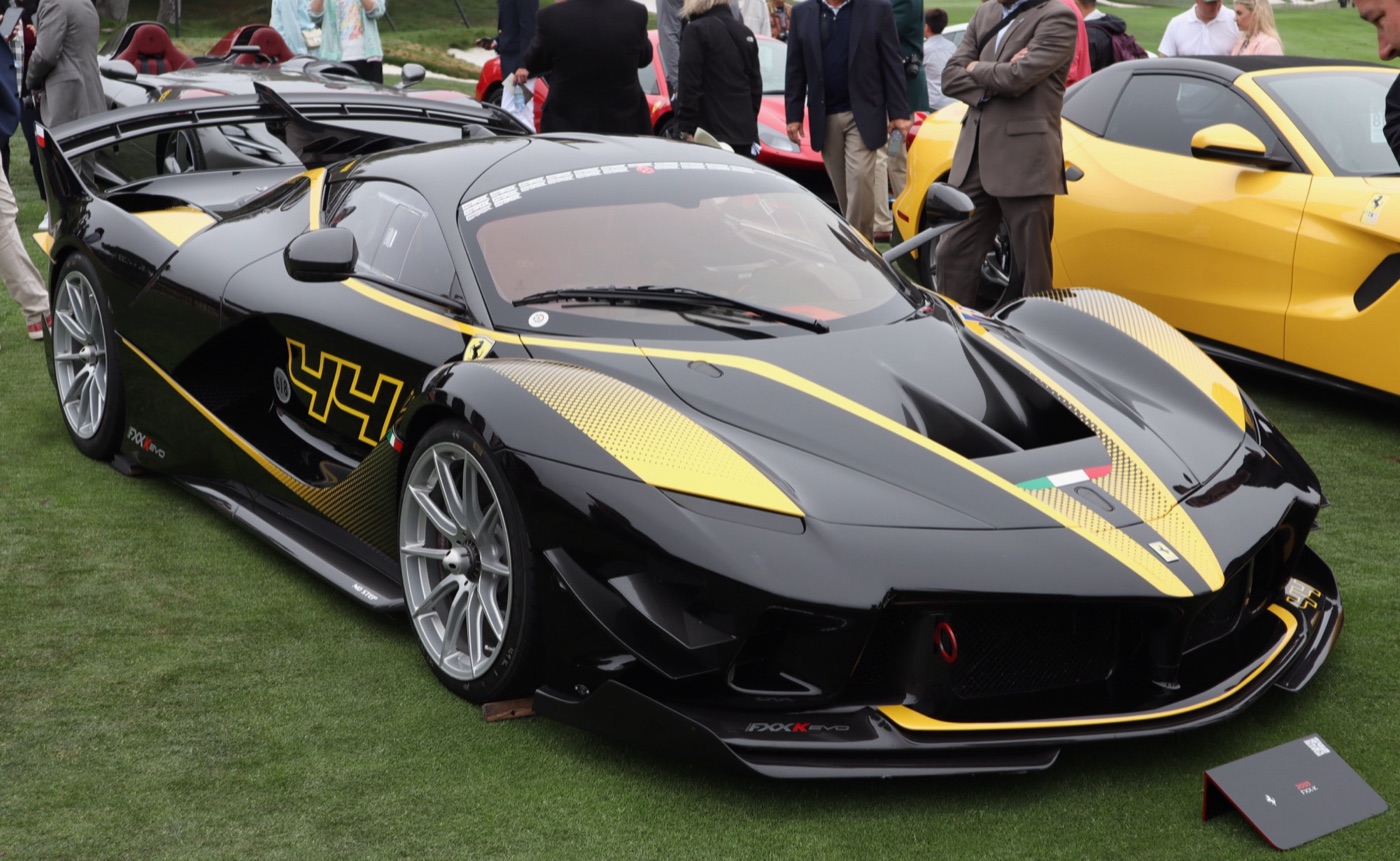
The FXX K is a track-only development car based on LaFerrari, unveiled at the 2014 Finali Mondiali at the Yas Marina circuit in Abu Dhabi, with the K standing for KERS. Ferrari's announcement gave 1,050cv, of which 860cv came from the V12 and 190cv from the electric motor, more than 900Nm and 540kg of downforce at 200km/h. It is never raced and is not homologated for the road; owners, whom Ferrari calls client test drivers, use it in the XX programme of track sessions run by its Corse Clienti department, which began with the FXX and 599XX.
Ferrari's FXX K page lists a 4,896mm body, 2,051mm wide, Pirelli slicks with sensors that read acceleration, temperature and pressure, and a four-position manettino for the hybrid: Qualify, Long Run, Manual Boost and Fast Charge. The Evo kit, introduced at the Mugello Finali Mondiali in 2017, raised the downforce coefficient by 23 per cent over the FXX K and by 75 per cent over the road car, with 640kg at 200km/h and more than 830kg at top speed, helped by a fixed twin-profile wing. RM Sotheby's described the FXX K Evo it sold in London on 1 November 2025, which had covered 5,722km, as one of about 60; it made £4,730,000.
How many LaFerraris were made?
Ferrari built 500 LaFerrari coupés: the 499 it announced in 2013 and the 500th for the earthquake fund in 2016. Add the 210 Apertas (209 for customers and one for charity) and there are 710 road cars. RM Sotheby's figure of about 60 FXX Ks is separate.
| Model | Years shown | Number | Use |
|---|---|---|---|
| LaFerrari | 2013 (Geneva) | 499 | Road |
| LaFerrari, 500th car | 2016 | 1 | Road; sold for earthquake relief |
| LaFerrari Aperta | 2016 (Paris) | 209 plus 1 sold for Save the Children | Road |
| FXX K, FXX K Evo | 2014; Evo kit 2017 | About 60, per RM Sotheby's | Track only |
How much is a LaFerrari worth?
A LaFerrari coupé is worth two to four times its price new, comparing these figures: the five coupés among RM Sotheby's seven dearest LaFerrari sales from 2025 to January 2026 made between $3.38 million and $5.48 million (two of them sold in euros and Swiss francs), against MotorTrend's $1.4 million list price, and an Aperta made $6.7 million. New, the car cost more than £1 million in Britain, according to Autocar; CAR put it at €1.2 million plus taxes, and MotorTrend's American test car was listed at $1,400,000.
The auction house's own list shows what lifts the price: very low mileage (54 miles for the $5.23 million car), unusual factory paint, options (that car carried $127,241 of them and a boot lid signed by Ferrari's workers) and a full dealer service record.
| Date | Car | Detail | Price |
|---|---|---|---|
| December 2016 | LaFerrari, the 500th | Charity sale, Daytona | $7,000,000 |
| September 2017 | LaFerrari Aperta, the 210th | Charity sale, Fiorano | €8,300,000 |
| February 2025 | 2015 LaFerrari | Giallo, 3,459km, Paris | €3,548,750 |
| August 2025 | 2015 LaFerrari | Rosso Corsa, 54 miles | $5,230,000 |
| August 2025 | 2017 LaFerrari Aperta | Nero Daytona, under 2,300 miles | $6,715,000 |
| October 2025 | 2014 LaFerrari | Grigio Ferro, 1,613km | CHF 3,323,750 |
| October 2025 | 2017 LaFerrari Aperta | Bianco Italia, 3,931km | CHF 5,292,500 |
| November 2025 | 2015 FXX K Evo | 5,722km, London | £4,730,000 |
| December 2025 | 2014 LaFerrari | Rosso Corsa, 3,701km | $3,380,000 |
| January 2026 | 2015 LaFerrari | Rosso Corsa, 1,938 miles | $5,477,500 |
Owning a LaFerrari: recalls and servicing
LaFerrari has had five safety recalls in the United States, each fixed by Ferrari dealers free of charge, according to the National Highway Traffic Safety Administration. American coupés built between 15 May 2014 and 4 March 2015 needed new headrests on the L32 seats, which failed the federal energy-absorption test (recall 15V-305), and corrected tyre-pressure warning software, which told the driver to continue at 50mph after a puncture instead of stopping (15V-306). Some 2015 cars had a wrongly assembled driver's airbag (15V-433).
The 2017 Aperta was recalled in 2019 for a fuel vapour separator that could crack and leak (19V-090). In 2022 a recall covering most Ferraris of the past two decades, including the 2013–15 LaFerrari and the Aperta, replaced brake fluid reservoir caps that might not vent, which could let fluid leak and brakes fail (22V-536), and added a low-fluid warning.
Ferrari runs a LaFerrari extended warranty and routine maintenance programme: the Aperta sold in August 2025 was covered until 31 August 2027, according to RM Sotheby's. The Swiss coupé sold in October 2025 had a documented service and battery check in June 2025, and the coupé sold in Paris in February 2025 had extended warranty cover into 2026.
LaFerrari vs McLaren P1 vs Porsche 918 Spyder
LaFerrari's rivals were the McLaren P1 and the Porsche 918 Spyder, the other hybrid hypercars of 2013. It is the most powerful of the three and the only one with a V12 and no electric-only mode. McLaren built 375 P1s with a 903bhp twin-turbo V8 and one motor; Porsche built 918 of the 918 Spyder, with a V8, two motors and four-wheel drive.
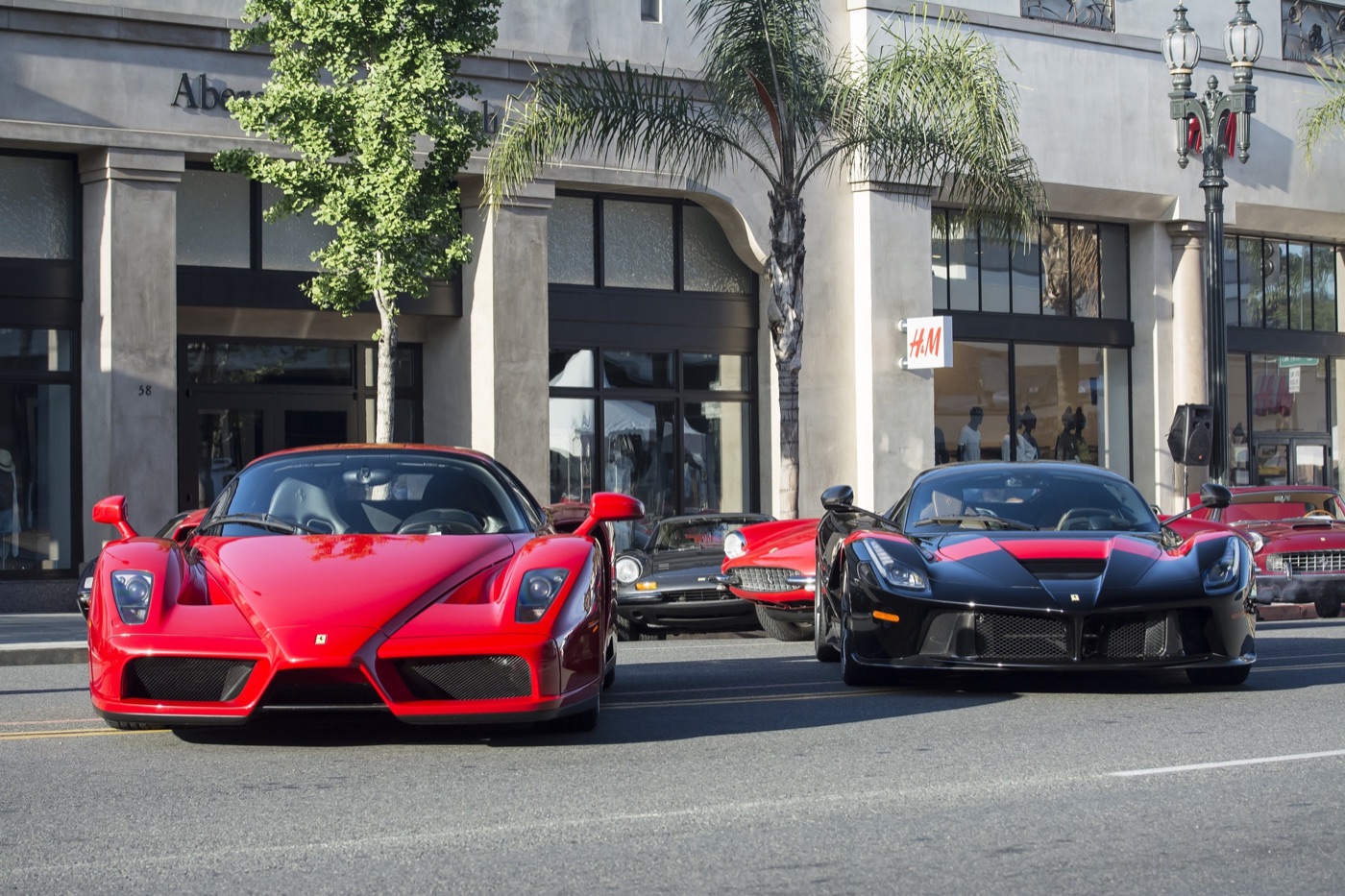
Within Ferrari, LaFerrari replaced the Enzo Ferrari of 2002, of which Ferrari built 399 for the road. It stayed Maranello's most powerful road car until the plug-in hybrid SF90 Stradale of 2019 reached 1,000cv. The next car in the series, the F80, has a 900hp V6 and an electric front axle for 1,200hp.
What reviewers said about LaFerrari
The name drew the first comments. A launch-day SkiddMark report said it "doesn't exactly trip off the tongue in English", CAR called it "so daft", and evo called it "The Ferrari so good they named it twice". Top Gear wrote that the car "looks like a spaceship, and drives like the best Ferrari ever made".
Steve Sutcliffe in Autocar found it "as natural and easy to drive as a 458 Italia", called the throttle response "just outrageous" and wrote: "However fast and furious and noisy and exciting to drive you might imagine LaFerrari to be, double it, add 20 and you might, just maybe, get somewhere close." Richard Meaden in evo called the electric motor "the ultimate silent partner", and wrote that the steering and stability control "only ever flatter your driving". Chris Chilton's verdict in CAR in 2014 was that "LaFerrari is a work of genius", with steering that was "plain lovely".
Questions
What does LaFerrari mean?
"LaFerrari" is Italian for "the Ferrari". Luca di Montezemolo, Ferrari's president, said at the launch on 5 March 2013 that the company chose it because the car was "the maximum expression of what defines our company".
What was the LaFerrari called before it was named?
Its project name was F150. The press called it F70 in 2012, after Ferrari's 70th anniversary, and Ferrari announced the name LaFerrari only at the Geneva motor show in March 2013.
Can the LaFerrari drive on electric power alone?
No. Ferrari designed the HY-KERS system to add the electric motor's 163cv to the V12 at all times, and Ferrari's magazine says the motor "was not designed to run in electric mode".
Is the FXX K road legal?
No. Ferrari built the FXX K for the track only: it is not homologated for the road and never races. Owners drive it in Ferrari's XX programme of track sessions.
Who designed the LaFerrari?
Ferrari's own styling centre under Flavio Manzoni designed the body. Rory Byrne, Ferrari's Formula 1 designer, helped design the carbon-fibre chassis.
What car replaced the LaFerrari?
The F80, Ferrari's next limited-series flagship, with a 900hp V6 and an electric front axle for 1,200hp. Between the two, the SF90 Stradale of 2019 took over as Ferrari's most powerful road car with 1,000cv.
How much did a LaFerrari cost new?
More than £1 million in Britain, according to Autocar; CAR put the price at €1.2 million plus taxes, and MotorTrend's American test car was listed at $1,400,000.
Sources
- Ferrari, "The LaFerrari unveiled at Geneva", 5 March 2013 (archived copy): name, 499 cars, Montezemolo, 330g/km.
- Ferrari, "LaFerrari: passion, technology, futuristic design and exclusivity", March 2013: requests above twice the number of cars.
- Ferrari, "HY-KERS experimental vehicle", Geneva, March 2010: the 599 hybrid prototype.
- Ferrari, LaFerrari model page (ferrari.com/en-EN/auto/laferrari), read 27 October 2026: technical data, Fiorano gain, 499 cars.
- Ferrari, LaFerrari Aperta page, and "The open-top LaFerrari arrives", 5 July 2016: the Aperta, 209 cars, roofs, chassis changes, sold out.
- Ferrari, FXX K page, and "FXX K debuts at the Finali Mondiali", 2014: outputs, downforce, manettino, Evo kit.
- Ferrari, "The 500th LaFerrari to be built", 31 August 2016, and "One-of-a-kind LaFerrari raises $7 million", 4 December 2016.
- Ferrari, Red Dot awards, 30 March 2015; Auto Moto award, 19 December 2017.
- Ferrari Magazine, "The definitive Ferrari: LaFerrari" and "The LaFerrari: a true trailblazer" (ferrari.com): design references, 0–200km/h, Fiorano, sold before unveiling, 210 Apertas, SF90 comparisons. Ferrari, Enzo Ferrari page (399 cars) and F80 page.
- RM Sotheby's, Maranello results, 11 September 2017; Paris results, 7 February 2025; London consignments and London results, November 2025.
- Sotheby's, "The seven most expensive Ferrari LaFerraris", 2026: RM Sotheby's sales from 2025 to January 2026, mileages, warranty and servicing.
- MotorTrend, "First Test: Ferrari LaFerrari", specifications, April 2015: measured weight, acceleration, braking, US price.
- US National Highway Traffic Safety Administration, recalls 15V-305, 15V-306, 15V-433, 19V-090 and 22V-536.
- CAR, "LaFerrari Aperta at Paris 2016": Aperta changes and 0–124mph.
- Porsche AG, press release 61/15, 19 June 2015: 918 Spyder production. McLaren Automotive, "Performance figures for the McLaren P1 confirmed as the first customer car is delivered", 21 October 2013: P1 output and production.
- Reviews quoted: Steve Sutcliffe, Autocar, LaFerrari review; Richard Meaden, evo, LaFerrari review; Chris Chilton, CAR, Ferrari LaFerrari (2014) review; Top Gear, Ferrari LaFerrari review.
- SkiddMark, "Judgement Day for the Holy Trinity: McLaren P1 vs Porsche 918 Spyder vs LaFerrari", 26 January 2016: the 2015 Silverstone, Bruntingthorpe and Santa Pod times (VBOX), Jackson's and the team's verdicts.
- SkiddMark: "Birth of the Ferrari F70: a study in carbon" (2 October 2012); "Ferrari F150: the grainy pictures keep on coming" (3 March 2013); "LaFerrari: the details" (5 March 2013); "Track test: Ferrari LaFerrari vs Porsche 918 Spyder vs McLaren P1" (19 September 2015).