Marco Simoncelli: 250cc world champion, MotoGP and the Sepang crash
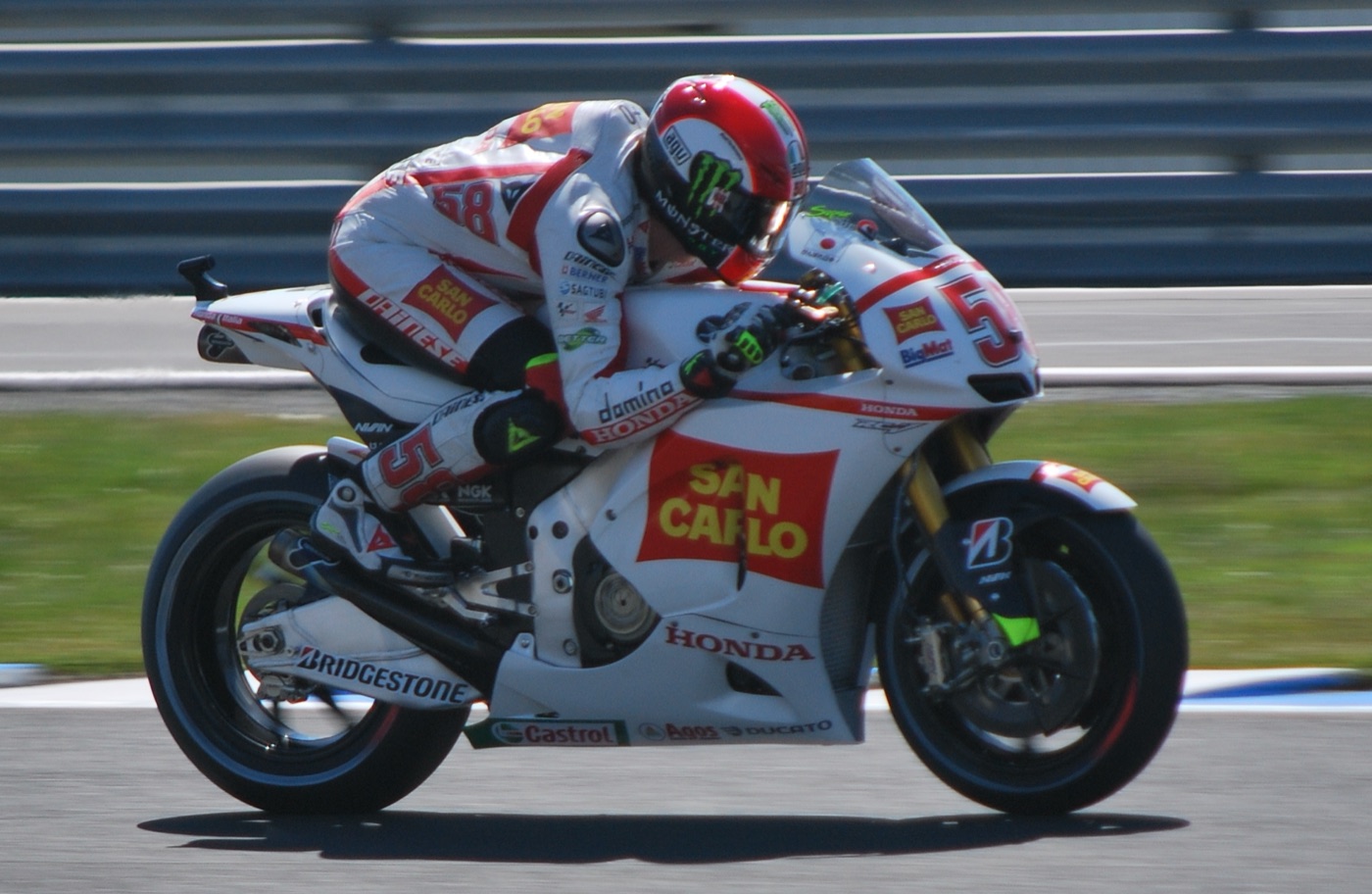
Marco Simoncelli (born in Cattolica, Italy, on 20 January 1987, died at Sepang, Malaysia, on 23 October 2011) was an Italian motorcycle racer who won the 250cc world championship for Gilera in 2008 and raced in MotoGP for the San Carlo Honda Gresini team in 2010 and 2011. He died aged 24 after a crash on the second lap of the 2011 Malaysian Grand Prix, a week after his best MotoGP result, second place at Phillip Island. In a Grand Prix career of ten seasons and 150 starts across the 125cc, 250cc and MotoGP classes he won 14 races, stood on the podium 31 times and took 15 pole positions, according to MotoGP’s official rider statistics.
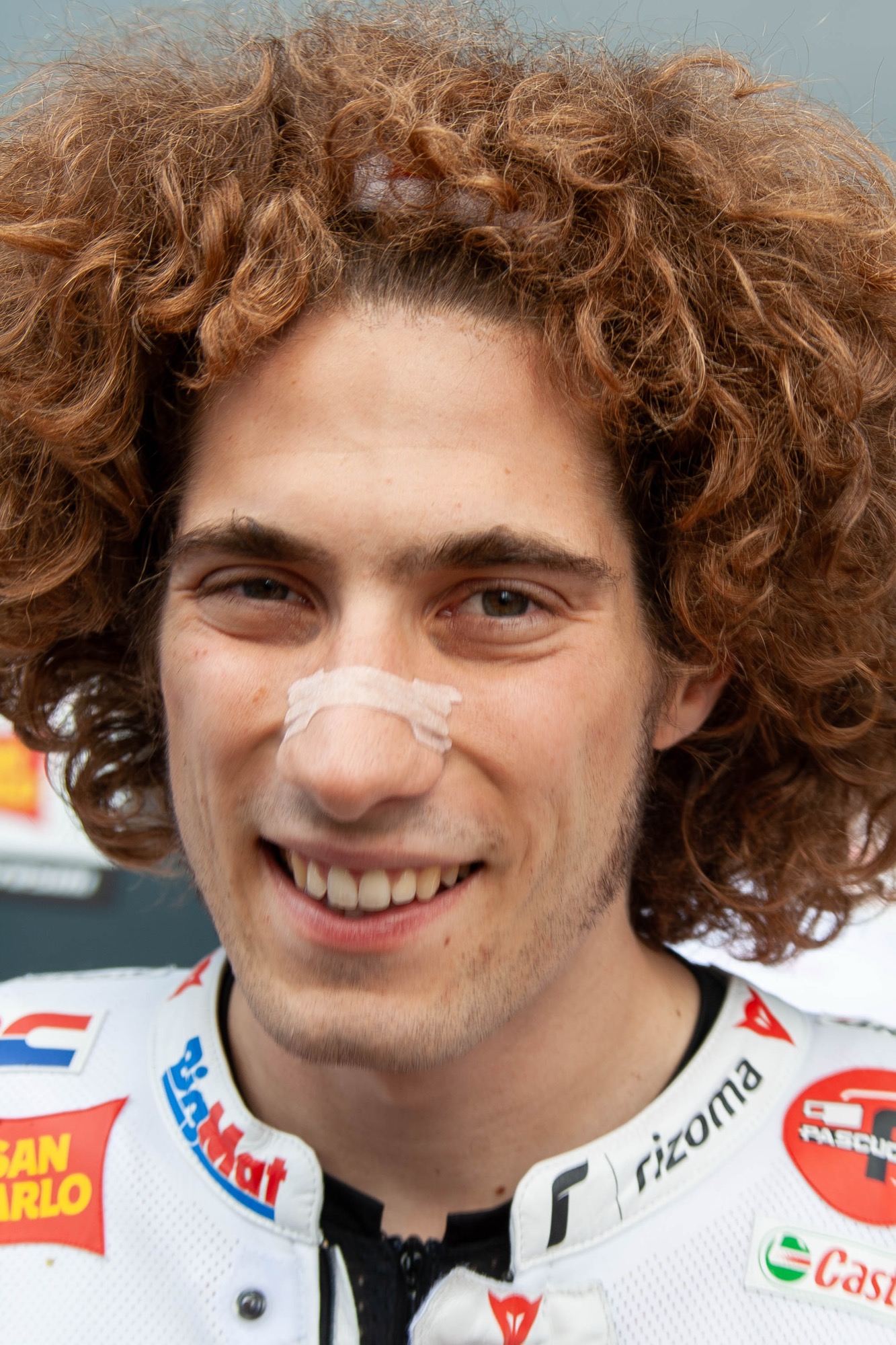
He was known as “Sic”, and to fans as “SuperSic”. At 183 cm he was tall for a motorcycle racer, and Motor Cycle News wrote that his “Jimi Hendrix replica mop of hair” made him recognisable anywhere. The Misano circuit near his home now carries his name, and MotoGP retired his race number, 58, in 2016.
Early life and minimoto in Coriano
Simoncelli was born in Cattolica on the Adriatic coast, next to the Misano circuit, and grew up in his hometown of Coriano, near Rimini. He started on minimoto, scaled-down racing motorcycles, and won the Italian Minimoto Championship twice while fighting with Andrea Dovizioso, his rival from childhood, Moto.it recalled in 2018. “We raced together since we were kids,” Dovizioso said in 2011. From minimoto he went straight to 125cc Grand Prix machinery, won the 125cc European Championship and made his world championship debut at Brno in 2002 (Moto.it; Autosport, 23 October 2011; MotoGP statistics).
125cc world championship, 2002–2005
Simoncelli raced Aprilia 125s in four seasons of the 125cc world championship and won two races, both at Jerez in Spain. His first Grand Prix, the 2002 Czech Republic Grand Prix, was the first of six starts that year, and from 2003, with the Matteoni Racing team, he raced as number 58 (MotoGP statistics).
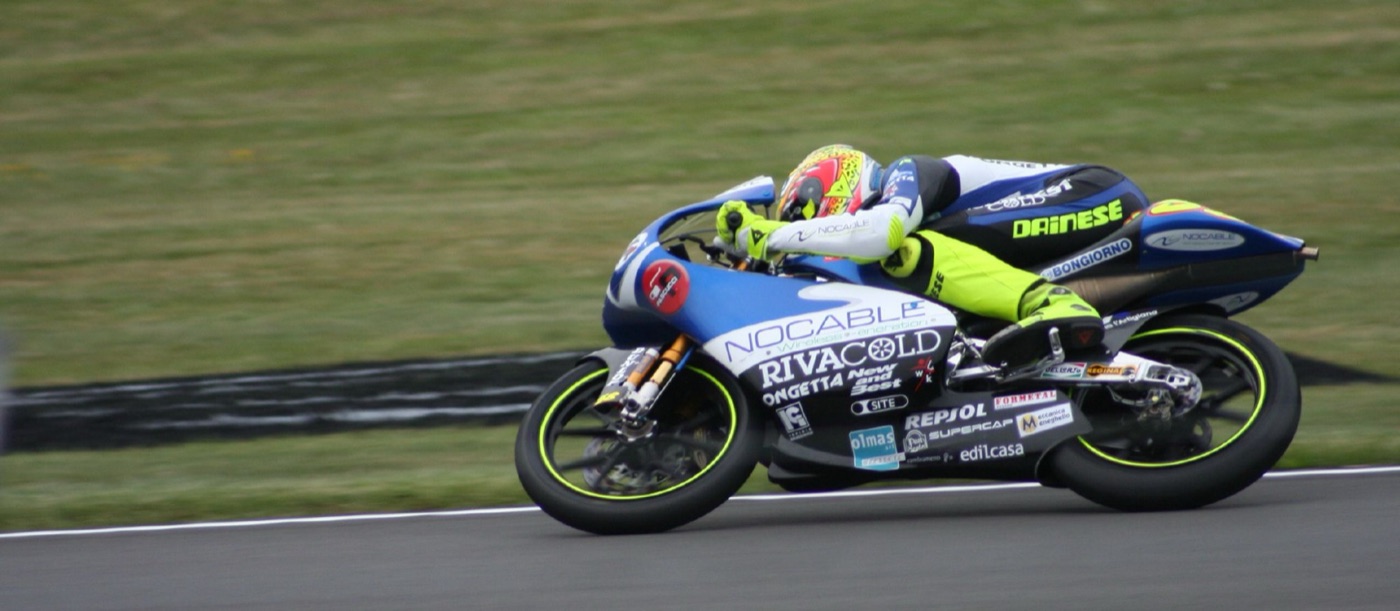
In 2004, riding for Rauch Bravo, he took his first pole position, first podium and first win at the Spanish Grand Prix, and finished the year 11th. With the Nocable.it Race team in 2005 he won at Jerez again, added five more podiums and finished fifth in the championship with 177 points. That was his last 125cc season: he was too long and heavy for the smallest class, as Moto.it put it.
The 250cc years with Gilera
Simoncelli moved up to the 250cc class in 2006 with the Metis Gilera team of the Piaggio group and stayed four seasons. He won 12 of his 64 races in the class, took 10 poles, won the title in 2008 and was third in 2009 (MotoGP statistics).
Learning the class in 2006 and 2007
He finished tenth in the championship in both seasons, with 92 points in 2006 and 97 in 2007, and did not reach the podium. His Gilera was an Aprilia under another name, Moto.it noted. In 2007 he failed to finish five of his 17 races, in a season when his crew chief missed half the year (Moto.it; MotoGP official race classifications). Gilera kept him for 2008 all the same.
How Simoncelli won the 2008 250cc title
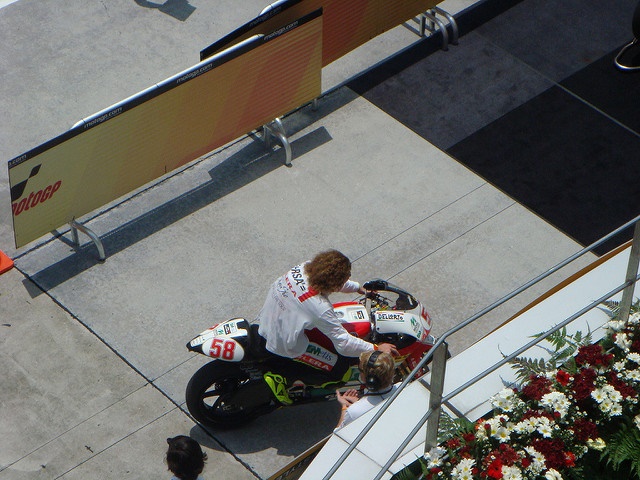
Simoncelli won the 2008 250cc world championship with six victories, twelve podiums and 281 points, and clinched the 250cc title with a race to spare by finishing third at Sepang on 19 October 2008. He started the year without a point: he fell in Qatar with a technical problem, and at Jerez he ran into Álvaro Bautista, whose engine had seized, Moto.it recorded. Gilera had started him on the older LE version of the bike, not the RSA the other factory riders had.
The turn came at Estoril, where he took his first 250cc pole and finished second. His first 250cc win followed at Mugello on 1 June, after he had collided with Héctor Barberá on the main straight and Barberá fell, and he won again in Catalonia a week later. After second at Donington and third at Assen, the Piaggio group gave him the factory RSA, InSella reported on the tenth anniversary, and on it he won at the Sachsenring, Motegi and Phillip Island.
He arrived in Malaysia 37 points ahead of Bautista. Bautista won the race; Simoncelli fought at the front until about ten laps from the end, then settled for third place once Julián Simón had retired, which was enough. It was Gilera’s eighth world title (InSella). He won the last race of the year, at Valencia, as champion.
| Grand Prix | Circuit | Result | Points |
|---|---|---|---|
| Qatar | Losail | Did not finish | 0 |
| Spain | Jerez | Did not finish | 0 |
| Portugal | Estoril | 2nd | 20 |
| China | Shanghai | 4th | 13 |
| France | Le Mans | 2nd | 20 |
| Italy | Mugello | 1st | 25 |
| Catalonia | Barcelona-Catalunya | 1st | 25 |
| Great Britain | Donington Park | 2nd | 20 |
| Netherlands | Assen | 3rd | 16 |
| Germany | Sachsenring | 1st | 25 |
| Czech Republic | Brno | 3rd | 16 |
| San Marino | Misano | 6th | 10 |
| Japan | Motegi | 1st | 25 |
| Australia | Phillip Island | 1st | 25 |
| Malaysia | Sepang | 3rd (title clinched) | 16 |
| Valencia | Ricardo Tormo | 1st | 25 |
Source: MotoGP official race classifications. No 250cc race was run at Indianapolis in 2008.
Defending the title in 2009
Simoncelli won six races in 2009 but finished third in the championship with 231 points; Hiroshi Aoyama took the title (Autosport). The season started badly. In April he broke the scaphoid in his right wrist in a fall from a motocross bike while training with Valentino Rossi, had a titanium screw fitted, and withdrew from the opening race in Qatar after the second practice session (Motor Cycle News, April 2009; Crash.net). “It is basically too painful for me to continue and I am not going to take any chances,” he said. His wins came at Le Mans, the Sachsenring, Brno, Indianapolis, Estoril and Phillip Island (MotoGP statistics).
A World Superbike podium at Imola
In September 2009 Aprilia gave Simoncelli a one-off ride on its RSV4 Factory at the Imola round of the World Superbike championship. He crashed out of race one from fifth place and finished third in race two, 6.510 seconds behind the winner, Michel Fabrizio, after passing his team-mate Max Biaggi at the final chicane, WorldSBK’s race report records. “I braked too hard and I think ‘either I hit him and we crash or I try to pass’,” Simoncelli said. “I succeeded and I am very happy.”
MotoGP with San Carlo Honda Gresini
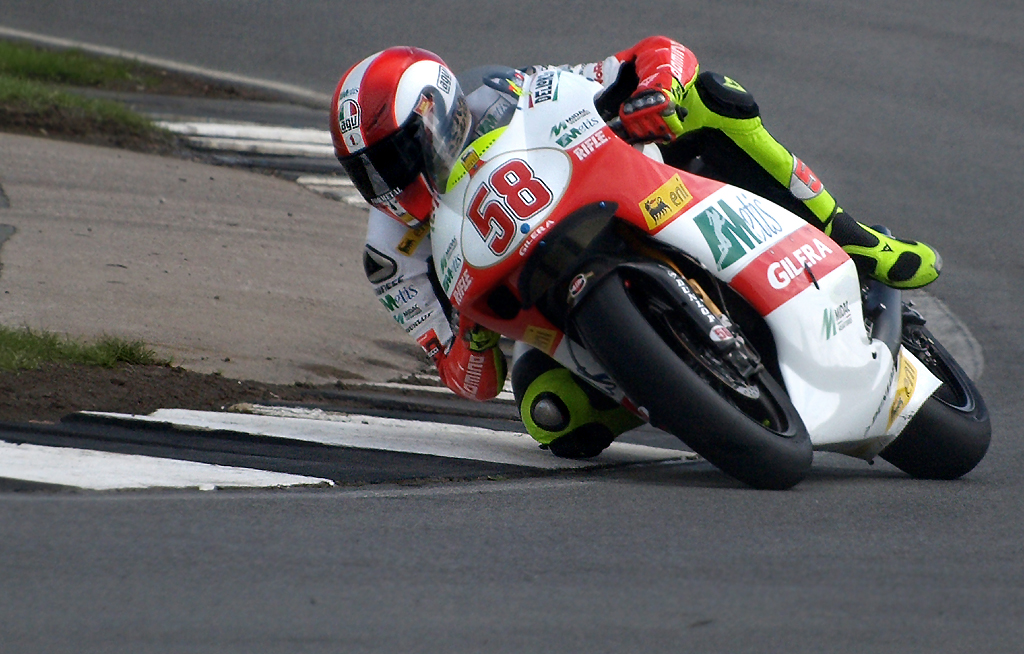
Simoncelli raced in MotoGP for Fausto Gresini’s San Carlo Honda Gresini team on the Honda RC212V in 2010 and 2011, and in 34 starts scored two podiums and two poles. He had signed to stay with the team on factory Honda equipment for 2012 (Autosport).
The 2010 rookie season
He made his MotoGP debut in Qatar in April 2010 and finished 11th. He scored points in 16 of his 18 races and finished eighth in the championship with 125 points, and Autosport noted that he grew more competitive as the season went on (MotoGP statistics).
Poles, podiums and the Pedrosa clash in 2011
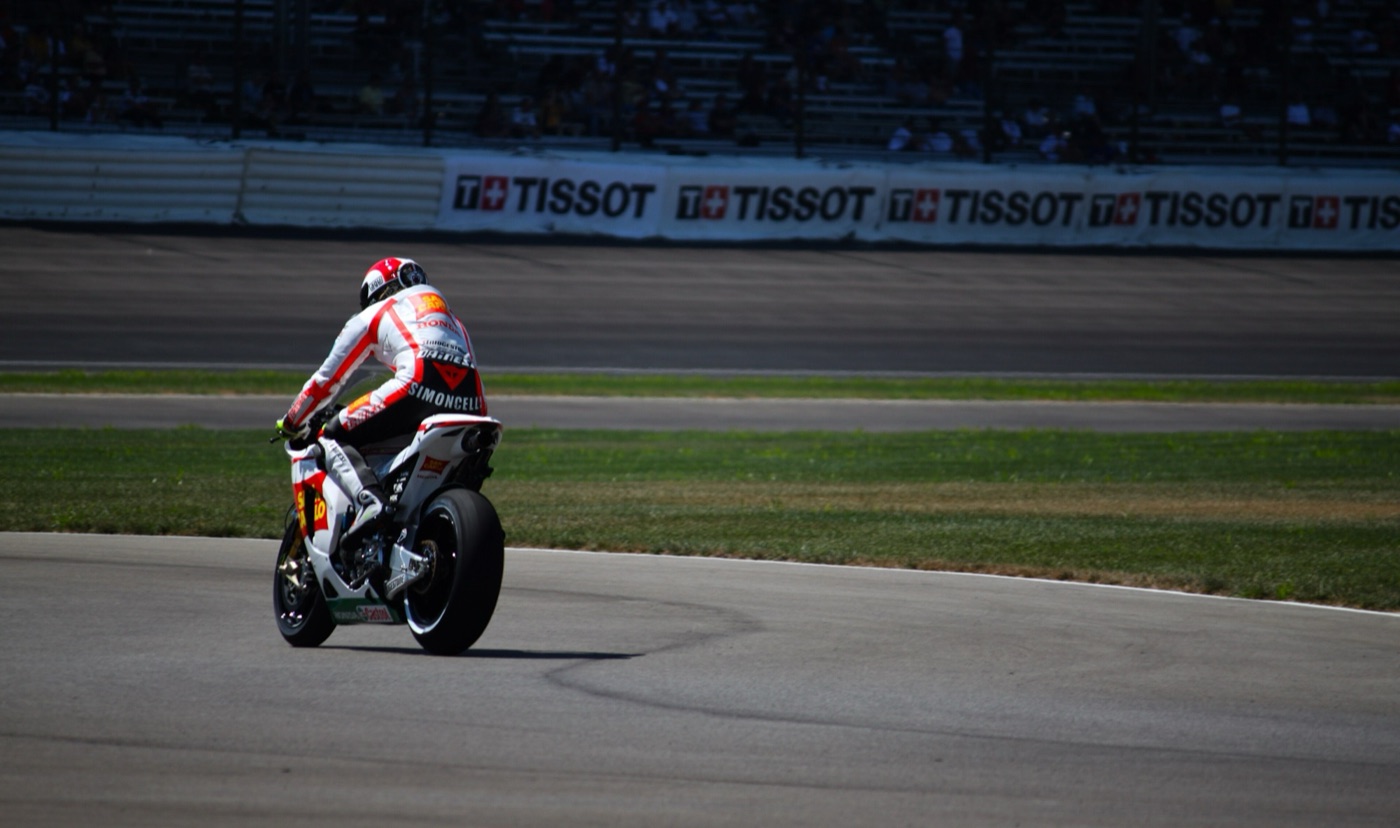
In 2011 Honda gave him factory-specification machinery. He started from pole position at Catalunya and Assen in a run of six straight front-row starts for the Gresini team, Autosport reported, but crashes kept him from the results his speed promised. Lorenzo and Dovizioso were among the most vocal critics of what they saw as his over-aggressive riding style (Autosport). At Estoril in April the reigning champion, Jorge Lorenzo, criticised him in a press conference: “I don’t like the way he overtakes, he is too aggressive,” the New Zealand Herald quoted him.
At Le Mans on 15 May, on lap 18 of 28, Dani Pedrosa passed Simoncelli for second on the back straight. Simoncelli went round the outside of him into the esses that follow, they touched, and Pedrosa fell and broke his collarbone, Crash.net reported. Race Direction gave Simoncelli a ride-through penalty, which dropped him from second to seventh; he recovered to fifth (Autosport, May 2011). He said his telemetry showed he had braked at the same point as on earlier laps, and that the penalty was “a result of all the talk over the past few days”. Rossi, his friend, disagreed: “He didn’t leave space for Dani.” Race Direction called him to a meeting at the next race, in Catalonia, and he later said: “Overall, on reflection, I have realised where I have gone wrong” (New Zealand Herald).
His first MotoGP podium finish was third at Brno on 14 August, behind Casey Stoner and Andrea Dovizioso. Honda’s Shuhei Nakamoto told him afterwards it was a “lucky podium”, to push him on, he recalled after Simoncelli’s death. Simoncelli was fourth at Misano, Aragón and Motegi, and on 16 October at Phillip Island he finished second to Stoner, the career-best result of his second MotoGP campaign (BBC Sport, 24 October 2011; MotoGP statistics). He is recorded sixth in the 2011 standings, with 139 points.
Marco Simoncelli’s career results by season
Simoncelli started 150 world championship Grands Prix between 2002 and 2011 and won one title, the 250cc championship of 2008.
| Season | Class | Team and bike | Starts | Wins | Podiums | Poles | Points | Position |
|---|---|---|---|---|---|---|---|---|
| 2002 | 125cc | Aprilia | 6 | 0 | 0 | 0 | 3 | 33rd |
| 2003 | 125cc | Matteoni Racing, Aprilia | 16 | 0 | 0 | 0 | 31 | 21st |
| 2004 | 125cc | Rauch Bravo, Aprilia | 14 | 1 | 1 | 2 | 79 | 11th |
| 2005 | 125cc | Nocable.it Race, Aprilia | 16 | 1 | 6 | 1 | 177 | 5th |
| 2006 | 250cc | Metis Gilera | 16 | 0 | 0 | 0 | 92 | 10th |
| 2007 | 250cc | Metis Gilera | 17 | 0 | 0 | 0 | 97 | 10th |
| 2008 | 250cc | Metis Gilera | 16 | 6 | 12 | 7 | 281 | 1st |
| 2009 | 250cc | Metis Gilera | 15 | 6 | 10 | 3 | 231 | 3rd |
| 2010 | MotoGP | San Carlo Honda Gresini, Honda | 18 | 0 | 0 | 0 | 125 | 8th |
| 2011 | MotoGP | San Carlo Honda Gresini, Honda | 16 | 0 | 2 | 2 | 139 | 6th |
| Total | 150 | 14 | 31 | 15 | 1,255 |
Source: MotoGP official rider statistics. He also scored 16 World Superbike points at Imola in 2009.
How did Marco Simoncelli die?
Simoncelli died at the age of 24 of very serious injuries to his head, neck and chest after he fell at Turn 11 on the second lap of the Malaysian Grand Prix at Sepang on 23 October 2011 and was struck by the bikes of Colin Edwards and Valentino Rossi. He was declared dead at 16:56 local time, less than an hour after the crash. He had qualified fifth on the grid, and was in fourth position, fighting with Álvaro Bautista, when he fell (MotoGP statistics; Autosport).
The crash at Turn 11
The accident began when Simoncelli lost the rear and then the front of his Honda as he left Turn 11, an 80 mph corner. The tyres kept gripping on their edges, so instead of sliding away to the outside of the track the bike carried on round in an arc, back across the racing line in front of Edwards and Rossi, Mat Oxley wrote in Motor Sport in January 2012. Officials who studied the footage believed the tyres never lifted from the track, possibly because the bike was propped on Simoncelli’s right leg, so he could not push it away. Edwards and Rossi had no room to avoid him, and both bikes hit him.
His helmet came off in the impact. The race was stopped at once with the red flag; officials at first meant to restart it, then cancelled it once the extent of his injuries became clear (BBC Sport, 23 October 2011). Edwards, the American, fell and dislocated his shoulder. Rossi stayed on his bike and rode back to the pits.
Medical treatment and the official statement
At a press conference that evening the medical director, Dr Michele Macchiagodena, gave the sequence of events, as MotoGP.com published it. Simoncelli was unconscious when the medical staff reached him. He went into cardiac arrest in the ambulance, where cardiopulmonary resuscitation began; in the circuit medical centre he was intubated, with the help of the Clinica Mobile’s doctor and local doctors, and blood was drawn from his chest. “The CPR was continued for 45 minutes because we tried to help him for as long as we thought it was possible,” Macchiagodena said. “Unfortunately it was not possible to help him and at 16:56 (local time) we had to declare he was dead.” MotoGP’s statement ended: “Everybody involved in MotoGP extends its deepest condolences to Marco’s family, friends and team at this tragic loss” (BBC Sport).
His was the first death in MotoGP since Daijiro Katoh was fatally injured at the 2003 Japanese Grand Prix. A year before, the Moto2 rider Shoya Tomizawa had died at Misano in a similar crash, and Simoncelli’s death came a week after the IndyCar driver Dan Wheldon was killed at Las Vegas (BBC Sport).
Why did Simoncelli’s helmet come off?
The chin strap of his AGV helmet broke at its mounting point, and the helmet was wrenched off, probably by the front of Rossi’s Ducati, Oxley reported. Franco Uncini, the 1982 500cc world champion and MotoGP’s safety officer, said the FIM would examine the helmet and leathers, and that helmet straps had to withstand a minimum breaking load of 750 kilos. “It sounds bad, but we think nothing could have been done to avoid the tragic outcome,” Uncini said. Ferry Brouwer, recently retired after two decades in the helmet industry, disagreed: “Under no circumstances should a helmet come off a rider’s head,” he told Oxley, and called for a separate standard for racing helmets. At the time, racing helmets only had to meet the general standards of Europe, Japan or the United States.
On the night of the crash the race director, Paul Butler, said the circumstances would be “thoroughly investigated”. The Sepang circuit chairman, Mokhzani Mahathir, called it “a one-of-a-kind freak incident where the helmet came off” (BBC Sport), and told AFP that the organisers would look at safety “from every angle again”, while describing the track as safe (Gulf Times, October 2011).
Reaction in the paddock and beyond
“Simoncelli for me was like a youngest brother,” Rossi wrote in his tribute on Twitter. “So strong on track and so sweet in the normal life. I will miss him a lot.” His manager, Carlo Pernat, said: “He could have become world champion one day. He had this desire to get to the top, it was really inside him, there was this desire for success because he knew he could have it” (BBC Sport). Major Italian sports events that day held a minute’s silence, and AC Milan, the team Simoncelli supported, wore black armbands against Lecce (BBC Sport). The first Indian Grand Prix in Formula One, a week later, was preceded by a minute’s silence, and Jenson Button, Sebastian Vettel and Fernando Alonso dedicated the race to Simoncelli and Wheldon. “These are sad weeks for motorsport,” Alonso said (BBC Sport, 30 October 2011).
The crash was also replayed endlessly online. A SkiddMark comment piece published on the day criticised the editors, bloggers and forum users who rushed to post the footage and photographs of the reactions, and SkiddMark counted nearly 50 copies of the same clip among the 60 most-watched YouTube videos worldwide in the first days after the race.
The funeral in Coriano
Simoncelli’s funeral was held on Thursday 27 October 2011 at the church of Santa Maria Assunta in Coriano. The day before, more than 10,000 people had queued in the rain to pass his coffin in the town theatre, and on the day the service was shown on big screens outside the church, on Italian television and to more than 10,000 people at the Misano circuit, AFP reported in the Taipei Times. His 2008 title-winning Gilera and his 2011 Honda stood beside the coffin, with his helmet on top of it.
Rossi, Giacomo Agostini, Loris Capirossi, Dovizioso, Jorge Lorenzo and Mattia Pasini were among the riders there, with Fausto Gresini, the Dorna CEO Carmelo Ezpeleta and Dr Claudio Costa of the Clinica Mobile (Crash.net). At the end Rossi started Simoncelli’s Honda, revved it and wheeled it out to Vasco Rossi’s “Siamo solo noi”, Simoncelli’s favourite song. Lorenzo wrote in the book of remembrance: “I’ll always remember you. Forgive me for having argued with you.”
At the season finale in Valencia on 6 November, riders from all three classes rode a tribute lap in his memory behind Kevin Schwantz, the 1993 500cc champion and a friend, on Simoncelli’s RC212V, and the lap ended with a two-minute display of traditional Valencian firecrackers (Crash.net; FIM). Capirossi ran the number 58 in his own last Grand Prix that day.
What is named after Marco Simoncelli?
The Misano circuit, a Coriano centre for disabled people and his father’s racing team carry his name, and MotoGP has made him a Legend and retired his number.
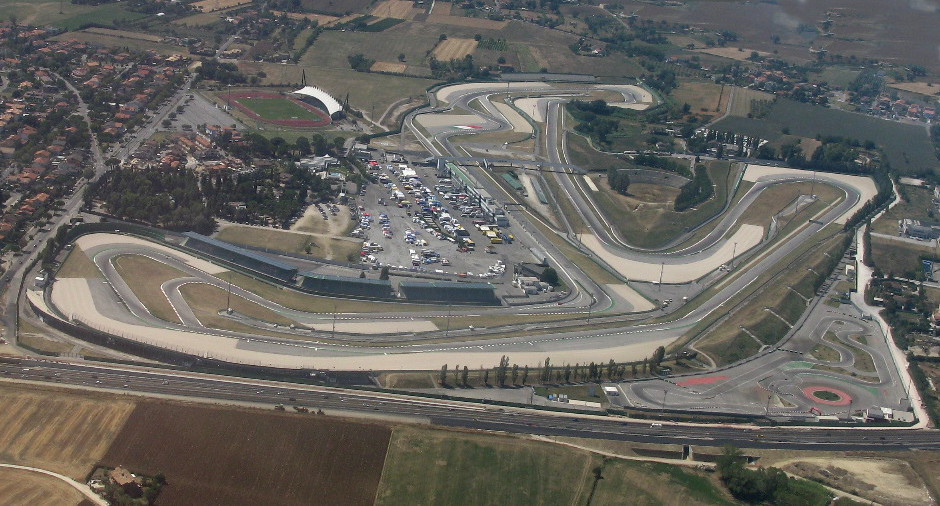
Misano World Circuit Marco Simoncelli
On 3 November 2011 the board of Santamonica Spa, the company behind the Misano circuit, voted unanimously to give the circuit Simoncelli’s name, and undertook not to use the name for marketing (MotoGP.com, 3 November 2011). “We owe it to the memory of Sic,” said the circuit’s vice-president, Lucas Colaiacovo. The new name, Misano World Circuit Marco Simoncelli, and its logo were unveiled on 9 June 2012 with Paolo Simoncelli present; the designer Aldo Drudi drew the double “l” in Simoncelli in the red of the stripes on Marco’s helmet (WorldSBK). The circuit hosts the San Marino Grand Prix.
MotoGP Legend
Ezpeleta inducted Simoncelli into the MotoGP Legends Hall of Fame on 30 May 2014, the first day of the Italian Grand Prix at Mugello, and Paolo Simoncelli accepted the medal. The FIM wrote that his “charisma, ability and racing style” had won him millions of fans. He was the 21st rider to be made a Legend, after Casey Stoner in 2013 (FIM; Motor Cycle News).
Why is number 58 retired in MotoGP?
MotoGP retired the 58 in Simoncelli’s honour at a ceremony at Misano on 8 September 2016, before the San Marino Grand Prix, and handed it to his family. “Today we say to Marco’s father, Paolo, that from now this number belongs to the Simoncelli family,” Ezpeleta said. “Nobody will use it, unless they decide somebody can use this number” (Crash.net, 8 September 2016). Numbers had been retired before after the deaths of Daijiro Katoh (74) and Shoya Tomizawa (48), and in honour of Kevin Schwantz (34) and Loris Capirossi (65) (Autosport).
SIC58 Squadra Corse and the Marco Simoncelli Foundation
Paolo Simoncelli set up a racing team in his son’s memory, and the family’s foundation built a centre for disabled people in Coriano.
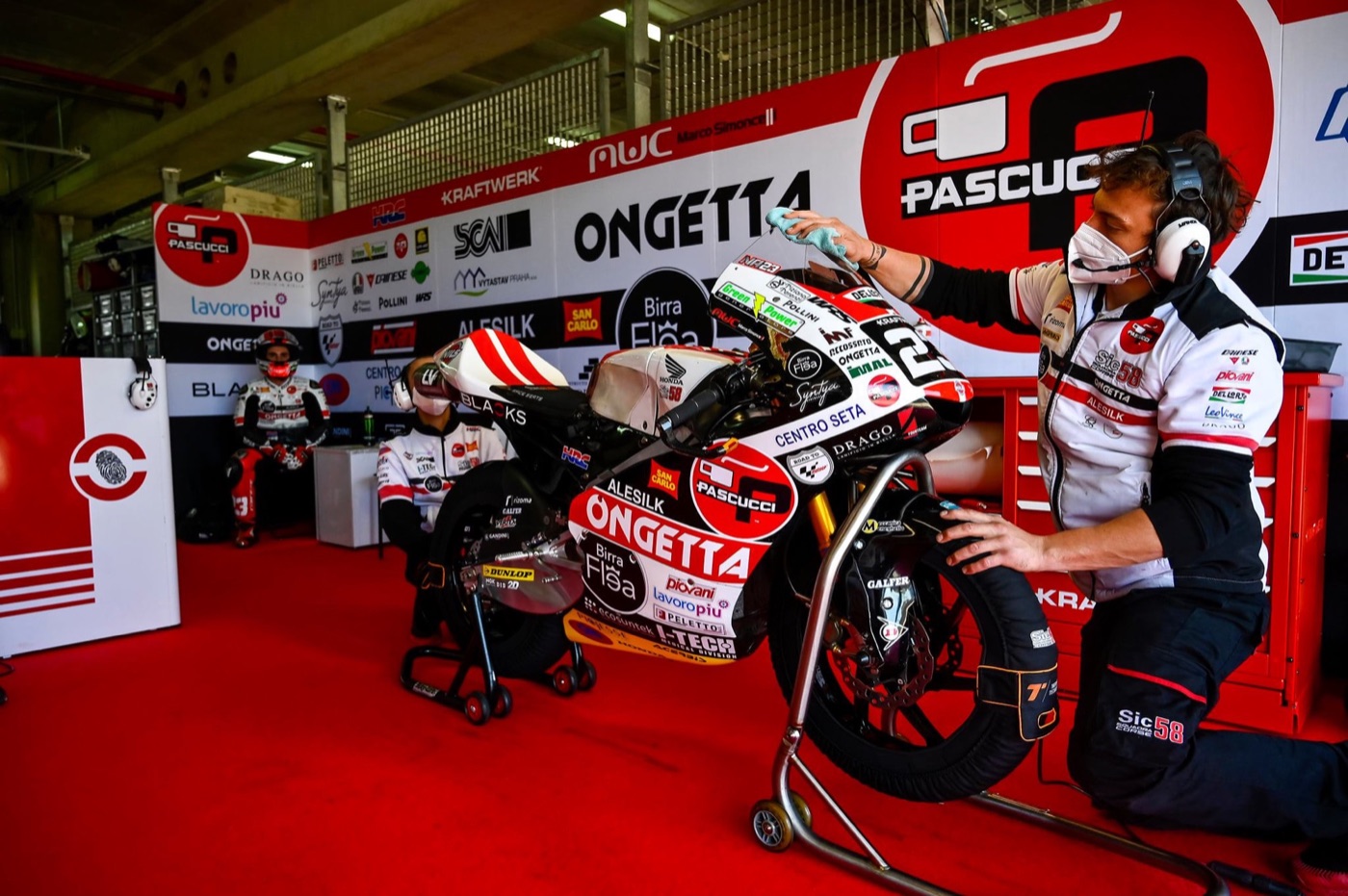
SIC58 Squadra Corse
SIC58 Squadra Corse raced in the FIM CEV Repsol championship in Spain before it entered the Moto3 world championship in 2017, a move Ezpeleta announced at the 2016 number ceremony (Cycle News). At Misano on 15 September 2019 the team’s Tatsuki Suzuki won the San Marino Moto3 race from pole position, his first Grand Prix win (Motorsport.com).
Casa Marco Simoncelli
Casa Marco Simoncelli, a day centre in Coriano for young people with severe disabilities, opened on 20 January 2019, his birthday: Simoncelli would have turned 32. The Fondazione Marco Simoncelli built it for €2.2 million, raised at events held in his memory and from private donations. It covers 1,700 square metres on three floors, with two hydrotherapy pools and a gym, and the Comunità Montetauro of Coriano runs it (Sky Sport Italia, 20 January 2019).
Simoncelli, Rossi and the VR46 Academy
Rossi and Simoncelli spent much of their time together from 2006 to 2011, and Rossi calls Simoncelli the first rider of the VR46 Academy, the training programme for young Italian riders that grew up after his death. “I still remember the moment after the race in Malaysia like one of the worst moments of my life,” Rossi told The Race ten years later. “I always say that Marco was the first rider of the Academy, even if the Academy didn’t exist.” The VR46 chief executive, Albi Tebaldi, said the academy came in part from the loss: “Marco was the one guy who could train with Valentino at the same level.” That weekend at Misano, Rossi’s last Italian race, Francesco Bagnaia, the academy’s most successful rider, took pole position.
Questions
How old was Marco Simoncelli when he died?
He was 24. His date of birth was 20 January 1987, and he died at the Sepang International Circuit in Malaysia on 23 October 2011, declared dead at 16:56 local time.
What number did Marco Simoncelli race with?
He raced as number 58 from 2003. MotoGP retired the number at Misano on 8 September 2016 and gave it to his family, who decide whether anyone else may use it.
Why was Marco Simoncelli called Sic?
SIC was the abbreviation of his name on the official timing screens, chosen so that it did not clash with Julián Simón’s, Moto.it noted. Fans also called him SuperSic, the name the FIM used when he was made a MotoGP Legend in 2014.
Did Marco Simoncelli ever win a MotoGP race?
No. His best MotoGP result was second at Phillip Island on 16 October 2011, a week before he died. His 14 Grand Prix wins came in the 125cc (two) and 250cc (twelve) classes.
Who was involved in Marco Simoncelli’s crash?
Colin Edwards and Valentino Rossi, on his Ducati, hit Simoncelli and his Honda as they slid back across the track at Turn 11. Edwards fell and dislocated his shoulder; Rossi stayed on his bike.
What bike did Marco Simoncelli win his world title on?
A Gilera RSA 250 of the Metis Gilera team, the Piaggio group’s 250cc entry. He began 2008 on the older LE version and got the factory RSA after the Dutch TT.
Is Marco Simoncelli’s father still in racing?
Yes. Paolo Simoncelli runs SIC58 Squadra Corse, which has raced in the Moto3 world championship since 2017 and won the 2019 San Marino Moto3 race with Tatsuki Suzuki.
Sources
- MotoGP (Dorna), official rider statistics and race classifications for Marco Simoncelli, read 28 October 2026: starts, wins, podiums, poles, points and positions by season; the 2008 and 2011 results; birth date and height.
- Moto.it, “Simoncelli, 10 anni fa il suo titolo”, October 2018: minimoto, the 125cc years, the 2007 and 2008 seasons.
- InSella, “Marco Simoncelli: 10 anni fa campione del mondo”, 19 October 2018: the factory RSA, the Sepang title race, Gilera’s eighth title.
- Autosport, “Simoncelli dies from injuries suffered in Malaysian GP crash”, 23 October 2011: the European title, the 2009 title, the 2011 poles and front rows, his 2012 contract, his position when he fell.
- Motor Cycle News, “Simoncelli withdraws from 250GP race”, 11 April 2009 and Crash.net, “Marco Simoncelli fractures wrist”, April 2009: the wrist injury.
- WorldSBK, Imola race report, 27 September 2009: the Superbike results and his quote.
- Crash.net, “Simoncelli defends Pedrosa pass”, 16 May 2011 and Autosport, “Simoncelli summoned by officials”, May 2011: Le Mans and the penalty.
- New Zealand Herald, “Inquiry to consider if Simoncelli was at fault”, October 2011: Lorenzo’s and Simoncelli’s quotes.
- BBC Sport, “Marco Simoncelli dies after MotoGP crash in Sepang”, 23 October 2011 and “Valentino Rossi pays tribute to Marco Simoncelli”, 24 October 2011: the crash, the statement, Katoh and Tomizawa, the tributes.
- MotoGP.com, “Race Direction press conference: Marco Simoncelli”, 23 October 2011 (archived copy): the medical account and Edwards’s injury.
- Mat Oxley, “Unavoidable tragedy?”, Motor Sport, January 2012, p. 41: how the crash happened, the helmet strap, Uncini and Brouwer.
- Gulf Times (AFP), “Sepang chairman vows safety review”, October 2011.
- BBC Sport, “Jenson Button dedicates Indian GP to Dan Wheldon and Marco Simoncelli”, 30 October 2011.
- Taipei Times (AFP), 29 October 2011 and Crash.net, “Friends, rivals salute Simoncelli at funeral ceremony”, 27 October 2011: the funeral.
- Crash.net, “Kevin Schwantz to lead Simoncelli lap of honour”, November 2011 and FIM, “Valencia pay tribute to Marco Simoncelli”, November 2011: the Valencia lap.
- MotoGP.com, “Misano circuit name to be associated with Simoncelli”, 3 November 2011 (archived copy) and WorldSBK, “Misano World Circuit now named after Marco Simoncelli”, 9 June 2012.
- FIM, “Simoncelli honoured as MotoGP Legend”, May 2014 and Motor Cycle News, “Simoncelli honoured as legend”, 30 May 2014: the Hall of Fame, the nickname and his hair.
- Crash.net, 8 September 2016, Autosport, September 2016 and Cycle News, September 2016: the number 58, the other retired numbers, Capirossi at Valencia, SIC58 Squadra Corse.
- Motorsport.com, “Misano Moto3: Suzuki takes maiden win, drama for Canet”, 15 September 2019.
- Sky Sport Italia, “Casa Marco Simoncelli, inaugurazione a Coriano”, 20 January 2019.
- The Race, “‘I was desperate’: Rossi on losing Simoncelli and creating VR46”, 23 October 2021.
- SkiddMark, “Comment: Marco Simoncelli (1987–2011)”, 23 October 2011: the crash footage online.