McLaren 12C: the MP4-12C's history, specification, variants and values
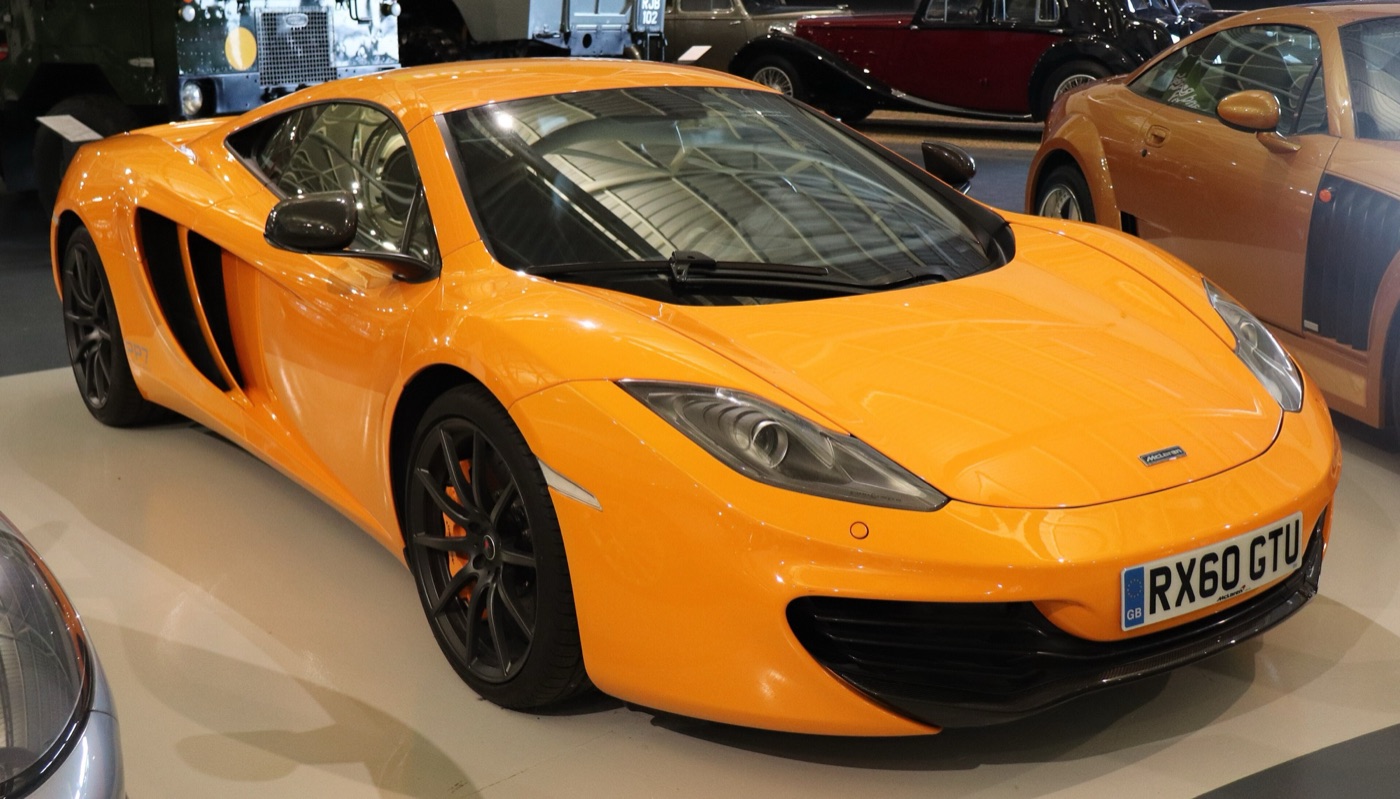
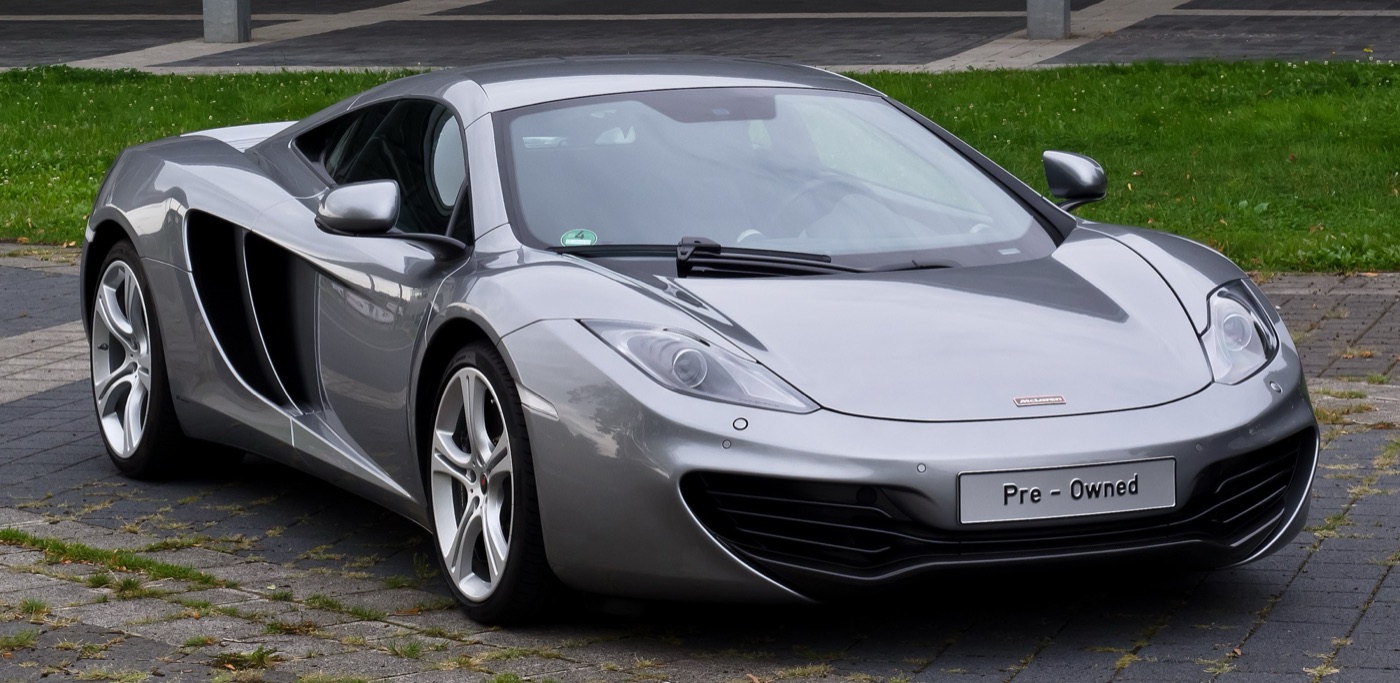
The McLaren 12C, launched in 2011 as the MP4-12C, is the mid-engined supercar that McLaren Automotive built in Woking, Surrey, from 2011 to 2014: the first car the company designed and built on its own since the McLaren F1. A 3.8-litre twin-turbo V8 behind a one-piece carbon-fibre tub gave it 600PS (592bhp) at launch and 625PS (616bhp) from 2012, it cost £168,500 new, and about 3,500 were sold before the 650S replaced it.
People look it up as the car that started McLaren's road-car range, as the rival to the Ferrari 458 Italia, and for what one costs now: a 2014 12C Spider with 18,300 miles sold at auction in Northamptonshire in May 2025 for £70,875.
History and development of the McLaren 12C
McLaren Automotive developed the 12C in the second half of the 2000s, showed it in pictures in September 2009, drove it in public at Goodwood in July 2010 and began building customer cars in February 2011. McLaren had not sold a car of its own design since the F1 ended production in 1998; in between it had engineered and built the Mercedes-Benz SLR McLaren for Daimler, 2,114 of them between 2003 and 2009 according to McLaren's launch press release of 18 March 2010.
Ferrari mules and the P11 project
The car was known inside McLaren as P11. Its first test mules were other makers' cars: Road & Track's history of the programme records that McLaren filled two Ferrari 360s with 12C parts and built an Ultima GTR mule, as it had for the F1 in 1991, and that it had running mules by 2007. Car and Driver, at the press launch in 2011, called the car the fruit of a seven-year project.
PistonHeads' 2020 buying guide sets out the brief the team was given: like Gordon Murray's F1, the 12C had to appeal to aesthetes as much as to drivers, but it also had to sell at a price as close to £150,000 as possible and in numbers that made a profit.
The 2010 press release named the next stage: XP-Beta development cars, tested in New Zealand, Arizona and Spain and on the Nürburgring Nordschleife before the first customer car was built.
The reveal, Goodwood and the launch
CAR magazine published the first official pictures in September 2009, with McLaren's own release: the MP4-12C was to be "pure McLaren", with no carry-over parts from any other car, aimed at what McLaren called the "core" sports car market of £125,000 to £175,000. McLaren planned to build 1,000 cars in the first year and expected a quarter of them to go to the US and a quarter to the UK.
On 18 March 2010 McLaren gave out the first performance data at the McLaren Technology Centre, where CAR reported that Lewis Hamilton and Jenson Button had driven the car at Goodwood on 2 March. "I got on the phone to Ron afterwards and said, 'When can I get delivery?' but he hasn't come back to me yet," Hamilton said. The public debut followed at the Goodwood Festival of Speed, 1 to 4 July 2010: a SkiddMark report from the event recorded that managing director Antony Sheriff drove an orange validation prototype up the hill first on the Friday, opening the show, with Button driving it on the Saturday and Hamilton on the Sunday.
The press drove the car in February 2011 in Portugal, on roads around Mexilhoeira Grande and on the Autódromo Internacional do Algarve. On 14 February 2011, as the first production cars entered the McLaren Technology Centre, McLaren published the full specification. The price was £168,500, reported by Top Gear when car number 01 entered production. McLaren's new production centre next door, a £50 million building, was opened by the prime minister, David Cameron, in November 2011; the BBC reported that the car had already sold out for its first year.
Why is it called the McLaren MP4-12C?
MP4 is the chassis prefix of every McLaren Formula 1 car since 1981, from the merger of Ron Dennis's Project 4 company with McLaren. The 12 is McLaren's internal Vehicle Performance Index, which rates its own cars and rivals on power, weight, emissions and aerodynamic efficiency, and the C stands for carbon, for the car's carbon-fibre structure; the 2009 release and the SkiddMark Goodwood report give the same reading. McLaren dropped the MP4 at the end of 2012, so later cars are badged 12C, according to PistonHeads' 2020 buying guide.
The 2012 changes and the end of production
The early car's character drew criticism. When the MP4-12C lost to the Ferrari 458 Italia in an evo group test (issue 159), evo's Harry Metcalfe emailed Antony Sheriff a list of changes to the gearchange rocker, the steering and the sound; evo reported that eight days later he was in Woking driving a revised car with those changes, which McLaren said would go into production. Metcalfe's verdict: "it's vastly better."
For 2012 McLaren raised the power from 600PS to 625PS, recalibrated the throttle and made the exhaust note selectable, and those changes reached both the coupé and the new Spider; PistonHeads' guide adds that 2012-on cars have quieter climate control, redesigned seats and rain-sensing headlights.
The 650S, shown at the Geneva motor show in March 2014, ended the 12C. In a letter to owners reproduced by PistonHeads in April 2014, chief executive Mike Flewitt wrote that the 650S already had "a six month order bank" and that McLaren would "focus all our capacity at the McLaren Production Centre on 650S". Owners were offered a free Technology Upgrade from June 2014: new Airbrake software that raises the wing on a throttle lift or over a crest, a drag-reduction mode that lowers it on a straight and updates to the Android-based IRIS system. Flewitt's letter says the 650S drew on "advancements made during the development of" the McLaren P1, the hybrid hypercar McLaren began building in 2013. It was built on the 12C platform, evo reported, with the 3.8-litre V8 at 641bhp and 500lb ft, according to Autocar's report of 4 April 2014.
Design and engineering
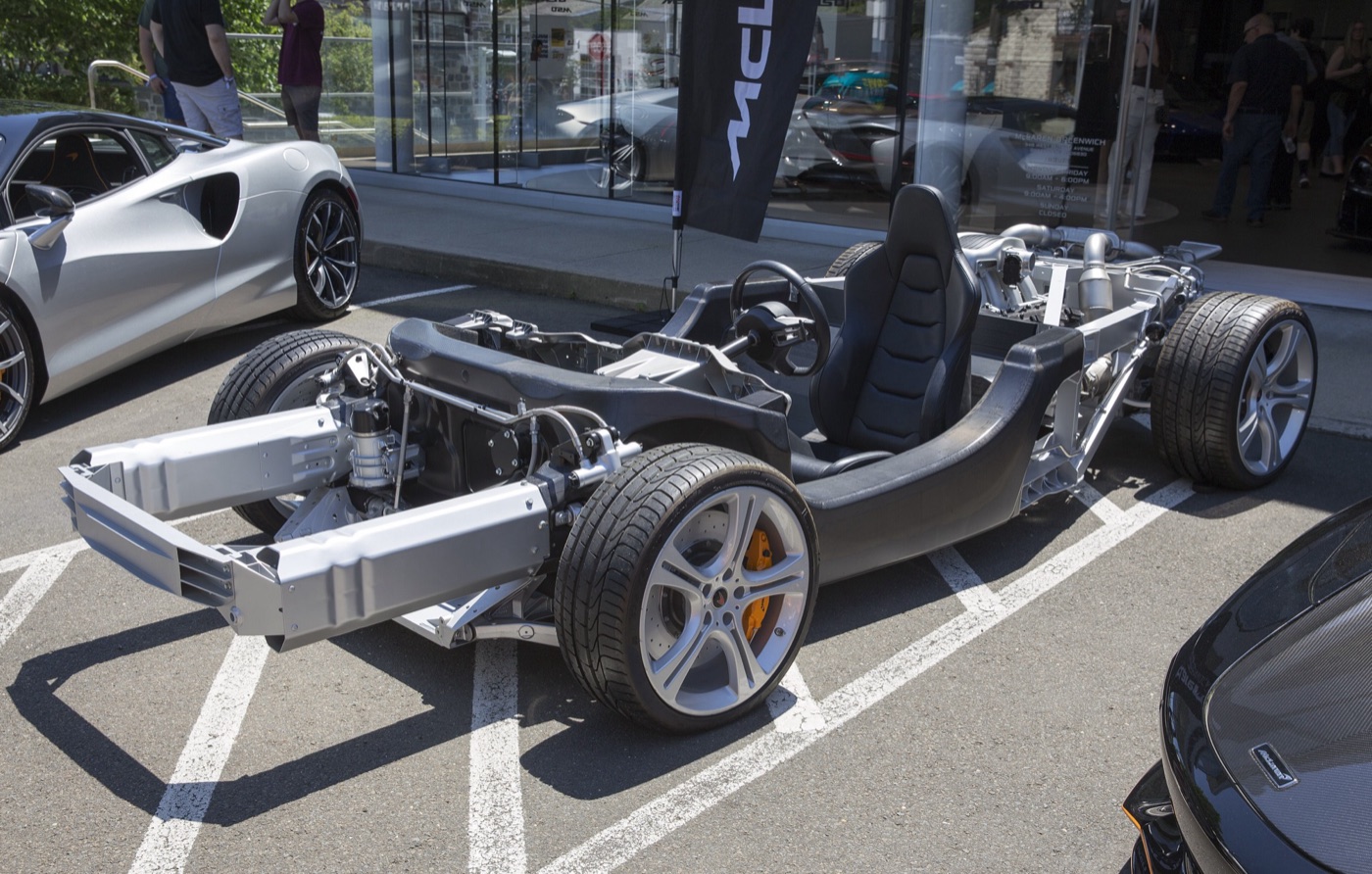
The 12C is a two-seat sports car, a coupé with dihedral doors, built around a one-piece carbon-fibre passenger cell with aluminium frames front and rear, a mid-mounted V8 driving the rear wheels, and hydraulically linked suspension in place of anti-roll bars. The body panels are aluminium and SMC plastic; the 2010 release says the SMC panels are 11 per cent lighter than on any other production car. Frank Stephenson was design director.
The MonoCell carbon tub
McLaren called the tub the Carbon MonoCell. It weighed below 80kg in the 2010 release and 75kg in the 2012 Spider release, and McLaren gave its manufacturing time as four hours; the 2020 buying guide compares that with three to four thousand hours for each F1 tub. The tubs were made by Carbo Tech of Salzburg: Autocar reported in June 2010 that McLaren's order was worth €150 million (£127.7 million) and that Carbo Tech would build a new factory with about 100 jobs. The technology came from Formula 1: McLaren had raced the first carbon monocoque there, the 1981 MP4/1, and had built no car with a metal chassis in the 30 years since.
Ride and handling: ProActive Chassis Control, Brake Steer and the Airbrake
ProActive Chassis Control links the dampers hydraulically across the car, so it needs no mechanical anti-roll bars; it controls roll in corners and lets each wheel move on its own in a straight line. Winter, Normal, Sport and Track modes are set on one knob, the powertrain modes on another. Brake Steer uses the stability system to brake the inside rear wheel and cut understeer, and the Airbrake rear wing rises under heavy braking to add downforce and move the centre of pressure rearwards. The standard brakes are cast-iron discs (370mm front, 350mm rear) on forged aluminium hubs, lighter than the optional carbon-ceramic set.
The M838T engine and the SSG gearbox
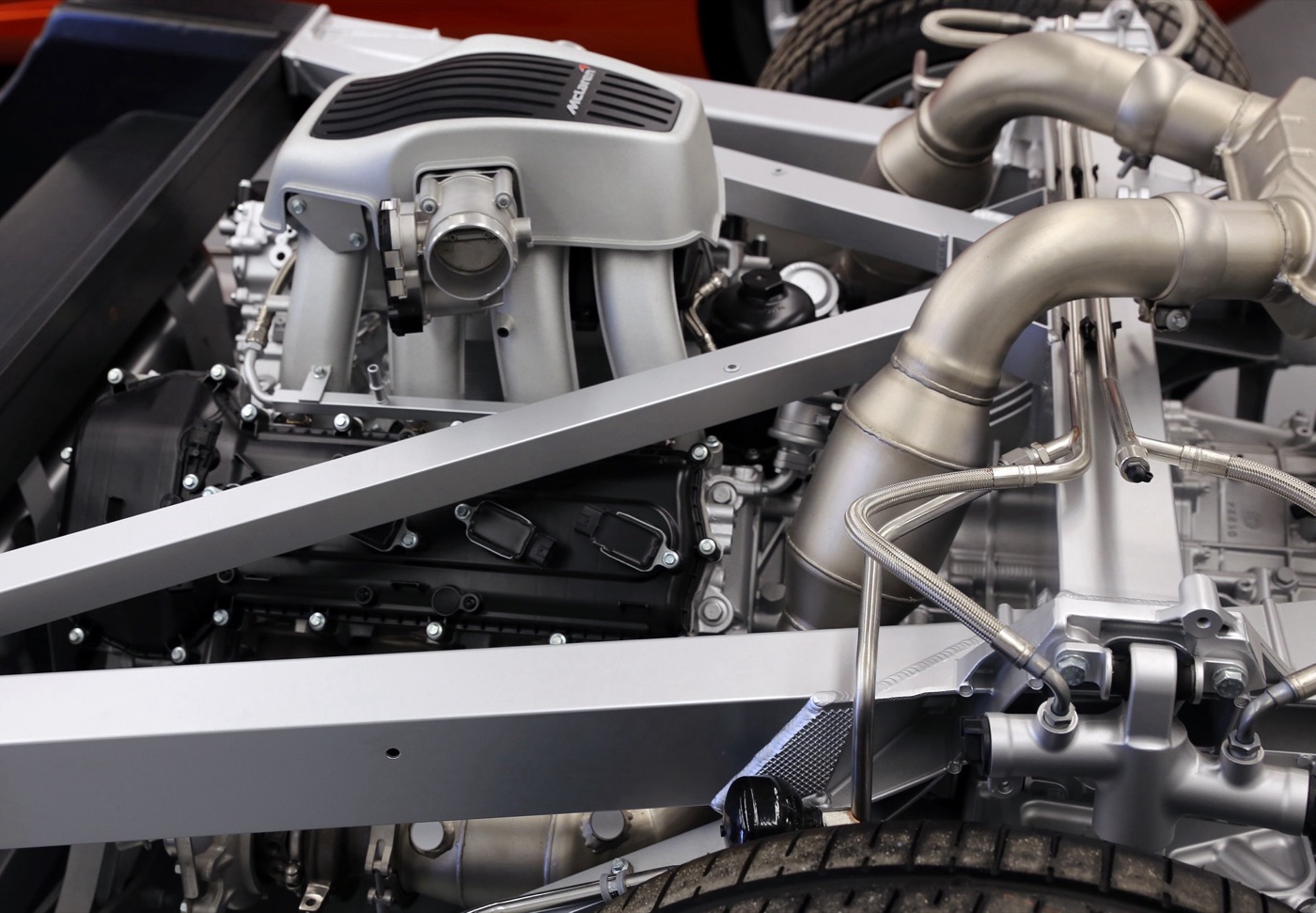
The engine is McLaren's own M838T: a 3,799cc 90-degree V8 with two turbochargers, a flat-plane crank, a dry sump and an 8,500rpm limit. PistonHeads' 2020 buying guide says McLaren built it with Ilmor and Ricardo after finding no existing engine small or light enough, and that it weighs 150kg. McLaren claimed 80 per cent of its torque below 2,000rpm. The gearbox is a seven-speed dual-clutch unit called SSG (seamless shift gearbox) with Pre-Cog: a light press on the rocker-mounted paddle pre-selects the next gear and a full press engages it. There is no manual.
Cabin and IRIS infotainment
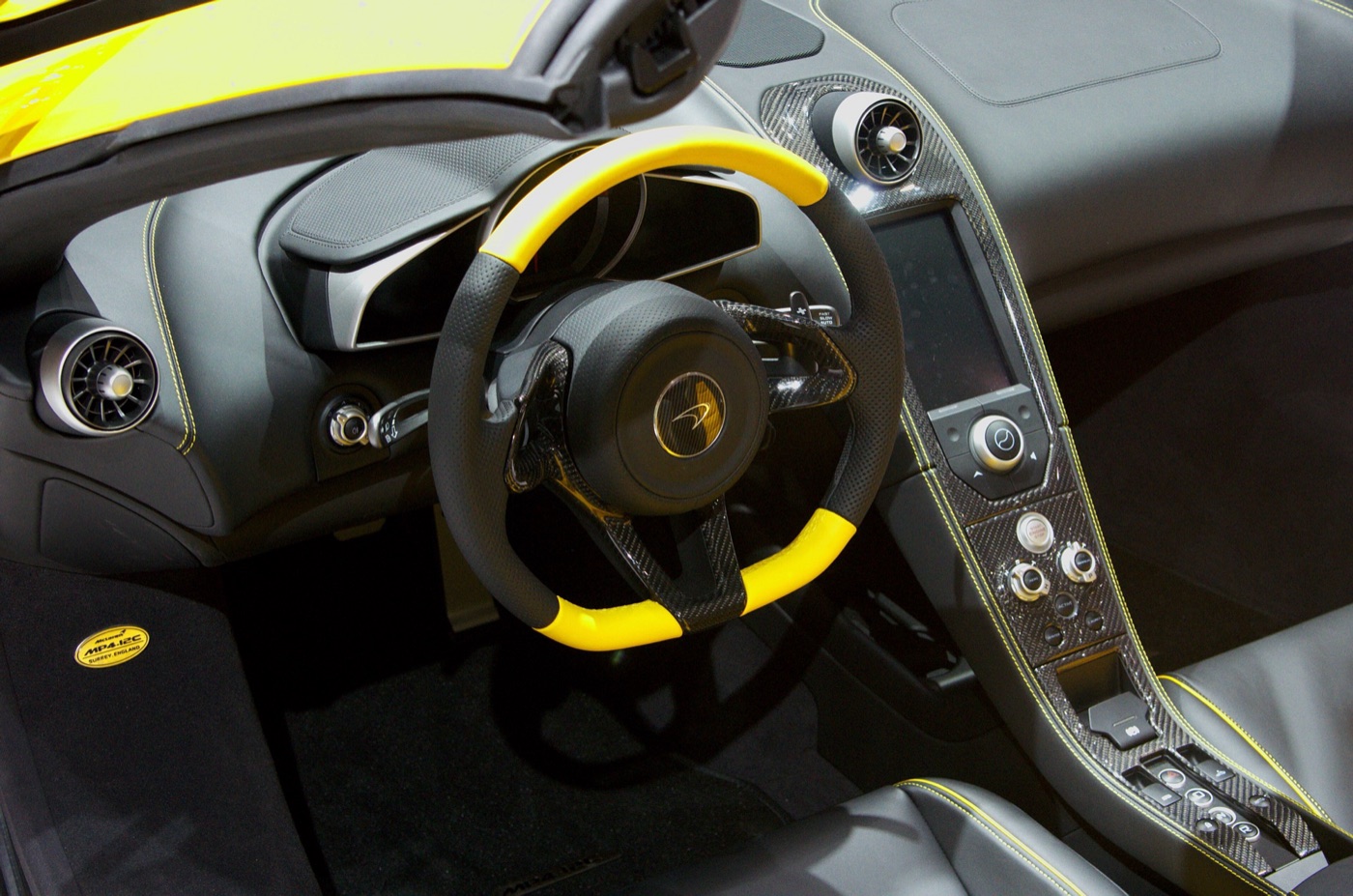
The two seats sit close to the car's centre line beside a slim centre console with an upright 7-inch touchscreen. The steering wheel carries no buttons and its rim shape was said to follow Lewis Hamilton's preferences. Doors on early cars opened by a touch sensor under the upper edge of the door, replaced on later cars by a button. The original IRIS system was replaced in 2014 by IRIS 2, which PistonHeads' 2020 buying guide prices at more than £3,000 as a retrofit and describes as "only a relative improvement" on the first.
McLaren 12C specs and performance
McLaren's official figures put the launch coupé at 0–62mph in 3.3 seconds and 205mph, and the 625PS cars from 2012 at 3.1 seconds and 207mph. The launch figures are from McLaren's February 2011 specification as reproduced by Cars UK, and the 2012 figures from McLaren's 12C Spider press release as reproduced by Ausmotive, which gives the coupé and the Spider side by side.
| Figure | MP4-12C, 2011 | 12C coupé, 2012 on | 12C Spider |
|---|---|---|---|
| Engine | 3,799cc twin-turbo V8 | 3,799cc twin-turbo V8 | 3,799cc twin-turbo V8 |
| Power | 600PS (592bhp) at 7,000rpm | 625PS (616bhp) | 625PS (616bhp) |
| Torque | 600Nm (443lb ft), 3,000–7,000rpm | 600Nm | 600Nm |
| 0–62mph | 3.3sec (3.1sec on Corsa tyres) | 3.1sec | 3.1sec |
| 0–124mph | 9.1sec (8.9sec on Corsa tyres) | 8.8sec | 9.0sec |
| Quarter mile | 10.9sec at 134mph | 10.6sec at 136mph | 10.8sec at 134mph |
| Top speed | 205mph | 207mph (333km/h) | 204mph (329km/h), 196mph roof down |
| Dry weight | 1,336kg (1,301kg with lightweight options) | 1,376kg (1,341kg with lightweight options) | |
| DIN weight | 1,434kg | 1,474kg | |
| CO2, combined economy | 279g/km, 24.2mpg | 279g/km, 24.2mpg | 279g/km, 24.2mpg |
Sources: McLaren Automotive specification, 14 February 2011 (via Cars UK); McLaren 12C Spider press release, 3 July 2012 (via Ausmotive); Autocar, October 2012 (roof-down top speed). The 2012 figures are for cars on P Zero Corsa tyres.
The launch car measures 4,507mm long, 1,909mm wide and 1,199mm high on a 2,670mm wheelbase, with 42.5 per cent of its weight on the front wheels. It runs on 19-inch front and 20-inch rear wheels with Pirelli P Zero tyres, 235/35 R19 and 305/30 R20, so there is no spare. The engine's bore and stroke are 93mm and 69.9mm and the compression ratio is 8.7:1.
How fast is the McLaren 12C?
The 12C's official top speed is 205mph as launched and 207mph from 2012, and McLaren quotes 0–62mph in 3.1 seconds for the 625PS car on Corsa tyres. McLaren's braking figures for the launch car are 100ft from 62mph and 403ft from 124mph.
How much does a McLaren 12C weigh?
McLaren gives a DIN weight, with fluids, of 1,434kg for the coupé, and a dry weight of 1,336kg, or 1,301kg with the lightweight options. The Spider is 40kg heavier.
McLaren 12C Spider
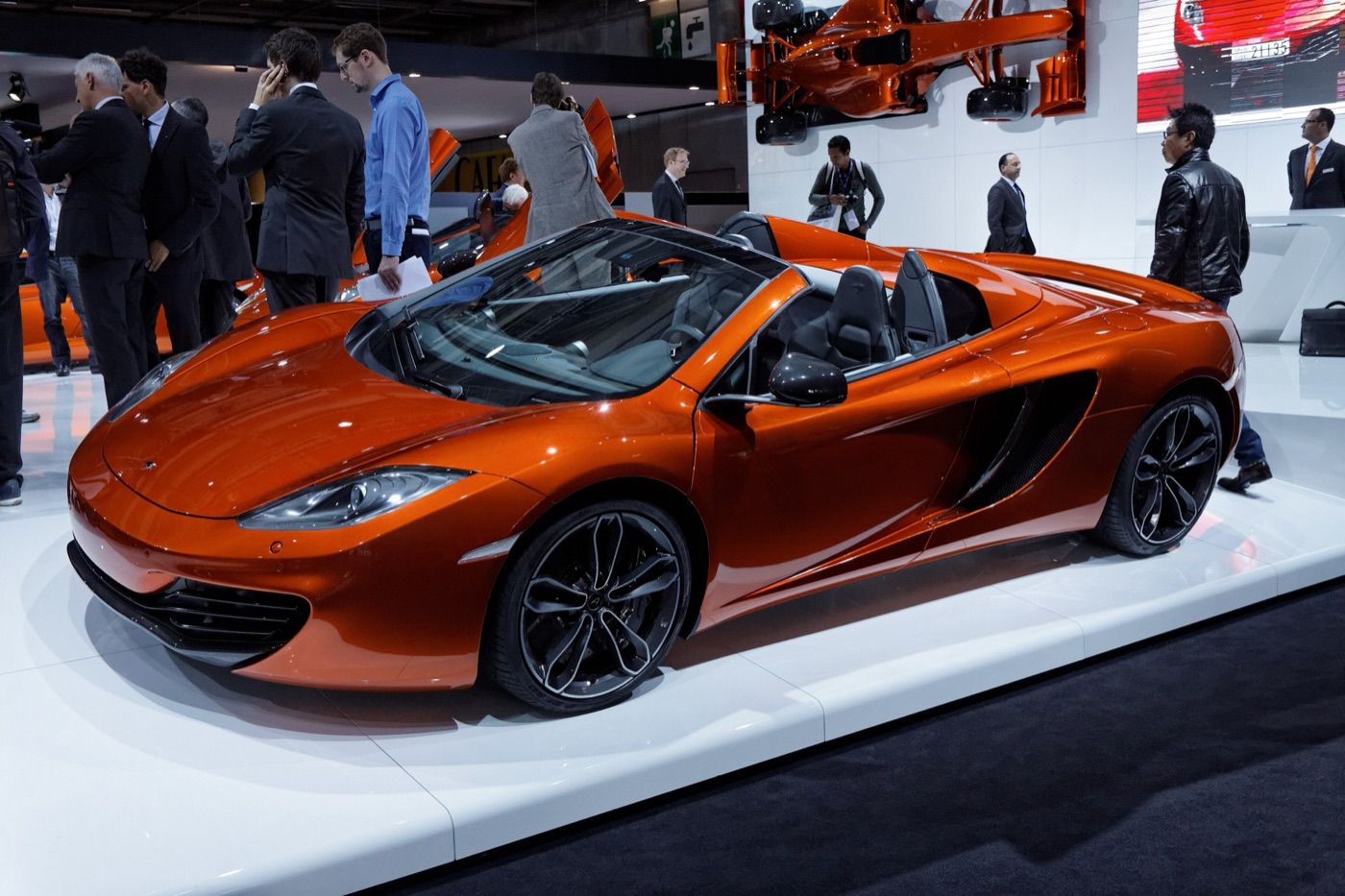
The 12C Spider is the convertible, with a two-piece folding hard top, and it was McLaren Automotive's second model: McLaren opened orders in 2012 at £195,500, £19,500 more than the coupé, with first deliveries planned for that November. Because the MonoCell was designed from the start for an open car, McLaren says, the Spider needed no extra strengthening and weighs 40kg more than the coupé. It kept the coupé's glass engine cover.
The roof rises or folds in 17 seconds, at up to 19mph, from a switch on the centre console. A rear screen between the buttresses lowers on its own, as a wind deflector with the roof down or to let the engine noise in with it up; each buttress holds a steel roll-over structure. With the roof up, the space under the tonneau holds 52 litres, and McLaren supplied fitted bags for it. With the roof down the top speed is 196mph, Autocar reported. "12C Spider owners will love the opportunity to lower the roof and hear the unhindered howl of a V8 twin turbo engine at full throttle," Antony Sheriff said in the release.
Variants and special editions of the 12C
Besides the coupé and the Spider, the 12C came as the 12C HS, the one-off X-1, the track-only 12C GT Can-Am Edition and the anniversary McLaren 50 12C, most of them built by McLaren Special Operations (MSO).
12C HS (High Sport)
The HS was an MSO car with bodywork after the 12C GT3: new front and rear bumpers, side air extractors and louvres on top of the front wings. Ten were built, according to Mecum's catalogue for its January 2016 Kissimmee sale, which offered chassis nine of the ten: commissioned by McLaren's chairman Ron Dennis, the only one in Vodafone McLaren Formula 1 team colours, with about 200 miles (Mecum's listing gives both 203 and 208) and a quoted 675hp.
McLaren X-1
The X-1 is a one-off road car on 12C mechanicals, built by MSO for a private client and shown at The Quail during the Monterey week on 17 August 2012. A SkiddMark report of that week carried McLaren's account of the project. "The conversation began with our Executive Chairman Ron Dennis almost three years ago, before the 12C was even launched," said MSO programme director Paul Mackenzie. Frank Stephenson said the client wanted "timeless and classical elegance".
The design team's mood book started from cars such as a 1961 Facel Vega, a 1953 Chrysler D'Elegance Ghia and a 1959 Buick Electra. The client asked for a competition between outside designers and McLaren's own; the winning design was by Hong Yeo, a Royal College of Art graduate on McLaren's staff, finished under Stephenson. The only feature the client prescribed was a run of bright metal rails from the nose over the shoulders to the rear of the glasshouse.
The styling took 18 months to sign off and the car two and a half years to build. Only the glasshouse came from the 12C: the body is carbon, painted piano black, with machined aluminium brightwork plated in nickel, its own lights and wheels, and enclosed rear wheels reached through hinged carbon panels. It is 4,658mm long, 109mm longer than a 12C, and 2,097mm wide across the mirrors, 188mm wider, at the 12C's 1,199mm height and about the same 1,400kg kerb weight. It covered about 625 miles of testing, including two sessions at the Idiada proving ground in Spain.
12C GT Can-Am Edition
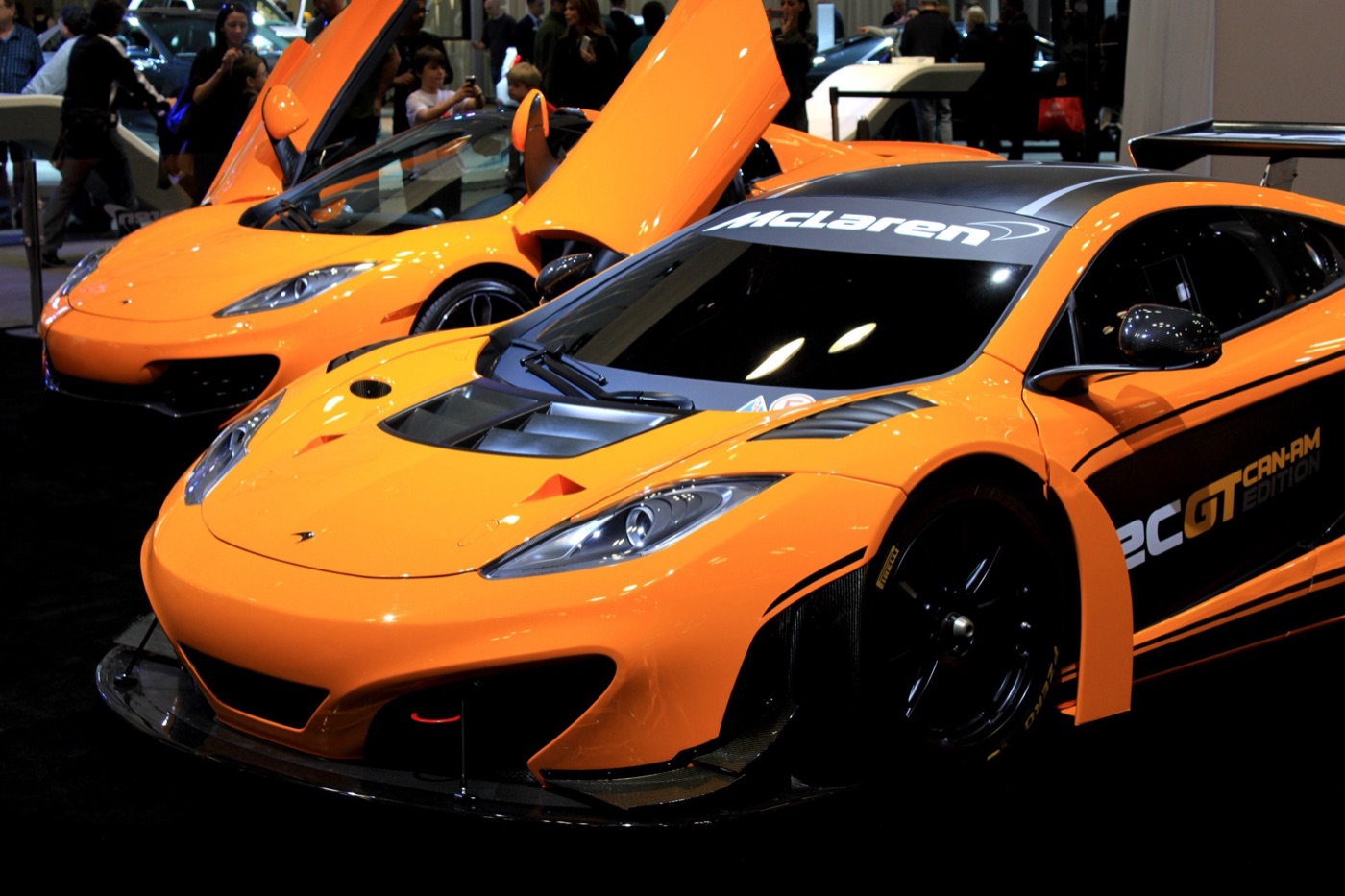
The Can-Am Edition was first a one-off design study for the US market, a 12C GT3 developed without racing rules, shown at the Pebble Beach Concours in August 2012. Its orange paint recalled the cars Bruce McLaren and Denny Hulme raced in the Can-Am series, and a SkiddMark report of the launch gave McLaren's figures: 621bhp, a dry weight of 1,200kg and 30 per cent more downforce than the GT3. In November 2012, at an event before the United States Grand Prix in Austin, McLaren GT confirmed a production run of no more than 30 at £375,000 each, built in Woking from March 2013, with about 630hp, Akebono brakes, an FIA roll cage and race seats with six-point harnesses, GTspirit reported. The car is for track use only.
McLaren 50 12C and 12C Spider
For the 50th anniversary of the McLaren organisation in 2013, McLaren built 50 coupés and 50 Spiders as the McLaren 50 12C. A SkiddMark report of May 2013 listed the changes: MSO parts such as a reshaped front bumper with a carbon lower section, a carbon-Kevlar front floor and a black heritage badge on the bonnet; carbon-ceramic brakes as standard, 394mm front and 380mm rear; Ultra Lightweight wheels, 19-inch front and 20-inch rear, 2kg lighter than the Super Lightweight option; and a choice of Carbon Black, Supernova Silver or McLaren Orange. Prices were £196,000 for the coupé and £215,500 for the Spider.
The 12C GT3 in racing
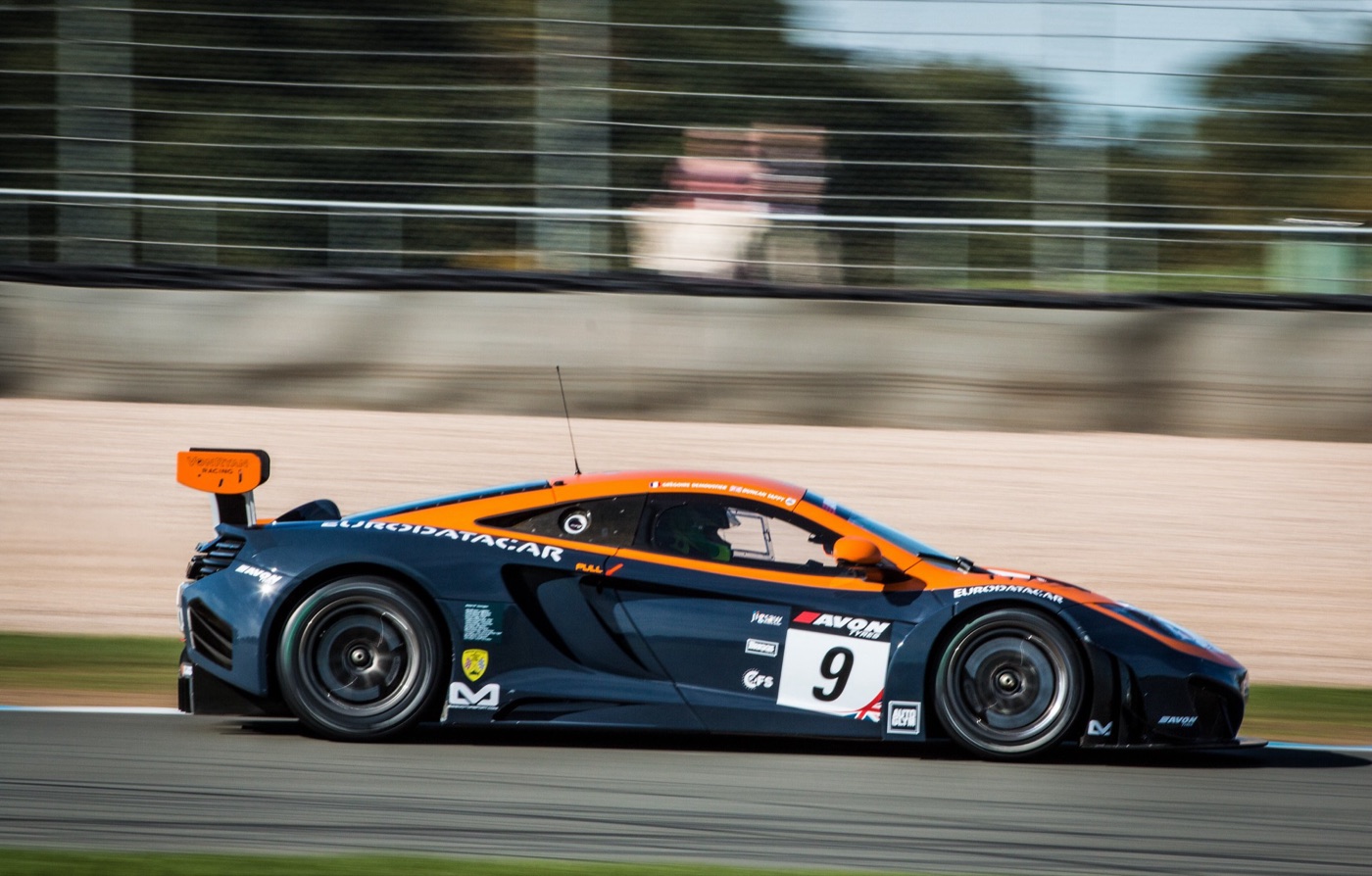
The 12C GT3 was the first McLaren built for FIA GT racing since production of the F1 GTR ended 14 years earlier, and in its first full season, 2012, customer teams won 19 races with it. McLaren GT, the racing operation McLaren formed with CRS Racing, homologated 20 cars for 2012, evo reported in 2011, and ran the car in selected races in 2011, including the Spa 24 Hours.
12C GT3 specification
Under GT3 rules the engine was detuned from 592bhp to 493bhp, with its own calibration and engine control unit. It drove through a six-speed sequential gearbox developed with Ricardo, 80kg lighter than the road car's seven-speed. The car gained a new front splitter, door blades, rear wing, diffuser and louvres in the front wings, and its steering wheel came from the MP4-24, the McLaren Formula 1 car of 2009.
12C GT3 results
McLaren GT's end-of-season release of 21 December 2012 counted 23 cars racing in 14 series for 13 customer teams, with 19 wins and more than 106,000 racing kilometres. Hexis Racing scored the first wins, both races of the FIA GT1 World Championship round at the Circuito de Navarra, then took eight wins and eight more podiums and missed retaining the championship by a single point. Lapidus Racing won the Barcelona 24 Hours, McLaren's first outright 24-hour win since the F1 GTR won Le Mans in 1995. At the Spa 24 Hours nine 12C GT3s started; the Von Ryan Racing car took pole in its class, third on the grid overall.
| Series or race | Winner or detail given by McLaren |
|---|---|
| FIA GT1 World Championship | Hexis Racing (first wins, Navarra) |
| Blancpain Endurance Series | Hexis Racing (Navarra, final round) |
| Barcelona 24 Hours | Lapidus Racing |
| FFSA French GT | ART Grand Prix (Magny-Cours) |
| Avon Tyres British GT | Win listed, team not named |
| City Challenge Baku | Win listed, team not named |
| GT Cup | Win listed, team not named |
Sources: McLaren GT season review, 21 December 2012; McLaren GT Spa preview, July 2012 (ART Grand Prix at Magny-Cours). McLaren's review does not name the winning team in every series.
The 12C GT3 had taken its first pole position at the Spa round of the 2011 British GT Championship, according to McLaren GT's preview of the 2012 Spa 24 Hours, which also recorded ART Grand Prix's win in the French GT series at Magny-Cours.
How many McLaren 12Cs were made?
About 3,500 McLaren 12Cs were sold between 2011 and April 2014, Autocar reported when production ended. PistonHeads' guide says 1,700 orders were placed before the car reached dealers and that nearly all were delivered in the first full year of production.
| Version | Number built | Source |
|---|---|---|
| 12C and 12C Spider (all road cars) | About 3,500 sold, 2011–2014 | Autocar, 4 April 2014 |
| McLaren 50 12C coupé | 50 | SkiddMark, May 2013 |
| McLaren 50 12C Spider | 50 | SkiddMark, May 2013 |
| 12C HS (High Sport) | 10 | Mecum, January 2016 |
| 12C GT Can-Am Edition | No more than 30 planned | McLaren GT via GTspirit, November 2012 |
| McLaren X-1 | 1 | McLaren via SkiddMark, August 2012 |
| 12C GT3 | 20 homologated for 2012; 23 raced in 2012 | evo, 2011; McLaren GT, December 2012 |
McLaren 12C prices new and value today
A new MP4-12C cost £168,500 in 2011 and £176,000 by 2014; the Spider cost £195,500. At auction the Graphite Grey 2014 Spider sold by Iconic Auctioneers at Sywell on 17 May 2025, with 18,300 miles and a file of service records, made £70,875, about 36 per cent of the Spider's 2012 list price.
| Version | Price new | Source |
|---|---|---|
| MP4-12C coupé, 2011 | £168,500 | Top Gear, 2011 |
| 12C coupé, 2014 | £176,000 | Autocar, April 2014 |
| 12C Spider, 2012 | £195,500 | McLaren press release; Autocar |
| McLaren 50 12C coupé | £196,000 | SkiddMark, May 2013 |
| McLaren 50 12C Spider | £215,500 | SkiddMark, May 2013 |
| 12C GT Can-Am Edition | £375,000 | GTspirit, November 2012 |
What a used McLaren 12C costs today
The three most recent British results run from £70,875 to £114,750, the top one for a Spider with 2,730 miles. The sterling results are from the auction houses' own pages; the American figures are from OUTLAW 8's record of auction results, run on 28 October 2026.
| Date | Auction house | Car | Result |
|---|---|---|---|
| 17 May 2025 | Iconic Auctioneers, Sywell | 2014 12C Spider, 18,300 miles | £70,875 |
| 16 May 2026 | Iconic Auctioneers, Sywell | 2014 12C Spider, 2,730 miles | £114,750 |
| 18 October 2026 | Collecting Cars | 2013 MP4-12C with a Mansory body kit, about 9,000 miles | £73,500 |
| 28 October 2025 to 28 October 2026 | US sales, 19 of them on Bring a Trailer, the rest at Mecum, Broad Arrow, Barrett-Jackson, Hagerty and Collecting Cars | 25 cars: 13 coupés (median $100,000) and 12 Spiders (median $107,500) | Median $103,400; range $61,500 to $163,500 |
Prices include the buyer's premium where the house adds one. In 2020 PistonHeads' buying guide found that a 2012 12C cost "literally half" a 2012 Ferrari 458 with the same 5,000 miles, about £75,000 against £150,000.
Two things set one 12C apart from another at the same mileage: the specification and the history. The same PistonHeads guide calls the carbon interior "a must-have", and the 2012-on cars have the 625PS engine and the revised throttle, exhaust, seats and climate control. A car's file shows whether it had the free 2014 Technology Upgrade and the IRIS 2 retrofit.
McLaren 12C reliability, known faults and running costs
The 12C's engine and gearbox have a good record and CarVerify rates it above average on UK MOT data, but parts are expensive and most faults owners meet are in the hydraulics, the electrics and the trim. CarVerify's analysis of DVSA MOT records, updated October 2026, gives a 94.2 per cent pass rate from 1,899 tests on 213 cars: 94.4 per cent from 945 tests for 2012 cars and 93.6 per cent from 514 tests for 2011 cars. The faults below are from the 2020 PistonHeads buying guide, which drew on specialists including John Thorney of Thorney Motorsport.
Engine, gearbox and cooling
The engine rarely leaks oil and its main seals are strong, though turbo feed pipes can drip. The dry-sump catch tank runs the full depth of the car: if the sump plug is over-tightened and the tank has to be replaced, that is a 15-hour engine-out job costing about £4,000 with parts. Dried water marks inboard of the nearside rear wheel point to a leaking water pump, and the engine takes pink coolant, not blue. On the gearbox, a telltale hole in the casing (three rear undertrays have to come off to see it) should show only a trace of fluid; a flow when warm can mean a rebuild, and the gearbox oil cooler can be punctured.
Suspension, body and electrics
A light vibration through the front is most likely a cracked bush on a lower suspension arm, which leaks fluid and fails the MOT; the balljoint is not sold on its own, so the whole arm costs about £700. A leaking damper can cost up to £7,000. The tyre-pressure monitoring gear sits on a plate behind the front subframe that takes knocks, and replacing it is a four-figure bill. Rear lights mist up and many were replaced under warranty, dihedral doors squeak with age, the scuttle drain pipe can come adrift, the dash can rattle, and the backlighting of the driver's side control panel fails at about £1,000 to fix. The Spider's roof is generally free of leaks and squeaks, but its wind seals wear.
Servicing and running costs
The first service is due at 10,000 miles or one year, and PistonHeads' 2020 buying guide puts servicing at about £1,000 a year, with standard brake pads that last well even on track days. It found economy above 30mpg easy on a motorway, against an official 24.2mpg combined. About a dozen McLaren dealers in the UK and independents such as Thorney Motorsport and Alastair Bols service the car; Thorney did a pre-warranty inspection for about £400 and then sold a 12-month warranty for £2,850 in 2020, about £900 less than McLaren's own.
McLaren 12C vs Ferrari 458 Italia
The 12C's rival was the Ferrari 458 Italia: the McLaren had more power, less weight and lower emissions on paper, but evo's 2011 group test preferred the Ferrari to drive. PistonHeads' guide gives the 458's price as £172,000, about £4,000 more than the 12C. The figures below are the launch-spec 12C against the 458 as Cars UK set them out in February 2011.
| Figure | McLaren MP4-12C | Ferrari 458 Italia |
|---|---|---|
| Power | 592bhp at 7,000rpm | 570bhp at 9,000rpm |
| Torque | 443lb ft at 3,000–7,000rpm | 398lb ft at 6,000rpm |
| DIN weight | 3,161lb (1,434kg) | 3,273lb (1,485kg) |
| 0–62mph | 3.3sec | 3.4sec |
| Top speed | 205mph | 202mph |
| CO2 | 279g/km | 307g/km |
| Combined economy | 24.2mpg | 20.6mpg |
Source: McLaren specification and Cars UK's comparison column, February 2011.
The difference was in how the cars behaved at the limit. PistonHeads' guide says the e-diffed Ferrari was easy to slide while the open-diff 12C would cut power mid-drift, even with the traction controls off, and that Brake Steer added to the correction; it adds that there was "very little to choose between the two on lap times".
How the press received the 12C
The first reviews praised the 12C's ride, speed and ease of use and found it short on drama. Don Sherman of Car and Driver, driving it at the Portuguese launch in February 2011, wrote of a "baby-carriage ride" in Normal mode and summed up the car as "speed without the spectacle"; he found the stability control so discreet that "amateurs will enjoy this ride, good drivers will feel like track stars". evo's 2011 group test put the 458 ahead, and McLaren had a revised car ready for evo's Harry Metcalfe eight days after he sent his suggestions. PistonHeads' guide, ten years on, said that "road testers and early-adopter owners expressed doubts about the on-the-limit behaviour of the 12C" and that McLaren put its answers into the Spider and then the coupé.
In 2009 Antony Sheriff told the press that McLaren designed cars that would still look contemporary and be easy to drive in 25 years, and PistonHeads' guide judged in 2020 that the 12C's styling had "breezed through its first decade".
Questions
Is the MP4-12C the same car as the McLaren 12C?
Yes. McLaren launched it as the MP4-12C in 2011 and dropped the MP4 from the name at the end of 2012, so later cars are badged 12C. The 2012 cars also gained 625PS in place of 600PS.
Is the McLaren 12C a good daily driver?
It is one of the easier supercars to live with: Car and Driver described a "baby-carriage ride" in Normal mode, and PistonHeads found it fits a standard garage, clears most driveways and returns more than 30mpg on a motorway. It has no spare wheel.
What engine does the McLaren 12C have?
McLaren's own M838T, a 3,799cc twin-turbo V8 with a flat-plane crank and a dry sump, mounted behind the seats and driving the rear wheels through a seven-speed dual-clutch gearbox.
What replaced the McLaren 12C?
The McLaren 650S, shown at Geneva in March 2014. It was built on the 12C platform with 641bhp, and McLaren stopped 12C production in April 2014 to build it.
How much does it cost to service a McLaren 12C?
PistonHeads' 2020 guide put servicing at about £1,000 a year, with the first service at 10,000 miles or one year. Single repairs can be large: a leaking damper up to £7,000, a sump catch tank about £4,000.
Does the McLaren 12C have butterfly doors?
It has dihedral doors, hinged at the front and rising up and forwards. Early cars open them with a touch sensor under the upper edge of the door and later cars with a button; there are no external handles.
Who designed the McLaren 12C?
Frank Stephenson was McLaren Automotive's design director for the 12C, under managing director Antony Sheriff, and Mark Vinnels was programme director in 2010.
Sources
- McLaren Automotive, MP4-12C reveal release, as published by CAR magazine, September 2009: P11 codename, target market and prices, MonoCell, engine, Brake Steer, Airbrake, first-year plans.
- McLaren Automotive, launch press release, as reproduced by PistonHeads, 18 March 2010: XP-Beta testing, MonoCell weight and build time, SMC panels, SLR McLaren total, Mark Vinnels as programme director.
- CAR magazine, McLaren MP4-12C (2011): the full spec announced, 18 March 2010: Hamilton and Button at Goodwood, SSG modes and Pre-Cog.
- McLaren Automotive, official performance data and technical specification, as reproduced by Cars UK, with AllCarIndex for the date, 14 February 2011: launch specification, dimensions, weights, and the Ferrari 458 comparison column.
- McLaren Automotive, 12C Spider press release, as reproduced by Ausmotive, 3 July 2012: Spider and 625PS coupé performance, roof, weights, price, deliveries, Sheriff quote.
- Autocar, McLaren MP4-12C Spider specifications, 2012: Spider price over the coupé, audio and climate, power after the coupé revisions.
- Autocar, McLaren invests in carbon tech, June 2010: the Carbo Tech order.
- Autocar, McLaren 12C supercar axed, 4 April 2014: about 3,500 sold, £176,000 final price, 650S outputs.
- Mike Flewitt, McLaren Automotive, letter to 12C owners, as reproduced by PistonHeads, April 2014: end of production and the Technology Upgrade.
- evo, McLaren 12C supercar discontinued, April 2014: the 650S on the 12C platform.
- evo, McLaren tweaks the MP4-12C supercar, 2011 (evo issue 160): the group test, Harry Metcalfe and the eight-day revisions.
- evo, McLaren MP4-12C GT3 racing car: new pictures and video, 2011: GT3 power, gearbox, aero, homologation numbers.
- McLaren GT, season review release, as reproduced by Clásicos al Volante, 21 December 2012: 2012 results.
- McLaren GT, Spa 24 Hours preview, as reproduced by Racecar, July 2012: ART Grand Prix win, 2011 British GT pole.
- GTspirit, McLaren GT confirms production of limited-run 12C GT Can-Am Edition, 17 November 2012: numbers, price, specification.
- Road & Track, McLaren Automotive started with two Ferraris and an Ultima: the test mules.
- Top Gear, First MP4-12C enters production, February 2011: car 01 and the £168,500 price.
- BBC News, McLaren's Woking supercar factory opened by David Cameron, 17 November 2011.
- Don Sherman, Car and Driver, 2012 McLaren MP4-12C first drive, 14 February 2011: the Portuguese launch and quotes.
- PistonHeads, McLaren 12C: PH used buying guide, June 2020: the brief, orders, name change, 2012 changes, known faults, costs, specialists, the 458 comparison.
- Mecum Auctions, 2012 McLaren MP4-12C High Sport, Kissimmee lot, January 2016: the HS.
- Iconic Auctioneers, 2014 McLaren MP4-12C Spider, sold, Sywell, 17 May 2025: the £70,875 result; and the 2014 Spider sold at Sywell on 16 May 2026 for £114,750.
- CarVerify, McLaren MP4-12C MOT history and reliability, data updated October 2026: MOT pass rates from DVSA records.
- Collecting Cars, 2013 McLaren MP4-12C, Mansory Custom, sold, 18 October 2026: £73,500.
- OUTLAW 8 auction records of McLaren 12C sales (read-only query of 28 October 2026: Bring a Trailer, Mecum Auctions, Broad Arrow Auctions, Barrett-Jackson, Hagerty and Collecting Cars results): the US sales figures.
- SkiddMark reports of July 2010 (Goodwood debut), 15 and 17 August 2012 (Can-Am Edition; X-1, with McLaren's release) and 23 May 2013 (McLaren 50).