Michael Schumacher at Mercedes: the comeback, Rosberg and Monaco
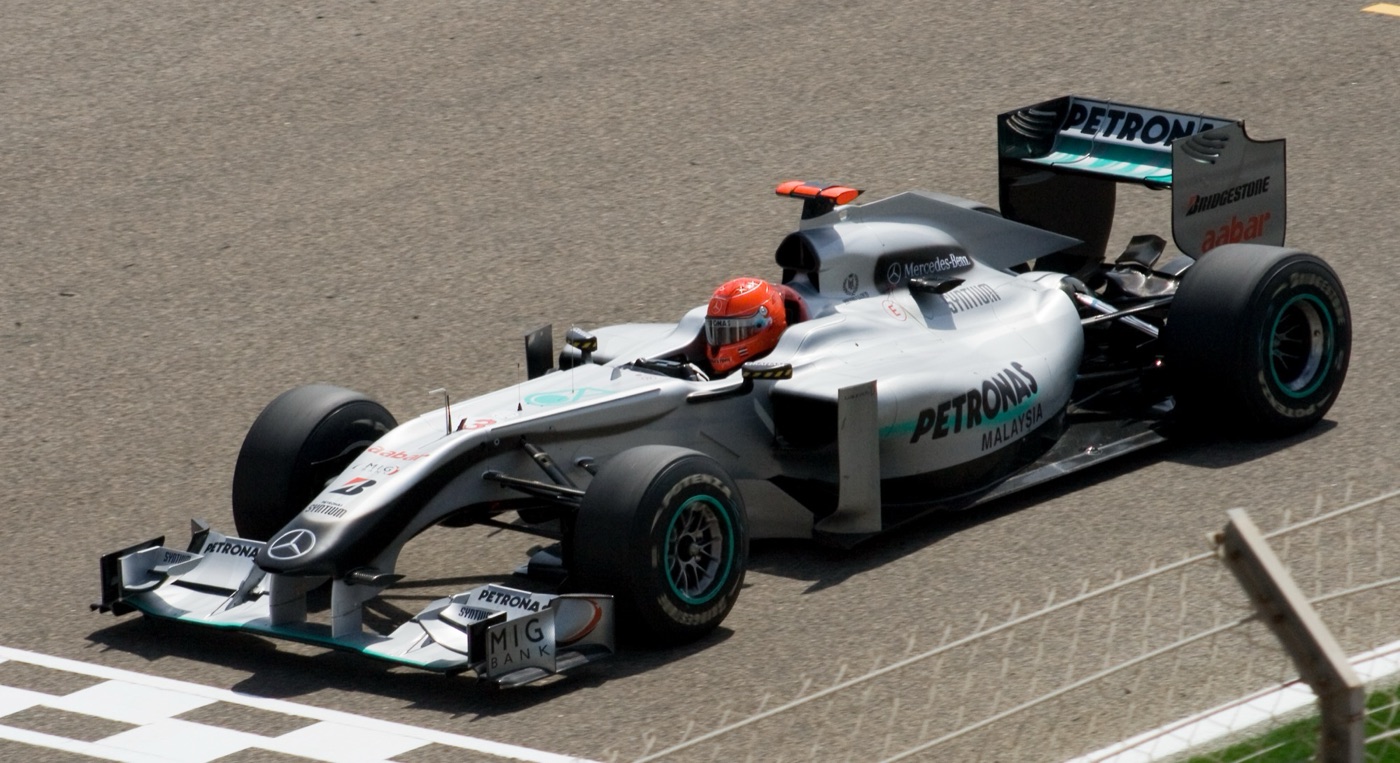
Michael Schumacher drove for Mercedes in Formula One from 2010 to 2012, coming out of a three-year retirement at 41 to race 58 Grands Prix alongside Nico Rosberg. He did not win a race for the team: his best result was third at the 2012 European Grand Prix in Valencia, the 155th and last podium of his career, and he set the fastest time in qualifying at Monaco in 2012 but lost pole position to a grid penalty. Rosberg outscored him 324 points to 197 over the three seasons, adding up Formula 1’s official standings for 2010 to 2012.
Mercedes was also where Schumacher started: the company paid for his sports car racing in 1990 and 1991, before he reached Formula One. Lewis Hamilton took his seat for 2013, and from 2014 Mercedes won eight constructors’ championships in a row.
Why did Michael Schumacher join Mercedes?
Schumacher joined Mercedes because the company bought the world champion Brawn team in November 2009 and offered him a three-year contract to drive for it, reuniting him with Ross Brawn, with whom he had won all seven of his world titles at Benetton and Ferrari. In the team’s announcement of 23 December 2009 he called it a move that “closes the circle”, because “Mercedes supported me for so many years when I began my Formula 1 career and now I can hopefully give something back to the brand with the star.”
The Mercedes junior team, 1990 and 1991
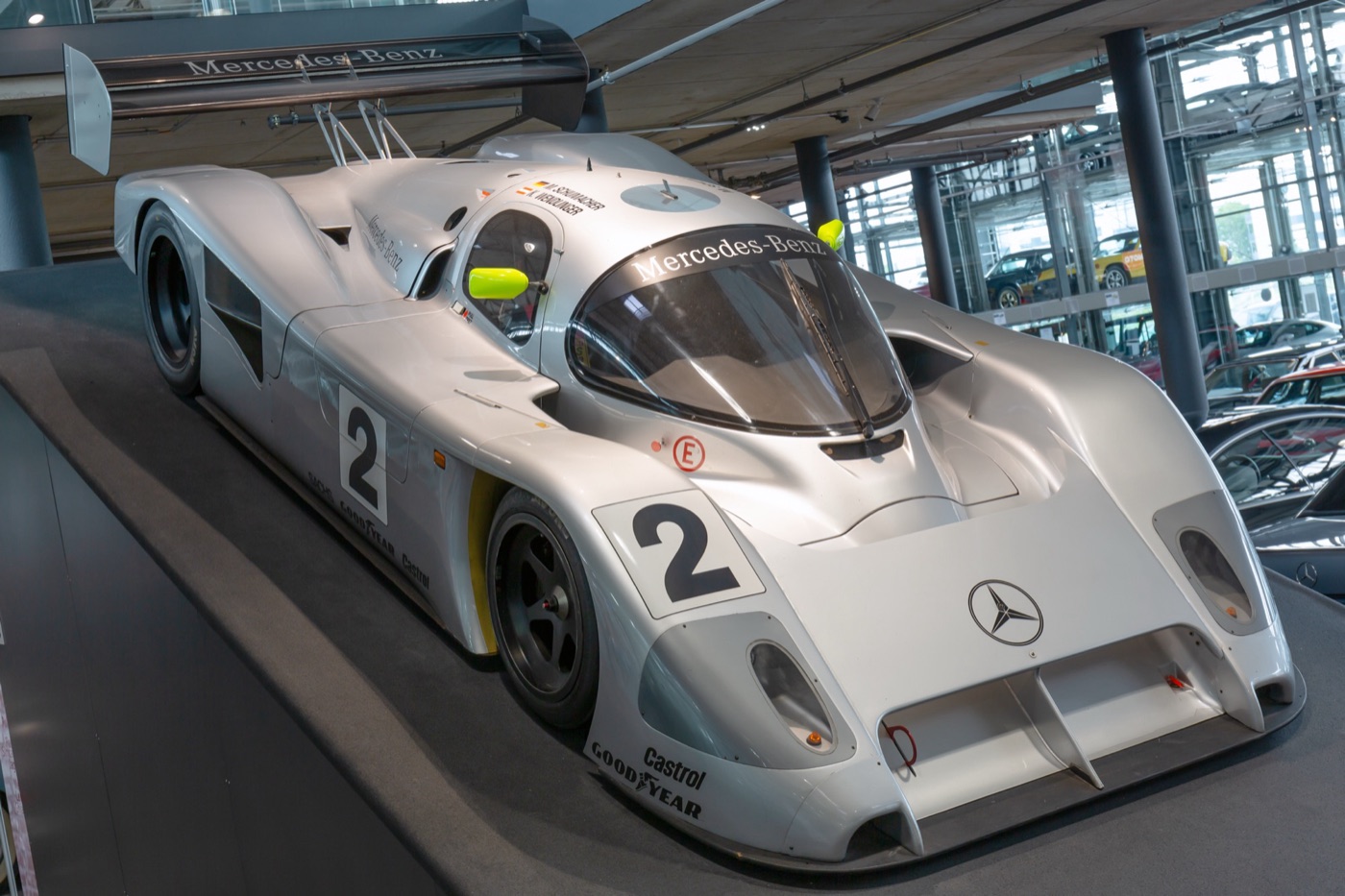
The circle began in sports cars. Jochen Neerpasch, Mercedes’ new motor sport manager, took Schumacher out of Formula 3 for a junior programme alongside Heinz-Harald Frentzen and Karl Wendlinger, according to Motor Sport’s history of the Mercedes-Benz C11. Each junior shared a Sauber-Mercedes C11 with the veteran Jochen Mass in the 1990 World Sports-Prototype Championship.
The Automobile Club de l’Ouest’s account lists Schumacher’s four races that year: disqualified at Silverstone, second at Dijon and at the Nürburgring, and a win in the 480 km of Mexico City after the sister car was disqualified. In 1991 he and Wendlinger raced the new normally aspirated C291, and retired from most of its races. At Le Mans, where Mercedes ran the older C11, the pair and Fritz Kreuzpointner finished fifth, seven laps behind the winning Mazda, and Schumacher set the race’s fastest lap, 3min 35.564sec. In the last round, the Autopolis 430 km in Japan, Schumacher and Wendlinger won “with some ease” from the Silk Cut Jaguars, in Motor Sport’s December 1991 report.
Mercedes’ own tribute for his 50th birthday in 2019 calls the Autopolis race Schumacher’s “first and only victory with Mercedes”; the ACO counts Mexico City too. By then he had already made his Formula One debut with Jordan at Spa, on 25 August 1991.
The Ferrari comeback that failed in 2009
Schumacher had already tried to come back once. When a spring from Rubens Barrichello’s Brawn struck Felipe Massa’s helmet in qualifying for the Hungarian Grand Prix on 25 July 2009, Ferrari asked its retired champion to take Massa’s seat. On 11 August he called it off: fractures to his head and neck from a motorcycle crash in February still hurt after a private day in a Formula One car at Mugello. “My neck cannot stand the extreme stresses caused by Formula One yet. I am disappointed to the core,” he wrote on his website, quoted by AFP in the Mail & Guardian. Luca Badoer drove instead.
The Brawn takeover and the contract
On 16 November 2009 Daimler and Aabar Investments bought 75.1 per cent of Brawn GP, which had just won both 2009 titles with Jenson Button; Daimler took 45.1 per cent and Aabar 30 per cent, as GrandPrix.com reported that day. The same deal changed Mercedes’ partnership with McLaren, in place since 1995, though Mercedes could go on supplying McLaren’s engines until 2015. The team became Mercedes GP Petronas for 2010, the first works Mercedes team in Formula One since 1955.
On 23 December Mercedes named Schumacher alongside Rosberg, then 24. Reports of the terms differed. A SkiddMark report of December 2009, citing Bild, described a one-year deal worth €3.5 million; Al Jazeera cited media reports of $10 million, while Schumacher himself said: “We are talking about a three-year deal, it’s not just a one-off thing.” He told reporters, after three years’ absence, that his aim “can only be to fight for the championship”, and Al Jazeera reported that he had set his sights on an eighth world title.
Michael Schumacher in 2010: the MGP W01
Schumacher’s first Mercedes season ended with 72 points and ninth place in the championship, no podiums and a best finish of fourth, while Rosberg scored 142 points, finished seventh and stood on the podium three times. The figures are from Formula 1’s record of his 2010 season and Rosberg’s.
He raced as number 3 in the MGP W01 and finished sixth on his return, in Bahrain on 14 March 2010, one place behind his team-mate. After four races Rosberg had outqualified and outraced him every time, and had 50 points to his 10, Dieter Rencken counted in Autosport, where a Mercedes source put Schumacher’s deficit in pace at one second. Rencken noted that younger rivals who had arrived after 2006, among them Sebastian Vettel and Lewis Hamilton, banged wheels with the Mercedes without a second thought. His explanation for the gap was the sport Schumacher came back to: a car designed before he signed, around Button’s smooth style; a ban on refuelling; narrow front tyres; and 16 days of winter testing in place of Ferrari’s private tracks.
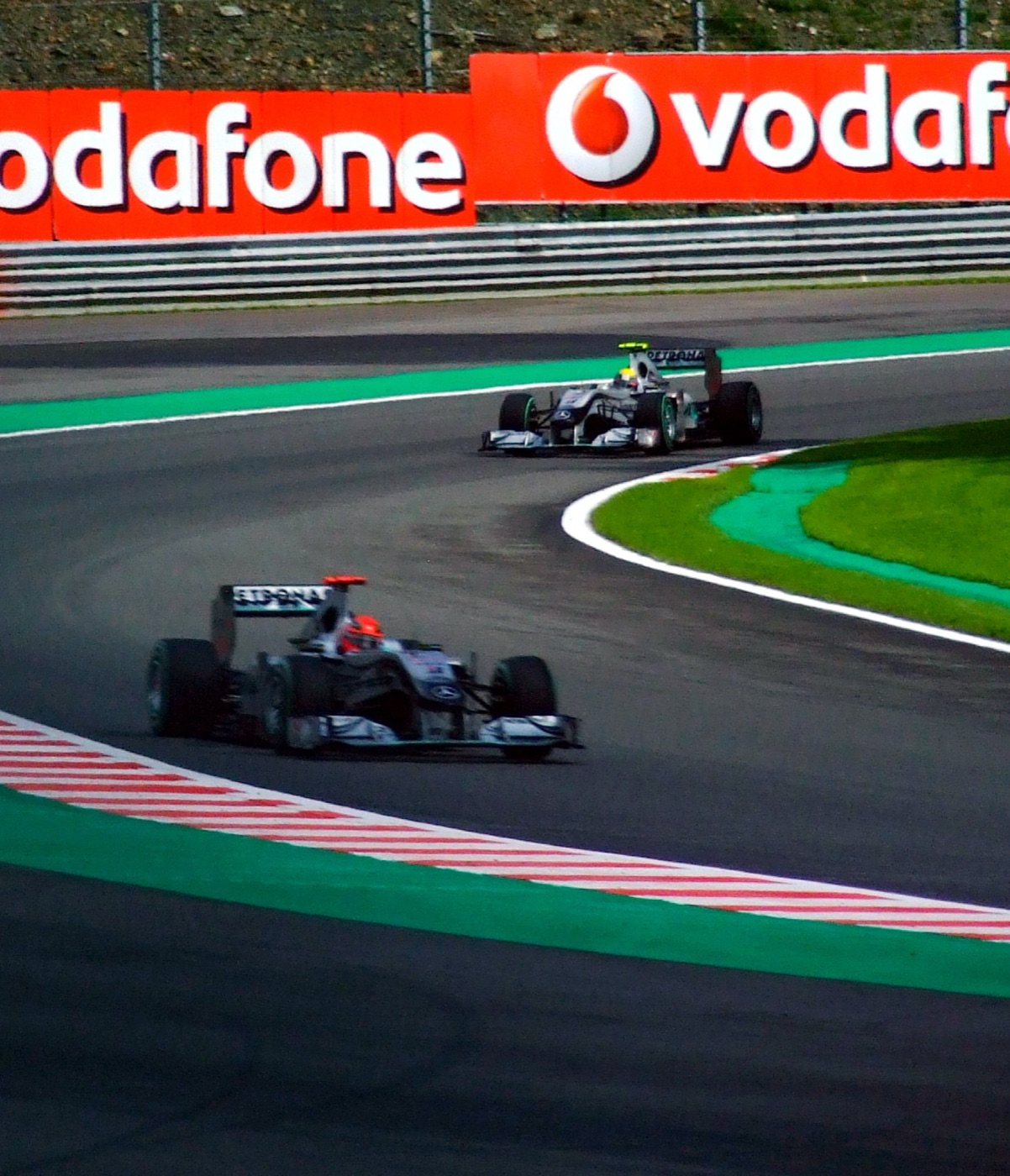
His best results were fourth places at the Spanish, Turkish and Korean Grands Prix. At Monaco he passed Fernando Alonso for sixth at the last corner, after the safety car had pulled into the pits on the last lap; the stewards gave him a retrospective drive-through penalty that dropped him to 12th, and the case led the FIA to review the safety car rule, in Motor Sport’s July 2010 report. In Hungary on 1 August he squeezed Barrichello towards the pit wall while they fought for tenth place. The stewards ruled that he had “illegitimately impeded” the Williams driver and moved him ten places down the grid at Spa, Associated Press reported.
Why was Schumacher slower than Rosberg?
Ross Brawn blamed the Bridgestone front tyres that the 2010 rules called for. “They saturate very quickly in terms of providing grip,” he told Autosport in August 2010, when Schumacher had 38 points to Rosberg’s 94. “Michael’s talents are an aggressive-style car that is on the edge of stability and controlling it there. I don’t think these tyres reward such an approach.” Brawn added that Rosberg was “very skilled and very talented at using the tyres”. The team itself was thin: to survive in 2009, Brawn GP had laid off a large number of staff, and Motor Sport’s 2012 season review found that this “2009 hangover played well into 2010”.
Michael Schumacher in 2011: the MGP W02
In 2011, with Pirelli tyres and the number 7, Schumacher came closer to his team-mate: 76 points and eighth place against Rosberg’s 89 points and seventh, with no podium for either driver (Formula 1’s 2011 standings). Mercedes finished fourth among the constructors in 2010 and again in 2011.
His best race was in the rain in Canada on 12 June. He passed Mark Webber and then went between Kamui Kobayashi and Massa into second place, and held it until Webber and Button came past with the drag reduction system in the last laps, leaving him fourth; Motor Sport’s race report called it “consummately the best performance we have seen from him since his return”.
At the Belgian Grand Prix in August, 20 years after his debut at Spa, he set no time in qualifying and started 24th and last on the official starting grid. He finished fifth. He was fifth again at Monza and in India, and finished the year with five retirements against Rosberg’s two (Formula 1’s results).
Michael Schumacher in 2012: the F1 W03
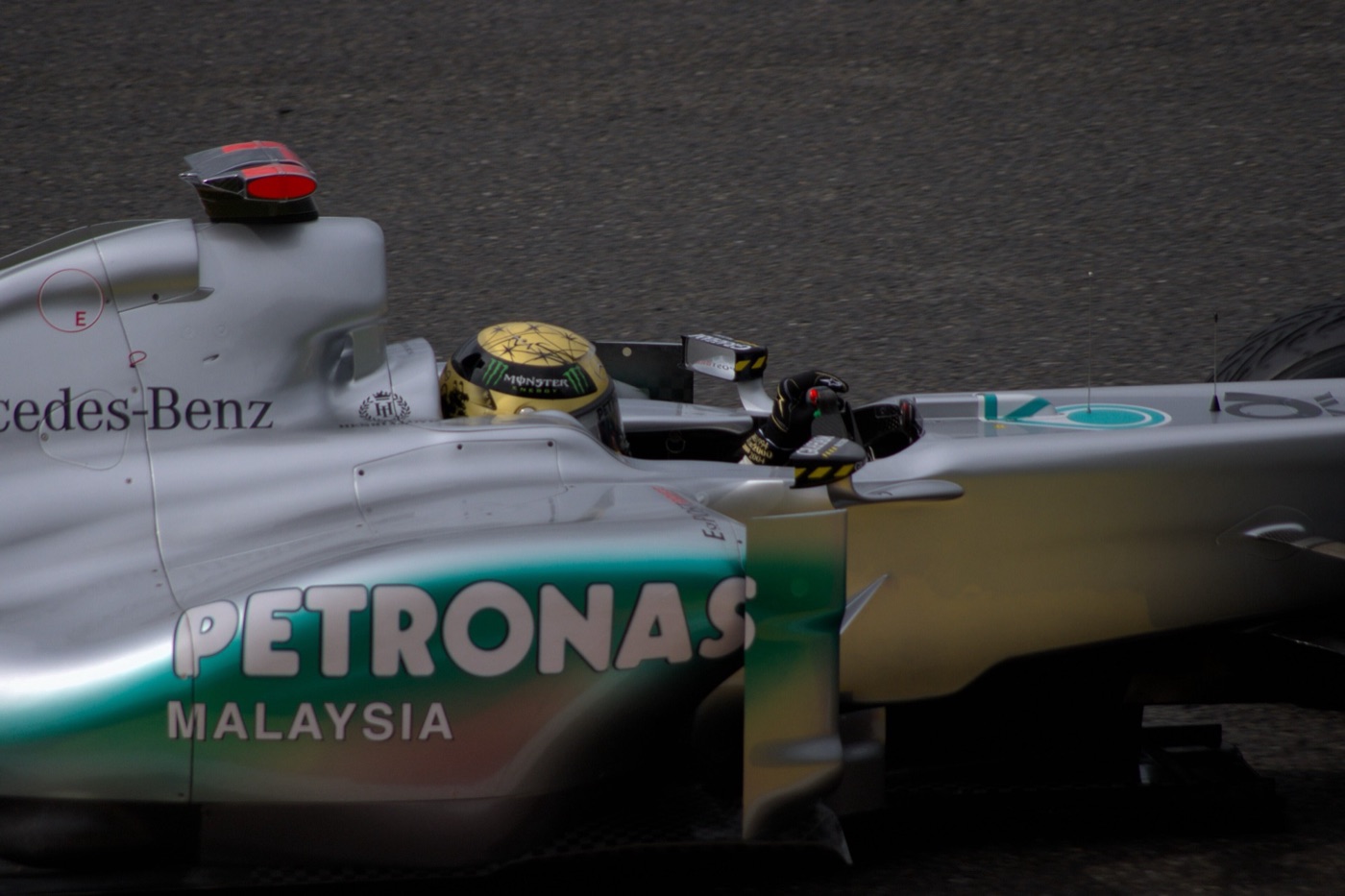
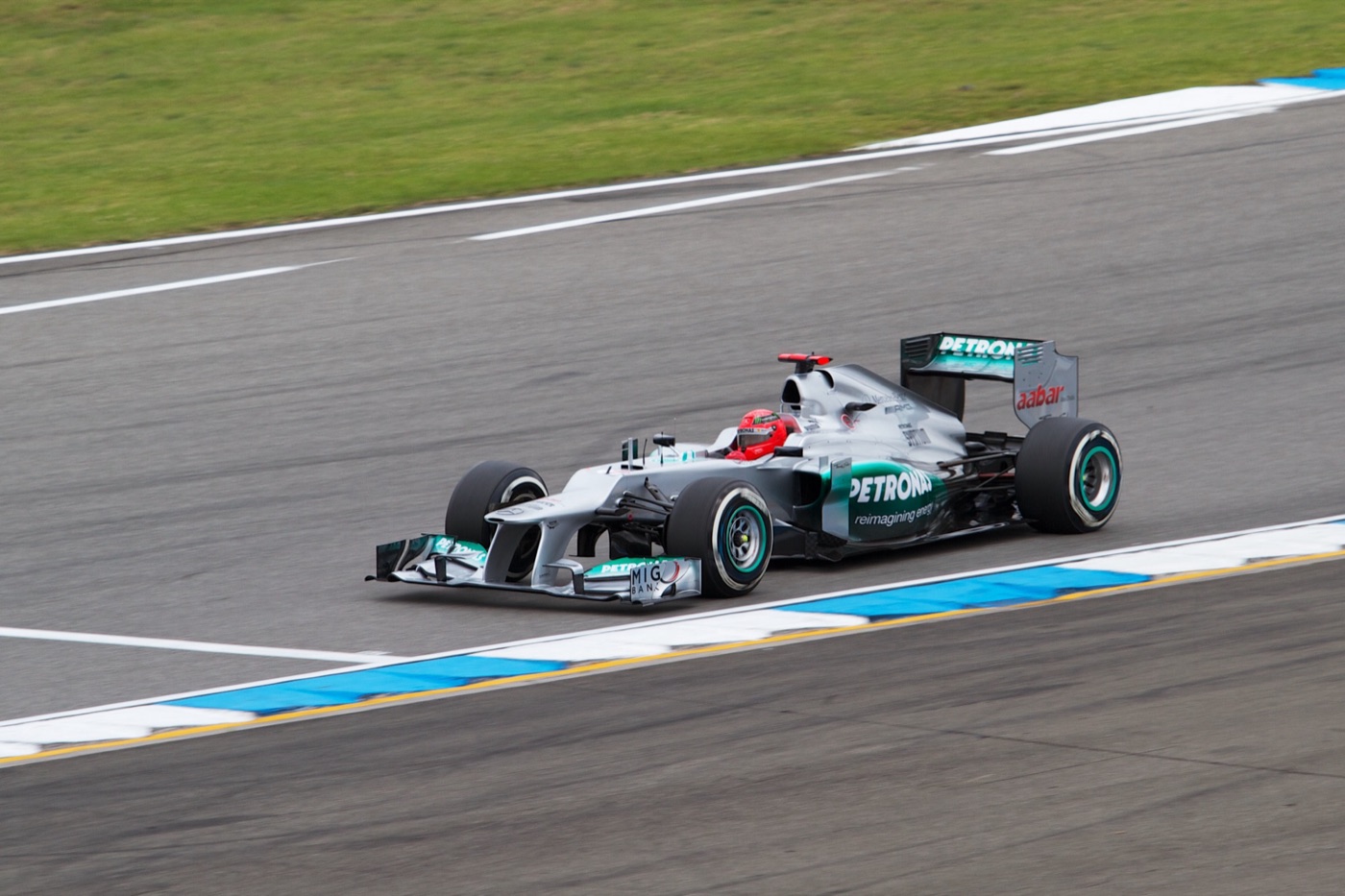
The 2012 car, the F1 W03, was quick from the start of the year, and Schumacher qualified fourth in Australia, third in Malaysia and third in China, but he finished only 12 of the 20 races and ended the season 13th with 49 points to Rosberg’s 93 (Formula 1’s 2012 results). In Australia he was running third when his gearbox failed, Motor Sport’s season review recorded.
In China he started second, beside Rosberg, and retired on lap 10 after a front wheel was not fastened properly at his first stop; the team was fined €5,000 for an unsafe release. Rosberg won by 20 seconds, the first Grand Prix win for a works Mercedes team since Juan Manuel Fangio and Piero Taruffi finished first and second at Monza on 11 September 1955, GrandPrix.com noted. “Michael was in great shape and looking like falling into the same strategy window as Nico,” said Brawn.
Did Michael Schumacher take pole at Monaco in 2012?
Schumacher was fastest in qualifying for the 2012 Monaco Grand Prix, but the record books credit pole position to Mark Webber, because Schumacher was already carrying a five-place grid penalty for a collision with Bruno Senna’s Williams in Spain, where he ran into the back of it. He lapped in 1min 14.301sec, ahead of Webber’s Red Bull on 1min 14.381sec and Rosberg’s 1min 14.448sec, on Formula 1’s qualifying classification.
At 43 he would have been the oldest pole-sitter since Jack Brabham in 1970, GrandPrix.com noted, and it would have been his 69th pole. “Monaco to all of us is the race of the year and to manage pole here after what’s happened in the last two and a half years, is just fabulous,” he said. He started sixth and retired from the race; Rosberg finished second.
Mercedes’ strategist James Vowles called it “one of the best laps he’d probably ever done in his life”, speaking on the Beyond The Grid podcast in 2021: “I was heartbroken, truly heartbroken for him.” Vowles also put part of the gap to Rosberg down to age: “He had shortcomings in terms of how he was able to drive the car relative to Nico, but he was very conscious and aware of that and doing what he could to remedy those areas. But the areas which, in truth, part of it was age, where he wouldn’t be helped to find anything on it, were there.”
Valencia: Schumacher’s last podium
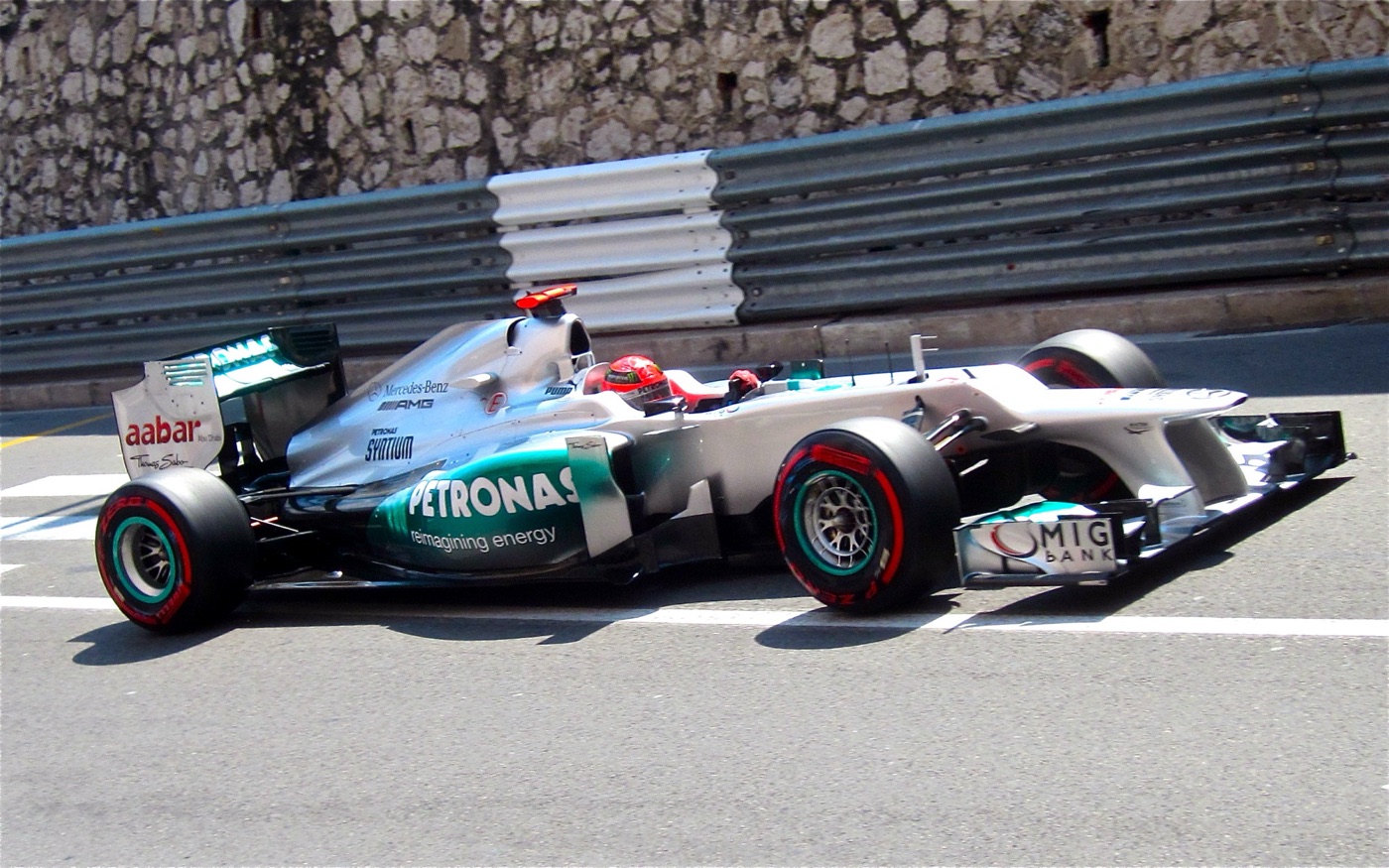
Schumacher finished third in the European Grand Prix at Valencia on 24 June 2012, his only podium for Mercedes. He started 12th, gained places when the race leader, Sebastian Vettel, retired with an alternator failure, and made a second stop for soft tyres with 16 laps left. On the fresher tyres he passed Vitaly Petrov, Button, Sergio Pérez and Paul di Resta, then Nico Hülkenberg’s Force India and the damaged Williams of Pastor Maldonado on the penultimate lap, with Webber behind him to the flag. It was his first podium since the 2006 Chinese Grand Prix, 99 races earlier, Autosport counted. “I asked my guys where we finished,” he said; he had lost count of the positions.
He qualified third at Silverstone, fourth at Hockenheim and sixth in Austin, and in the races after Valencia he outscored Rosberg 32 points to 18. In Singapore he ran into the back of Jean-Éric Vergne’s Toro Rosso, and in Japan he started 23rd after qualifying 13th, a ten-place drop.
Schumacher against Rosberg: the record
Over three seasons Rosberg beat Schumacher on points, wins, podiums and qualifying: 324 points to 197, one win to none, five podiums to one, and 40 qualifying sessions to 18. The table counts every race from Formula 1’s official results; in qualifying, a driver who set no time counts as behind.
| Season | Car | Schumacher: points (position) | Rosberg: points (position) | Podiums, Schumacher–Rosberg | Ahead in qualifying, Schumacher–Rosberg | Ahead at the finish, Schumacher–Rosberg | Retirements, Schumacher–Rosberg |
|---|---|---|---|---|---|---|---|
| 2010 | MGP W01 | 72 (9th) | 142 (7th) | 0–3 | 5–14 | 5–14 | 2–3 |
| 2011 | MGP W02 | 76 (8th) | 89 (7th) | 0–0 | 3–16 | 7–11 | 5–2 |
| 2012 | F1 W03 | 49 (13th) | 93 (9th) | 1–2 | 10–10 | 10–10 | 8–3 |
| Total | 197 | 324 | 1–5 | 18–40 | 22–35 | 15–8 |
“Ahead at the finish” leaves out the one race in which both cars retired, Australia in 2011. In 2012 they were level at ten each in qualifying, but Schumacher retired eight times to Rosberg’s three. Rosberg stayed at Mercedes and became world champion in 2016, five points ahead of Hamilton, on Formula 1’s 2016 standings.
Why did Michael Schumacher retire again?
Schumacher retired at the end of 2012 because Mercedes had signed Lewis Hamilton to replace him. The team confirmed Hamilton’s move from McLaren on a three-year contract on 28 September 2012, Speedcafe reported; Brawn said that “over the past three years, we have been putting in place the foundations and building blocks that are needed to compete regularly for the world championship.”
A week later, on 4 October at Suzuka, Schumacher announced that he would stop at the end of the season. “It is without doubt that we did not achieve our goals to develop a world championship fighting car,” he said (GrandPrix.com). He told Autosport: “I said in 2006 my battery was empty and now I am in the red zone.” Talk of a move to Sauber came to nothing.
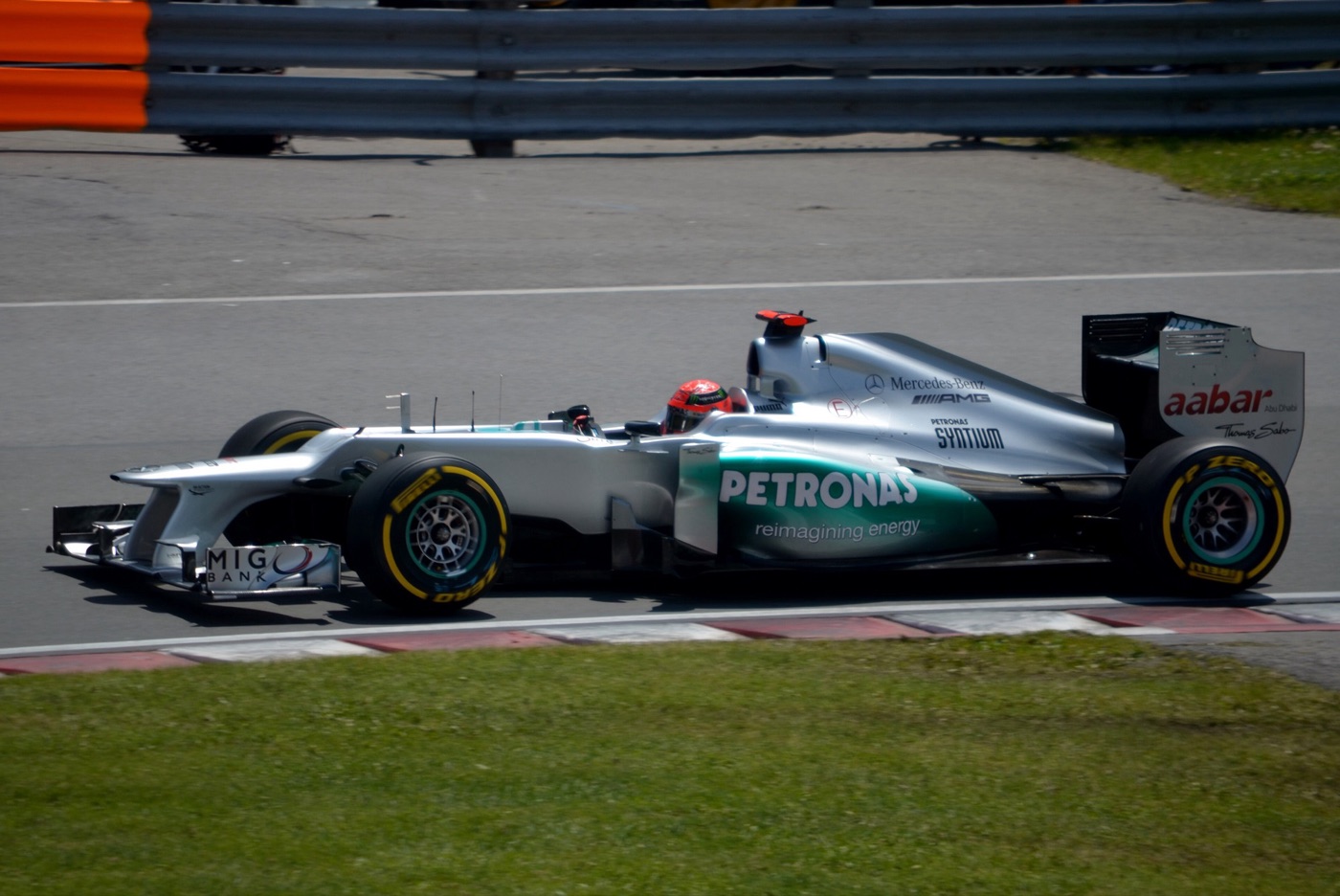
His last race was the Brazilian Grand Prix at Interlagos on 25 November 2012, where he finished seventh. He left Formula One with seven world championships, 91 wins, 155 podiums and 68 pole positions, the totals in Mercedes’ 2009 announcement plus the one podium he added. Mercedes listed 248 starts and 154 podium finishes before the comeback, and he started 58 more races for the team.
What Schumacher left at Mercedes
Mercedes finished fourth, fourth and fifth in the constructors’ championship in Schumacher’s three seasons, and from 2014 it won the title every year to 2021, on Formula 1’s team standings. People inside the team give Schumacher some of the credit.
Ron Meadows, the team’s sporting director, said on the 2021 podcast: “A couple of years later we couldn’t stop winning and he deserves some of that because the reason we’re winning today, a lot was down to him because he made us better.” Toto Wolff, the team principal, called him “one of the founding fathers of the success we have had in the last five years” in the team’s 2019 birthday tribute. Brawn told the German broadcaster RTL that “it frustrates me that we were not able to give him the car that he deserved”, quoted by GrandPrix247.
His son Mick joined Mercedes as reserve driver for 2023, after two seasons racing for Haas; Formula 1’s report of the signing noted the family’s links with the team.
What happened to Michael Schumacher after Mercedes?
Schumacher’s skiing accident came a year after his last race. On 29 December 2013 he fell while skiing at Méribel in the French Alps and hit his head on a rock. The local gendarmerie said he was wearing a helmet. He was flown to hospital, taken on to Grenoble with “a serious brain trauma with coma”, in the hospital’s words, and operated on, Al Jazeera reported.
In June 2014 he was moved to the university hospital in Lausanne, and on 9 September 2014 he left it to continue his rehabilitation at the family home on Lake Geneva. His manager, Sabine Kehm, said then that “considering the severe injuries he suffered, progress has been made in the past weeks and months” (Al Jazeera); Swissinfo added that she did not present the move as a dramatic change in his condition. The family has kept his condition private since. His wife, Corinna, said in the 2021 Netflix documentary Schumacher, quoted by Sky Sports: “Michael is here. Different, but he’s here.”
The family has gone to court to keep that privacy. In May 2024 the publisher Funke paid it €200,000 over an AI-generated “interview” that its magazine Die Aktuelle printed in April 2023, after a Munich labour court judgement and settlement, Sky Sports reported. In February 2025 a court in Wuppertal found three men guilty of trying to blackmail the family with the threat of releasing photos and videos; the ringleader was jailed for three years, and his son and a former employee of the family’s security firm were given suspended sentences (TimesLIVE, from Reuters).
Questions
Did Michael Schumacher win a race for Mercedes?
Not in Formula One: his best Grand Prix result for Mercedes was third at Valencia in 2012. He did win sports car races in Mercedes’ junior team, at Autopolis in 1991 with Karl Wendlinger and, by the ACO’s count, at Mexico City in 1990 with Jochen Mass.
How old was Michael Schumacher when he came back to Formula One?
He was 41. Born on 3 January 1969, he raced his first Grand Prix for Mercedes in Bahrain on 14 March 2010 and his last in Brazil on 25 November 2012, at 43.
Who replaced Michael Schumacher at Mercedes?
Lewis Hamilton, who signed a three-year contract in September 2012 and joined Nico Rosberg for 2013.
What number did Schumacher race with at Mercedes?
Number 3 in 2010 and number 7 in 2011 and 2012, in Formula 1’s results.
How much was Schumacher paid by Mercedes?
Neither side published the figure. Reports in December 2009 ranged from €3.5 million (Bild, for one year) to $10 million.
How many Grands Prix did Schumacher start for Mercedes?
58: 19 in 2010, 19 in 2011 and 20 in 2012. He scored points in 31 of them.
Did Mick Schumacher drive for Mercedes?
Yes, as reserve driver from 2023, after two seasons racing for Haas. Mercedes named him in December 2022, the day Ferrari ended its four-year link with him.
Sources
- Mercedes GP Petronas, “Michael Schumacher joins Mercedes GP Petronas”, 23 December 2009: the signing, career totals to 2006, quotes from Schumacher.
- Al Jazeera, “Schumacher signs Mercedes deal”, 23 December 2009: the three-year deal, reported pay, the championship aim.
- SkiddMark, “Schumacher will drive for Mercedes F1 in 2010”, December 2009: Bild’s report of a one-year, €3.5 million deal.
- GrandPrix.com, Mercedes takes control of Brawn GP, 16 November 2009: the shareholdings.
- Mail & Guardian (AFP), “Neck injury wrecks Schumacher return”, 11 August 2009: the abandoned Ferrari comeback.
- Motor Sport, “Great racing cars: 1990 Mercedes-Benz C11”: the junior programme and Neerpasch.
- Automobile Club de l’Ouest, “1990–2010: from Mercedes to Mercedes”: Schumacher’s 1990 races and Le Mans 1991.
- Motor Sport, “Autopolis 430 km”, December 1991: the Autopolis win.
- Mercedes-AMG Petronas F1 Team, “50 years ago, a star was born”, January 2019: birth date, junior years, Wolff’s quotes.
- Formula 1, official results: driver standings for 2010, 2011, 2012 and 2016; Schumacher’s season results for 2010, 2011 and 2012; Rosberg’s results; qualifying classifications and starting grids for all 58 races, including Monaco 2012 and Belgium 2011; team standings 2014 to 2021.
- Autosport, Dieter Rencken, “Analysing the mystery of Schumacher’s pace”, April 2010: the first four races, testing days.
- Autosport, “Front tyres design hurting Schumacher”, 2 August 2010: Brawn on the tyres.
- Motor Sport, “FIA to review safety car rule after Schumacher penalty”, July 2010: Monaco 2010.
- Mail & Guardian (AP), “Schumacher penalised after impeding Barrichello”, 2 August 2010: Hungary 2010.
- Motor Sport, “2011 Canadian Grand Prix report”: Canada 2011.
- GrandPrix.com, Chinese GP 2012 race report: Rosberg’s win, Schumacher’s retirement, the fine.
- GrandPrix.com, Monaco GP 2012 qualifying report: the penalty, Brabham comparison, Schumacher’s quote.
- Formula 1, “Long-serving Mercedes staff reveal heartbreak of Schumacher failing to win”, 2021: Vowles and Meadows.
- Autosport, “Valencia F1 ’12: How Schumacher scored his final podium”: Valencia 2012.
- Motor Sport, “Season review: Mercedes”, 2012: Australia 2012, Singapore, the 2009 staff cuts.
- Speedcafe, “Hamilton replaces Schumacher at Mercedes”, 28 September 2012: Hamilton’s contract, Brawn’s quote.
- GrandPrix.com, “Schumacher calls time on F1 career”, 4 October 2012 and Autosport, “Michael Schumacher to retire at the end of 2012”: the retirement.
- GrandPrix247, “Brawn: Michael helped make Mercedes the force it is now”: Brawn’s RTL interview.
- Formula 1, “Mick Schumacher to join Mercedes as reserve driver for 2023”, December 2022.
- Al Jazeera, skiing accident report, 30 December 2013; Al Jazeera, “Schumacher leaves hospital for home”, 9 September 2014; Swissinfo, September 2014: the accident and the move home.
- Sky Sports, compensation over the AI “interview”, May 2024: the settlement and Corinna Schumacher’s words.
- TimesLIVE (Reuters), “Three sentenced for attempted blackmail of Michael Schumacher’s family”, 13 February 2025.