MINI John Cooper Works GP: the GP1, GP2 and GP3 compared
The MINI John Cooper Works GP is the limited-run, two-seat top model of the BMW-era MINI hatch, built in three generations: the 2006 MINI Cooper S with John Cooper Works GP Kit (2,000 cars), the 2012 MINI John Cooper Works GP (2,000 cars) and the 2020 MINI John Cooper Works GP (3,000 cars). MINI launched each as its most powerful or fastest model to date, with the rear seats taken out and its own suspension, brakes and bodywork, and MINI published a Nürburgring Nordschleife lap time for each: about 8 minutes 42 seconds for the first, 8:23 for the second and under eight minutes for the third. Owners and the trade shorten the name to JCW GP, and call the three cars GP1, GP2 and GP3. In the UK a used one costs from about £12,000 for a high-mileage GP1 to about £30,000 for a GP3, according to 2024 buying guides.
History of the MINI John Cooper Works GP
Each GP was built in a fixed number as the top model of its generation, above the MINI John Cooper Works (JCW), the British brand's performance range named after John Cooper, whose tuned version of the original Mini, the Mini Cooper, was "three-times winner of the Monte Carlo Rally" in the words of BMW's 2012 press kit for the GP2. MINI USA's 2006 release says "GP" stands for Grand Prix, a tribute to that racing record.
GP1: MINI Cooper S with John Cooper Works GP Kit
The first GP was shown at MINI United in Misano, Italy, from 28 to 30 October 2005. BMW's media information of 29 October 2005 gave it "around 160 kW (218 bhp)" from the supercharged 1.6-litre engine, a limited-slip differential as standard, aluminium rear trailing arms and a weight saving of about 40 kg (88 lb), with the rear seats, part of the sound deadening and the air conditioning (a no-cost option) left out. It promised 2,000 cars, on sale in Europe from July 2006 at around 30,000 euros in Germany.
In Britain the GP cost £22,000, the figure in Jethro Bovingdon's evo road test of July 2006. MINI USA's release of 12 April 2006 launched it at the New York show with 415 cars for the United States at $31,150 including delivery, and a sequential number on a roof graphic just above the side door of every car. PistonHeads calls it the final version of the first-generation (R53) Cooper S, and it is the only GP with a supercharged engine.
Built by Bertone near Turin
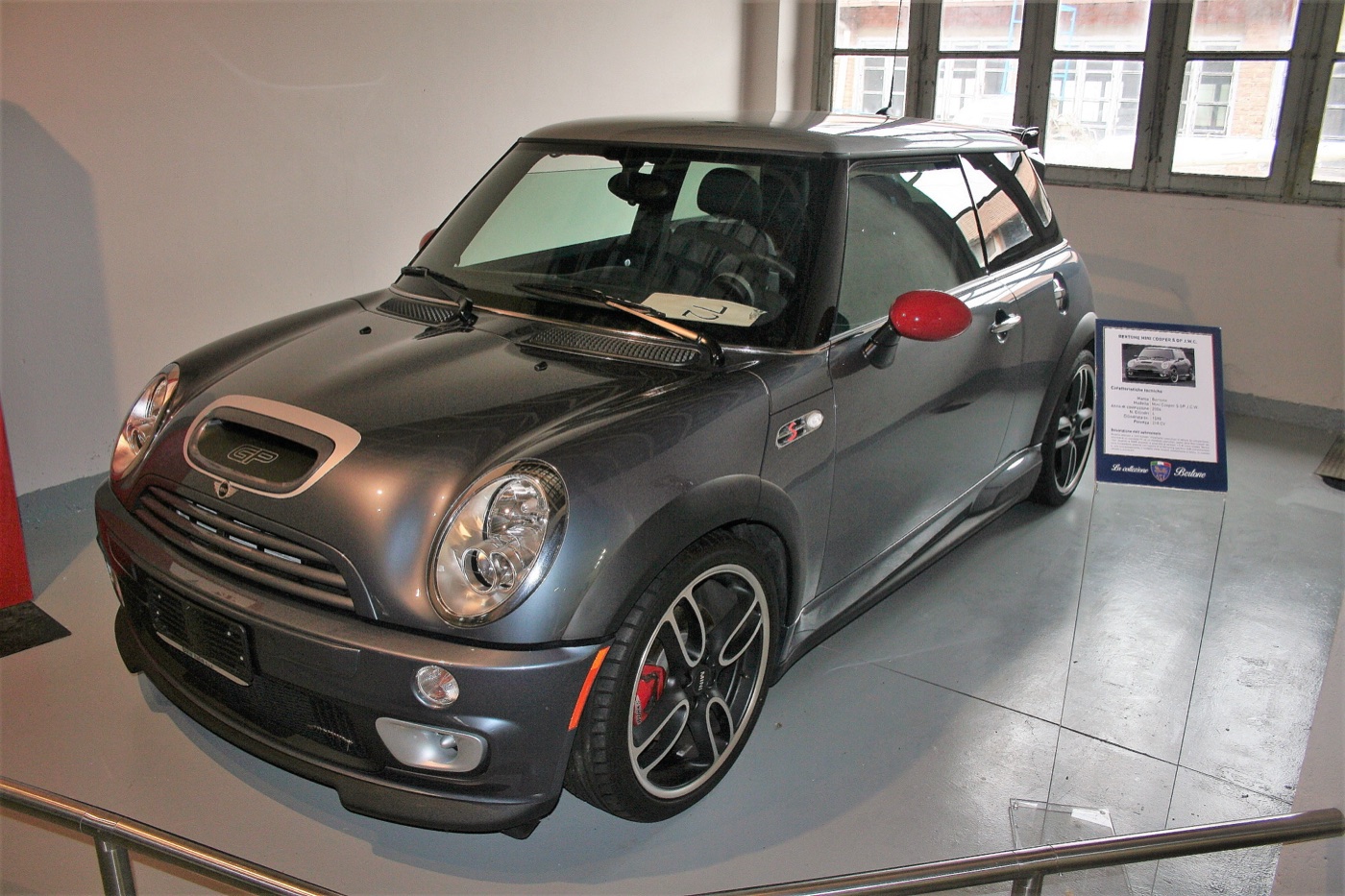
The GP1 was finished in Italy. just-auto, reporting Automotive News Europe on 29 November 2005, said Bertone would receive bodies in white from MINI's Oxford plant and complete final assembly at its Grugliasco works near Turin; BMW sources told the paper the contract made up for the end of BMW C1 scooter production, which Bertone had also built. A GP1 is kept in the Bertone collection of the Automotoclub Storico Italiano at Volandia, beside Milan Malpensa airport.
GP2: the R56 MINI John Cooper Works GP
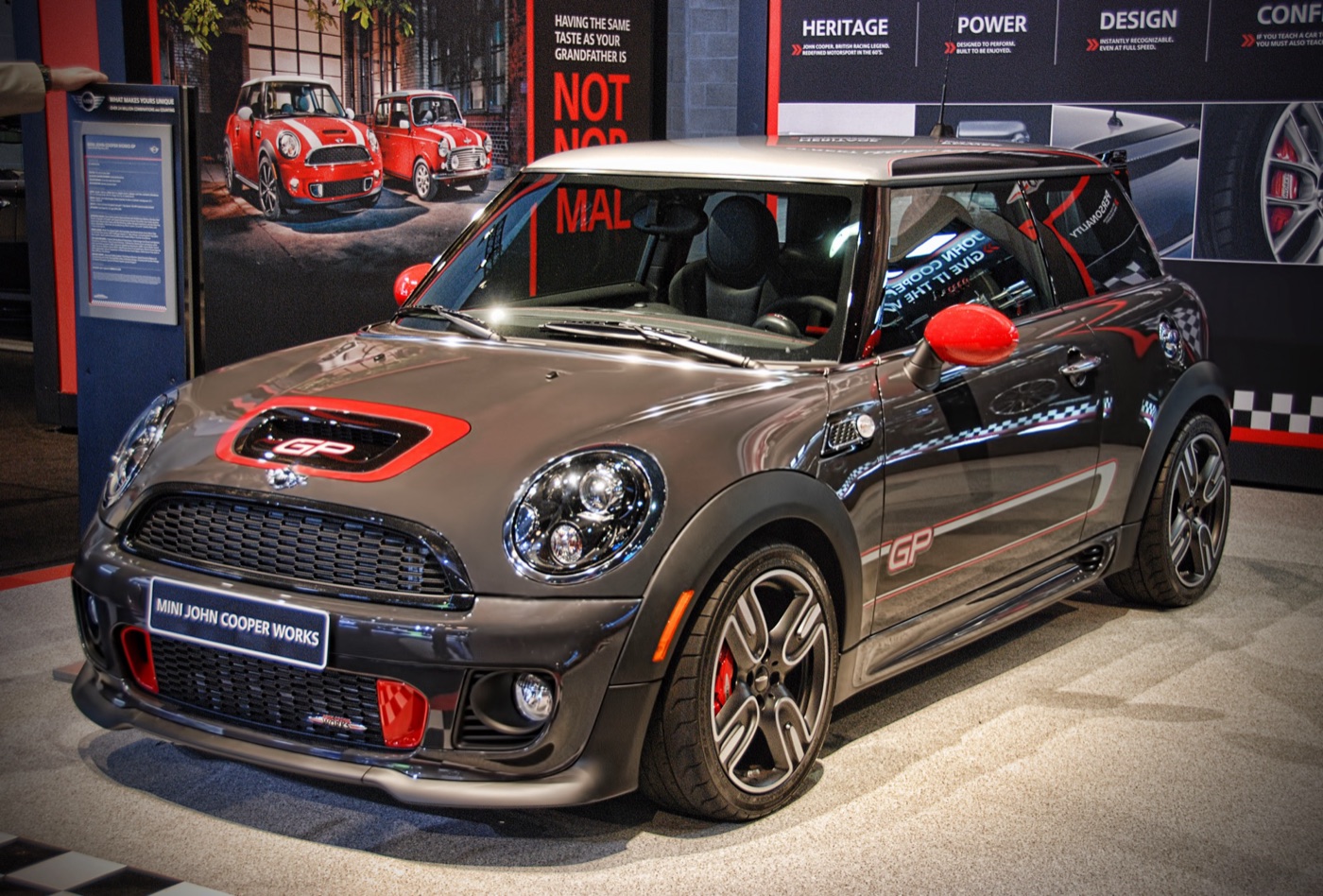
BMW announced the second GP on 12 May 2012, during the MINI United festival at Le Castellet in France (11 to 13 May), where it was shown to the public for the first time. The release called it "the sportiest road-registered MINI ever made", with "powertrain, chassis and aerodynamics technology inspired directly by motor sport", limited to 2,000 cars, and gave its Nordschleife lap as 8 minutes 23 seconds, "almost 19 seconds" faster than the GP1. The press kit for its world debut at the Paris motor show (29 September to 4 October 2012) put the gain at 18 seconds and said production would start later that year. It is based on the second-generation (R56) hatch.
Its UK price tag was £28,790, about £6,000 more than the regular MINI JCW it was based on, according to evo's first drive of 9 November 2012. A SkiddMark report of September 2012 gave the planned UK allocation as 200 cars. DVLA figures analysed by How Rare Is My Car (data to August 2026) count 295 first registered in the UK: 55 in 2012, 219 in 2013 and 14 in 2014. The GP2 owners' site johncooperworksgp.com says 288 were built for the UK market. In the United States MINI USA allocated 500 at $39,950 including delivery, sold as a 2013 model after its debut at the Los Angeles show on 28 November 2012.
The John Cooper Works GP Concept
MINI showed the next GP first as a design study, the John Cooper Works GP Concept, at the Frankfurt motor show in September 2017. MINI USA's release of 6 September 2017 named the 2006 and 2012 cars as its forebears, each built in 2,000 examples. The concept had wide wheel-arch extensions and a double-wing roof spoiler, and the production GP3 of 2019 has both, in smaller form.
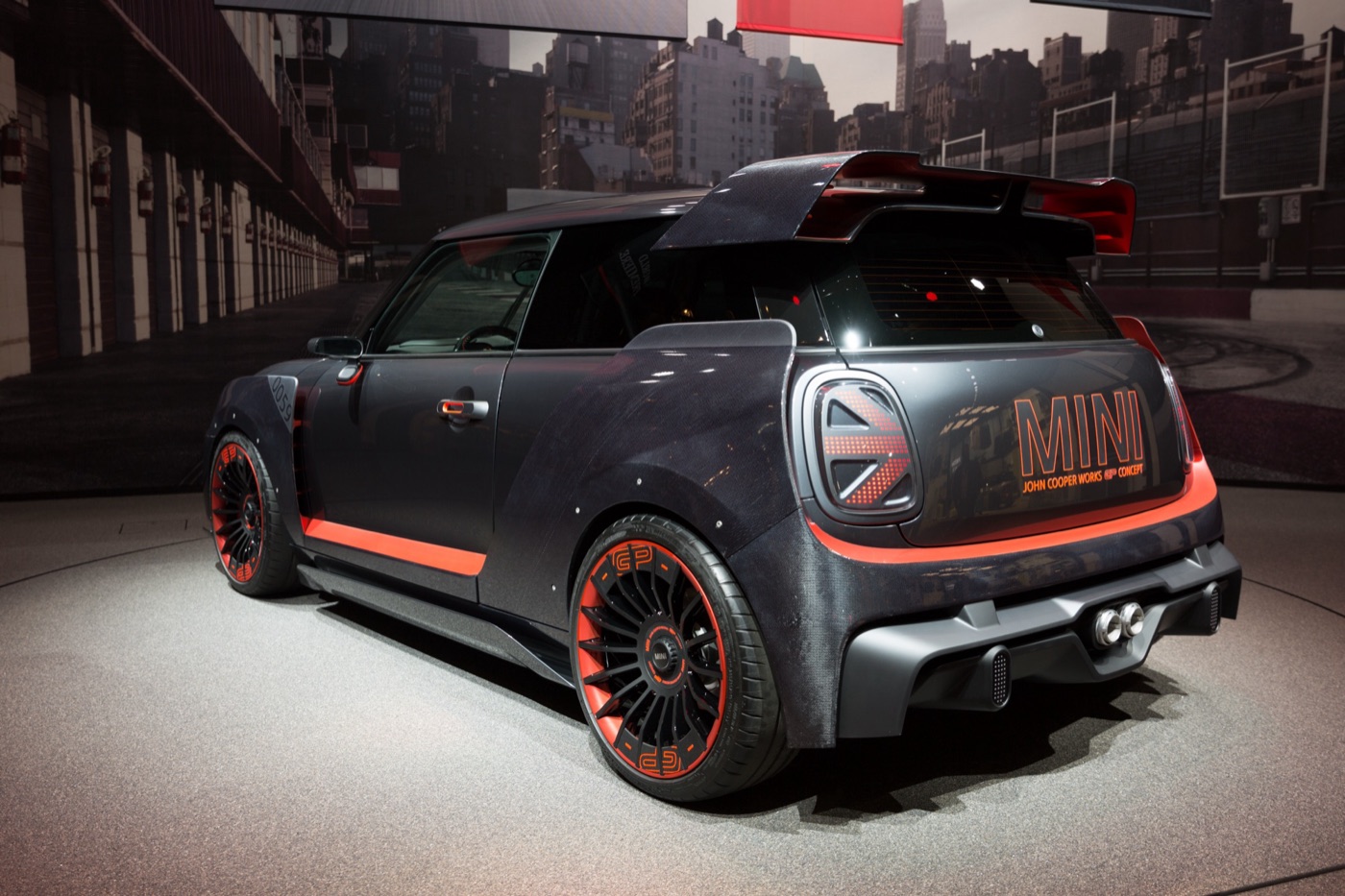
GP3: the F56 MINI John Cooper Works GP
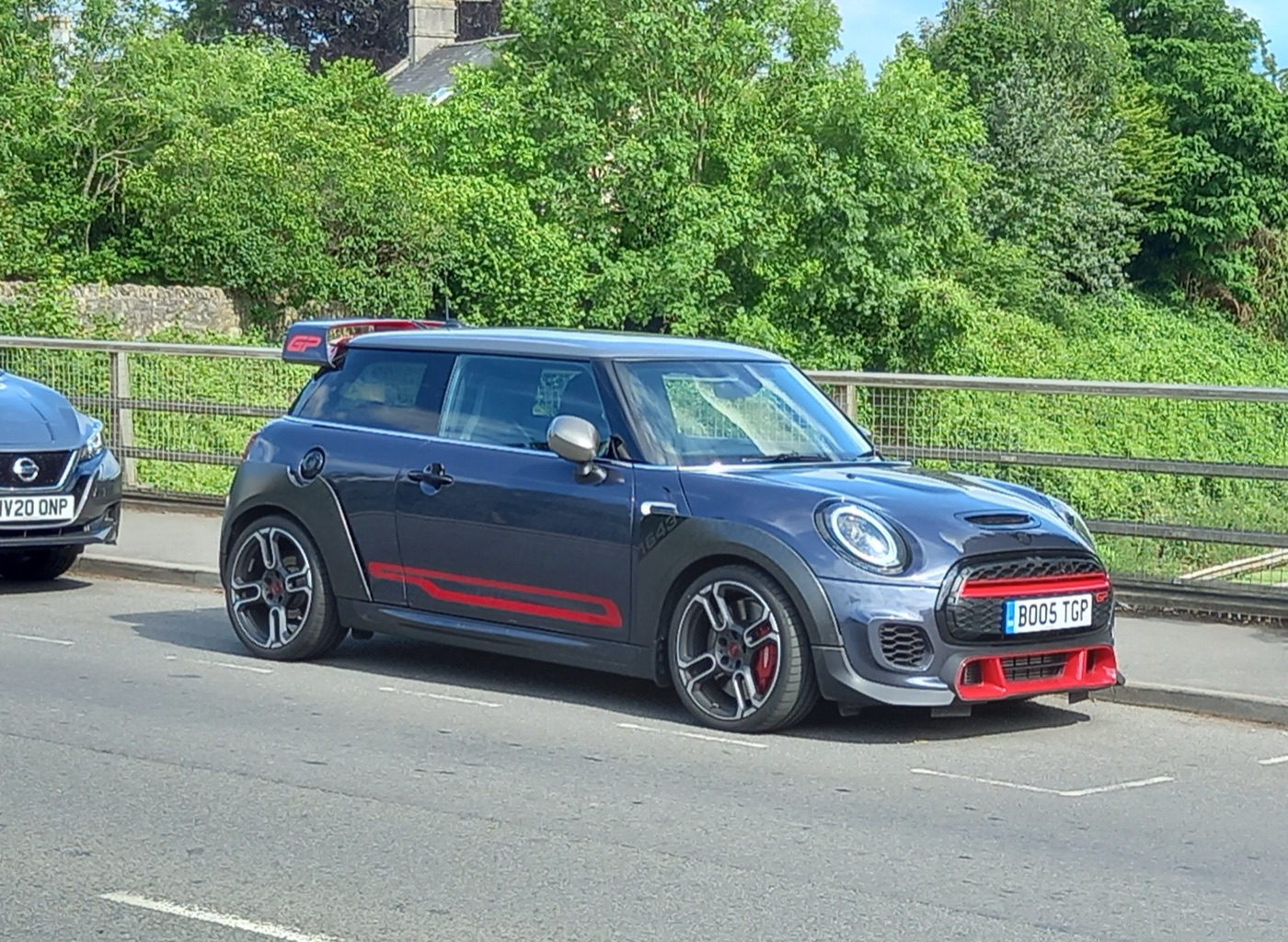
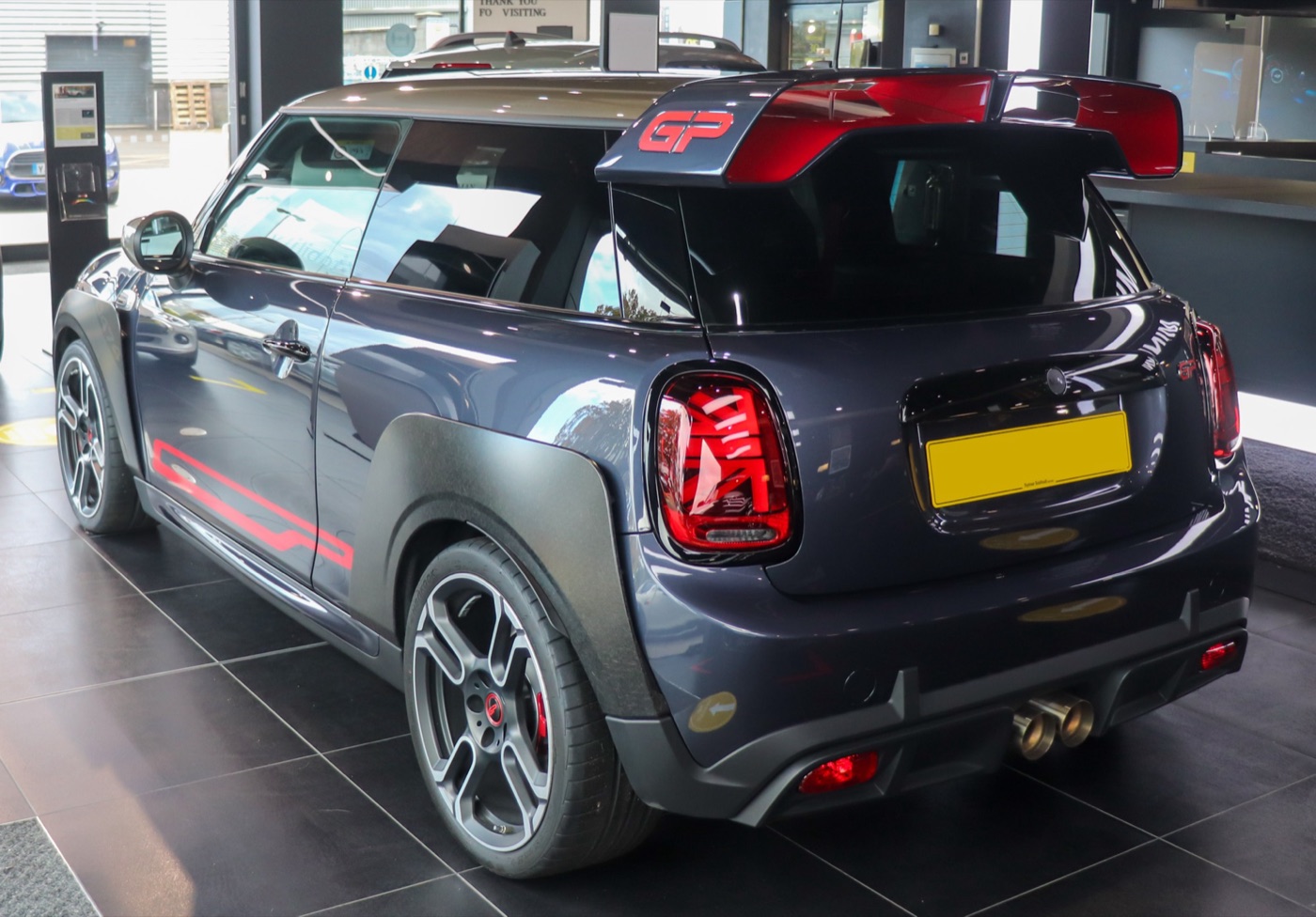
A disguised prototype of the third GP was shown at the Nürburgring 24 Hours in June 2019, with demonstration laps alongside a GP1 and a GP2, and BMW said it had already lapped the Nordschleife "in less than eight minutes". The production car was shown at the Los Angeles show in November 2019. BMW's press kit gave it 225 kW (306 hp) from a 2.0-litre turbocharged four, 0 to 62 mph in 5.2 seconds and 3,000 cars built at MINI's Oxford factory, with deliveries from March 2020. Each car carries its number, 0001 to 3000, on the front wheel-arch trims and on the passenger side of the dashboard.
The UK got 575 of the 3,000, at a list price of £33,895, according to Antony Ingram's evo review of June 2020. In the United States MINI USA priced it at $44,900 plus $850 delivery, and delivered car 0001 to a reservation holder in Latham, New York, on 1 June 2020; American cars are 2021 models.
The GP Pack for the John Cooper Works
From July 2020 MINI offered a John Cooper Works GP Pack on the ordinary four-seat John Cooper Works. BMW's announcement lists what it brings: the GP3's Racing Grey and Melting Silver paint, 18-inch Cup Spoke wheels with GP centre caps, GP-badged seats, mats and sill plates, and 3D-printed metal gearshift paddles with the automatic. BMW describes it as design and equipment only; the car keeps its four seats and is not one of the 3,000 GPs.
How each GP differs from a MINI John Cooper Works
All three GPs follow the same recipe, a MINI John Cooper Works hatchback with more power, no rear seats and track-tuned suspension, but the engine, gearbox, differential and brakes changed with each generation.
GP1: supercharger, limited-slip differential, less weight
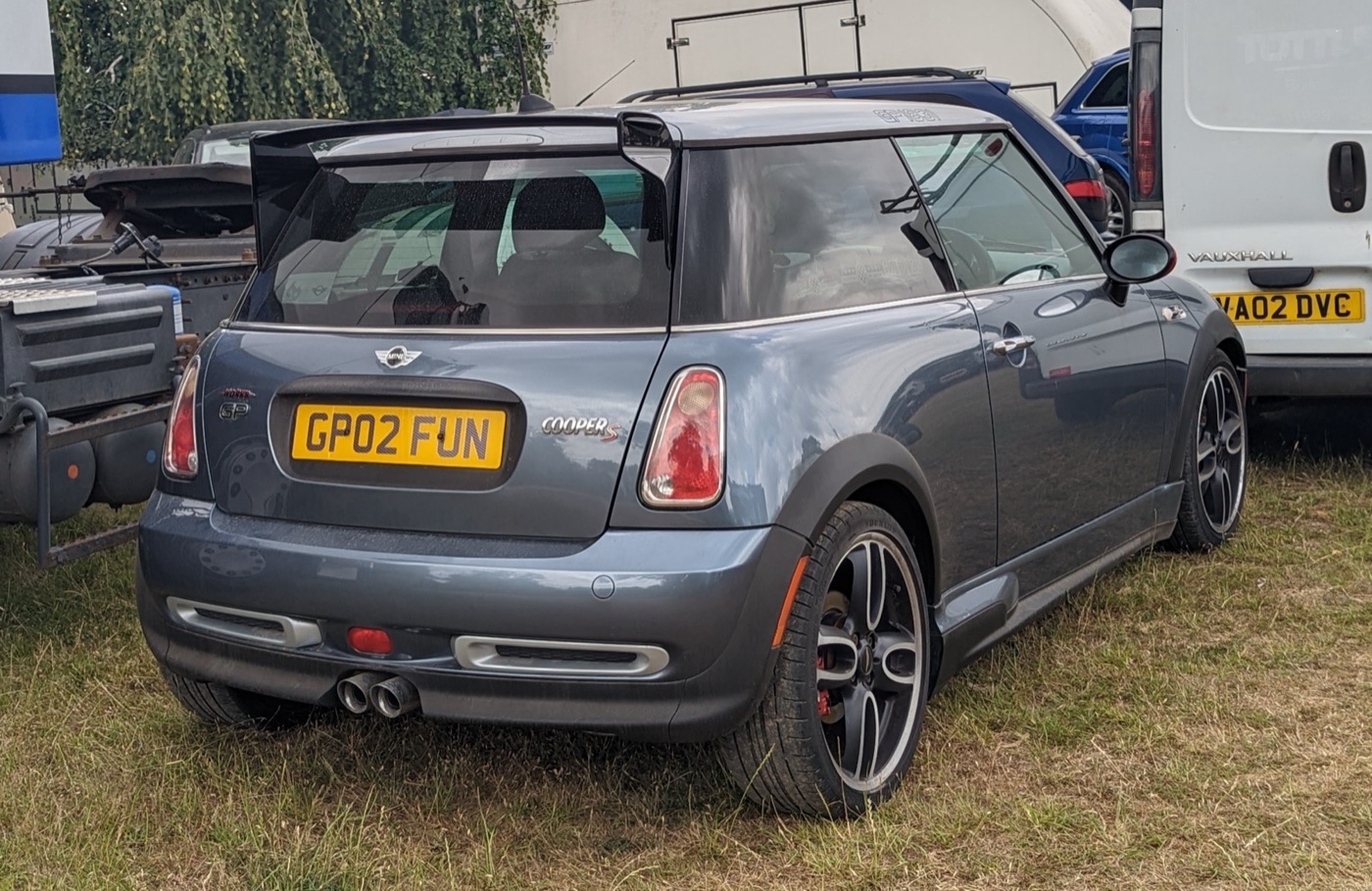
The GP1 kept the 1,598 cc Tritec four with an Eaton M45 supercharger and a six-speed Getrag manual gearbox. PistonHeads' R53 buying guide of October 2020 lists the changes over the John Cooper Works kit: a faster-spinning supercharger pulley, a revised air intake, injectors and engine mapping, and a better intercooler, for peak power at 7,100 rpm and 184 lb ft at 4,600 rpm; CAR's 2006 data panel gives the power peak as 6,250 rpm. The aluminium rear control arms save 15 kg, the four-spoke 18-inch wheels 2 kg a corner, and the car sits 10 mm lower than a Cooper S on firmer springs and dampers. An aluminium brace between the rear suspension towers takes the place of the rear seat.
The power figure has three versions, all for the same engine (and the GP2 has the same three: 218 hp, 215 bhp and, in America, 211 hp). BMW wrote "around 160 kW (218 bhp)", 218 being the metric horsepower (PS) figure; 160 kW is about 215 bhp, the number PistonHeads and CAR use; MINI USA quoted 214 hp on the American SAE scale.
GP2: turbocharged engine, coilovers, six-piston brakes
The GP2's 1.6-litre twin-scroll turbocharged engine has direct injection and BMW's Valvetronic variable valve lift, which BMW's press kit lists, and that marks it as the later N18 version of the Prince engine. It makes 160 kW (218 hp) at 6,000 rpm and 260 Nm from 1,750 rpm, with an overboost to 280 Nm (207 lb ft) from 2,000 rpm, through a six-speed manual gearbox. There is no mechanical differential: a GP mode of the stability control lets the electronic differential lock (EDLC) brake the inside front wheel without cutting engine power.
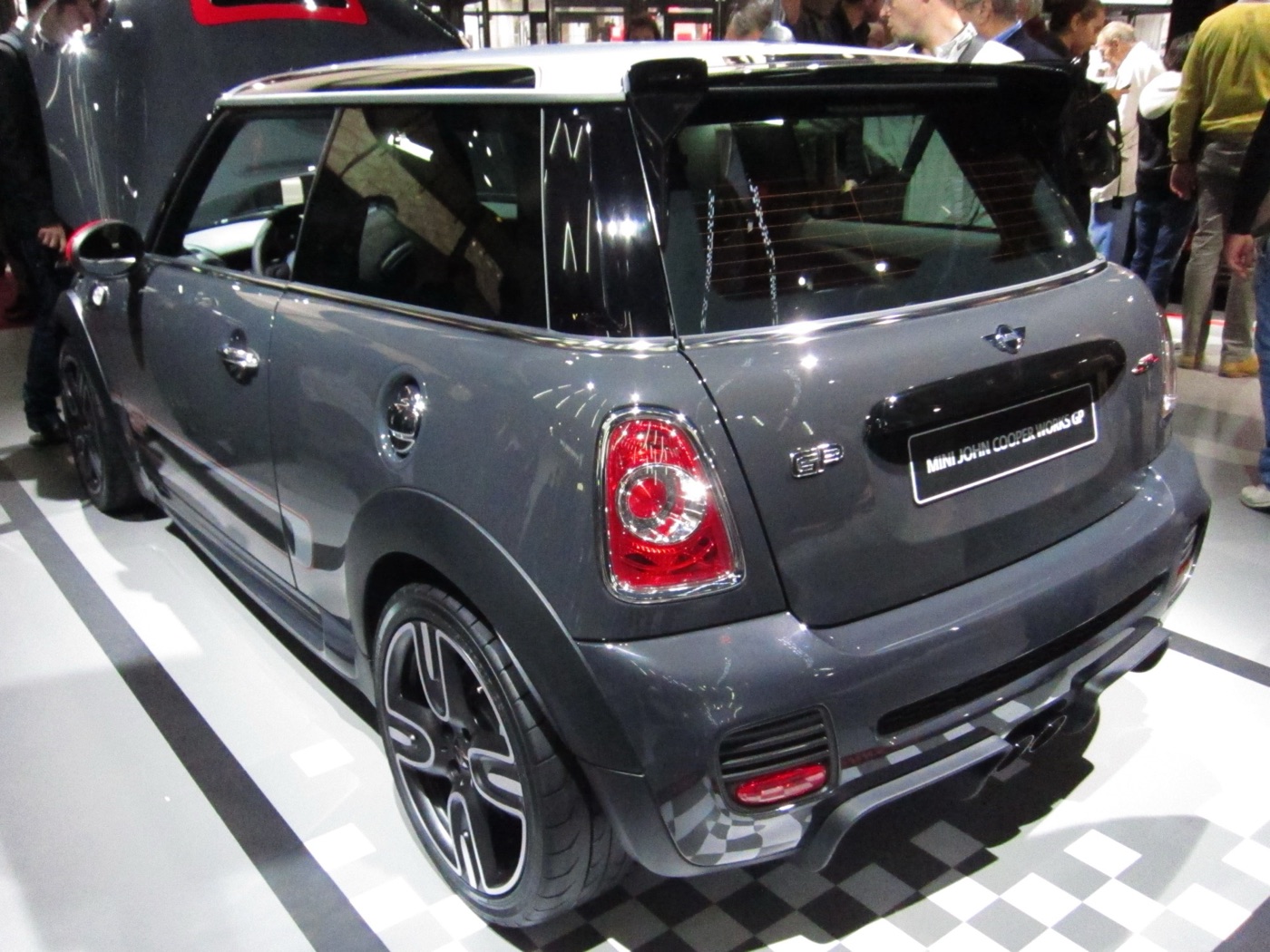
The chassis changes are larger. BMW fitted a coilover suspension with adjustable ride height (down by up to 20 mm), the first on a MINI, so that the set-up could be changed for each circuit, with the front dampers mounted upside down, more front camber and less toe-in. The racing-derived brakes have six-piston fixed callipers on 330 x 25 mm front discs and 280 x 10 mm rear discs. The 17-inch wheels (7.5J, derived from the MINI Challenge one-make racing car) carry 215/40 R17 Kumho Ecsta tyres, or 205/45 R17 tyres for wet and cold weather. BMW said the diffuser, underbody panels and the spoiler at the back of the roof cut rear-axle lift by 90 per cent and drag by six per cent.
GP3: 2.0-litre B48 engine, automatic only, mechanical differential
The GP3 uses BMW's B48 2.0-litre turbocharged four. BMW's press kit lists a reinforced crankshaft with larger main bearings, new pistons, bushless connecting rods, a new turbocharger in the exhaust manifold and a compression ratio lowered from 10.2 to 9.5 for more boost; peak power of 225 kW (306 hp) runs from 5,000 to 6,250 rpm and 450 Nm (332 lb ft) from 1,750 to 4,500 rpm. MINI USA quoted 301 hp (SAE). evo and Top Gear quote the output as 302bhp. The only transmission is an eight-speed Steptronic automatic with a torque converter and a mechanical front differential lock giving up to 31 per cent locking.
The body sits 10 mm lower than the JCW on wider tracks, with stiffer bushes, ball joints on the outer ends of the rear wishbones, a front strut brace and a solid support for the rear axle member in place of the tunnel bridge. The brakes are four-piston aluminium callipers on 360 x 30 mm front discs, the set PistonHeads says the Clubman and Countryman ALL4 versions of the John Cooper Works also use. The 8.0J x 18 forged wheels weigh less than nine kilograms each and wear 225/35 R18 tyres. The engine meets the Euro 6d-TEMP standard for exhaust emissions with a petrol particulate filter. The flared wheel-arch trims are carbon-fibre-reinforced plastic recycled from BMW i3 and i8 production, the first exposed matt carbon on a BMW Group production car, according to BMW. Behind the two seats is a Chili Red aluminium cross-brace that BMW says stops luggage sliding forward under braking.
Paint, mirror caps and interior
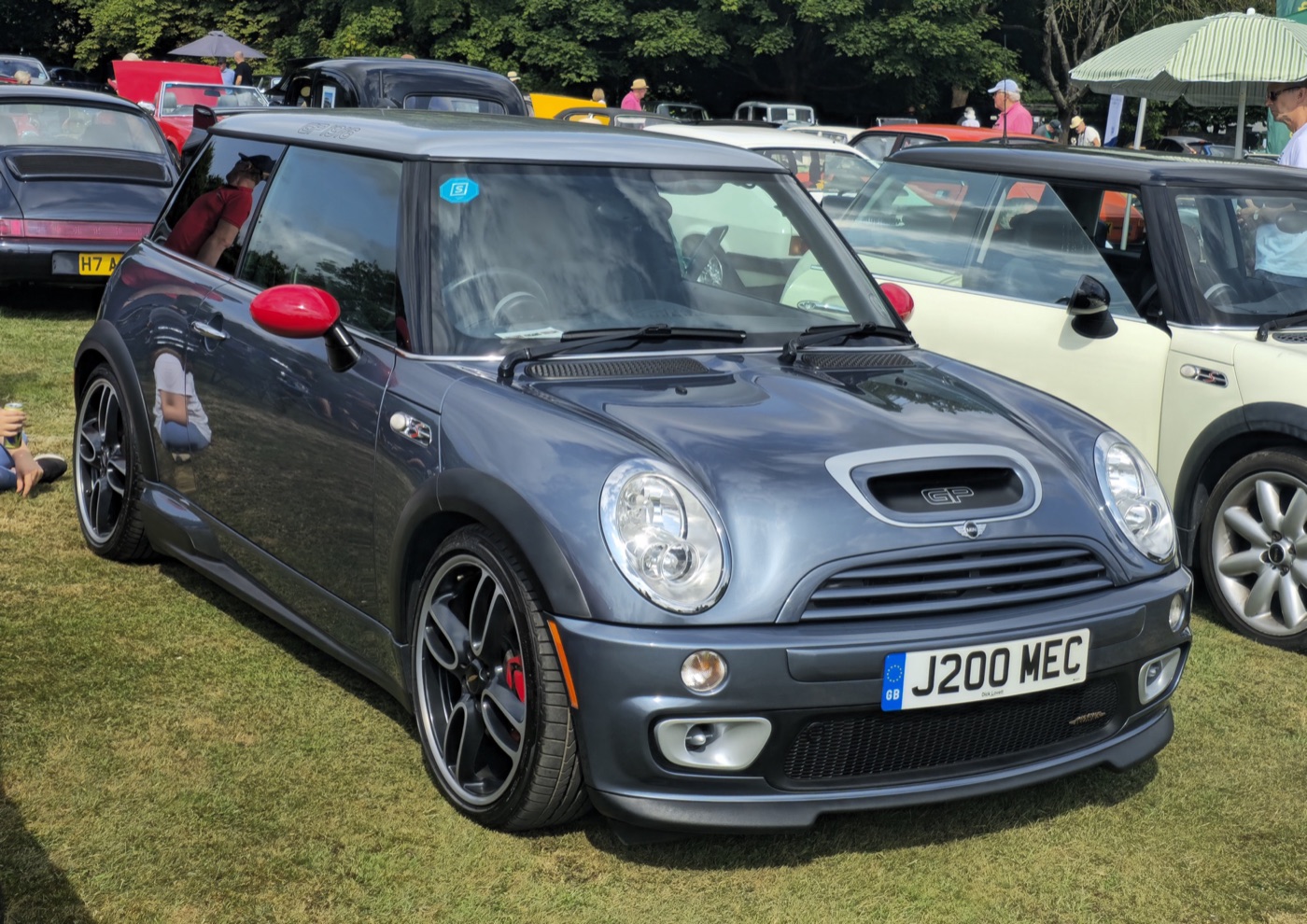
Each GP came in one colour scheme only. The GP1 is grey-blue metallic (Thunder Blue in MINI USA's release) with a Pure Silver roof and bonnet-scoop surrounds, Chilli Red mirror caps and white side indicators. Inside it has Recaro sports seats in GP cloth and leather, a three-spoke leather sports steering wheel and anthracite dials with red needles; CAR noted that the rear wiper was deleted to save weight.
The GP2 is Thunder Grey metallic, with red edging round the bonnet opening, red mirror caps and red side air intakes in the front apron, and GP side stripes between the wheel arches. Xenon headlights in black shells, air conditioning and Recaro seats with GP stitching were standard, with a thick-rimmed John Cooper Works leather steering wheel and an anthracite roof lining.
The GP3 is Racing Grey metallic with a Melting Silver roof and mirror caps and a Chili Red bar across the grille. Its John Cooper Works sports seats are in Dinamica fabric and leather; the steering wheel's 12 o'clock marker and the gearshift paddles are 3D-printed metal; the instruments are a 5-inch digital screen behind the wheel and a 6.5-inch central display. Automatic climate control and navigation were options.
MINI John Cooper Works GP specs and performance
The GP3 has 40 per cent more power than either earlier GP and is the only one with an automatic gearbox; the first two have the same 218 hp, one supercharged and one turbocharged.
| GP1 (R53), 2006 | GP2 (R56), 2012 to 2013 | GP3 (F56), 2020 to 2021 | |
|---|---|---|---|
| Engine | 1,598 cc four, supercharged | 1,598 cc four, twin-scroll turbo (N18) | 1,998 cc four, turbo (B48) |
| Power | 160 kW (218 hp; 215 bhp) at 7,100 rpm (PistonHeads) or 6,250 rpm (CAR) | 160 kW (218 hp) at 6,000 rpm | 225 kW (306 hp) at 5,000 to 6,250 rpm |
| Torque | 249 Nm (184 lb ft) at 4,600 rpm | 260 Nm from 1,750 rpm; 280 Nm (207 lb ft) on overboost | 450 Nm (332 lb ft) at 1,750 to 4,500 rpm |
| Gearbox | Six-speed manual | Six-speed manual | Eight-speed automatic |
| Differential | Limited-slip | Electronic (brake-based) | Mechanical lock, up to 31% |
| Front brakes | John Cooper Works, red callipers | Six-piston, 330 mm discs | Four-piston, 360 mm discs |
| Wheels and tyres | 18-inch, 205/40 R18 | 17-inch, 215/40 R17 | 18-inch forged, 225/35 R18 |
| Kerb weight | 1,090 kg | 1,160 kg (DIN) | 1,255 kg |
| 0 to 62 mph | 6.5 sec | 6.3 sec | 5.2 sec |
| Top speed | 149 mph (MINI USA: 150 mph) | 150 mph (242 km/h) | 164 mph (265 km/h) |
| Official economy and emissions | 20 mpg city, 27 mpg highway (US gallons, EPA) | 39.8 mpg (UK combined), 165 g/km | 38.7 mpg (UK, PistonHeads), 167 g/km |
| Nordschleife lap (MINI) | About 8:42 | 8:23 | Under 8:00 |
MINI's 2012 data sheet, as SkiddMark printed it that September, also gives the GP2's weight to the EU standard, 1,235 kg, the same as a standard John Cooper Works; the DIN figure leaves out the driver and luggage allowance.
How fast is the MINI John Cooper Works GP?
The GP3 is the fastest MINI built for the road: 0 to 62 mph in 5.2 seconds and 164 mph, with no speed limiter. The GP2 does 0 to 62 mph in 6.3 seconds and 150 mph, and the GP1 6.5 seconds and 149 mph.
Nürburgring lap times of the three GPs
MINI timed each GP on the Nordschleife, almost 21 km a lap, during development. The GP2's 8:23 is the only lap MINI published to the second: BMW's 2012 release and press kit put it 18 to 19 seconds ahead of the GP1, and PistonHeads' R56 buying guide of May 2020 gives the GP1's time as 8:42. For the GP3 MINI said only "less than eight minutes", almost half a minute faster than the GP2. The Renault Mégane RS 265 Trophy lapped in 8:07.97 in June 2011, evo reported from the track, so the GP2 was 15 seconds slower than a cheaper rival before it went on sale.
How many MINI John Cooper Works GPs were made?
MINI built 7,000 GPs in all: 2,000 GP1s, 2,000 GP2s and 3,000 GP3s. Each was announced as a fixed run of units, and the GP3's run was 1,000 cars larger than either of its predecessors'.
| Generation | Built | United Kingdom | United States |
|---|---|---|---|
| GP1 (2006) | 2,000 (Oxford bodies, finished by Bertone) | 450 to 500 (sources differ); 440 first registered (DVLA) | 415 |
| GP2 (2012 to 2013) | 2,000 | 200 planned (2012); 288 (owners' site); 295 first registered (DVLA) | 500 |
| GP3 (2020 to 2021) | 3,000 (Oxford) | 575; 568 first registered (DVLA) | Not published by MINI |
The British count for the GP1 varies by source: Chris Chilton's CAR magazine road test of 2006 said 500 were bound for Britain, all sold before launch; PistonHeads and Stephen Dobie's Top Gear buying guide say about 450; evo's 2024 update says 459, "demand proving stronger than anticipated". DVLA data counts 440 GP1s first registered in the UK, 435 of them in 2006, and 568 GP3s (558 in 2020).
MINI John Cooper Works GP prices and values
British guides put used GPs at between about 55 and 85 per cent of their price new, and at American auctions the GP1 now sells for more than the GP2.
Prices new
In Britain the GP1 cost £22,000 in 2006, the GP2 £28,790 in 2012 and the GP3 £33,895 when announced in 2019; PistonHeads' GP3 buying guide of March 2024 says the price had risen to £35,345 by the time cars went on sale in 2020. In the United States they cost $31,150, $39,950 and $45,750, each including delivery.
What a GP is worth in the UK
British guides in 2024 put a GP1 at £12,000 for a car with 120,000 miles or more, about £15,000 for a tidy one at around 50,000 miles and close to £18,000 for the best low-mileage cars (evo, August 2024). PistonHeads' GP2 Heroes feature of September 2024 gave £17,000 to £22,000 for a GP2, and its GP3 guide gave £30,000 for a GP3 in March 2024.
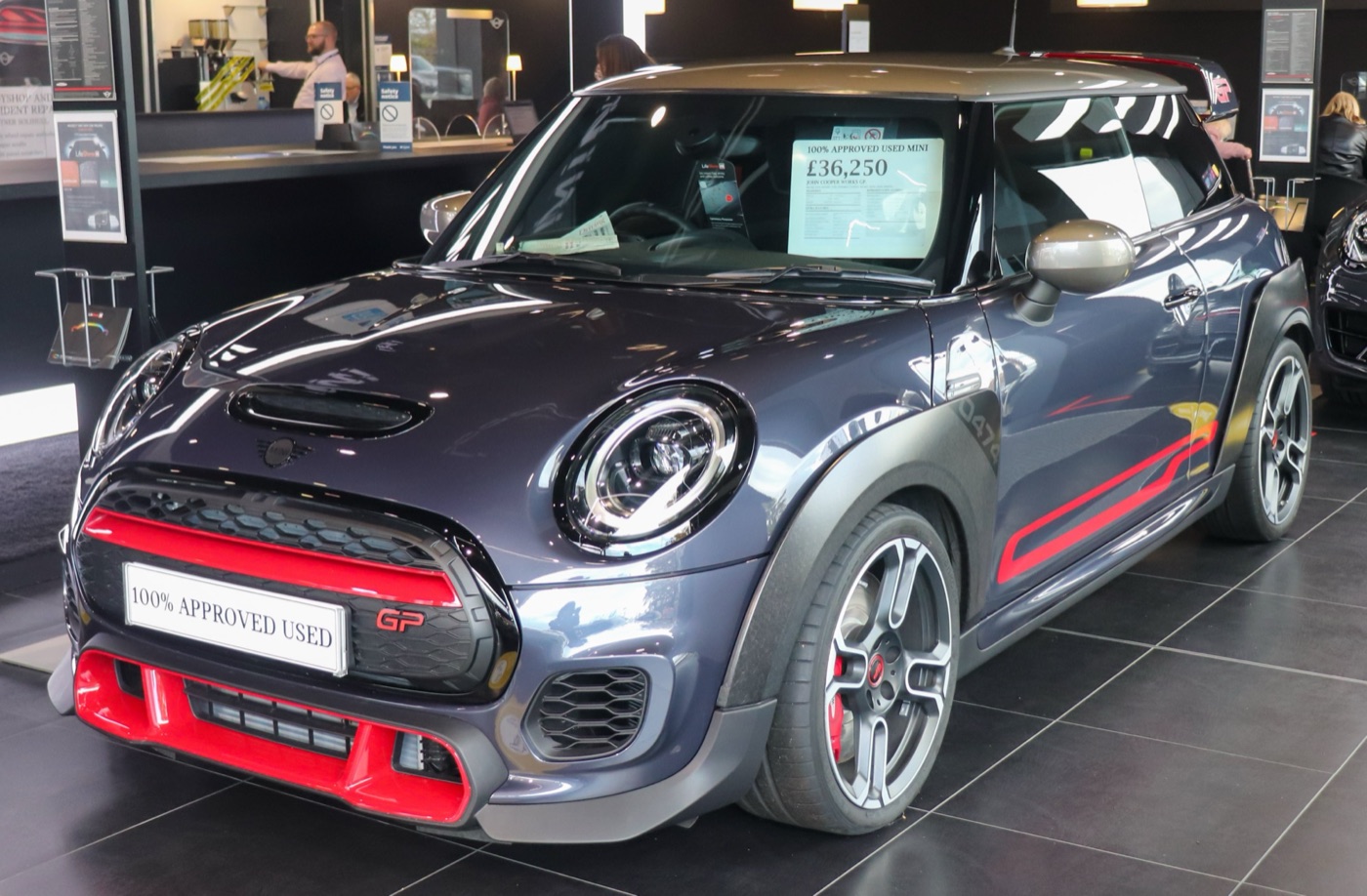
GP auction prices in the United States
OUTLAW 8's auction records hold 27 sales of GPs in the United States in the two years to 26 October 2026. The median GP1 made $29,503 against $25,500 for a GP2; the two highest prices, $57,200 and $59,000, were for cars with 354 and 1,900 miles.
| Generation | Sales | Low | Median | High | Range |
|---|---|---|---|---|---|
| GP1 (2006) | 11 | $20,000 | $29,503 | $51,000 | $17,533 to $57,200 |
| GP2 (2013 model year) | 15 | $19,500 | $25,500 | $37,500 | $15,000 to $59,000 |
| GP3 (2021 model year) | 1 | $28,288 (25,000 miles, Cars & Bids, June 2025) | |||
Mileage drives the spread. Among GP1s, the four with 13,000 miles or fewer made $40,000 to $57,200, and the two with more than 50,000 miles $17,533 and $20,000; the cheapest GP2, at $15,000, had covered 97,000 miles.
Buying a used MINI John Cooper Works GP: known faults
Buying guides rate the GP1's and GP3's engines as largely sound. The GP2 has the N18, the later version of the Prince engine used in every turbocharged second-generation MINI, which fixed many of the earlier N14's faults.
GP1 faults
Top Gear's buying guide says the cylinder head can crack if the engine has overheated (about £500 to fix) and that superchargers may need replacing at about 100,000 miles; evo names the supercharger and the power steering as the costliest items to repair, and warns that GP-only parts, the decals included, are expensive. PistonHeads notes that the air filter sits under the strut brace, which has to come off to change it, so some filters go unchanged for years.
GP2 faults
PistonHeads' R56 guide lists the faults of the first Prince engine, the N14, as carbon build-up on the intake valves (cleaned by walnut-shell blasting for about £200), timing-chain and tensioner wear (worst on 2007 to 2009 engines), leaking VANOS solenoids and oil use of as much as a litre every 1,000 miles, for which it advises an oil change every 5,000 miles. It says the N18, the engine in the GP2, "resolved many of the Prince's mechanical problems" with a variable oil pump, new pistons and rings, a revised crankcase ventilation system and a heat shield over the turbo oil line. What remains on the N18: high-pressure fuel pumps still fail (£600 to £700 to replace), and water pumps and turbochargers can go. It also records bonnet scoops warping above the hot turbo and trim rattles common to the R56.
GP3 faults
PistonHeads' GP3 guide calls the B48 engine a reliable unit with forged rods and crankshaft from new, prone at higher mileage to valve-cover oil leaks and cracked plastic oil-filter housings. Front suspension control arms wear on a car this stiff, so expect knocking from the front. Servicing is every two years or 18,000 miles; PistonHeads put an independent specialist's charge at about £220 for a minor service and £325 for a major one in 2024.
MINI John Cooper Works GP rivals
Each GP was priced against bigger and more powerful front-wheel-drive hot hatches. The GP2 cost £4,000 more than the 261 bhp Renault Mégane 265 Cup, a 2012 SkiddMark report noted, and the 1 Series M135i launched the same summer at £29,995, PistonHeads recalled in 2024. For the GP3, evo named the Honda Civic Type R, the Mégane RS and the Hyundai i30 N, all offered with manual gearboxes, and the Ford Fiesta ST as its only rival of the same size.
In an evo group test (issue 280), Adam Towler drove the GP3 against the Renault Mégane RS Trophy-R (£51,455, then the front-wheel-drive Nordschleife record holder at 7:40.1) and the 2016 Volkswagen Golf GTI Clubsport S (£33,040 new). Towler found that the differential struggled to deploy the GP3's 332 lb ft, "meaning plenty of torque steer". The Golf won; he called the GP3 "one of the strangest and most disappointing cars we've driven for some time".
What the press said about the GPs
Of the three, the GP1 had the warmest welcome from the British motoring press. CAR called it "serious fun all the same, the best Mini we've yet driven" while mocking a £22,000 car with no back seat, and Bovingdon in evo found "hardly a trace of torque-steer" thanks to the standard limited-slip differential, and the sound of the "central twin-outlet exhaust" through the reduced sound deadening. In 2020 PistonHeads' R53 guide counted it as "one of the best Mini variants ever made".
The GP2 was judged on its price. MINI's head, Kay Segler, said at the time, as SkiddMark reported in September 2012, "We did not want to enter the horsepower race with the GP. The Mini is designed to be a car that can be enjoyed, and driven fast by an amateur." A September 2012 SkiddMark report called it "overpriced, underpowered" next to the Mégane. evo's first drive on Mallorca's circuit found it "much better on track than a regular JCW" with strong brakes but "gloopy, unnatural" steering in Sport mode. Revisiting a 7,500-mile GP2 in September 2024, PistonHeads' Matt Bird called it the last GP with a manual gearbox and a "fantastic little Mini", and wrote that its rear wing "helps create a touring car vibe" above "two big exhausts coming out the middle".
The GP3 drew the harshest reviews. Ingram's verdict in evo was that it "struggles where our favourite hatches shine brightest", listing among its faults "steering and diff fight each other, unsettled ride" and an automatic gearbox that "adds little to the experience"; and PistonHeads' guide calls its chassis "a bit disappointing on UK roads" while noting that its used value had held firm.
Questions
What does GP stand for on a MINI?
Grand Prix. MINI USA's release for the first GP in April 2006 said the two letters pay tribute to the brand's racing record, from the classic Mini's Monte Carlo Rally wins of the 1960s onwards.
Does the MINI John Cooper Works GP have rear seats?
No. All three GPs are two-seaters: the GP1 has an aluminium brace between the rear suspension towers, the GP2 a cargo guard and the GP3 a red-painted aluminium cross-brace behind the front seats.
Is the MINI GP3 a manual?
No. The 2020 GP3 was sold only with an eight-speed automatic gearbox with paddles. The GP1 and GP2 have six-speed manuals, so the GP2 is the last manual GP.
What engine is in the MINI GP3?
BMW's B48 2.0-litre turbocharged four-cylinder, the engine evo noted was shared with the BMW M135i of the time, strengthened for the GP with a new crankshaft, pistons, connecting rods and turbocharger to make 306 hp (225 kW).
What colours did the MINI GP come in?
One each. The GP1 is grey-blue metallic with a Pure Silver roof and Chilli Red mirrors (Thunder Blue in MINI USA's release, Thunder Grey to evo and Top Gear); the GP2 is Thunder Grey metallic with red trim; the GP3 is Racing Grey metallic with a Melting Silver roof and mirror caps.
How can you tell a real GP3 from a JCW with the GP Pack?
A GP3 has two seats and its build number, 0001 to 3000, on the carbon-fibre front wheel-arch trims and on the passenger side of the dashboard. A John Cooper Works with the 2020 GP Pack has the same paint and badges but keeps its rear seats and has no number.
Sources
- BMW AG, "More power, less weight: MINI Cooper S with John Cooper Works GP Kit", media information, 29 October 2005: GP1 power, weight saving, run of 2,000, Misano debut.
- MINI USA, "MINI Cooper S with John Cooper Works GP Kit makes North American debut", 12 April 2006: 415 US cars, $31,150, 214 hp, roof numbering.
- just-auto, "Italy: Bertone prepares to build a Mini", 29 November 2005, reporting Automotive News Europe: Bertone assembly at Grugliasco from Oxford bodies.
- BMW Group, "Big on performance, small in number: the MINI John Cooper Works GP", 12 May 2012: GP2 announcement, 8:23 lap, 2,000 cars.
- BMW Group, "The MINI John Cooper Works GP", press kit, 2012: GP2 engine, suspension, brakes, aerodynamics, weights.
- MINI USA, "Gearing up for its North American premiere", 28 November 2012: 500 US cars at $39,950, 211 hp.
- MINI USA, John Cooper Works GP Concept release, 6 September 2017: Frankfurt concept.
- BMW Group, "Warm-up on the Nordschleife", June 2019: GP3 prototype under eight minutes, 3,000 cars.
- BMW Group, "The new MINI John Cooper Works GP", press kit, November 2019: GP3 engine, gearbox, chassis, carbon arches, numbering.
- MINI USA, GP3 pricing, 4 November 2019: $44,900 plus $850, 301 hp SAE.
- MINI USA, GP3 number 0001 delivered, 1 June 2020: first US delivery.
- BMW Group, "Inspired by motor sport", 2020: John Cooper Works GP Pack.
- Jethro Bovingdon, evo, Mini Cooper S Works GP (R53) road test, July 2006, with buying update of 6 August 2024: GP1 weight, UK price and numbers, values, faults.
- Chris Chilton, CAR magazine, Mini Cooper S Works GP (2006) review: 500 UK cars, 0 to 62 mph, verdict.
- Stephen Dobie, Top Gear, "TG's buying guide: the original Mini Works GP", read 28 October 2026: GP1 UK numbers, faults.
- PistonHeads, "Mini Cooper S (R53): PH buying guide", 15 October 2020: GP1 engine changes, chassis, 450 UK cars.
- Tony Middlehurst, PistonHeads, "Mini JCW and GP2 (R56): PH used buying guide", 5 May 2020: Prince engine faults, GP1 lap time of 8:42.
- Matt Bird, PistonHeads, "Mini John Cooper Works GP2 | PH Heroes", 6 September 2024: GP2 values and drive.
- Tony Middlehurst, PistonHeads, "Mini JCW GP (F56) | PH used buying guide", 10 March 2024: GP3 price, value, faults, servicing.
- evo, Mini John Cooper Works GP first drive, 9 November 2012: GP2 UK price and track drive.
- Antony Ingram, evo, "Mini JCW GP 2020 review", 27 June 2020: GP3 UK price and allocation, verdict.
- Adam Towler, evo, "Mini JCW GP v Renault Mégane RS Trophy-R v Volkswagen Golf GTI Clubsport S", evo issue 280: GP3 group test.
- evo, "Renaultsport Mégane 265 Nürburgring record", 2011: 8:07.97 lap.
- How Rare Is My Car, MINI John Cooper Works GP, Cooper S JCW GP and John Cooper Works GP Auto pages, DVLA data to 15 August 2026, read 28 October 2026: UK first registrations of the three GPs.
- johncooperworksgp.com (GP owners' site), "The GP2: the origin of the fastest production MINI ever built", read 28 October 2026: 288 GP2s for the UK.
- SkiddMark, "MINI John Cooper Works GP: here's why we're none too impressed with MINI's hottest model", 6 September 2012: GP2 price comparisons, UK allocation of 200, Kay Segler's comments.
- OUTLAW 8's auction records, read 28 October 2026: US auction sales of the three GPs (Bring a Trailer, Mecum, Cars & Bids).