Mitsubishi Lancer Evolution: every Evo from I to X
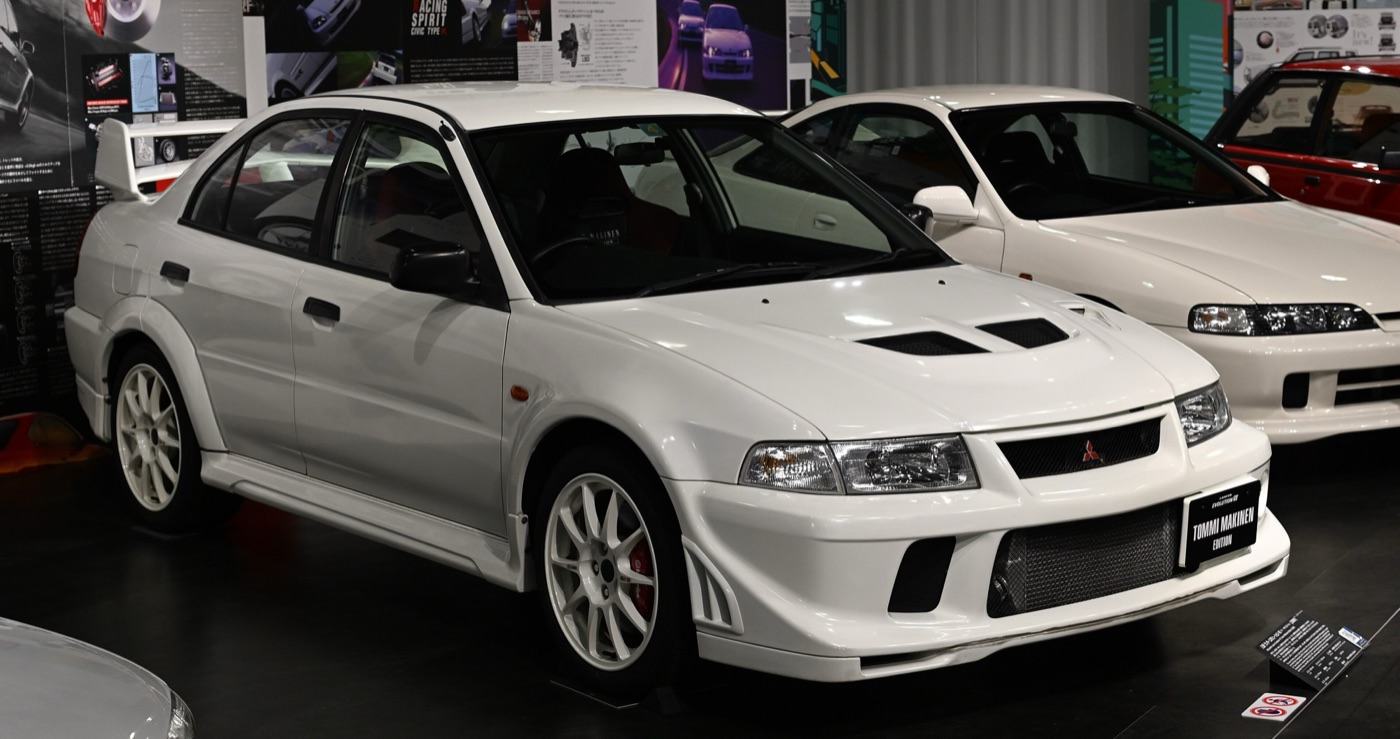
The Mitsubishi Lancer Evolution, the “Evo”, is a four-door Lancer saloon (a sedan in the maker’s own releases) with a two-litre turbocharged engine and four-wheel drive, built in Japan in ten numbered versions from October 1992 to 2016. It was made so that Mitsubishi could homologate a Group A car for the World Rally Championship, and Tommi Mäkinen won four drivers’ titles in a row in Evos from 1996 to 1999. People still look it up for that rally record, for the long rivalry with the Subaru Impreza, and because the 2000s UK FQ cars and the Tommi Mäkinen Edition now sell at auction for collector money.
History of the Lancer Evolution, Evo I to Evo X
The Mitsubishi Lancer Evolution moved the turbocharged engine and four-wheel drive of the Galant VR-4 into the smaller, lighter Lancer and was then improved almost every year for rallying. Japanese writers group the ten models into four generations: Evo I to III, IV to VI, VII to IX, and the Evo X, as Kuruma News sets out in its history of the first generation. The Galant had been the works rally car until then, and it was often beaten by the Lancia Delta, Toyota Celica and Subaru Legacy.
Evo I, II and III: the first generation
The first three Evos shared the same Lancer body and the 4G63 engine, and each was sold in Japan in limited numbers.
Evolution I
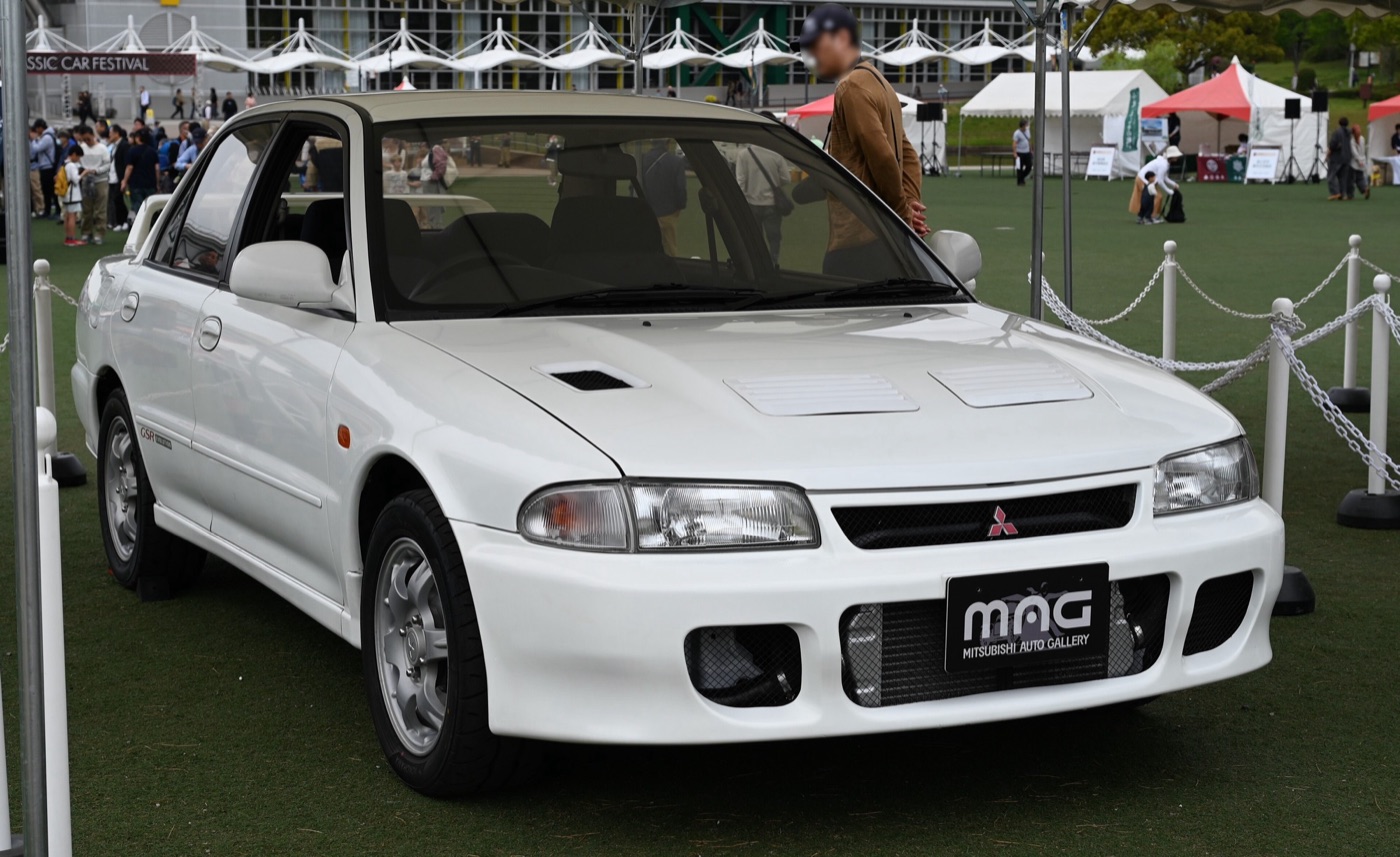
The first Lancer Evolution went on sale in Japan in October 1992, a date Mitsubishi gave in its 2005 Evo IX press release. It was built on the Lancer 1800GSR (chassis CD9A), with the Galant VR-4’s intercooled 4G63 turbo engine tuned to 250 PS and 31.5 kg-m (309 N·m). The plan was for 2,500 cars, but demand was such that it sold 7,600. It was judged quick in a straight line but reluctant to turn.
Evolution II
The Evo II followed in January 1994, again in limited numbers. It looked much like the Evo I, but improvements to intake and exhaust flow raised the 4G63 to 260 PS. The Mitsubishi Lancer Evolution’s first World Rally Championship win came at the 1995 Swedish Rally, the second round of that season, where Kenneth Eriksson beat Tommi Mäkinen by 12 seconds, both in Evo IIs (juwra.com results).
Evolution III
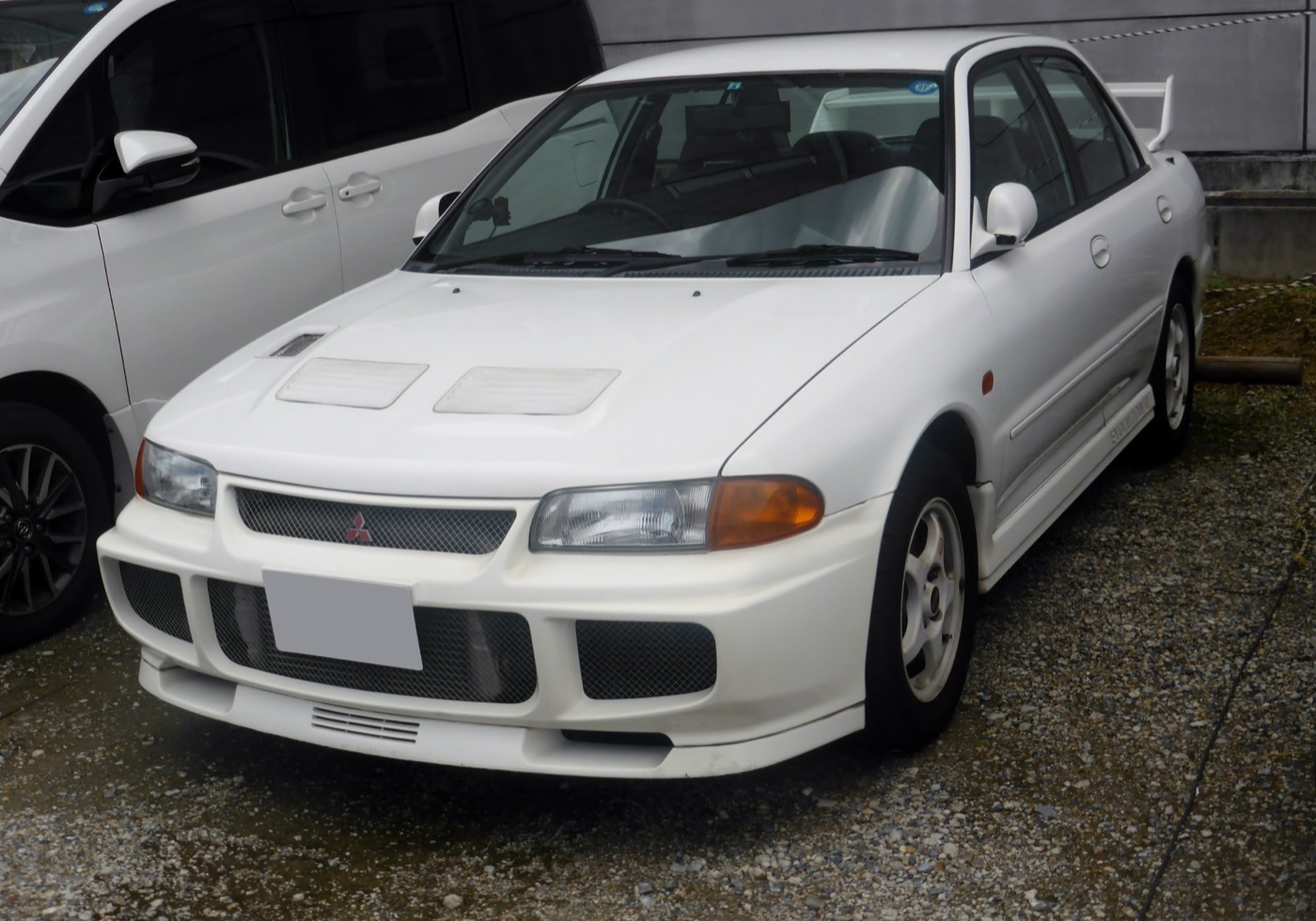
The Evo III arrived in January 1995 with new styling (a deeper front bumper and a larger rear wing with endplates) and 270 PS. Mitsubishi Motors North America’s heritage sheet on the Evo III records new crowns on the pistons for a 9.0:1 compression ratio, a turbocharger compressor wheel enlarged from 60 mm to 68 mm, a twin water spray for the same-size intercooler, a rear wing that made significantly more downforce, stiffer suspension arms in the chassis, and body torsional stiffness up 20 per cent on the Evo II. The Evo III’s first win was Eriksson’s at the 1995 Rally Australia (juwra.com results), and in 1996 it won the Swedish, Safari, Argentina, 1000 Lakes and Australia rallies.
Evo IV, V and VI: the second generation
Mitsubishi redesigned the Lancer in October 1995, and the next three Evos were built on the new car (Kuruma News on the second generation).
Evolution IV
The Evo IV went on sale in August 1996. A twin-scroll turbo took the 4G63 to 280 PS, the most Japanese makers then agreed to advertise, and the GSR was the first car with Mitsubishi’s Active Yaw Control. PistonHeads reported in 2014 that Mäkinen’s 1996 success sold the first 6,000 cars within days and that 3,000 more were built. About a tenth of production was the stripped RS version, a base for competition, without Active Yaw Control, ABS, air conditioning or alloy wheels.
Evolution V
The Evo V of January 1998 had the series’ first wide body, which put it in Japan’s larger “3-number” size class, so that wider tyres could carry the power. Torque rose to 38.0 kg-m (373 N·m), more than the R33 Nissan Skyline GT-R, and it gained Brembo brakes and a wider track.
Evolution VI
The Evo VI of January 1999 changed the aerodynamics and cooling to suit new WRC regulations; its number plate moved to one side of the bumper to clear the air intake. evo magazine calls it “the last of the pure homologation Evos” and the last on the smaller Lancer shell, with 130 extra spot welds in the body. About 7,000 were made, most of them GSRs.
Evo VII, VIII and IX: the third generation
From 2001 the Evo was based on the larger Lancer Cedia, the saloon launched the year before (Kuruma News on the third generation).
Evolution VII
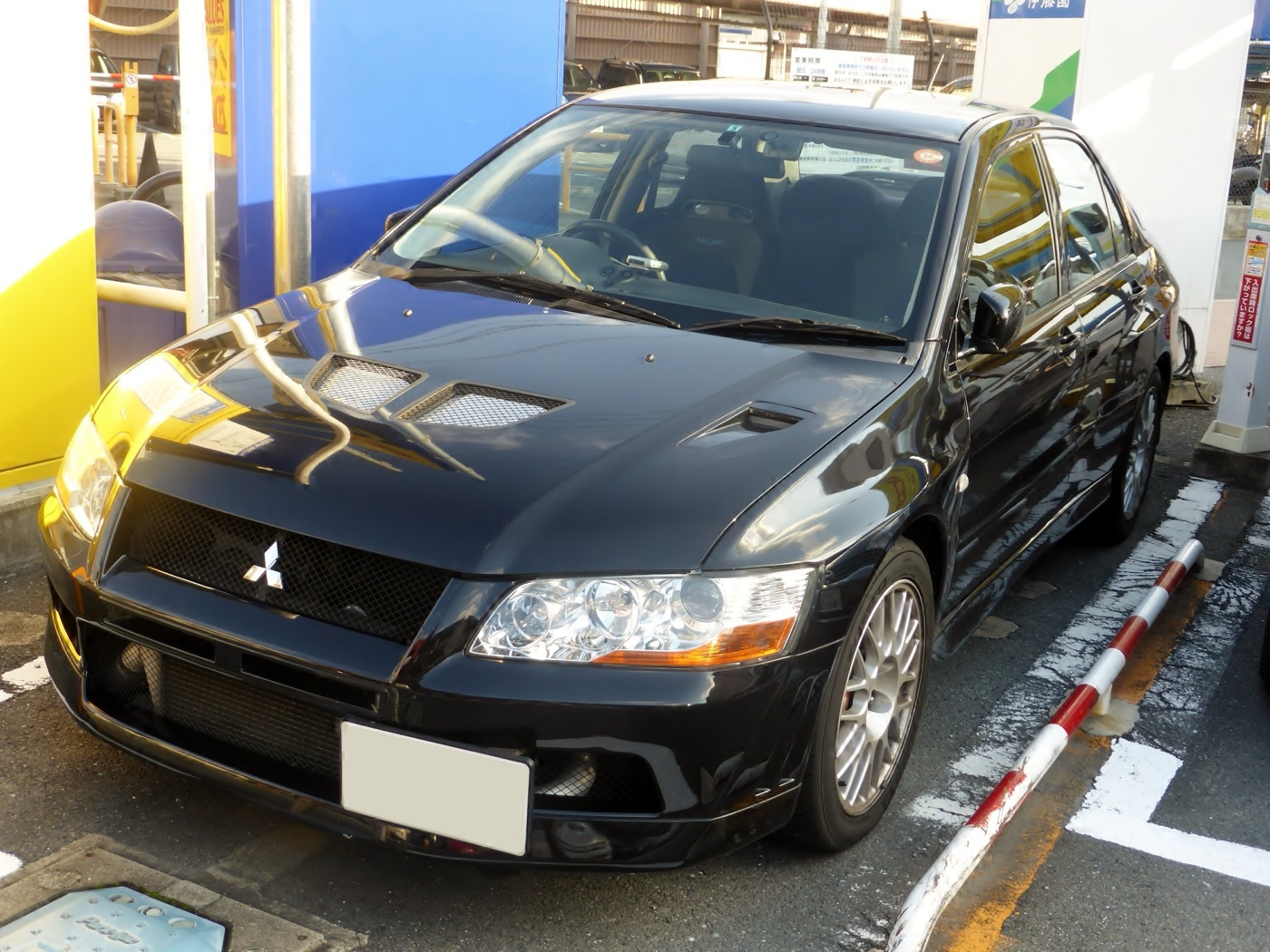
The Evo VII went on sale in February 2001. The GSR weighed 1,400 kg against 1,360 kg for the Evo VI, so torque went up to 39.0 kg-m (382 N·m) while power stayed at 280 PS. It brought the Active Centre Differential, and evo magazine gives the shell as 50 per cent more resistant to twisting. In February 2002 the Evo VII GT-A was the first version with an automatic gearbox, a five-speed, and a plainer body without bonnet vents.
Evolution VIII
The Evo VIII of January 2003 added a six-speed manual transmission and 40.0 kg-m (392 N·m), and Kuruma News says its carbon-fibre rear wing was a world first on a mass-production saloon. It was also the first Evo sold new in the United States (PistonHeads). The Evo VIII MR of February 2004 had an aluminium roof, which with other changes saved about 10 kg, and a larger turbo that gave 40.8 kg-m (400 N·m).
Evolution IX
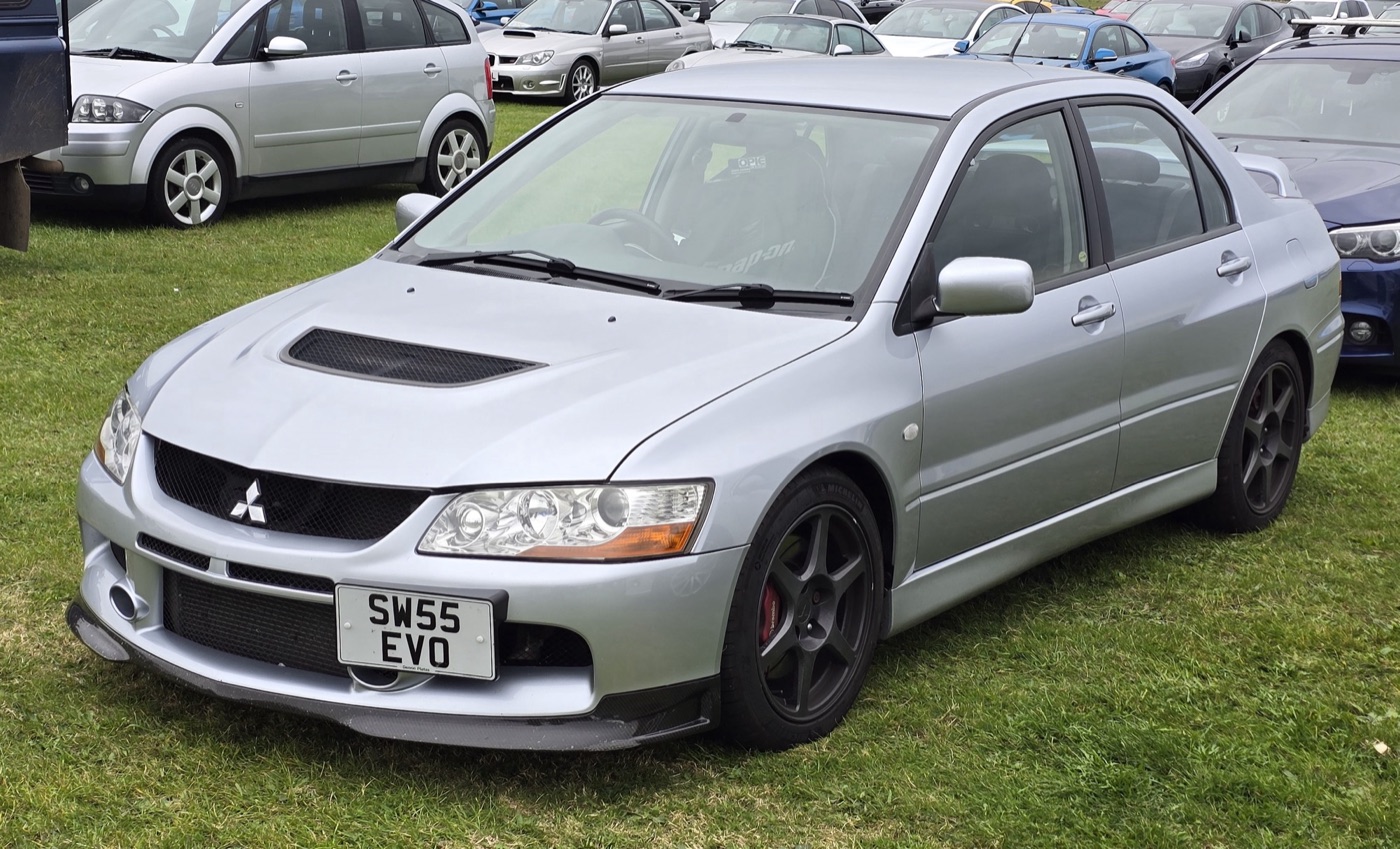
Mitsubishi launched the Evo IX in Japan on 3 March 2005, calling it the twelfth model in the series counting the automatic, in three trims. MIVEC variable valve timing technology on the intake side gave the GSR 400 N·m at 3,000 rpm; the RS and the new GT trim had a magnesium-alloy turbocharger compressor wheel and 407 N·m. The GSR had Recaro bucket seats trimmed in Alcantara and leather and 17-inch Enkei wheels. Prices ran from ¥2,940,000 to ¥3,570,000. An Evolution Wagon based on the Evo IX followed that September, and the Evo IX MR of August 2006 was the last car with the 4G63 engine.
Evo X: the fourth generation
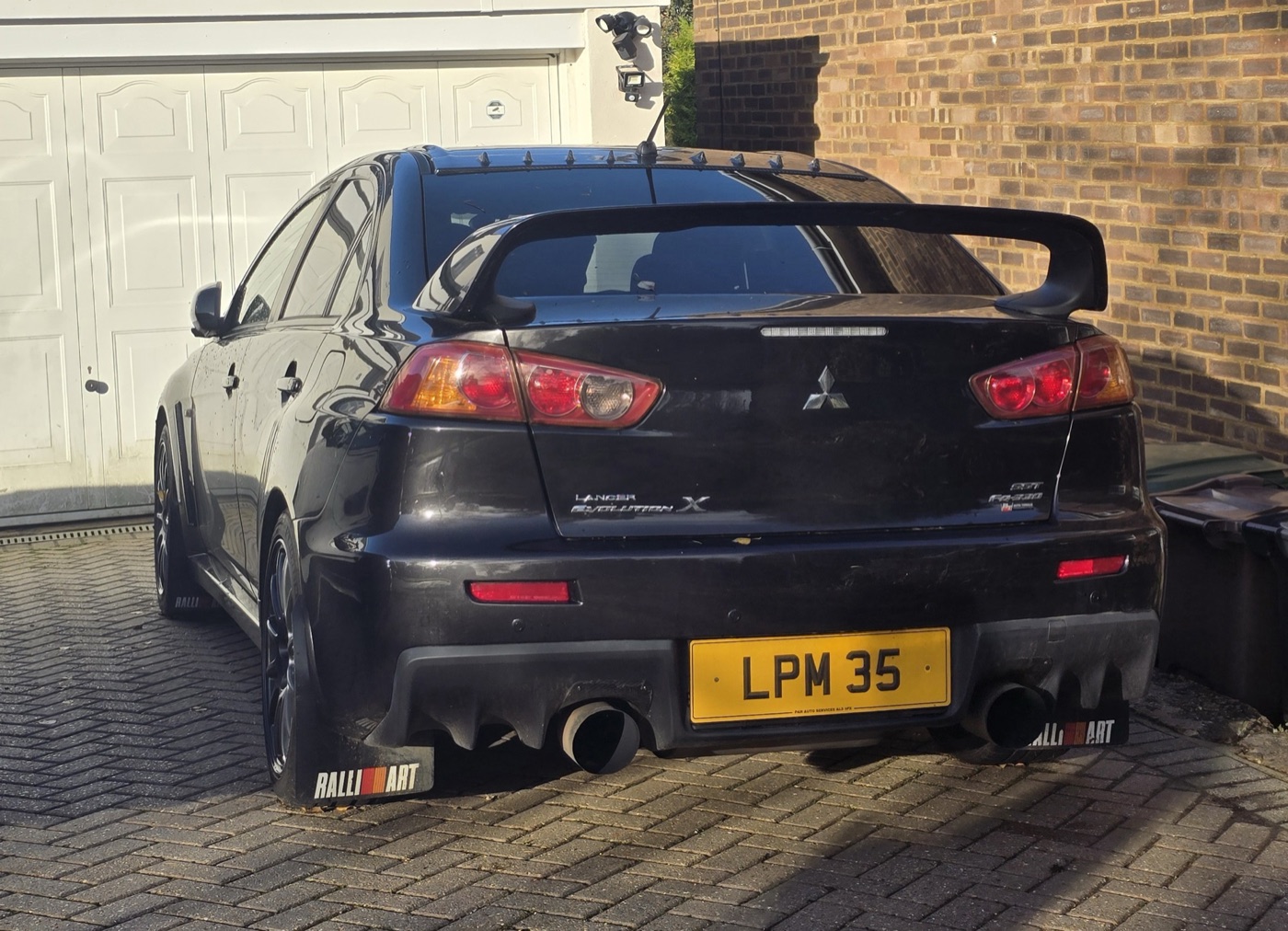
Mitsubishi previewed the Evo X as the Concept-X at the 39th Tokyo Motor Show in October 2005, with an aluminium-block MIVEC turbo engine, a six-speed auto-manual transmission and Super All Wheel Control (Mitsubishi’s show release). The production Evo X, which Mitsubishi called a “new-generation high-performance 4WD sedan”, went on sale in Japan on 1 October 2007 with a new platform, a new engine and prices from ¥2,997,750 to ¥3,750,600 (Mitsubishi’s launch release). The release set a Japanese sales target of 4,000 for the 2007 financial year. The six-speed Twin Clutch SST automated gearbox followed at the end of November; a five-speed manual gearbox was the alternative, and the RS competition base had only the manual. The front-end design, an inverted-slant nose with a trapezoidal grille, was shared with the Galant Fortis. The body was 40 per cent stiffer in torsion and 60 per cent in bending than the Evo IX MR, and the roof, front wings and rear spoiler frame were aluminium. The GSR came with 18-inch Enkei wheels, Brembo brakes, Recaro front seats and, for safety, a knee airbag for the driver. The seats were new full buckets with room for optional side airbags. The High Performance Package added Bilstein shock absorbers, Eibach coil springs and two-piece Brembo discs; other options were BBS wheels, fog lights and a Rockford Fosgate audio system with a 650-watt amplifier and nine speakers. It reached the UK in spring 2008 from £27,499 (Autocar), and at 1,540 kg it was 140 kg heavier than the Evo IX it replaced.
How the Evo works: engine and four-wheel drive
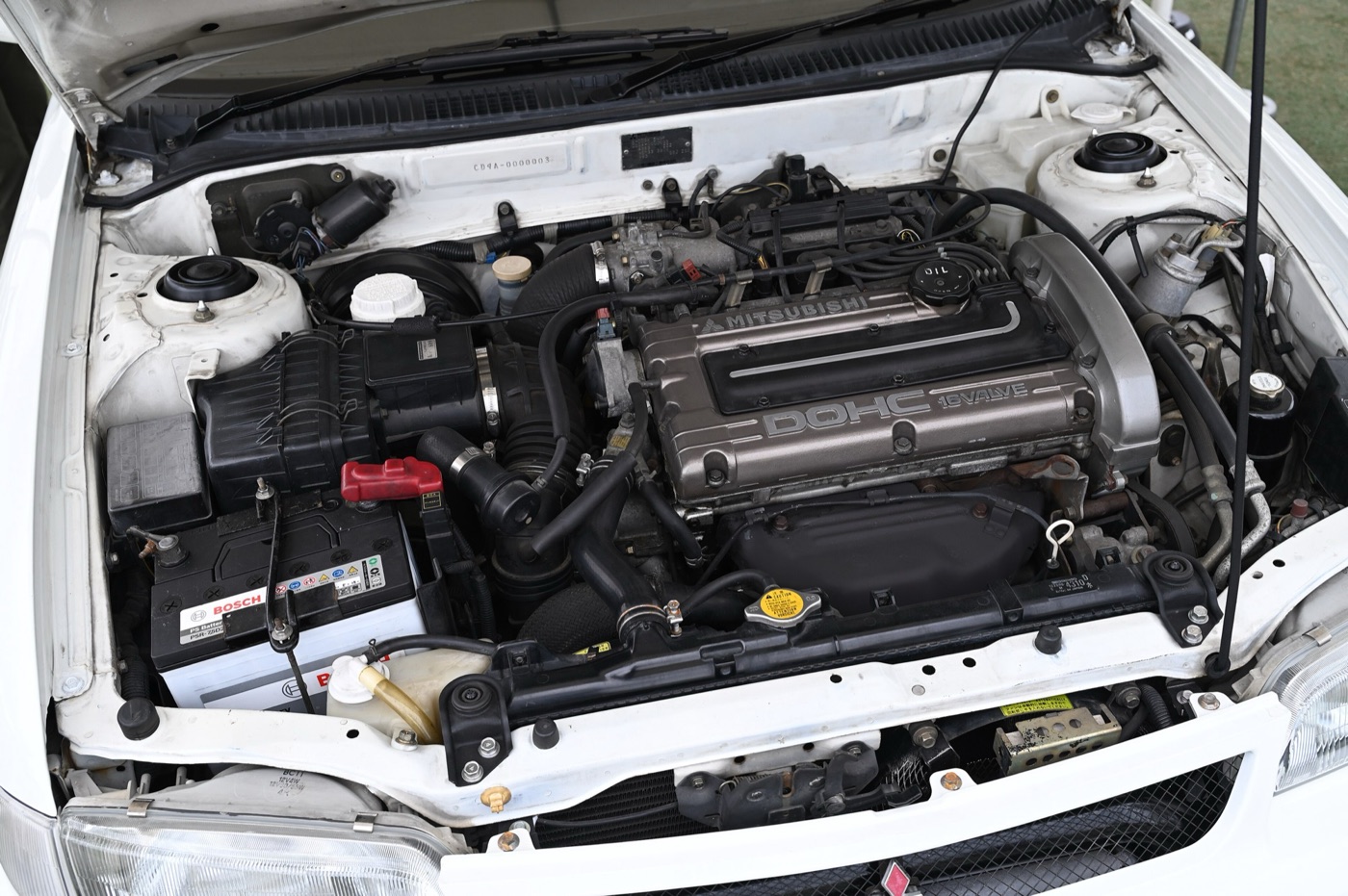
Every Evo has a transverse two-litre turbocharged four-cylinder engine and all-wheel drive, and the technology that set it apart is in the drivetrain: from the Evo IV on, electronics share the drive between the wheels. The first nine used the 4G63 (4G63T in turbocharged form) with a cast-iron block; the Evo X used the 4B11T, with a die-cast aluminium block that made it 12 kg lighter, MIVEC on both camshafts and 422 N·m at 3,500 rpm, more torque than its 4G63 predecessor (Mitsubishi, 2007). Both engines have a single turbocharger and an intercooler. PistonHeads adds that the 4B11T has a timing chain in place of a belt and a square 86 mm bore and stroke, where the 4G63 had an 88 mm stroke.
Active Yaw Control and the Active Centre Differential
Active Yaw Control, first on the Evo IV GSR, uses a torque-transfer mechanism in the rear differential to send more drive to one rear wheel and so turn the car into a corner. For the Evo IX’s Super AYC, the maker changed the rear differential from bevel to planetary gears, which almost doubled the torque it could move between the rear wheels. The Active Centre Differential, from the Evo VII, splits drive front to rear with an electronically controlled hydraulic multi-plate clutch, and the driver picks Tarmac, Gravel or Snow.
Super All Wheel Control on the Evo X
The Evo X put the centre differential, Active Yaw Control, Sport ABS (its anti-lock brakes) and a new Active Stability Control under one system, Super All Wheel Control, with the same three modes. A yaw-rate sensor let the system read how the car was turning in real time, and the driver changes mode with a selector on the left spoke of the steering wheel.
Lancer Evolution specifications, Evo I to Evo X
Japanese-market Evos never advertised an output above 280 PS until the Evo X, so the real gains from the Evo IV to the Evo IX show in torque and in the hardware listed below.
| Model | On sale in Japan | Engine | Quoted power | Peak torque | What was new |
|---|---|---|---|---|---|
| Evo I | October 1992 | 4G63 turbo | 250 PS | 309 N·m | Galant VR-4 drivetrain in the Lancer |
| Evo II | January 1994 | 4G63 turbo | 260 PS | 309 N·m | Better intake and exhaust flow |
| Evo III | January 1995 | 4G63 turbo | 270 PS | 309 N·m | New nose and wing, 9.0:1 compression |
| Evo IV | August 1996 | 4G63 turbo | 280 PS | 353 N·m | New Lancer, twin-scroll turbo, Active Yaw Control |
| Evo V | January 1998 | 4G63 turbo | 280 PS | 373 N·m | Wide body, Brembo brakes |
| Evo VI | January 1999 | 4G63 turbo | 280 PS | 373 N·m | Aero and cooling for WRC rules |
| Evo VII | February 2001 | 4G63 turbo | 280 PS | 382 N·m | Lancer Cedia base, Active Centre Differential |
| Evo VIII | January 2003 | 4G63 turbo | 280 PS | 392 N·m | Six-speed manual, carbon rear wing |
| Evo VIII MR | February 2004 | 4G63 turbo | 280 PS | 400 N·m | Aluminium roof, larger turbo |
| Evo IX | March 2005 | 4G63 turbo, MIVEC | 280 PS | 400 N·m (GSR), 407 N·m (RS, GT) | Variable valve timing |
| Evo X | October 2007 | 4B11T turbo | 280 PS, later 300 PS | 422 N·m | Aluminium block, twin-clutch SST, S-AWC |
| Evo X Final Edition | August 2015 | 4B11T turbo | over 300 PS | 414 N·m (US car) | Last 1,000 Japanese cars |
Performance figures depend on markets and tune. A UK Evo VIII 260 did 0–62 mph in 6.1 seconds and had a limited top speed of 152 mph (Mitsubishi Motors UK); a UK Evo IX FQ-360 reached 60 mph in 3.9 seconds by CAR magazine’s figures in 2006; and PistonHeads gives the Evo VIII MR FQ-400 3.5 seconds to 60 mph and 175 mph.
Special editions and the UK FQ models
Beyond the GSR and the stripped RS, the Evo was sold in dozens of limited versions, and the British importers added their own more powerful FQ cars.
Tommi Mäkinen Edition
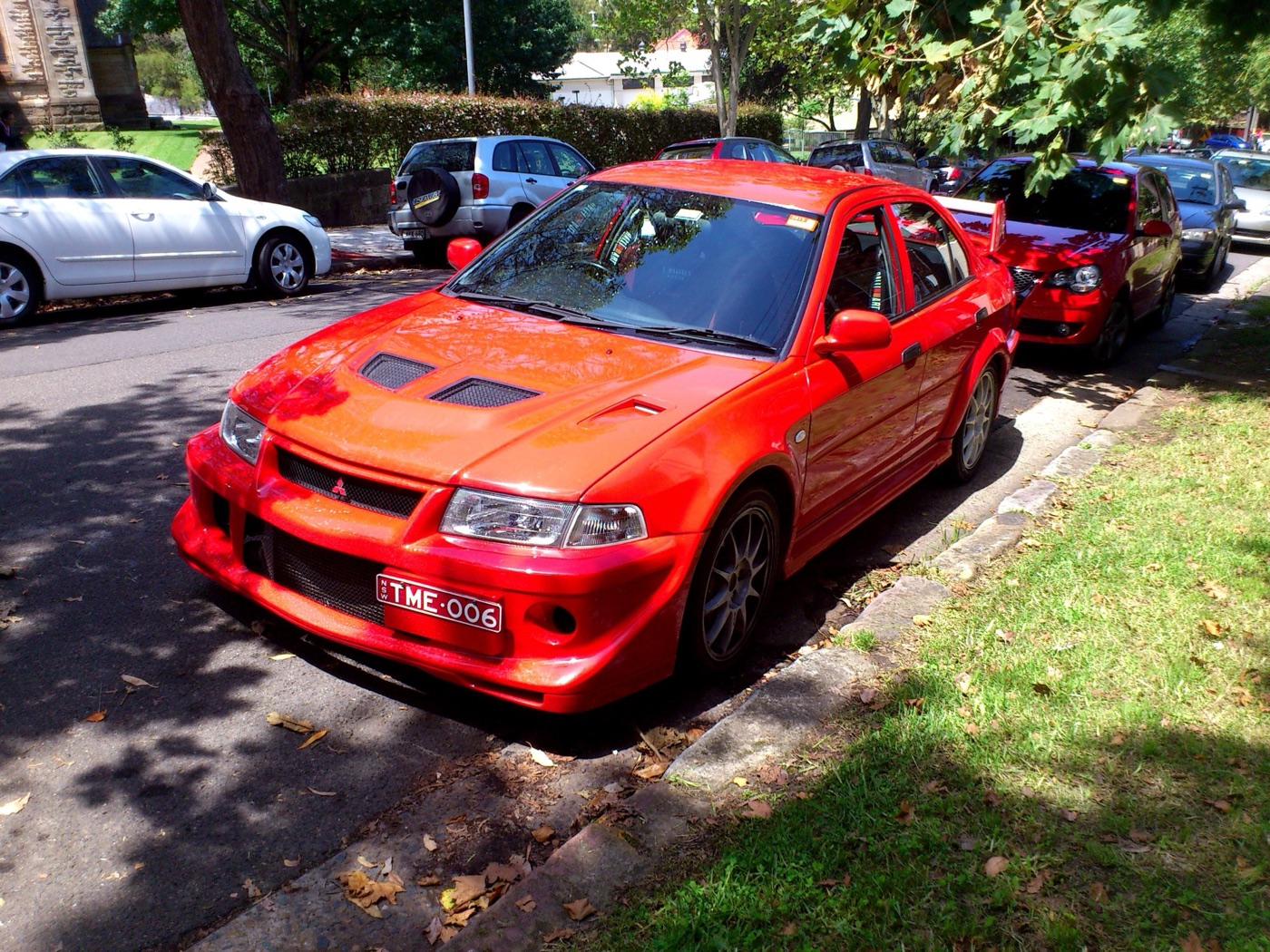
Mitsubishi launched the Lancer Evolution VI Tommi Mäkinen Edition in Japan in January 2000 to mark Mäkinen’s fourth straight drivers’ title. evo magazine gives 2,500 built for homologation, with a titanium turbocharger for quicker response, revised aerodynamics, revised suspension and white 17-inch wheels like the rally car’s; Passion Red was offered only on this model, and an optional decal set copied the livery of Mäkinen’s rally car. In the UK, Ralliart dealers sold it from March 2000 at £32,995, and almost every buyer added the £700 WRC colour pack (PistonHeads). Mitsubishi UK says its first 250 cars sold out within weeks (Carscoops, reporting Mitsubishi UK in 2020); Hagerty describes a car recorded as number one “from the 50 officially imported to the UK”.
UK specials of the Evo VI and VII
Ralliart in the UK built its own versions of the Evo VI: the RS450, a road-going rally car with a roll cage at £44,000; the RS Sprint with a mildly upgraded engine and brakes; and the RSX. evo also lists 12 RS Monte Carlo cars built in 2001 for Mäkinen’s last Mitsubishi win. PistonHeads lists the £41,995 Evo VI Extreme, based on Japan’s Zero Fighter tuning package, and its 2012 Evo VI buying guide counts 26 Extremes. For the Evo VII, priced at £29,995, Ralliart offered a 339 bhp Extreme at £39,995 and the FQ-300 at £31,495 (evo).
What the FQ cars were
FQ was the UK badge for Evos tuned in Britain, much as MR (Mitsubishi Racing) marked the sharper factory versions, from the Evo VII FQ-300 to the Evo X FQ-440 MR, with the number roughly the horsepower and the upgrades growing with each generation. Mitsubishi never spelled the letters out; evo wrote that the name was “pretty easy to decipher from its performance”. The Evo VIII MR FQ-400 had 405 hp (PistonHeads), and the Evo IX FQ-360 made 366 bhp at 6,887 rpm and 363 lb ft at 3,200 rpm for £35,504 (CAR).
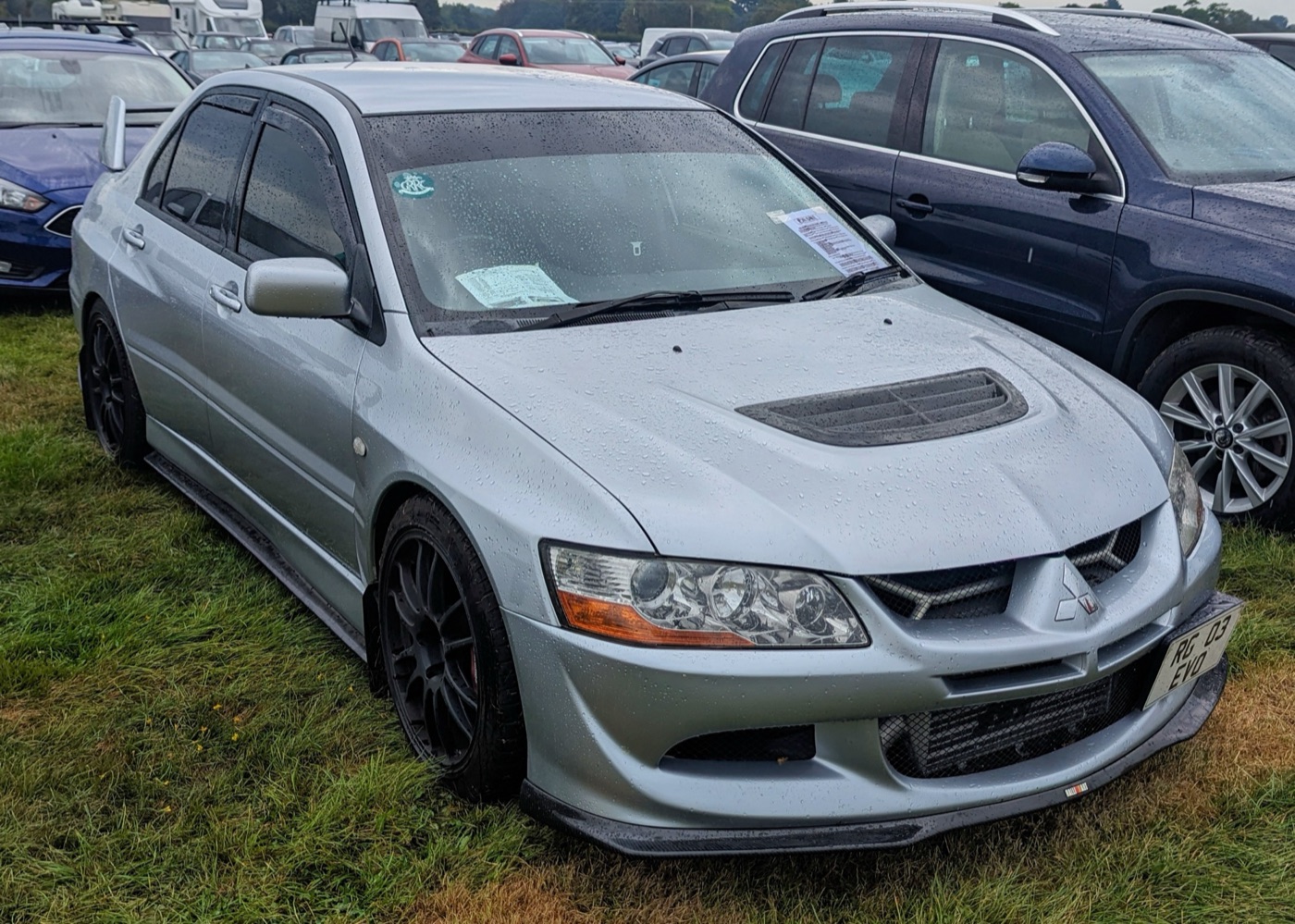
The Evo X came to the UK as the FQ-300 GS and GSR, with 290 bhp by Autocar’s pre-launch figure, and then as the FQ-330, FQ-360 and FQ-400. evo’s test of the FQ-400 put it at about £50,000 and 201.7 bhp per litre, with New Zealand’s WRC Developments and Ecutek responsible for the whole UK FQ line-up, while Autocar reported in 2007 that HKS had developed the FQ-330 and FQ-360 engine packs; its tracks were 20 mm wider, the ride height 30 mm lower, and a remapped ECU worked with a larger intercooler and a revised turbo. The last was the FQ-440 MR of 2014: 40 cars for Mitsubishi’s 40 years in the UK, 440 bhp from an HKS turbocharger, a Janspeed exhaust system and a new map, only in Frost White, at £50,000, with a data logger whose removal voided the warranty (evo, March 2014).
Final Edition
Mitsubishi opened orders for the Lancer Evolution Final Edition on 10 April 2015: 1,000 cars for Japan from August 2015 at ¥4,298,400, based on the five-speed manual GSR, with more than the regular car’s 300 PS (Monoist). In October 2015 Mitsubishi Motors North America announced 1,600 numbered US cars at $37,995 with 303 hp and 305 lb ft, Bilstein dampers, Eibach springs and a black roof.
The Lancer Evolution in the World Rally Championship
Evos won the World Rally Championship drivers’ title four years running with Tommi Mäkinen from 1996 to 1999, and the manufacturers’ title in 1998. Ralliart Europe ran the Evo in the WRC from 1993 (evo), and while Subaru moved to the World Rally Car rules for 1997, Mitsubishi kept to Group A, so its rally cars had to keep the road car’s arches, wing and air dam. Mitsubishi’s own statement in 2005 counted 34 WRC wins for the team since the 1974 Safari Rally (the statement, as published by Racecar).
Tommi Mäkinen’s four titles
Mäkinen joined Mitsubishi for 1995 and won his first title in 1996 with two rounds to spare, taking five wins from seven starts by the time the title was settled in Australia (Autosport’s 1996 report). Team boss Andrew Cowan had told Mitsubishi in Japan that if it paid to sign Mäkinen, he would deliver the championship. Mäkinen clinched his fourth title at Rally Australia in 1999, before the final round (Autosport, 1999).
| Season | Starts | Wins | Podiums | Retirements | Drivers’ championship |
|---|---|---|---|---|---|
| 1995 | 7 | 0 | 1 | 3 | 5th |
| 1996 | 9 | 5 | 6 | 2 | 1st |
| 1997 | 14 | 4 | 9 | 4 | 1st |
| 1998 | 13 | 5 | 7 | 6 | 1st |
| 1999 | 14 | 4 | 7 | 4 | 1st |
| 2000 | 14 | 1 | 5 | 6 | 5th |
| 2001 | 14 | 3 | 4 | 6 | 3rd |
The Rally GB finale and the manufacturers’ title
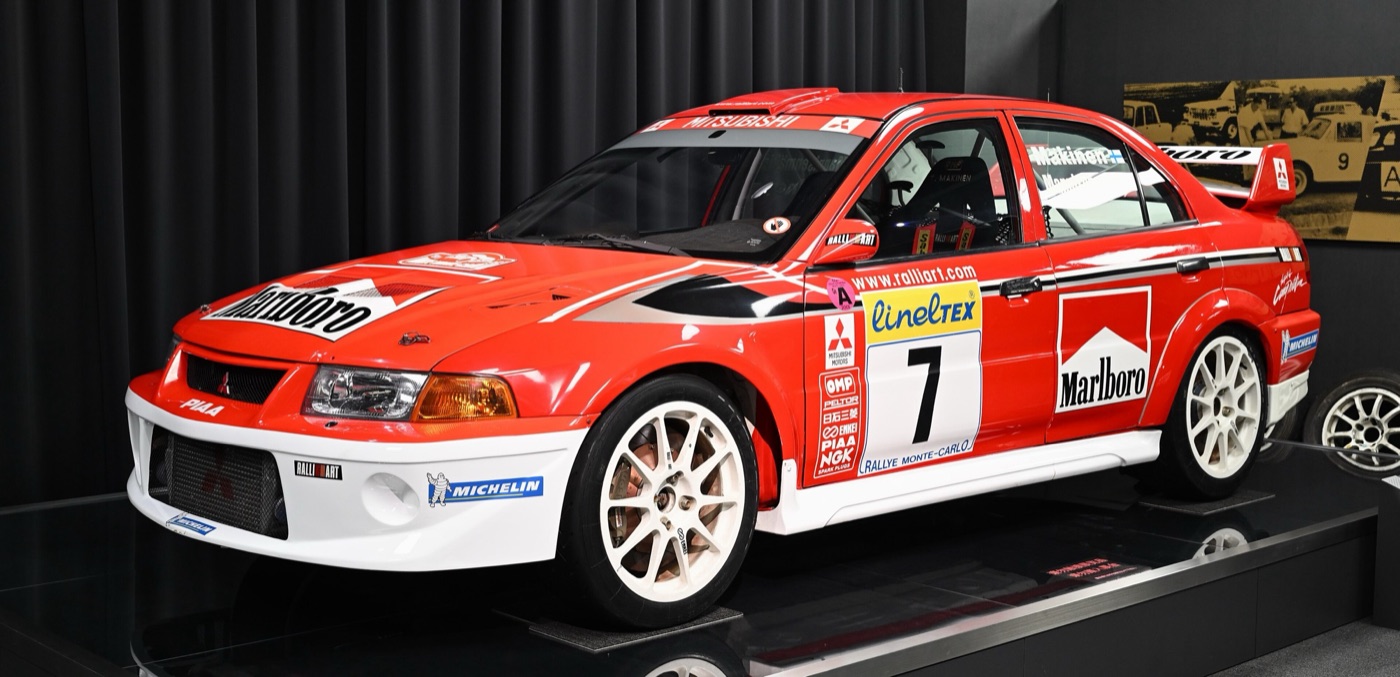
Mäkinen came to the 1998 final round in Britain two points ahead of Toyota’s Carlos Sainz, then lost his right rear wheel against a concrete block, which seemed to have cost him the title (DirtFish). The engine of Sainz’s Corolla then blew up 1 km from the end of the final stage, so Mäkinen was champion, and his team-mate Richard Burns won the rally by almost four minutes in a Mitsubishi entered as the Carisma GT, winning every stage of the last day (The Auto Channel’s report). Mitsubishi also won the 1998 manufacturers’ title, the only one its 2005 statement lists.
WRC wins by Evolution
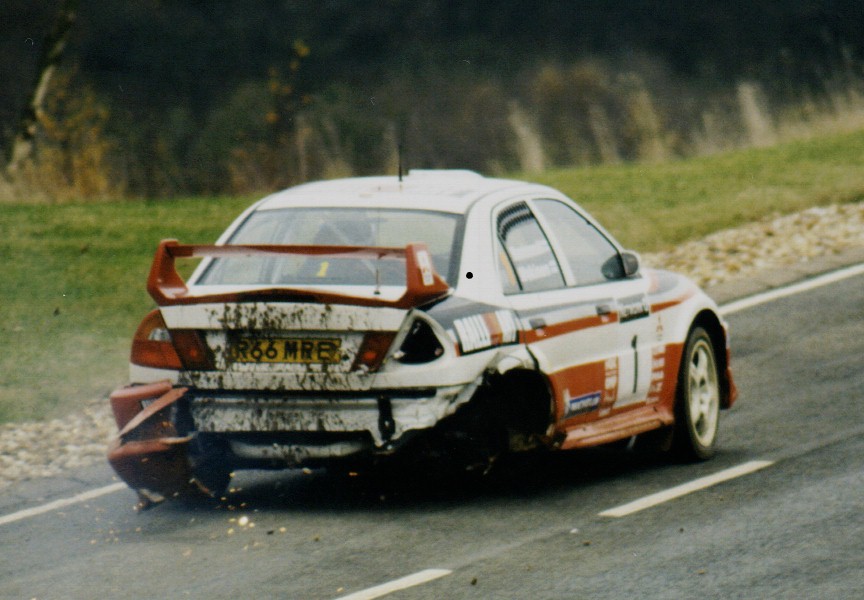
The Evo III was the most successful single model, and the cars entered as the Carisma GT (the name of Mitsubishi’s European family car) were Evos underneath.
| Car | Wins | Second places | Third places |
|---|---|---|---|
| Lancer Evo I | 0 | 2 | 1 |
| Lancer Evo II | 1 | 2 | 1 |
| Lancer Evo III | 6 | 1 | 1 |
| Lancer Evo IV | 5 | 1 | 4 |
| Lancer Evo V | 4 | 0 | 2 |
| Lancer Evo VI | 5 | 1 | 6 |
| Lancer Evo 6.5 | 3 | 0 | 1 |
| Carisma GT | 2 | 2 | 0 |
Why Mitsubishi left the WRC
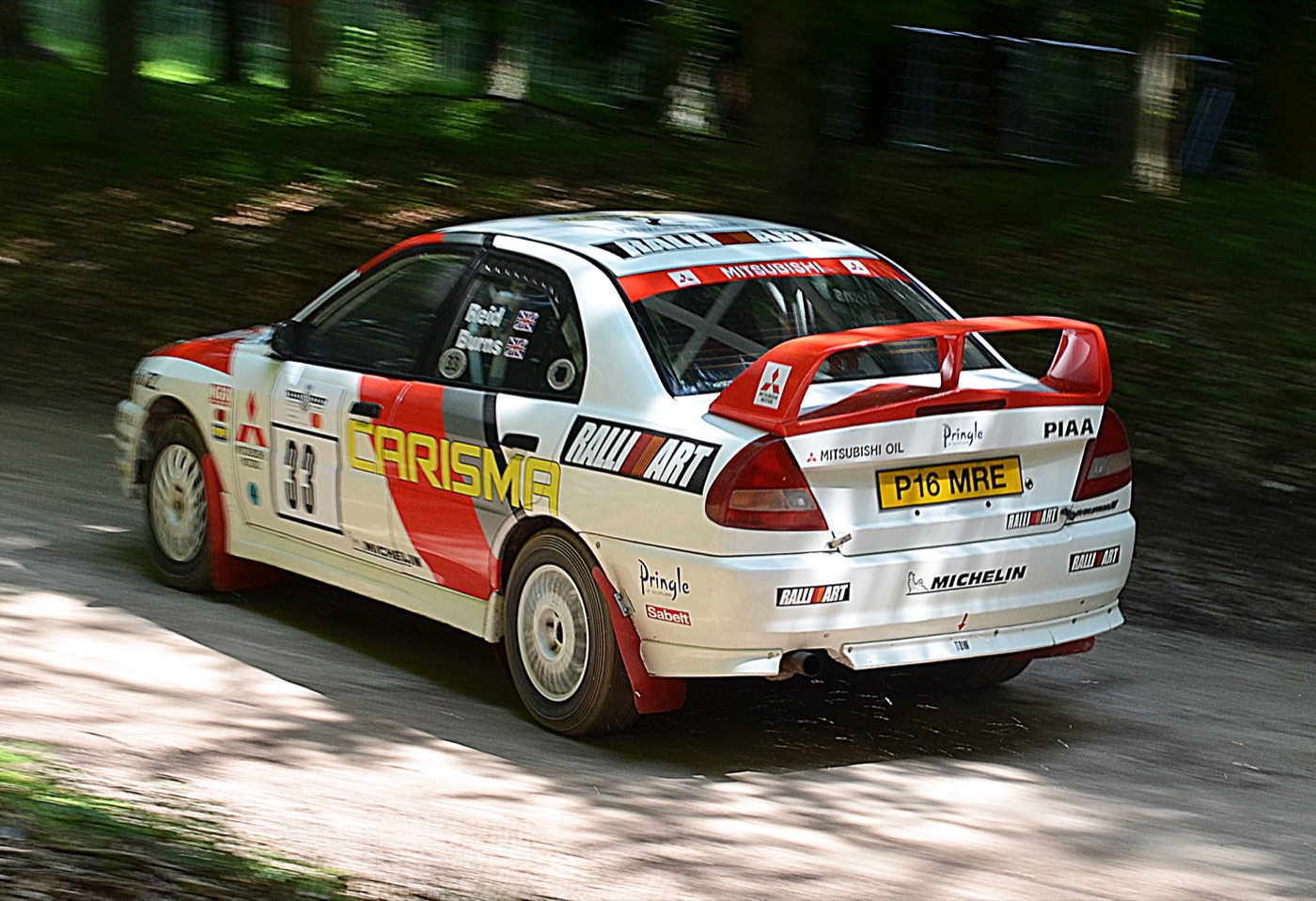
Mitsubishi announced in December 2005 that it would suspend its entry from 2006, saying it hoped to return in 2008 once its three-year Revitalization Plan was complete, and that it would stay in the Dakar Rally (Mitsubishi’s statement). The withdrawal left two works teams, Subaru and Ford, where five years earlier there had been seven (Autosport, 14 December 2005). Mitsubishi UK’s Evo IX Group N works car, driven by Guy Wilkes, was a two-time championship winner in Britain (Motoring Research).
How many Lancer Evolutions were made?
The production figures that exist are per model or per market. The Evo I was planned at 2,500 and sold 7,600 (Kuruma News). The Evo IV ran to 6,000 plus 3,000 more and the Evo VI to about 7,000 (PistonHeads), of which 2,500 were Tommi Mäkinen Editions (evo). For the Evo X, Mitsubishi set a Japanese target of 4,000 in its first financial year, and the run ended with 1,000 Japanese and 1,600 US Final Editions.
In Britain, Mitsubishi says it sold 5,728 Evos from the first official cars in 2000 to the end in 2015, across five of the ten generations (Carscoops, 2020).
The Evo in the UK: grey imports, Ralliart and Mitsubishi UK
British buyers had Evos years before Mitsubishi sold them here, as personal and grey imports from Japan, and Ralliart dealers and then Mitsubishi UK took over from 1999 and 2000.
Grey imports before 1999
The first five Evos were never homologated for sale in Europe, so Japanese domestic market (JDM) cars came in privately; a 1998 change brought Single Vehicle Approval, which let small batches in (Carscoops). A UK recall covered them too: in July 2001 DVSA recall R/2000/127 replaced the Active Yaw Control control unit on 196 Lancers built between December 1996 and July 1998, the Evo IV and V years (DVSA recalls data). PistonHeads wrote in 2012 that most Evo VIs in the UK were grey imports.
Official sales from the Evo VI
Sources differ on which Evo was first official. PistonHeads says the Evo VI went on sale officially at the start of 1999 at £30,995 through a small number of Ralliart dealers, and evo says it was the first Evo imported officially, under an agreement between Ralliart UK and Mitsubishi UK. Mitsubishi UK names the Tommi Mäkinen Edition of 2000 as the first official Evo registered, prepared with extra corrosion protection, mph instruments and extra security, and PistonHeads notes they arrived with a ready-made reputation for point-to-point speed. Mitsubishi UK sold the Evo until the FQ-440 MR in 2015, and in 2021, after 47 years, the company stopped selling new cars in the UK (Goodwood Road & Racing).
How many Evos are left in the UK?
At the end of June 2026 the UK’s licensing records held 3,987 Lancer Evolutions, 1,633 taxed for the road and 2,354 declared off the road (SORN), from Department for Transport table VEH0120. The Evo VIII and the Evo X are the most numerous.
| Generation | Licensed | SORN | Total |
|---|---|---|---|
| Evo I | 19 | 58 | 77 |
| Evo II | 9 | 48 | 57 |
| Evo III | 16 | 68 | 84 |
| Evo IV | 69 | 272 | 341 |
| Evo V | 104 | 200 | 304 |
| Evo VI | 194 | 398 | 592 |
| Evo VII | 101 | 175 | 276 |
| Evo VIII | 404 | 577 | 981 |
| Evo IX | 139 | 199 | 338 |
| Evo X | 578 | 359 | 937 |
| All | 1,633 | 2,354 | 3,987 |
The total has barely moved in a decade (3,988 at the end of 2016, a peak of 4,075 at the end of September 2020), but the balance has turned: 2,729 were licensed at the end of 2016 against 1,407 at the end of 2025. Licensing is seasonal: 1,633 were taxed at the end of June 2026 against 1,407 at the end of December 2025.
How much is a Lancer Evolution worth?
A usable Evo X costs from about £15,000 to £16,000, a good Evo VI £20,000 to £30,000, and the best Tommi Mäkinen Edition has made over £100,000. evo quotes an Evo X FQ-300 with the twin-clutch gearbox from £16,000 and advises a few thousand more for the 324 bhp FQ-330; PistonHeads found UK-supplied Evo Xs under 100,000 miles from under £15,000 in 2021. For the Evo VI, evo says there are “still plenty of cars in the £20k-£30k bracket”, with the best collectible examples “nudging £100k”.
Recent UK auction results
OUTLAW 8’s database of auction results recorded seven Evos sold at UK auctions in the 12 months to 27 October 2026.
| Car | Auction house | Sale date | Price |
|---|---|---|---|
| 2003 Evo VIII | Car & Classic | 19 December 2025 | £18,500 |
| 1999 Evo VI GSR, UK-registered | Car & Classic | 14 September 2026 | £19,000 |
| 1998 Evo V GSR | Car & Classic | 27 July 2026 | £23,000 |
| 1998 Evo V GSR | Iconic Auctioneers | 21 February 2026 | £33,750 |
| 2003 Evo VII FQ-300 | Iconic Auctioneers | 16 May 2026 | £33,750 |
| 1999 Evo VI RS | Iconic Auctioneers | 21 February 2026 | £43,875 |
| 2000 Evo VI Tommi Mäkinen Edition | Iconic Auctioneers | 25 July 2026 | £58,500 |
US auction prices by generation
The United States had Evos new only from the Evo VIII. Over the same 12 months the database recorded 31 US sales.
| Model | Sales | Lowest | Median | Highest |
|---|---|---|---|---|
| Evo IV | 4 | $11,600 | $16,000 | $36,250 |
| Evo VI | 4 | $28,000 | $30,250 | $51,000 |
| Evo VI Tommi Mäkinen Edition | 1 | $46,000 | $46,000 | $46,000 |
| Evo VIII | 6 | $27,750 | $36,750 | $66,000 |
| Evo IX (all MR) | 8 | $20,750 | $56,500 | $111,000 |
| Evo X | 8 | $17,500 | $20,269 | $31,500 |
The $111,000 car was a 2006 Evo IX MR with 23,000 miles, sold on Bring a Trailer on 24 July 2026.
Record prices
The UK record is £100,100, paid on 30 April 2021 for the Evo VI Tommi Mäkinen Edition from Mitsubishi UK’s heritage fleet (Motoring Research). Hagerty adds that Mäkinen had signed it on the bonnet and that it had covered little more than 10,000 miles. It beat a delivery-mileage Evo IX sold for £99,000 in 2017. The same sale made £68,900 for an Evo IX MR FQ-360 by HKS and £58,100 for the 40th and last FQ-440 MR, the last official Evo sold in the UK (PistonHeads).
Buying and owning an Evo: known faults
An Evo stands up to hard use if it has been serviced on time, and the faults that matter are in the four-wheel-drive hardware, the clutch and gearbox, and rust.
Evo I to IX: the 4G63 cars
evo’s Evo VI guide gives the schedule: oil every 4,500 miles, Active Yaw Control fluid every 9,000 miles, and the cambelt and balance-shaft belt every 45,000 miles. Grey or blue smoke points to worn piston rings or a failing turbocharger. Whining from the transmission can mean gearbox or transfer box wear, and groaning from the back can mean a failing Active Yaw Control differential; evo warns that some sellers have removed the AYC warning bulb, so check that it lights with the ignition. Japanese imports were not undersealed from new, so look at the sills, boot lid, chassis legs, suspension mounts and inner wings.
Evo X
PistonHeads’s 2021 guide lists the Evo X faults. The pump that runs the Active Centre Differential and Active Yaw Control can fail through corrosion: 33 of nearly 1,900 UK buyers of Evo Xs and Lancer Ralliarts had it replaced under warranty, a genuine replacement pump has cost one owner £3,500, and specialists refurbish them for about £500. The twin-clutch SST can wear its clutches in under 20,000 miles, the manual can lose even gears through a weak selector fork, and the clutch master cylinder fails often enough to be well known, at about £350. Owners should check that every factory software update (reflash) has been done. The wheelbase is 25 mm longer than the Evo IX’s, the plastics of the interior are hard and scratch easily, service intervals are 10,000 miles, and an FQ-360 averages about 22 mpg.
UK recalls
The DVSA recall list has these recalls for cars recorded as Lancer Evolution; the vehicle counts are for the whole recall, which in some cases covered other Lancers.
| Recall | Launched | Problem | Vehicles | Built |
|---|---|---|---|---|
| R/2000/127 | July 2001 | Active Yaw Control unit may leave the rear differential clutches disengaged | 196 | Dec 1996 to Jul 1998 |
| R/2013/116 | November 2013 | Clutch master cylinder may fail | 529 | not stated |
| R/2014/073 | July 2014 | Lighting switch solder may crack, lights and indicators may fail | 1,074 | Mar 2005 to Nov 2006 |
| R/2014/124 | November 2014 | Drive belt idler pulley wear, loss of power steering assistance | 3,885 | Dec 2007 to Sep 2008 |
| R/2015/219 | January 2016 | Parking brake cable may wear through the fuel tank coating | 40 | May to Jul 2014 |
| R/2016/155 | July 2016 | Indicators and lights may switch off or blink | 1,801 | Dec 2007 to Jul 2008 |
| R/2018/355 | January 2019 | Airbag inflator may rupture | 13,756 | Jan 2004 to Jun 2007 |
Lancer Evolution vs Subaru Impreza
The Subaru Impreza WRX and STi was the Evo’s rival on the stages and in the showroom from the early 1990s, and the two were compared in almost every generation. evo’s Adam Towler, comparing an Evo VI with an Impreza in 2024, wrote that the Evo’s 4G63 “sounds thin and digital after the Impreza’s flat-four” and that “where the Impreza is far more traditional in its handling balance, the Evo is a freak”. Against the STi, evo found the Evo VII’s turbo gave boost sooner, from about 2,500 rpm, with “little between them” on Welsh roads.
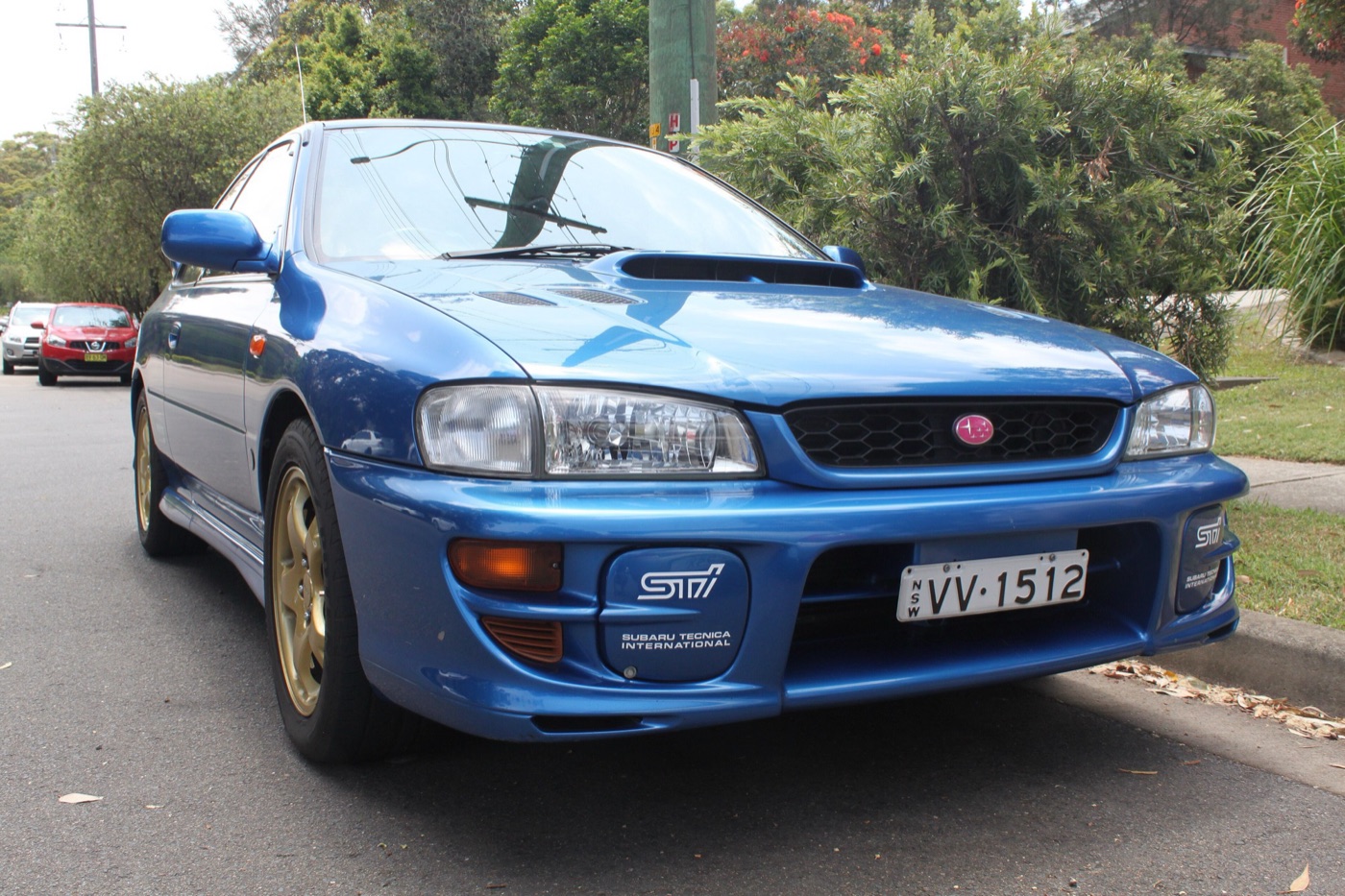
The rivalry ended in stages. Subaru’s parent, Fuji Heavy Industries, withdrew from the WRC on 16 December 2008 after 19 years with Prodrive, three manufacturers’ titles and three drivers’ titles, blaming the sudden fall in the world economy (Tyrepress, reporting FHI’s announcement). SkiddMark marked the moment that month by driving an Impreza Type-20, an Evo VI Tommi Mäkinen Edition and an Audi quattro together. evo notes that the Evo X arrived alongside a hatchback Impreza that it called disappointing, which kept the Evo’s appeal secure.
In 2010 a SkiddMark column asked whether either car had a future. It noted that the new Impreza had been designed “as a Focus-rivalling hatch first and B-road annihilator second”, that Mitsubishi was putting more weight on ordinary Lancers, and that spotting an Evo on the road “requires the hawk-like vision of a trainspotter”.
Why did Mitsubishi stop making the Lancer Evolution?
Mitsubishi announced in spring 2014 that Evo production would end after the 2015 model year and that it would concentrate on electric propulsion (PistonHeads). The twin-clutch Evo X ended production in March 2015 and the manual with the Final Edition that year, closing a run Mitsubishi counted as 23 years from October 1992 (Monoist). evo dates the last production to 2016, and Mitsubishi has sold no successor.
Will there be a new Lancer Evolution?
Not on any announced plan. At Mitsubishi’s shareholder meeting in June 2026, president Keisuke Kishiura called the Lancer Evolution, Galant and Diamante “treasures” but said “at this time, there are no specific plans to introduce these” (Carscoops, quoting Car Watch). He added that a factory return to the World Rally Championship would be a dream, and Mitsubishi’s published plan puts SUVs, off-roaders, cars for south-east Asia and electrified models first.
Questions
What does FQ stand for on a Mitsubishi Evo?
Mitsubishi never said. FQ was the badge Mitsubishi UK and Ralliart put on Evos tuned for Britain, from the Evo VII FQ-300 to the Evo X FQ-440 MR, and evo wrote that the name was “pretty easy to decipher from its performance”.
Which is the best Lancer Evolution?
The Evo VI and its Tommi Mäkinen Edition are the usual answers. evo calls the Evo VI the last of the pure homologation Evos, PistonHeads wrote that for many it “remains the iconic pinnacle of Mitsubishi Evo design”, and Mitsubishi UK called the Tommi Mäkinen Edition the most recognisable and desirable Evo it imported.
What is the most powerful Lancer Evolution?
The UK Evo X FQ-440 MR of 2014, with 440 bhp, was the most powerful production Evo; 40 were made. Of the factory cars, Mitsubishi Motors North America called the 303 hp US Final Edition the most powerful mass-production Evo.
Was the Lancer Evolution sold in America?
Yes, from the Evo VIII in 2003. Three generations, the Evo VIII, IX and X, were sold new in the US over 12 years, ending with 1,600 Final Editions in 2015.
What do GSR and RS mean on an Evo?
The GSR is the fully equipped road version; the RS is the lightweight competition base with less equipment, sold for rally teams to build on. On the Evo IV, about one car in ten was an RS.
What was the Mitsubishi Carisma GT?
Carisma GT was the name under which Mitsubishi entered some of its works Lancer Evolution rally cars, after its European family car. Richard Burns won the 1998 Safari Rally and Rally GB in one.
How much horsepower does a Lancer Evolution have?
Japanese-market Evos went from 250 PS for the Evo I to 280 PS from the Evo IV to the Evo IX, and 300 PS for the later Evo X. UK FQ models ran from about 300 to 440 bhp.
Sources
- Mitsubishi Motors, “Mitsubishi Motors launches Lancer Evolution IX hi-performance 4WD sports sedan”, press release, 2 March 2005 (archived): Evo I launch month, Evo IX launch, torque, trims, prices, Super AYC.
- Mitsubishi Motors, “Mitsubishi Motors Exhibits at 39th Tokyo Motor Show”, press release, 28 September 2005 (archived): Concept-X.
- Mitsubishi Motors, “MMC launches Lancer Evolution X”, press release, 1 October 2007 (archived): Evo X launch, prices, 4B11T engine, SST, S-AWC, body stiffness, sales target.
- Mitsubishi Motors North America, Evo heritage sheet: Lancer Evolution III (archived PDF): Evo III engine and body changes, first WRC win.
- Mitsubishi Motors North America, “The 2015 Mitsubishi Lancer Evolution Final Edition”, press release, October 2015: US Final Edition numbers, price and output.
- Monoist (ITmedia), Final Edition announcement report, 10 April 2015 (Japanese): Japanese Final Edition, end of SST and manual production.
- Kuruma News, history of the first-generation Lancer Evolution (Japanese), pages 1 and 2: Evo I to III dates, outputs, sales, rally wins.
- Kuruma News, history of the second-generation Lancer Evolution (Japanese): Evo IV to VI dates, outputs, Active Yaw Control, wide body.
- Kuruma News, history of the third-generation Lancer Evolution (Japanese): Evo VII to IX dates, outputs, GT-A, VIII MR, Wagon, last 4G63.
- Goo-net Exchange, catalogue data for the Lancer RS Evolution II (E-CE9A): Evo II torque.
- Goo-net Exchange, catalogue data for the Lancer RS Evolution III (E-CE9A): Evo III torque.
- Best Car, history of the 4G63 engine in the Lancer Evolution (Japanese): Evo III, IV and VI torque.
- Mitsubishi Motors UK, Evolution VIII 260 offer, press release (archived): Evo VIII 260 price, output and performance.
- juwra.com, Tommi Mäkinen driver record: Mäkinen season-by-season results.
- juwra.com, Mitsubishi all-time WRC statistics: WRC wins by model.
- Autosport, archive report on Mäkinen’s 1996 title (from the 26 September 1996 issue): 1996 title, Cowan quote.
- Autosport, “1999: Makinen’s fourth WRC title”: 1999 title at Rally Australia.
- DirtFish, “Inside Mitsubishi’s most dramatic title win”, 18 May 2020: 1998 Rally GB, Mäkinen’s retirement.
- The Auto Channel, Network Q Rally of Great Britain report, 25 November 1998 (archived): Sainz’s engine failure, Burns’s win.
- juwra.com, Swedish Rally 1995 final results: Eriksson and Mäkinen first and second in Evo IIs.
- juwra.com, Rally Australia 1995 final results: Eriksson’s win in an Evo III.
- Autosport, “Analysis: Mitsubishi exit cripples WRC”, 14 December 2005: two works teams left, seven five years before.
- Mitsubishi Motors statement on suspending WRC participation, December 2005, as published by Racecar: WRC withdrawal, 34 wins, 1998 manufacturers’ title.
- Tyrepress, Fuji Heavy Industries’ announcement of Subaru’s WRC withdrawal, December 2008: Subaru’s exit and record.
- PistonHeads, “Mitsubishi Evo IV, V, VI: market watch”, 28 April 2014: Evo IV and VI production, UK prices, TME pack.
- PistonHeads, “PH buying guide: Mitsubishi Evo VI”, 3 October 2012: UK Evo VI launch price, grey imports, Extreme numbers.
- PistonHeads, “Mitsubishi Evo X: PH used buying guide”, 7 August 2021: Evo X faults, FQ outputs, UK prices, end of production.
- PistonHeads, “Mitsubishi Evo VI TME sells for record £100k”, 5 May 2021: Heritage fleet auction results.
- evo, Mitsubishi Lancer Evo VI review and buying guide: Evo VI history, TME, UK specials, servicing and faults, Impreza comparison.
- evo, Mitsubishi Lancer Evolution VII review: Evo VII stiffness, UK prices, FQ name.
- evo, Mitsubishi Lancer Evolution X (2008-2016) review: Evo X weight, prices, end of production.
- evo, Mitsubishi Evo X FQ-400 review: FQ-400 price, output, tuners.
- evo, “Mitsubishi Evo X FQ-440 MR announced”, March 2014: FQ-440 MR run, price and specification.
- CAR, Mitsubishi Evo IX FQ-360 review, 2006: FQ-360 output, price and acceleration.
- Autocar, Mitsubishi Evo X UK prices, 2007: Evo X UK prices and FQ-300 output.
- Carscoops, “UK celebrates two decades of Mitsubishi Lancer Evos”, July 2020: Mitsubishi UK sales total, first official car, SVA.
- Carscoops, Mitsubishi president on reviving the Evo, June 2026: Kishiura’s comments.
- Motoring Research, “Mitsubishi Evo sells for record £100,000 at auction”, May 2021: Record price and previous record.
- Goodwood Road & Racing, Mitsubishi UK heritage collection sale, 2021: Mitsubishi leaving the UK after 47 years.
- Hagerty UK, Tommi Mäkinen Edition auction preview, 2021: UK TME numbering.
- Department for Transport, table VEH0120 (UK), licensed and SORN vehicles by model, to 2026 Q2: Evos on UK records.
- Driver and Vehicle Standards Agency, vehicle recalls data, downloaded 28 October 2026: UK recalls.
- OUTLAW 8 listings database, auction results 28 October 2025 to 27 October 2026, queried 28 October 2026: UK and US auction prices.
- SkiddMark, “End of the road for the Turbo-Nutter?”, October 2010, and “Impreza Type-20 v Evo VI TME v Audi quattro”, December 2008: the 2010 column and the 2008 feature.