Pikes Peak Hill Climb: history, records, winners and how to watch
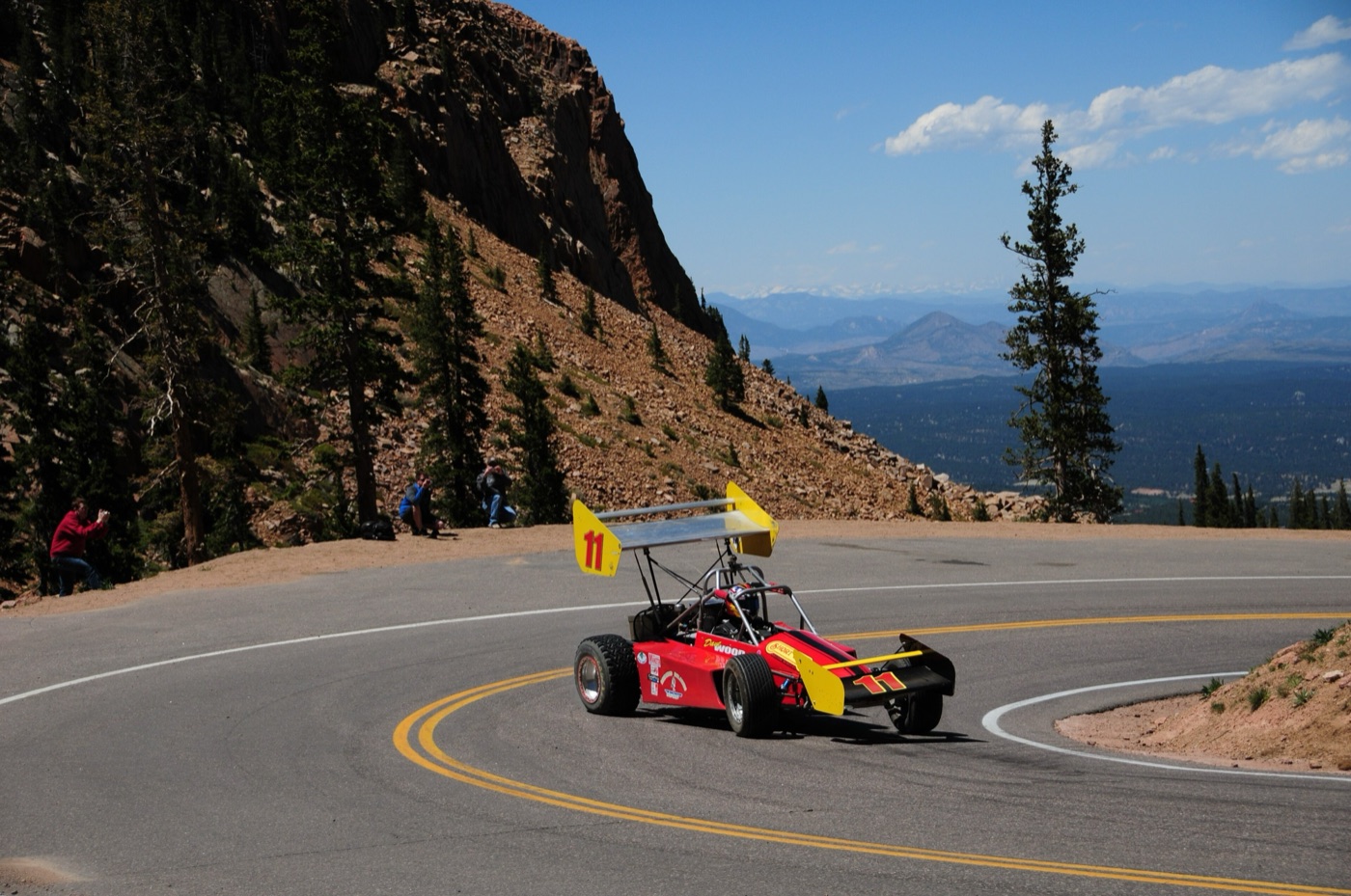
The Pikes Peak hill climb, officially the Pikes Peak International Hill Climb and better known as the Race to the Clouds, is a timed sprint up the Pikes Peak Highway in Colorado: 12.42 miles, 156 turns, from a start line at 9,390ft to the finish on the 14,115ft summit. It has run since 1916, which makes it, by its organisers’ count, America’s second-oldest motor race; only the Indianapolis 500, first run in 1911, is older. The course record is 7:57.148 (seven minutes, 57.148 seconds), set by Romain Dumas in the electric Volkswagen I.D. R in 2018, and the 2026 race, the 104th, was won by Dumas again in a Ford Super Mustang Mach-E in 8:18.202.
What is the Pikes Peak hill climb?
The Pikes Peak hill climb is a one-day race against the clock in which each car runs alone from the start line to the finish line at the summit, and the fastest time of the day takes the overall title, known as King of the Mountain. The organisers’ own description calls it an invitational, self-sanctioned event run on a public toll road, the Pikes Peak Highway, which is closed for the day; competitors apply for an invitation and the race sets its own rules. Its full title, with its sponsors, is The Broadmoor Pikes Peak International Hill Climb presented by Gran Turismo, and the mountain rises just west of Colorado Springs, about 90 minutes’ drive south of Denver. On race day cars leave the line about every four to five minutes, and the organisers’ fan guide warns that stoppages for incidents, weather and spectators have added an average of two to three hours to the day over the past five years.
Divisions run side by side, from purpose-built Unlimited prototypes to near-standard road cars, and each division has its own winner and its own records. A car from any division can be King of the Mountain: Romain Dumas won in 2026 in the new Unlimited Production Based class, and Clint Vahsholtz won in 2020 in an Open Wheel car.
Why is it called the Race to the Clouds?
Because the weather on the mountain changes faster than the cars climb it. The race’s official history says a driver can start in sunshine and pass through sleet, thunderstorms, wind, hail, fog or snow before the finish, and that is where the name came from. In 2025 winds gusting over 85mph in the upper section forced the organisers to stop the whole field at Glen Cove, near mile 13, and in 2026 Pirelli measured about 20°C on the asphalt at the start and below freezing at the top.
When is the Pikes Peak hill climb held?
In late June. The City of Colorado Springs, which runs the highway, lists the race-day closure as the third Sunday in June; the 2026 race was on Sunday 21 June, and the organisers have set Sunday 27 June 2027 for the next one. Race week begins with technical inspection on the Monday, which in 2026 was free to watch at the Broadmoor World Arena; practice and qualifying run from Tuesday to Friday at dawn, before the highway opens to tourists.
The course: how long is the Pikes Peak hill climb?
The Pikes Peak hill climb course is 12.42 miles (19.99km) of the Pikes Peak Highway, from the start line at mile 7 to the finish line on the summit, with 156 turns and a climb of 4,720ft (1,440m). The fastest cars cover it in a little over eight minutes, which works out at about 90mph on average. At the top the air is thin enough, the organisers say, to rob a combustion engine of up to 30 per cent of the power it makes at the start, and drivers feel it too: thin air slows their reactions and saps their strength.
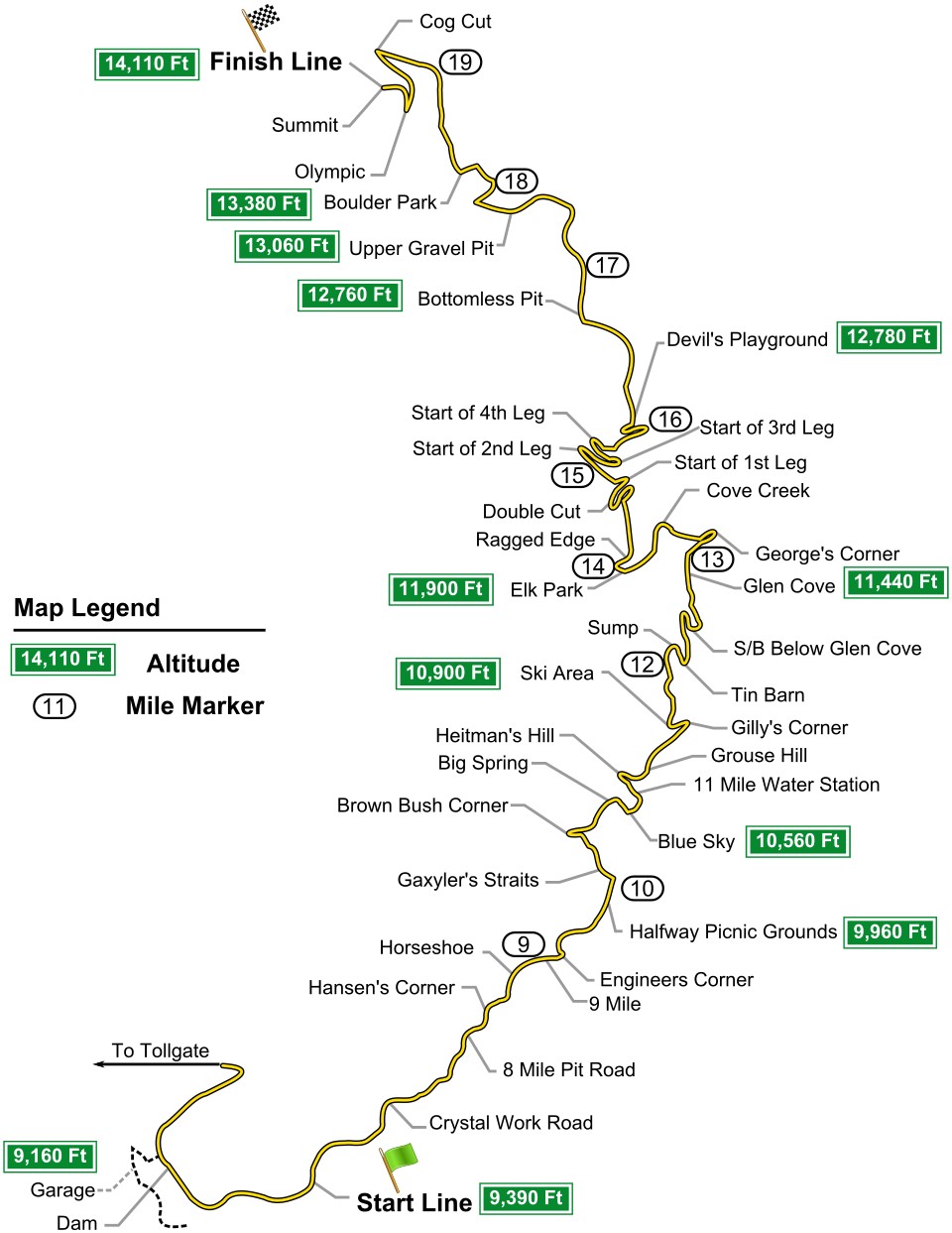
Corners and landmarks on the course
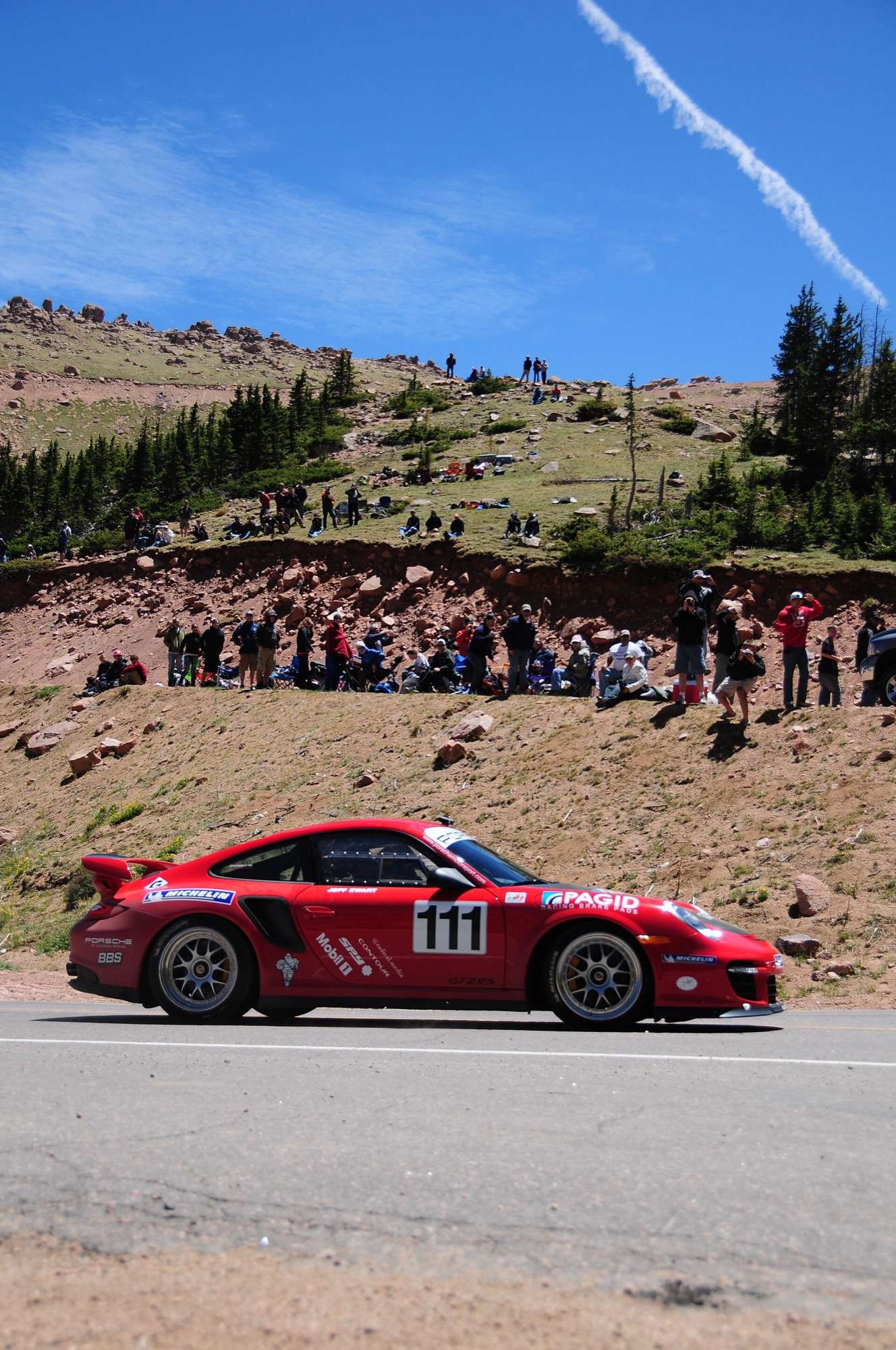
The named corners and landmarks run up the mountain in this order. Low down, in the forest, the road passes Engineers Corner and the Halfway Picnic Grounds, where the fan guide says cars pass at over 100mph, then Blue Sky (10,560ft) and the Ski Area. Glen Cove, at 11,440ft, is the last big spectator area below the trees. Just above it is Cove Creek, at the treeline, and then come Elk Park, the Ragged Edge and the switchbacks up to Devils Playground (12,780ft). The last miles run along the open ridge past Bottomless Pit, Boulder Park and Olympic to the Cog Cut, beside the railway, and the finish. For practice the organisers split this into lower, middle and upper sections, and each group of cars runs one section a morning.
When was the Pikes Peak course paved?
The highway was paved bit by bit between 2002 and 2011, and the 2012 race was the first run on asphalt from start to finish. The organisers’ account of the paving says the first six miles, to about a mile below the start line, were paved in the 1950s. In August 1998 the Pikes Peak chapter of the Sierra Club sued the City of Colorado Springs and the US Forest Service under the Clean Water Act over gravel washing off the 13 unpaved miles into streams, wetlands and reservoirs; after the February 1999 settlement the state required the city to fix the erosion before 2012, and the city found no way to do it except paving. The first mile of new asphalt went down in 2002 and the last weeks after the 2011 race. The race rents the road from the city each year, and it says it was not in favour of losing the dirt surface it had used since 1916.
Paving changed the cars and the times. The winning time dropped from 9:51.278 in 2011, the last year with a gravel section, to 8:13.878 in 2013, and motorcycles went under ten minutes for the first time in 2012.
Is the Pikes Peak hill climb dangerous?
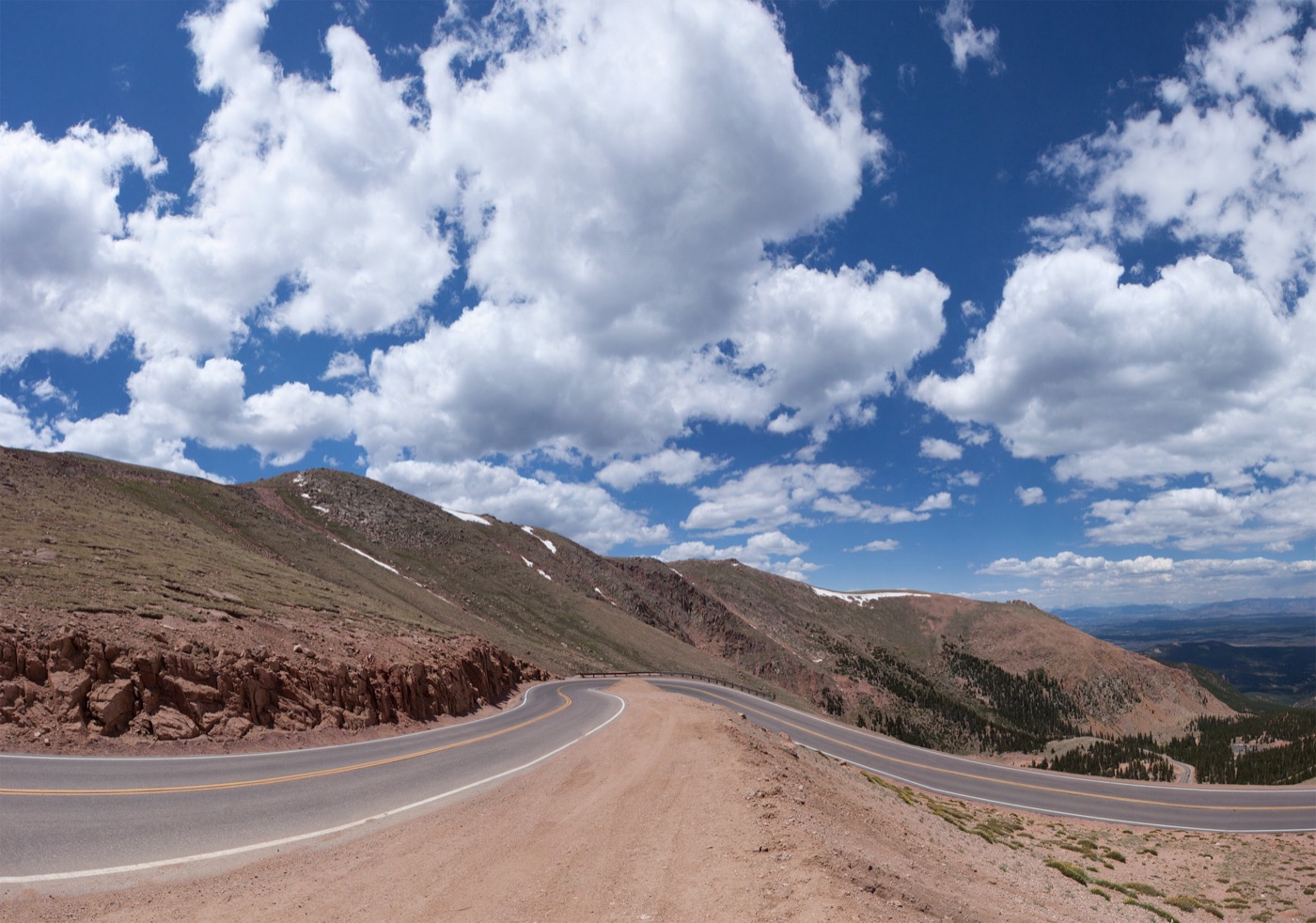
Yes, and the organisers say so on every ticket: spectators attend at their own risk and sign a liability waiver. Much of the road has no barrier between the tarmac and a drop. Carlin Dunne, who had set motorcycle records in 2011 and 2012, was killed on 30 June 2019 when his Ducati highsided coming into the last turn before the finish, the race’s investigation found; the bike showed no sign of mechanical failure. In 2026 Franco Caruso’s Nova Proto left the road and hit trees just after the start, Bruce Jouanny’s Ligier went more than 100ft off the road at Engineers Corner, and Patrick Culligan was flown to hospital with a broken pelvis and femur after a crash near the summit. Caruso and Jouanny walked away.
History of the Pikes Peak hill climb
The Pikes Peak hill climb began as a publicity stunt for a new road and grew into a meeting where American dirt-track families, then European rally teams, then car makers with electric prototypes have all tried to set the fastest time up the same mountain.
Spencer Penrose and the first race in 1916
Spencer Penrose, a Colorado Springs businessman, finished turning the carriage road up Pikes Peak into the Pikes Peak Highway in 1915, and ran a car race to the summit to publicise it and fill his new hotel, the Broadmoor. The organisers’ short history records the first Pikes Peak Auto Hill Climb on 10, 11 and 12 August 1916. It was won by Rea Lentz, 22, from Washington, in the Romano Demon Special, the smallest car in the field, in 20:55.6; Barney Oldfield entered a Delage, Eddie Rickenbacker was entered too, and Penrose put up a 43-inch trophy in Colorado silver and gold valued at $10,000. Mechanics rode with the drivers in the early years.
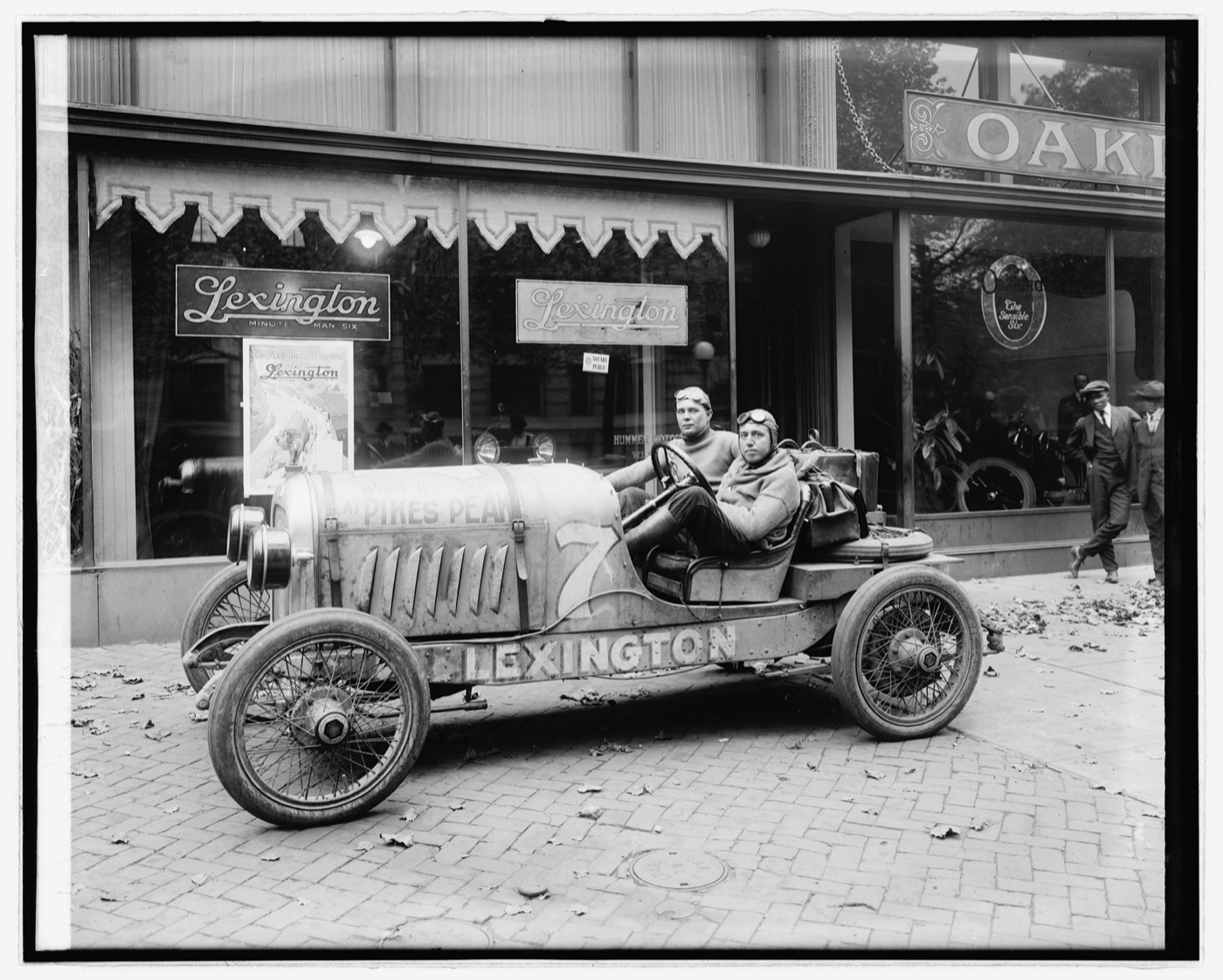
The race lapsed during the First World War and came back in 1920 under the American Automobile Association, won by Otto Loesche in a Lexington; he won again in 1924. Glen Shultz took seven Open Wheel titles between 1923 and 1933.
The Unser family
The Unsers have won more King of the Mountain titles than any other family, 26 by the organisers’ count. Louis Unser won the first of his nine titles in 1934 and raced until he was 70, trading wins with his friend and rival Al Rogers, who won five. His nephew Bobby Unser won ten times overall between 1956 and 1986, the last of them in an Audi; Bobby’s brother Al won in 1964 and 1965, Al’s son Al Unser Jr in 1983, and Bobby’s son Robby won in 1989, 1990 and 1992, and shared the 2004 title with Paul Dallenbach. The Vahsholtz family from Woodland Park, Colorado, has more wins across all divisions, 44 including six on motorcycles, but only one overall title, Clint Vahsholtz’s in 2020.
Mouton, Röhrl and Vatanen: the European rally era
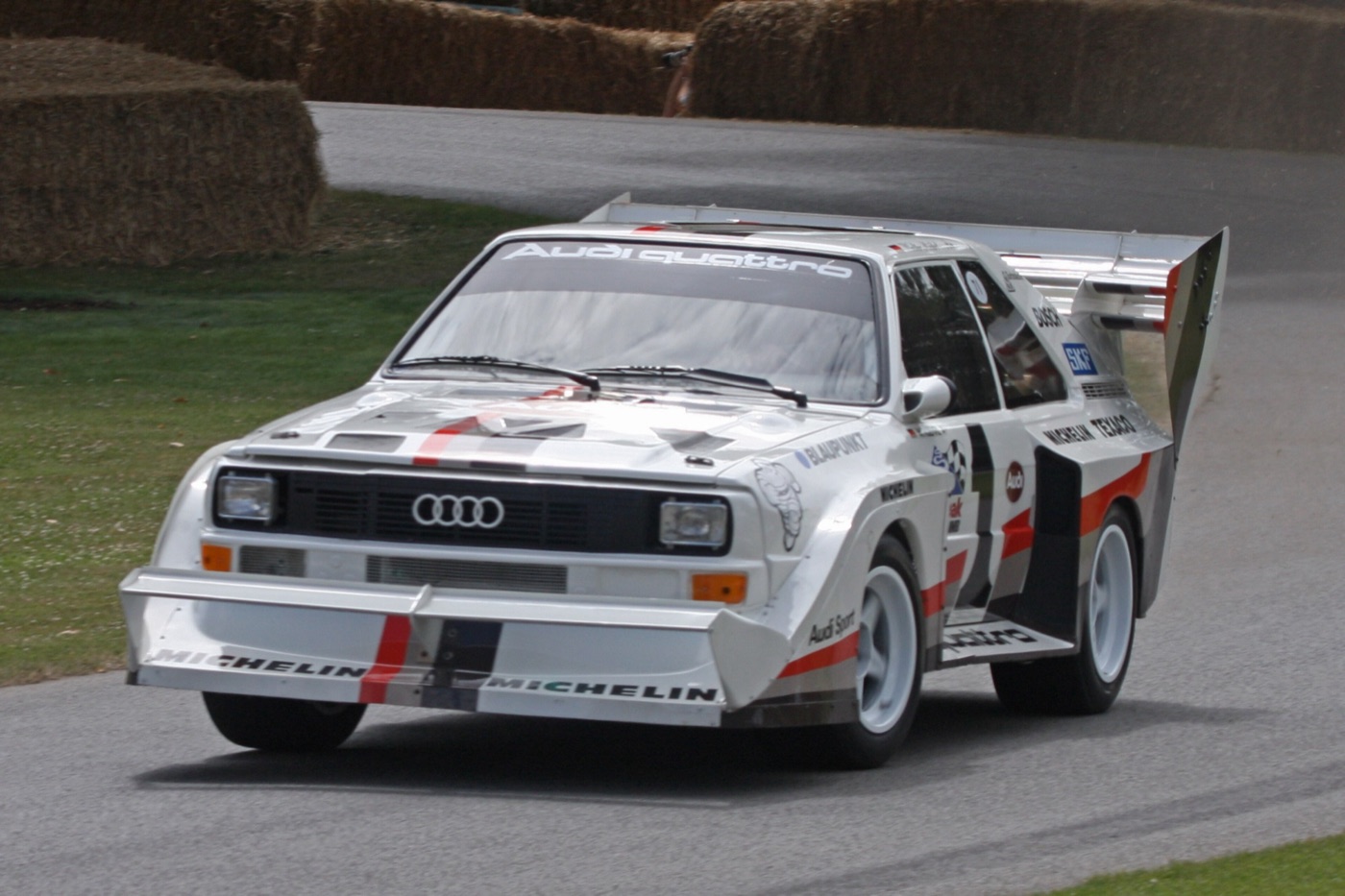
European rally teams arrived in 1984: the Norwegian rallycross driver Martin Schanche came with a Ford Escort, a 2013 SkiddMark report noted, and Audi of America brought Michèle Mouton and Fabrizia Pons in an Audi Quattro. They won the Open Rally class in 12:10.38 and were second overall, Goodwood’s history of Mouton’s runs records. Audi then won the next three races outright, each in record time.
Michèle Mouton’s win in 1985
Mouton came back in 1985 alone, without Pons, in the Sport Quattro that Walter Röhrl had used on the Tour de Corse a month earlier: about 507PS and just over 1,000kg. She was fined for speeding in practice and for spraying gravel at marshals while warming her tyres, denied a flying start and banned from driving the car anywhere but the course, so her mechanics pushed it to the line. A hailstorm made the road slippery on race day, and she still won in 11:25.39, 13 seconds inside Al Unser Jr’s record. In the results she is the first, and still the only, woman to win the race outright; the race inducted her into its Hall of Fame in 2025, 40 years on.
Bobby Unser won in 1986 in a Sport Quattro S1 in 11:09.22. In 1987 Röhrl won in the Sport Quattro S1 E2 Pikes Peak in 10:47.85, the first time under 11 minutes, ahead of Ari Vatanen’s Peugeot 205 T16, a Group B car, in 10:54.83, according to the race’s historical results, 1916–2024. A 2012 SkiddMark report counted that as Audi’s third win in a row.
Climb Dance and Vatanen’s 1988 record
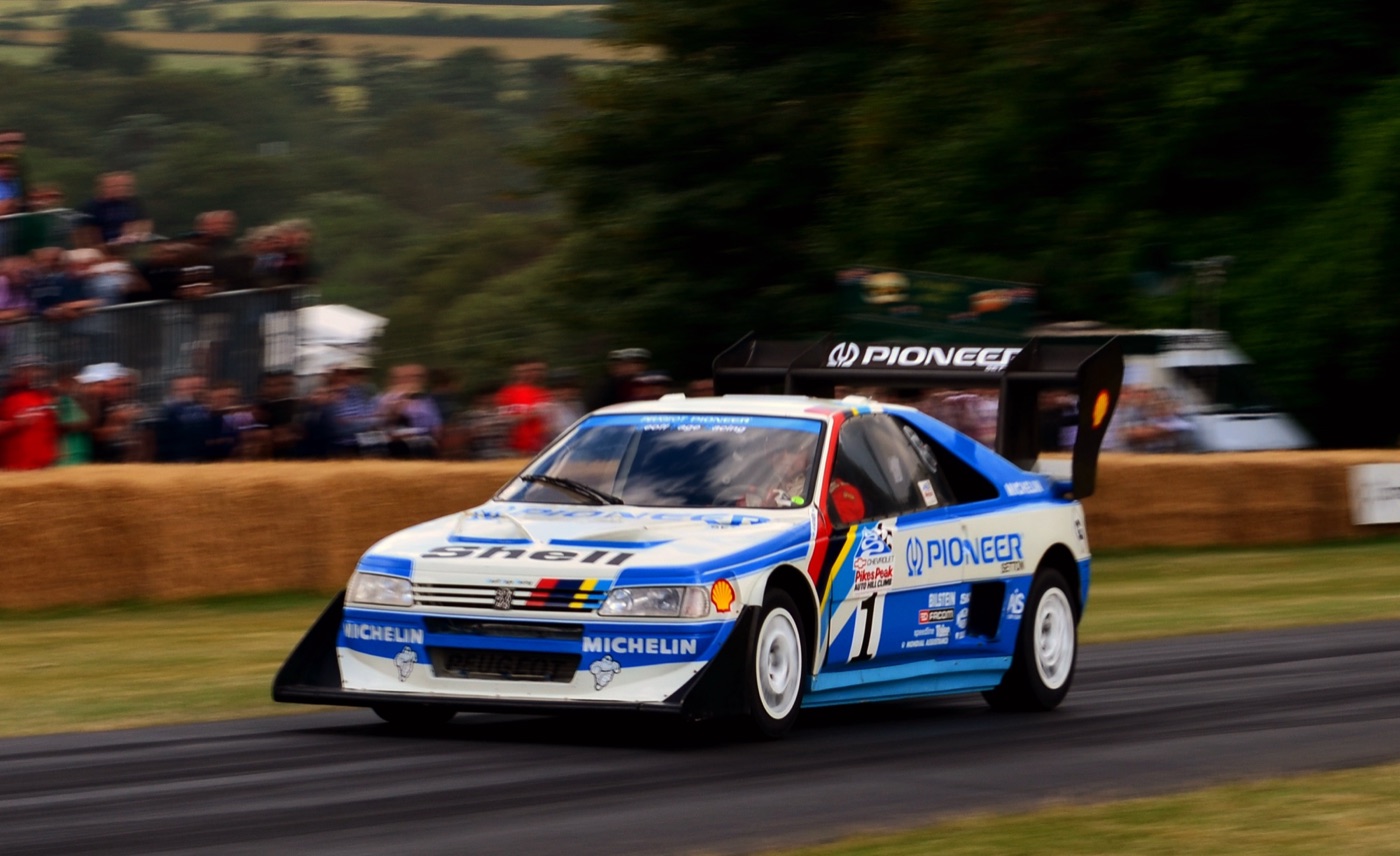
Peugeot won the next two races with the 405 Turbo 16. Vatanen won in 1988 in 10:47.22, 0.63sec inside Röhrl’s record, with Juha Kankkunen second in another 405; Robby Unser won in 1989 in 10:48.34 with Vatanen second. Peugeot had the French director Jean-Louis Mourey film the car, and the result, Climb Dance, won awards at festivals in Chamonix, Val d’Isère, Chicago and Houston in 1990, Driven’s history of the film says. The shot most people remember is Vatanen lifting a hand from the wheel to shade his eyes from the low sun, sideways, near the summit. The film mixes his 1988 run with Robby Unser’s in the same car a year later.
Rod Millen and Monster Tajima
The New Zealander Rod Millen set the fastest time ever on the gravel course, 10:04.06, in 1994 in a four-wheel-drive Toyota Celica. Speaking to Toyota’s UK magazine, he said Toyota Racing Development found a light engine that gave 850hp at altitude, and that the car never saw more than 140mph on the mountain, so its aerodynamics were set up to work between about 70 and 140mph. Millen won five times; he and his son Rhys have 15 division titles between them.
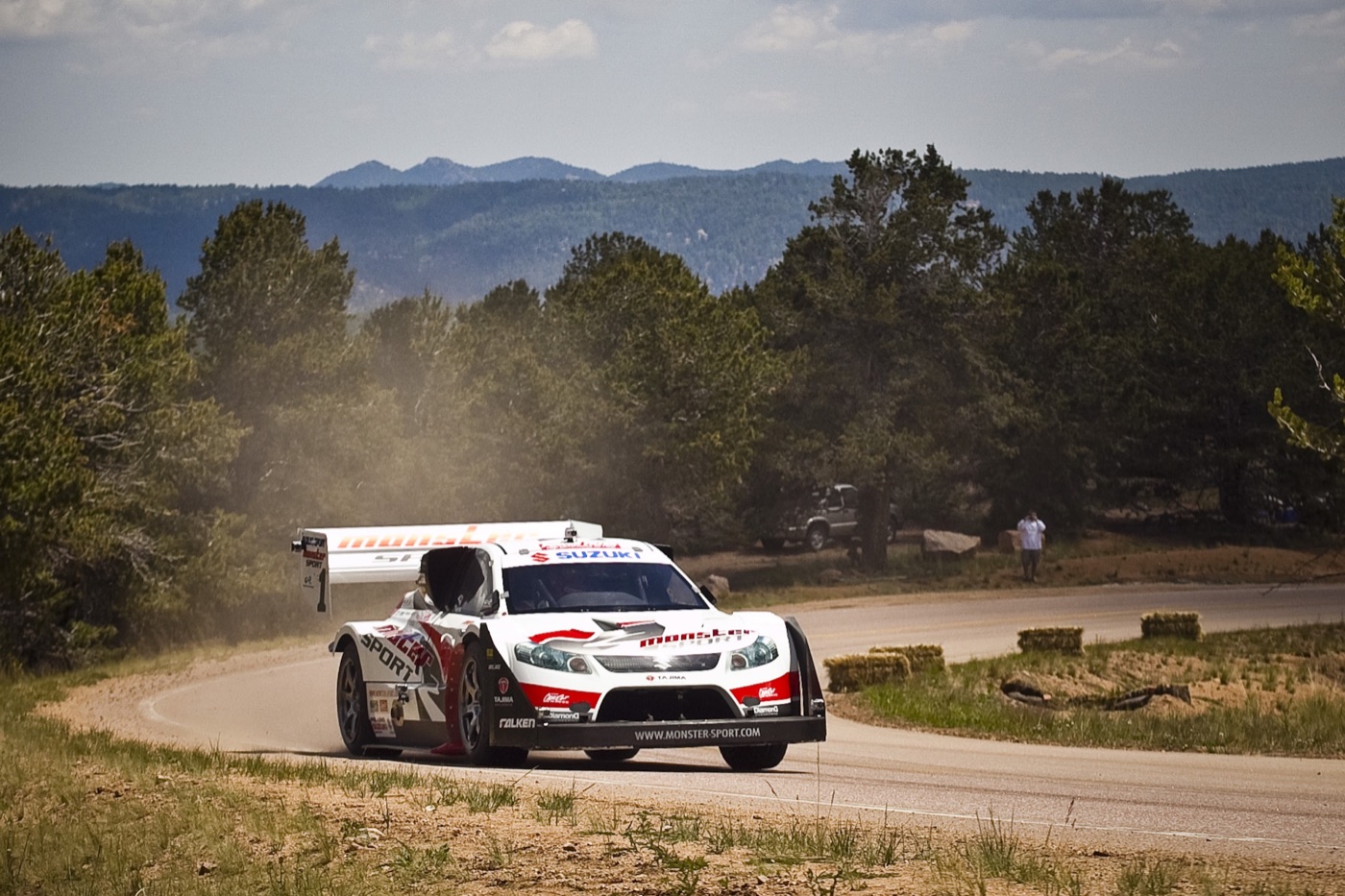
Nobuhiro “Monster” Tajima of Japan won six years running, from 2006 to 2011, in Suzuki-badged specials built by Monster Sport in Japan. He beat Millen’s record in 2007 with 10:01.408 in a Suzuki XL7, on a road that was by then partly paved, and in 2011, aged 60, he became the first driver under ten minutes, with 9:51.278 in an SX4 Hill Climb Special of 910hp, nursing an overheating radiator over the last half mile, Modern Tire Dealer reported in June 2011.
Sébastien Loeb and the Peugeot 208 T16
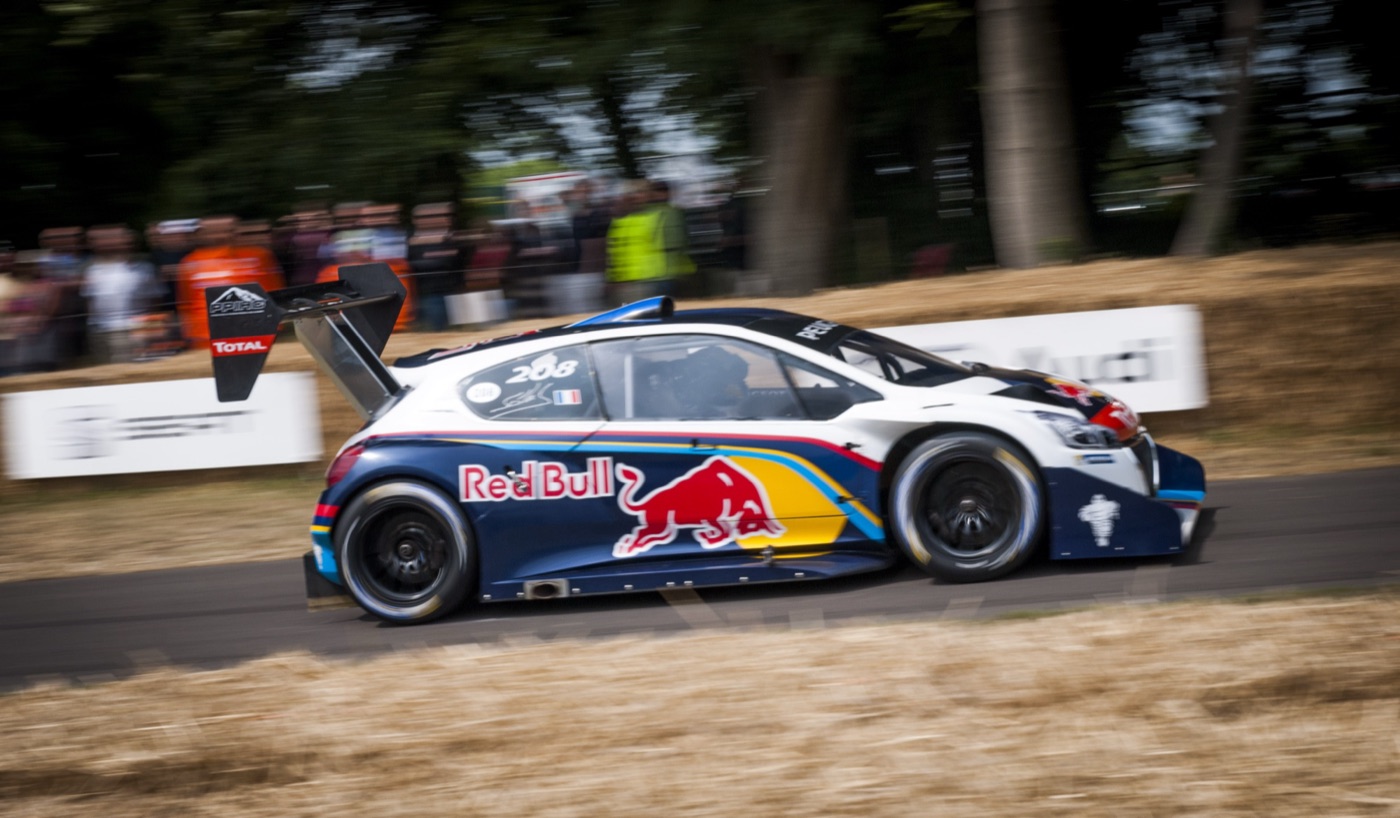
The 2012 race, the 90th and the first on a fully paved road, was moved from 8 July to 12 August by the Waldo Canyon fire, SkiddMark reported at the time, and Rhys Millen won it in a Hyundai Genesis Coupe in 9:46.164. A year later Peugeot came back. Its 208 T16 Pikes Peak was entered in the Unlimited class with the number 208, and Maxime Picat, Peugeot’s director general, said when it was announced in March 2013: “Our objective is to win.” Citroën lent the team its nine-time world rally champion, Sébastien Loeb.
Loeb won in 8:13.878, a minute and a half inside Millen’s record and over a second faster than the “perfect time” Peugeot Sport had predicted, Evo reported from the 2013 race; the car had 875bhp. Rhys Millen was second in 9:02.192, 44 seconds inside his own old record. It was Loeb’s only attempt at the mountain, and his time is still the record for a car with a combustion engine.
Electric cars and the Volkswagen I.D. R
Electric cars took the top places in the 2010s. They lose no power to the thin air, and the course is short enough for a battery. In 2015 Rhys Millen won outright in the electric eO PP03 in 9:07.222, and in 2016 he set an electric record of 8:57.118. In 2018 Volkswagen came with the I.D. R Pikes Peak, an electric prototype that reached 100km/h from a standstill in 2.25 seconds, and Romain Dumas, a two-time Le Mans winner, beat Loeb’s record by almost 17 seconds with 7:57.148, the only run up the mountain under eight minutes, Michelin’s race report records. The organisers note the car went from concept to competition in nine months.
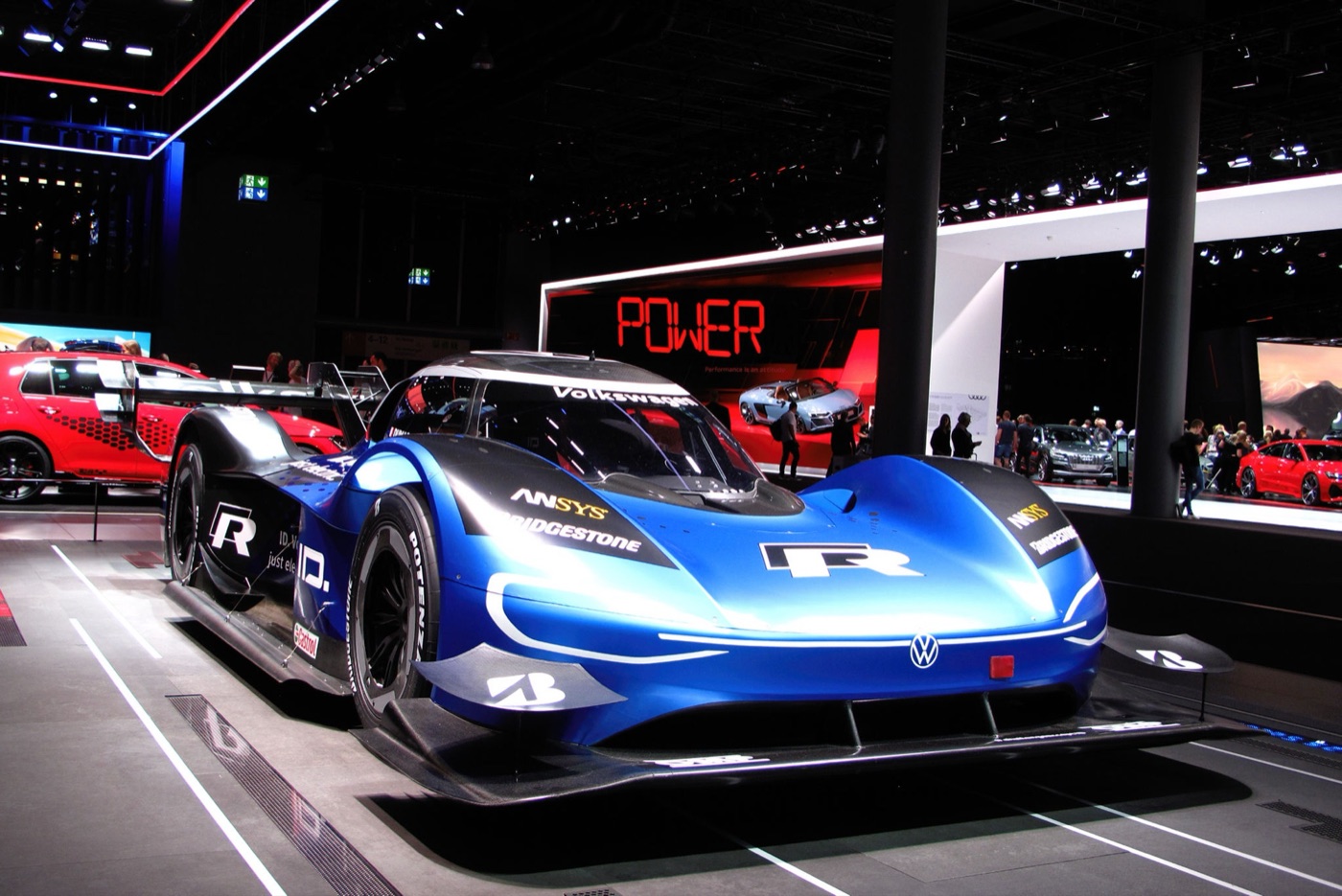
Shute, Faggioli and Dumas since 2019
Robin Shute won four times between 2019 and 2023 in Wolf single-seaters, his best an 8:40.080 in 2023. Dumas, already the winner in 2014, 2016, 2017 and 2018, came back with Ford and won in 2024 in the electric F-150 Lightning SuperTruck. In 2025 Italy’s Simone Faggioli won in a Nova Proto NP01 on the course cut short at Glen Cove, in 3:37.196. In 2026 Dumas took his sixth title in the Super Mustang Mach-E, which has three motors, more than 1,400hp and a 50kWh battery, Ford’s release on the win says. Shute was second in 8:29.497 in his Sendycar V1, a record for a rear-wheel-drive car, and Faggioli third after a technical problem on his run.
Pikes Peak records
The overall record is 7:57.148, by Romain Dumas in the Volkswagen I.D. R in 2018. Below it the race keeps records for each division and for kinds of car (production, electric, hybrid, by drivetrain), and several fell in 2026, according to the organisers’ report of the 2026 race.
| Record | Driver | Car | Year | Time |
|---|---|---|---|---|
| Overall course record (electric) | Romain Dumas | Volkswagen I.D. R Pikes Peak | 2018 | 7:57.148 |
| Fastest combustion-engined car | Sébastien Loeb | Peugeot 208 T16 Pikes Peak | 2013 | 8:13.878 |
| Unlimited Production Based | Romain Dumas | Ford Super Mustang Mach-E | 2026 | 8:18.202 |
| Rear-wheel drive | Robin Shute | Sendycar V1 | 2026 | 8:29.497 |
| Open Wheel division | Dan Novembre | Wolf GB08S TC Special | 2026 | 9:01.689 |
| Production car, hybrid | JR Hildebrand | Chevrolet Corvette ZR1X | 2026 | 9:30.104 |
| Fastest motorcycle (last raced 2019) | Rennie Scaysbrook | Aprilia Tuono V4 1100 | 2019 | 9:44.963 |
| Production car, combustion engine | David Donner | Porsche 911 Turbo S | 2026 | 9:53.740 |
| Fastest woman on four wheels | Emelia Hartford | Chevrolet Corvette | 2026 | 10:11.018 |
| Front-wheel drive | Jim Morris | Volkswagen Golf | 2026 | 10:33.104 |
Sources: PPIHC race records sheet, 2026; PPIHC 2026 overall results; PPIHC 2026 race report; PPIHC historical results 1916–2024 (motorcycle record); PPIHC tribute to French record holders, 2024 (Loeb’s combustion record).
How the outright record has fallen
The record has fallen 11 times since 1985, by almost three and a half minutes in all, and nine of those runs came from drivers from outside the United States.
| Year | Driver | Car | Surface | Time |
|---|---|---|---|---|
| 1985 | Michèle Mouton | Audi Sport Quattro | Gravel | 11:25.39 |
| 1986 | Bobby Unser | Audi Sport Quattro S1 | Gravel | 11:09.22 |
| 1987 | Walter Röhrl | Audi Sport Quattro S1 E2 | Gravel | 10:47.85 |
| 1988 | Ari Vatanen | Peugeot 405 Turbo 16 | Gravel | 10:47.22 |
| 1993 | Paul Dallenbach | Chevrolet | Gravel | 10:43.63 |
| 1994 | Rod Millen | Toyota Celica | Gravel | 10:04.06 |
| 2007 | Nobuhiro Tajima | Suzuki XL7 | Part paved | 10:01.408 |
| 2011 | Nobuhiro Tajima | Suzuki SX4 Hill Climb Special | Part paved | 9:51.278 |
| 2012 | Rhys Millen | Hyundai Genesis Coupe | Paved | 9:46.164 |
| 2013 | Sébastien Loeb | Peugeot 208 T16 Pikes Peak | Paved | 8:13.878 |
| 2018 | Romain Dumas | Volkswagen I.D. R Pikes Peak | Paved | 7:57.148 |
Sources: PPIHC historical results 1916–2024, course records marked CR; PPIHC All Time Kings of the Mountain, 1916–2025. Times set on shortened courses (7:53.00 in 1995, 5:06.230 in 2004, 7:38.900 in 2006, 5:55.246 in 2021, 3:37.196 in 2025) are not records.
Who holds the production car record: Corvette or Porsche?
Both claim it, in different categories. In 2026 JR Hildebrand drove a Chevrolet Corvette ZR1X, a hybrid with 1,250hp from a twin-turbo V8 and an electric front motor, up the mountain in 9:30.104 to win Time Attack 1. Apart from a roll cage, fuel cell, fire system and harnesses it was standard, down to its road-legal Michelin Pilot Sport Cup 2 R tyres, and its time stands in a separate category for hybrids, CorvSport reported from the race. The race’s records sheet lists both: “Production Car”, which excludes hybrid and electric vehicles, and “Hybrid Production Car”. Its report of the race credits David Donner’s 9:53.740, two cars earlier, in a 2022 Porsche 911 Turbo S entered by 000 Magazine, as the production car record, beating Rhys Millen’s 10:12.024 in a BMW M8 from 2023. Porsche’s report of the 2026 race says the race confirmed the five-year-old Turbo S, with its Lightweight Package, as the official production car record holder.
The fastest women at Pikes Peak
Michèle Mouton is the only woman to have won outright. Germany’s Lucy Glöckner is the fastest woman ever up the mountain and the first under ten minutes, with 9:58.878 on a BMW S 1000 R motorcycle in 2019, according to the organisers’ history. On four wheels the record changed hands twice on race day in 2026: Laura Hayes lowered her own mark to 10:17.538 in a Toyota Supra GT4, and later that morning Emelia Hartford, in her second year, went up in 10:11.018 in a Corvette.
Pikes Peak hill climb winners
Romain Dumas, with six wins, is the most successful driver of the paved era; Bobby Unser, with ten overall wins between 1956 and 1986, has the most of anyone. Tajima’s six wins came in a row, from 2006 to 2011.
| Year | Winner | Car | Time |
|---|---|---|---|
| 2012 | Rhys Millen | Hyundai Genesis Coupe | 9:46.164 |
| 2013 | Sébastien Loeb | Peugeot 208 T16 Pikes Peak | 8:13.878 |
| 2014 | Romain Dumas | Norma M20 RD Limited | 9:05.801 |
| 2015 | Rhys Millen | eO PP03 (electric) | 9:07.222 |
| 2016 | Romain Dumas | Norma M20 RD Limited | 8:51.445 |
| 2017 | Romain Dumas | Norma MXX RD Limited | 9:05.672 |
| 2018 | Romain Dumas | Volkswagen I.D. R Pikes Peak (electric) | 7:57.148 |
| 2019 | Robin Shute | Wolf TSC-Honda | 9:12.476 |
| 2020 | Clint Vahsholtz | Ford Open | 9:35.490 |
| 2021 | Robin Shute | Wolf GB08 TSC-LT | 5:55.246 (shortened course) |
| 2022 | Robin Shute | Wolf TSC-FS | 10:09.525 |
| 2023 | Robin Shute | Wolf TSC-FS | 8:40.080 |
| 2024 | Romain Dumas | Ford F-150 Lightning SuperTruck (electric) | 8:53.553 |
| 2025 | Simone Faggioli | Nova Proto NP01 | 3:37.196 (shortened at Glen Cove) |
| 2026 | Romain Dumas | Ford Super Mustang Mach-E (electric) | 8:18.202 |
Sources: PPIHC historical results 1916–2024; PPIHC All Time Kings of the Mountain, 1916–2025; PPIHC 2026 overall results; PPIHC 2025 and 2026 race reports.
Who won Pikes Peak in 2026?
Romain Dumas won the 104th race, on 21 June 2026, in 8:18.202 in the Ford Super Mustang Mach-E, ahead of Robin Shute’s Sendycar V1 (8:29.497) and Simone Faggioli’s Nova Proto (8:32.997 in the official results), which had taken pole on the Thursday, Pirelli’s race report says. Dan Novembre was fifth overall and won the Open Wheel division in 9:01.689, a division record. Billy Johnson, a former NASCAR driver, was sixth overall in a 2015 Porsche 911 GT3 Cup, won the Pikes Peak Open division in 9:12.723 and was the fastest of 15 rookies. Clint Vahsholtz won the naturally aspirated GT4 class on his 32nd appearance, his 25th division win.
Divisions: what races at Pikes Peak?
In 2026 the race ran five divisions plus an exhibition class. Unlimited is for anything that passes the safety inspection and is split into Super Unlimited, for prototypes such as Shute’s Sendycar and Faggioli’s Nova Proto, and Production Based, for extreme cars that keep a link to a road model, such as the Mach-E. Time Attack 1 is for near-standard road cars, Pikes Peak Open for production-based cars with free modifications, Open Wheel for single-seaters, and the Pikes Peak GT4 Trophy by Yokohama for GT4 cars on a balance of performance, in turbo and naturally aspirated classes. The 2026 exhibition class was for Ultra4 off-roaders, won by Loren Healy’s Ford Bronco in 12:03.795.
Why were motorcycles banned at Pikes Peak?
After Carlin Dunne’s death in 2019 the organisers suspended motorcycle racing and, after two years of review, discontinued it for good. Announcing the decision, the interim chairman, Fred Veitch, said motorcycles had been part of the race on and off since 1916 and had been “both thrilling and tragic”. Dunne had been the first rider under ten minutes, in 2012 on a Ducati Multistrada 1200 S in 9:52.819, reaching more than 144mph on the straights, Powersports Business reported; Rennie Scaysbrook’s 9:44.963 on an Aprilia Tuono V4 in 2019 is the fastest motorcycle time in the race’s results.
How to watch the Pikes Peak hill climb
You watch from one of the designated spectator areas along the course, which you must reach before dawn, and you stay there until the race is over. There are no grandstands; the organisers tell fans to bring a camp chair or a blanket. Everyone aged ten and over needs a ticket bought online in advance, children of nine and under go free, and tickets are priced by spectator area and the number of people in the car, so a full car is cheaper per head.
Spectator areas, tickets and camping
On race day the gateway opens at 2:30am, spectators cannot go beyond the start line after 5:30am, and the first car starts at 7:30am, according to the organisers’ ticket page for 2026. The spectator areas, from the bottom, are the start line and pits, 9 Mile, the Halfway Picnic Grounds, the Ski Area, Glen Cove, Cove Creek and Devils Playground. Park above the start line and you cannot leave until the race is over, which with delays can be after 4pm, and no spectator cars go above Devils Playground. The race’s fan questions say Devils Playground has views above the treeline but can be cold and windy, Glen Cove is a popular spot below the trees, and at the start line the pits are open to spectators.
Camping permits for the Saturday night, at 9 Mile (tents only), the Halfway Picnic Grounds, the Ski Area and Glen Cove, go on sale on 1 December, and each needs a race ticket as well. The sites have no water, electricity or hook-ups, vehicles are limited to 25ft, trailers are banned, and so are pets and open fires. Practice can be watched too, from the pits at Turn 1 and from Devils Playground: in 2026 tickets for the Tuesday and Wednesday sessions cost $85 a person a day, and gates closed at 4:45am.
Altitude and weather
The organisers warn that a summer day on the mountain can start warm and turn cold, with rain, snow, fog or hail, and that lightning is common; in a storm, shelter in your car. Some spectator areas get no sun until mid-morning. Altitude sickness (nausea, dizziness, fainting) is a real risk for visitors spending 12 to 14 hours above 9,000ft, and the fan guide suggests a lower spectator area for anyone not used to the height, plenty of water and no alcohol. On the way down after the race the advice is to use a low gear, because hot brakes fail.
Driving the Pikes Peak Highway yourself
The rest of the year the course is a toll road, open weather permitting. The city’s 2026 timetable opens the gates at 7:30am from late May to 30 September and at 9am in winter, and admission from May to November is $18 for adults and $8 for children aged 6 to 15, or $65 for a car of up to five. From 22 May to 30 September every car going past mile 7 also needed a $2 timed-entry permit booked in advance, KOAA reported in April 2026. A shuttle from mile 7 ($40 for adults, $12 for children) stops at Glen Cove, Devils Playground and the summit. The Broadmoor Manitou and Pikes Peak Cog Railway also climbs to the summit, and the Penrose Heritage Museum has race cars and the history of the hill climb.
Questions
Who won the 2026 Pikes Peak hill climb?
Romain Dumas, in the Ford Super Mustang Mach-E, in 8:18.202 on 21 June 2026. It was his sixth overall win; Robin Shute was second in 8:29.497 and the 2025 winner, Simone Faggioli, third.
Why was the 2025 winning time only 3 minutes 37 seconds?
Winds gusting over 85mph in the upper section made the organisers stop every car at Glen Cove, near mile 13 and 11,440ft, after a two-hour delay. Simone Faggioli won the shortened race in 3:37.196, and no records could fall.
Has a woman ever won the Pikes Peak hill climb?
Once. Michèle Mouton won outright in 1985 in an Audi Sport Quattro in a record 11:25.39, and she is still the only woman to have done so.
How fast do cars go at Pikes Peak?
The fastest cars average about 90mph over the 12.42 miles, and the organisers say cars pass the Halfway Picnic Grounds at over 100mph. Rod Millen said his 1994 Celica never saw more than 140mph, and Carlin Dunne’s Ducati topped 144mph in 2012.
Did Sébastien Loeb race at Pikes Peak more than once?
No. His record-breaking run in the Peugeot 208 T16 in 2013, 8:13.878, was his only attempt, the organisers’ history records.
Can you drive up Pikes Peak on race day?
Only as a ticketed spectator going to a designated area. The Pikes Peak Highway is closed to ordinary traffic on race day, the gateway opens at 2:30am, and no spectator cars go above Devils Playground.
What does King of the Mountain mean at Pikes Peak?
It is the title for the driver with the fastest time of the day, whatever the division. The Unser family has won it 26 times, the most of any family.
Sources
- Pikes Peak International Hill Climb, “Records fall and history is made during the 2026 Race to the Clouds”, 24 June 2026: 2026 results, records, incidents and divisions.
- Pikes Peak International Hill Climb, “2026 PPIHC overall results”, June 2026: every finisher’s place, division and time in 2026.
- Pikes Peak International Hill Climb, race records sheet, June 2026: division, production, hybrid, electric and drivetrain records after the 2026 race.
- Pikes Peak International Hill Climb, “All Time Kings of the Mountain 1916–2025”: every overall winner, course records and shortened races, including 2004.
- Pikes Peak Hill Climb Historical Association, “PPIHC Results 1916–2024”, updated 2 December 2024: every result and course record from 1916 to 2024, including 1985–1994, 2012–2024 and the motorcycle record.
- Pikes Peak International Hill Climb, “A quick history”, May 2021: the 1916 race, the Unser, Vahsholtz and Millen families, Tajima, Loeb, the I.D. R and the fastest women.
- Pikes Peak International Hill Climb, “History”: Penrose, the Race to the Clouds name and the course figures.
- Pikes Peak International Hill Climb, “About”: course length, turns, altitudes and the loss of engine power at altitude.
- Pikes Peak International Hill Climb, “Paving Pikes Peak”: the Sierra Club lawsuit and the paving of the highway.
- Pikes Peak International Hill Climb, “2025 official Pikes Peak race results”, June 2025: the course shortened to Glen Cove and earlier shortened races.
- Pikes Peak International Hill Climb, “2025 PPIHC Unlimited division highlights”, June 2025: Faggioli’s win and time.
- Pikes Peak International Hill Climb, “2024 PPIHC division winners and record holders”, June 2024: Dumas’s 2024 win and Glöckner’s motorcycle time.
- Pikes Peak International Hill Climb, “A tribute to French record holders”, August 2024: Loeb’s record for a combustion-engined car.
- Pikes Peak International Hill Climb, “Michèle Mouton returns to Pikes Peak”, 2025: Mouton’s 1985 record and Hall of Fame induction.
- Pikes Peak International Hill Climb, “Carlin Dunne accident information”, 2019: the findings on the 2019 accident.
- Pikes Peak International Hill Climb, “Motorcycle competition decision announced”, 2021: the end of motorcycle racing.
- Pikes Peak International Hill Climb, “Tickets and camping permits” (2026 edition): race-day times, camping and practice tickets.
- Pikes Peak International Hill Climb, “FAQs”: spectator areas, parking, weather, altitude and race-day timing.
- Pikes Peak International Hill Climb, “2026 Pikes Peak race week”: technical inspection, the Penrose Heritage Museum and the Cog Railway.
- Ford, “Romain Dumas and Ford Racing crowned King of the Mountain at Pikes Peak”, June 2026: the Super Mustang Mach-E and its specification.
- Pirelli, “Dumas wins Pikes Peak 2026, Faggioli third after technical setback”, June 2026: the 2026 podium, Faggioli’s pole and the temperatures.
- Porsche Newsroom, “Porsche powers to class wins at Pikes Peak International Hill Climb 2026”, June 2026: Johnson, Vahsholtz, Donner and the production car record.
- Goodwood Road & Racing, “When Michèle Mouton conquered the clouds”: Mouton’s 1984 and 1985 runs, her car and her penalties.
- Driven, “Car-Vid Classics: a salute to Ari Vatanen and Climb Dance”: the film, its awards and its composite of two runs.
- Toyota UK Magazine, “Toyota People: motorsport legend Rod Millen”: Millen’s 1994 record and the Celica.
- Modern Tire Dealer, “‘Monster’ Tajima claims overall victory in the 89th Pikes Peak International Hill Climb”, 28 June 2011: the first run under ten minutes.
- Evo, “Peugeot and Loeb smash Pikes Peak record”, July 2013: Loeb’s run, the 208 T16 and Millen’s second place.
- Michelin Motorsport, “Volkswagen and Michelin establish new Pikes Peak record”, June 2018: the I.D. R record and the earlier electric record.
- CorvSport, “Corvette ZR1X claims Pikes Peak production car record in stock trim”, June 2026: the ZR1X’s run, its specification and its category.
- Powersports Business, “Dunne rides Multistrada 1200 S to Pikes Peak record”, 13 August 2012: the first motorcycle run under ten minutes.
- City of Colorado Springs, Pikes Peak – America’s Mountain, “Hours and rates”: opening hours, admission and the race-day closure.
- City of Colorado Springs, “PPAM rate structure and hours of operation”, September 2026: seasonal opening hours and admission rates.
- KOAA, “Timed-entry permits and shuttle tickets for Pikes Peak on sale Wednesday”, April 2026: the 2026 permit and shuttle.
- SkiddMark, “Audi commemorates Pikes Peak with a special RS 5”, August 2012, and “Peugeot returns to Pikes Peak with Sébastien Loeb”, 28 March 2013: the 2012 postponement, Peugeot’s 2013 entry and Maxime Picat’s words.