Renault’s Twizy goes F1 mental
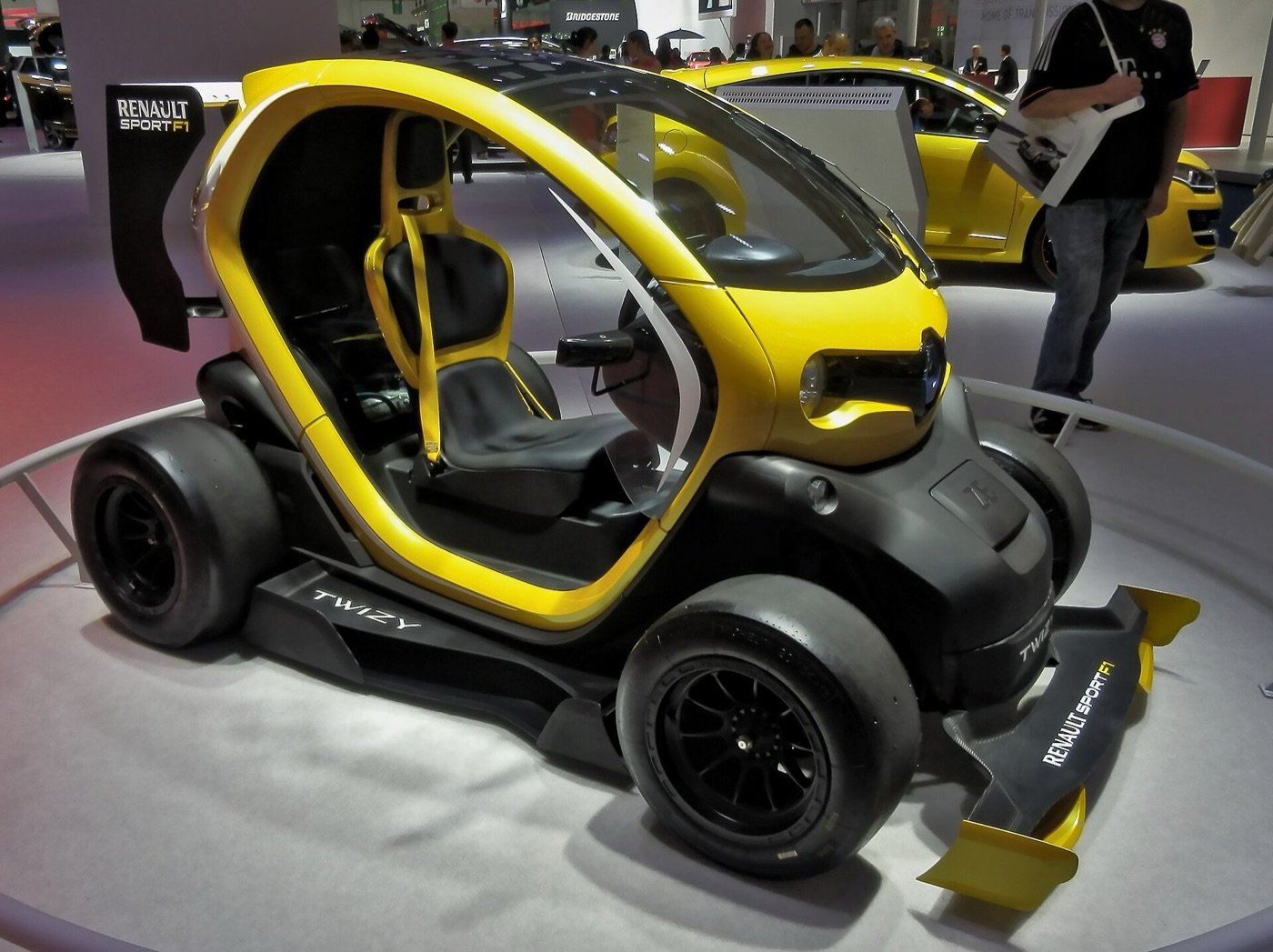
Every so often a car maker builds something for no better reason than that its engineers wanted to find out whether it could be done. In April 2013 Renault did exactly that. It took a Renault Twizy, the tandem two-seat electric runabout it had put on sale the year before, and grafted on the energy recovery hardware from its Formula 1 engines.
The result was the Twizy Renault Sport F1, a one-off concept unveiled at the Valladolid factory in Spain that builds the Twizy. Renault Sport F1, the engine division at Viry-Châtillon, did it together with Renault Sport Technologies, the arm that builds the company’s race cars and its quicker road cars. It was never going to be sold, but it was a working, properly engineered machine rather than a styling buck, and the details hold up.
A KERS from the Grand Prix paddock
Renault was one of the first engine makers to race a kinetic energy recovery system, in 2009, the year the rules allowed it. KERS has three parts: a motor-generator unit (the MGU-K), a dedicated lithium-ion battery and a control unit. Under braking the MGU-K acts as a generator and fills the battery; on demand it runs as a motor and hands the energy back. In a Grand Prix car of the period it was limited to 60 kW, a little over 80 hp, and to roughly six and a half seconds of use per lap.
The Twizy has the same 60 kW unit. The MGU-K is small enough to fit inside a 10 cm cylinder and turns at up to 36,000 rpm, so it drives the Twizy’s own motor through a 3.6:1 reduction gear which, Renault said, shares its drive gear with the RS27 V8 F1 engine. With its battery the whole package weighs about 30 kg. It sits behind the driver, in the space where the Twizy’s passenger normally rides, under a clear cover so that you can see it.
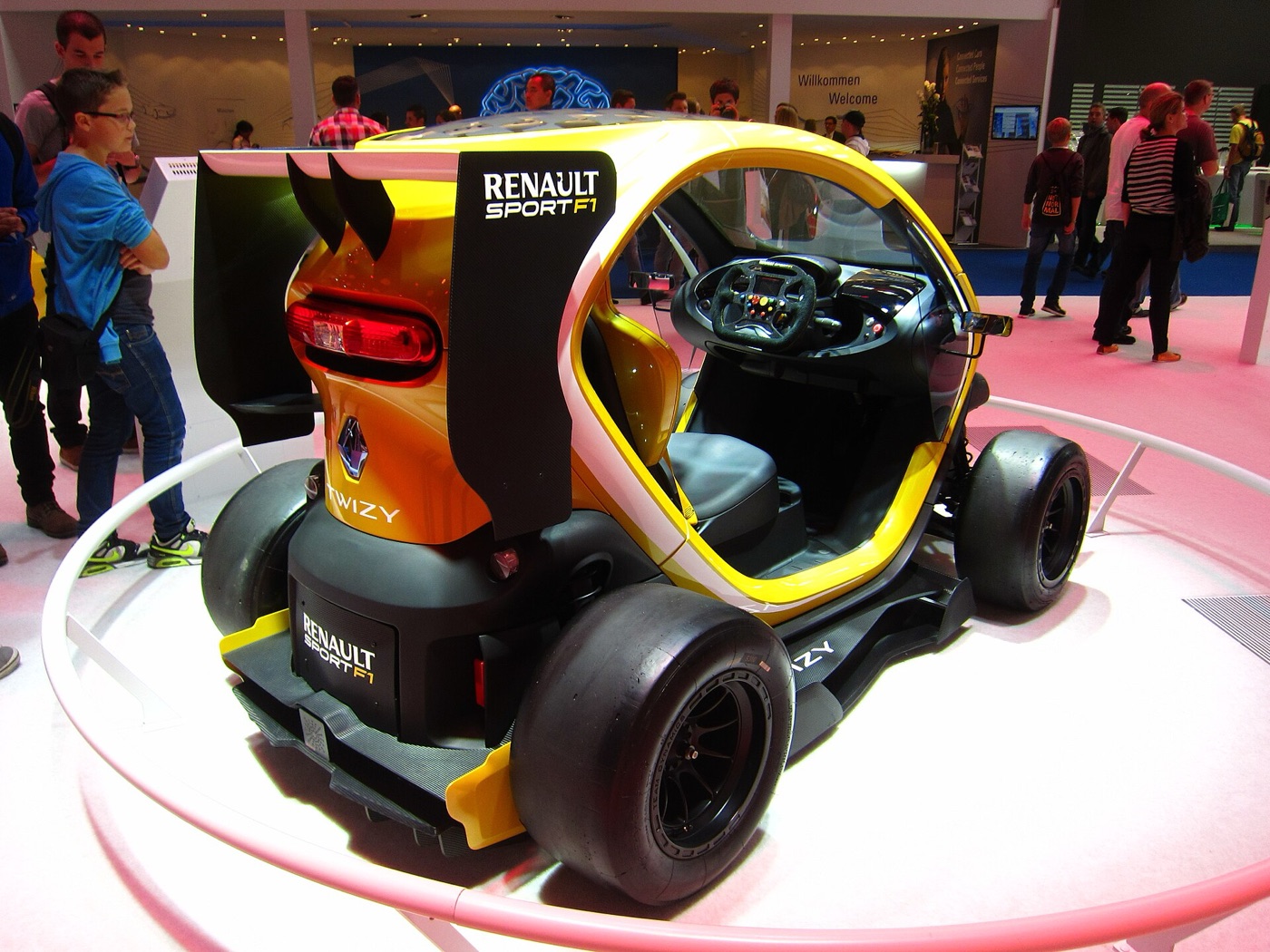
There was one obvious problem. A Twizy is never going fast enough for its brakes to harvest much energy, so the engineers let the KERS charge from the car’s main motor instead. In recovery mode up to 4 kW is drawn off while the car is moving; in boost mode the stored energy goes back to the wheels through the driveshaft. One rotary knob on the steering wheel sets how hard the system recovers, another picks one of six boost levels from 10 kW to 60 kW, and the driver releases it by pulling both paddles at once. A rain light from a Formula Renault 3.5 car, set into the diffuser, comes on to tell onlookers that the boost is in use.
From 17 hp to 97 hp, for a few seconds
A standard Twizy 80 has a 13 kW (17 hp) electric motor and, on Renault’s figures, a top speed of 85 km/h (53 mph). With the KERS deployed the concept makes 72 kW, or 97 hp, for around 14 seconds. The main motor’s rev limit rises from 7,500 rpm to 10,000 rpm, and top speed goes up to 110 km/h (68 mph).
Renault’s headline claim was that the concept would reach 100 km/h (62 mph) from rest as quickly as the Mégane Renault Sport 265. The arithmetic behind it is power to weight: at 564 kg against the standard car’s 473 kg, the concept carries 5.8 kg for each horsepower, close to the Mégane’s 5.2. Treat the comparison with some care, though. Renault’s material gave no time, and 100 km/h is only 10 km/h short of the Twizy’s top speed. It is quick to 60-odd mph, and then it has nowhere left to go.
Dressed for the part
The bodywork spells out the theme: a carbon front splitter, side pods, a large rear wing, single-seater mirrors and a diffuser. It runs on slicks of the kind used on the Formula Renault 2.0 single-seater. The steering wheel is adapted from the Formula Renault 3.5 car with a wider rim, and carries a multi-page display for the charge in both batteries, oil pressure and water temperature. There is also an RS Monitor data logger, like the one in the Mégane R.S. and the Clio R.S. 200, for timing 0–50 and 0–100 km/h runs.
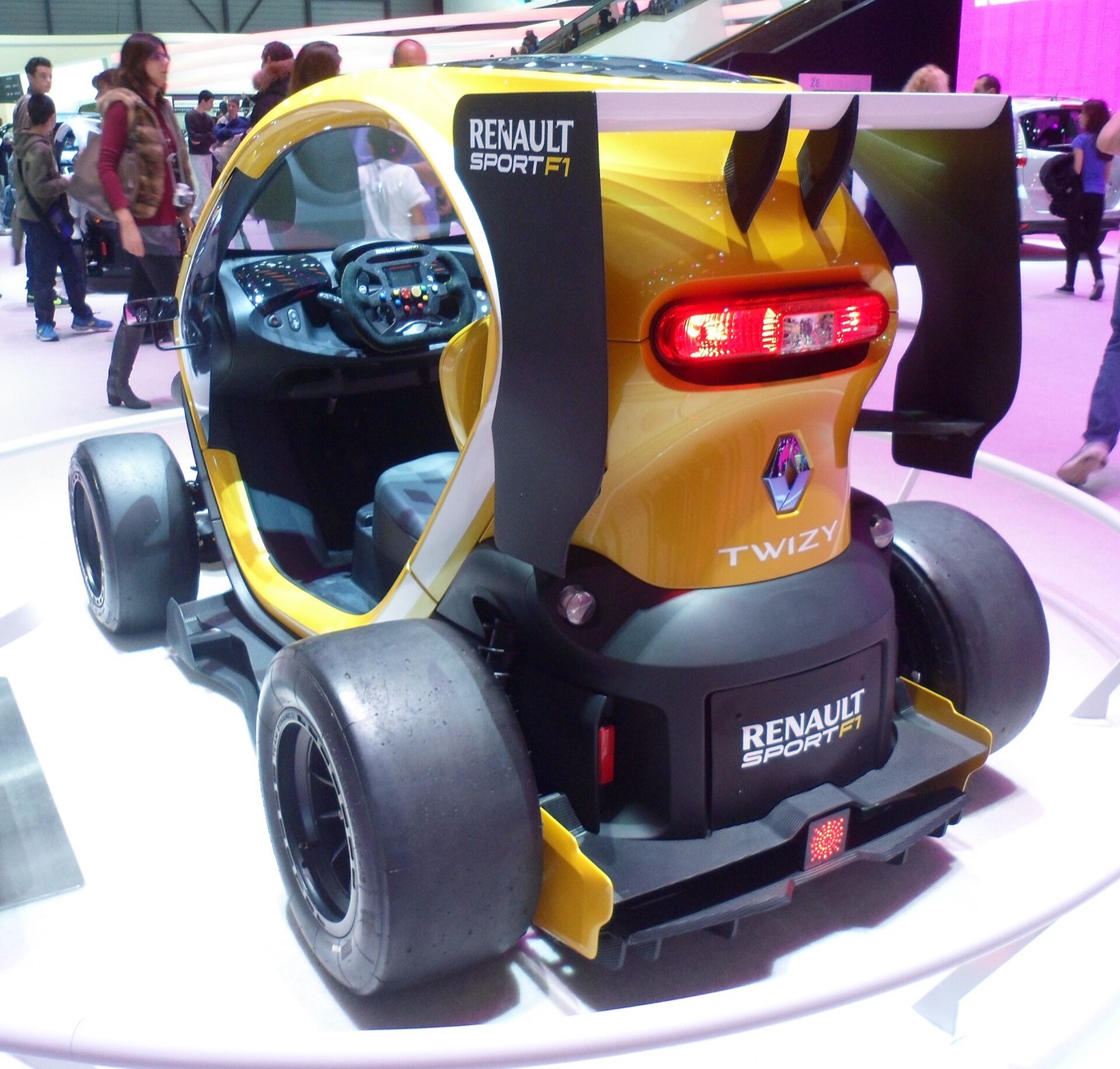
Nobody at Renault pretended this was a production proposal. Jean-Michel Jalinier, then president of Renault Sport F1, described the car as “the evil elder brother” and said he hoped it would “make a few people smile while also making a serious point”. The serious point was that the electrical know-how Renault had built up in Formula 1 could be carried across to its road cars.
An echo of the Espace F1
Renault drew the comparison itself. For the Espace’s tenth birthday it showed the Espace F1 at the 1994 Paris Motor Show, built with Matra: a carbon-fibre body in the shape of the second-generation Espace, on top of the mid-mounted 3.5-litre RS5 V10 and six-speed semi-automatic gearbox from the 1993 Williams-Renault FW15C. It had about 800 hp and four seats.
The two could hardly be further apart, at 800 hp against 97 and a people carrier against a city car, but they make the same point, that Formula 1 hardware can be made to work in something with number plates. The Twizy’s version was the more relevant of the two. Within a year of its unveiling, Formula 1 had moved to 1.6-litre turbo hybrids whose MGU-K was allowed twice as much power, 120 kW.
Where it was shown
After its unveiling at Valladolid, the concept’s first public outing was the World Series by Renault meeting at MotorLand Aragón on 27–28 April 2013, followed by the Barcelona Motor Show in May, where it was billed as a world premiere. It then stayed on the show circuit. The photographs here show it at the Frankfurt Motor Show in September 2013 and at Geneva in March 2014, and it was also photographed at the São Paulo show in November 2014. It remained a one-off.
Sources and picture credits
- Renault press kit, “Twizy Renault Sport F1 concept car: improbable and spectacular!”, April 2013: technical data, KERS operation and the Espace F1 comparison.
- Wikipedia, “Renault Twizy”, “Renault Espace” (Espace F1) and “Kinetic energy recovery system”.
- Contemporary reports by Autoguide and CompleteCar, 25 April 2013.
- Catalan News Agency, preview of the 2013 Barcelona International Motor Show (dates and premieres).
- Lead photo: “Renault Twizy Sport F1 IAA 2013” by Alexander Migl, Wikimedia Commons, licensed CC BY-SA 4.0 (creativecommons.org/licenses/by-sa/4.0).
- “Renault Twizy F1 Concept” by Rutger van der Maar, Wikimedia Commons, licensed CC BY 2.0 (creativecommons.org/licenses/by/2.0).
- “Renault Twizy Sport F1” by Lukasdesign, Wikimedia Commons, licensed CC BY-SA 3.0 (creativecommons.org/licenses/by-sa/3.0).
This article was written in October 2026 to replace SkiddMark’s original report of 25 April 2013, with every figure checked against Renault’s own material.