Spirit of Ecstasy: the Rolls-Royce mascot, its versions and dating
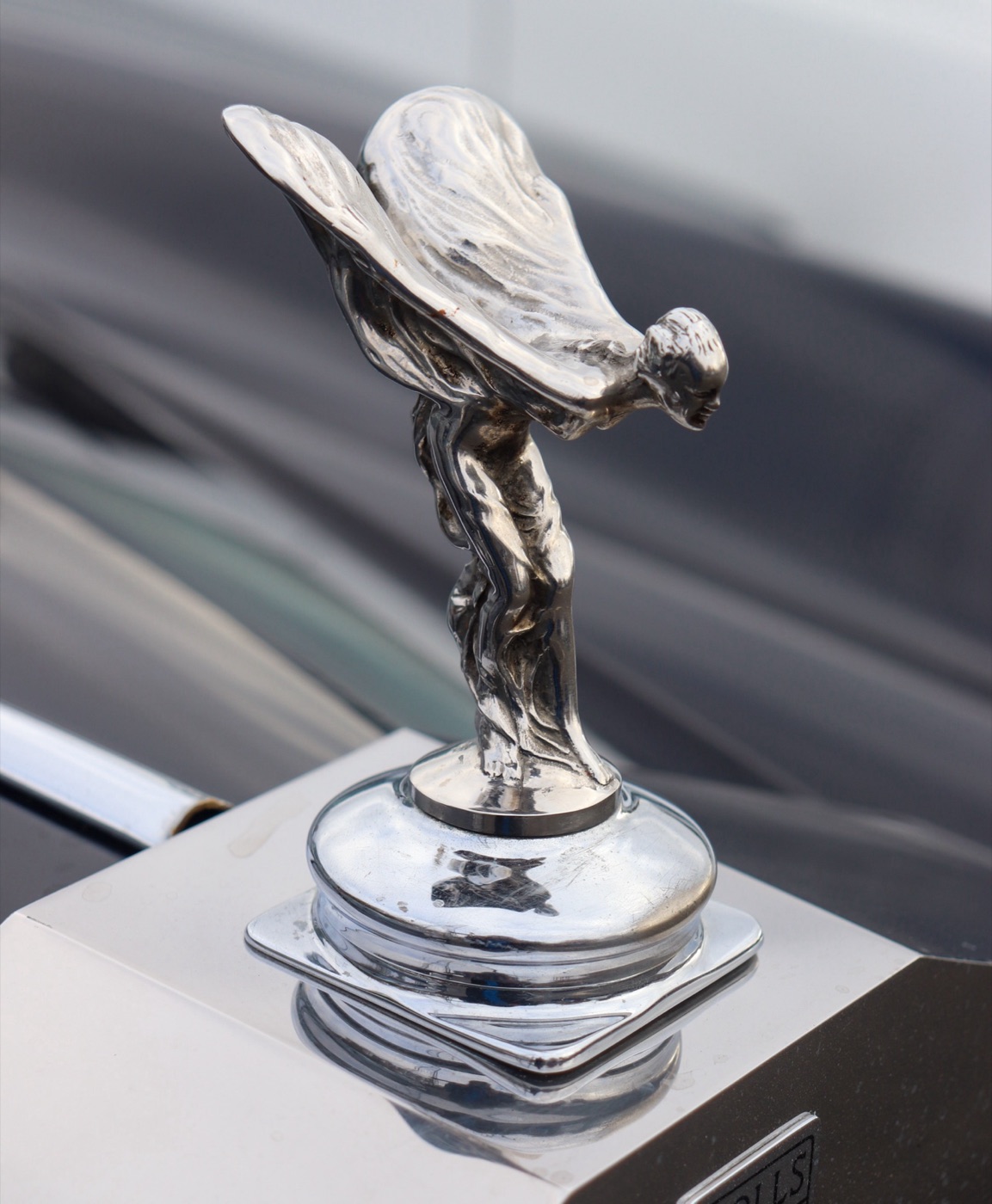
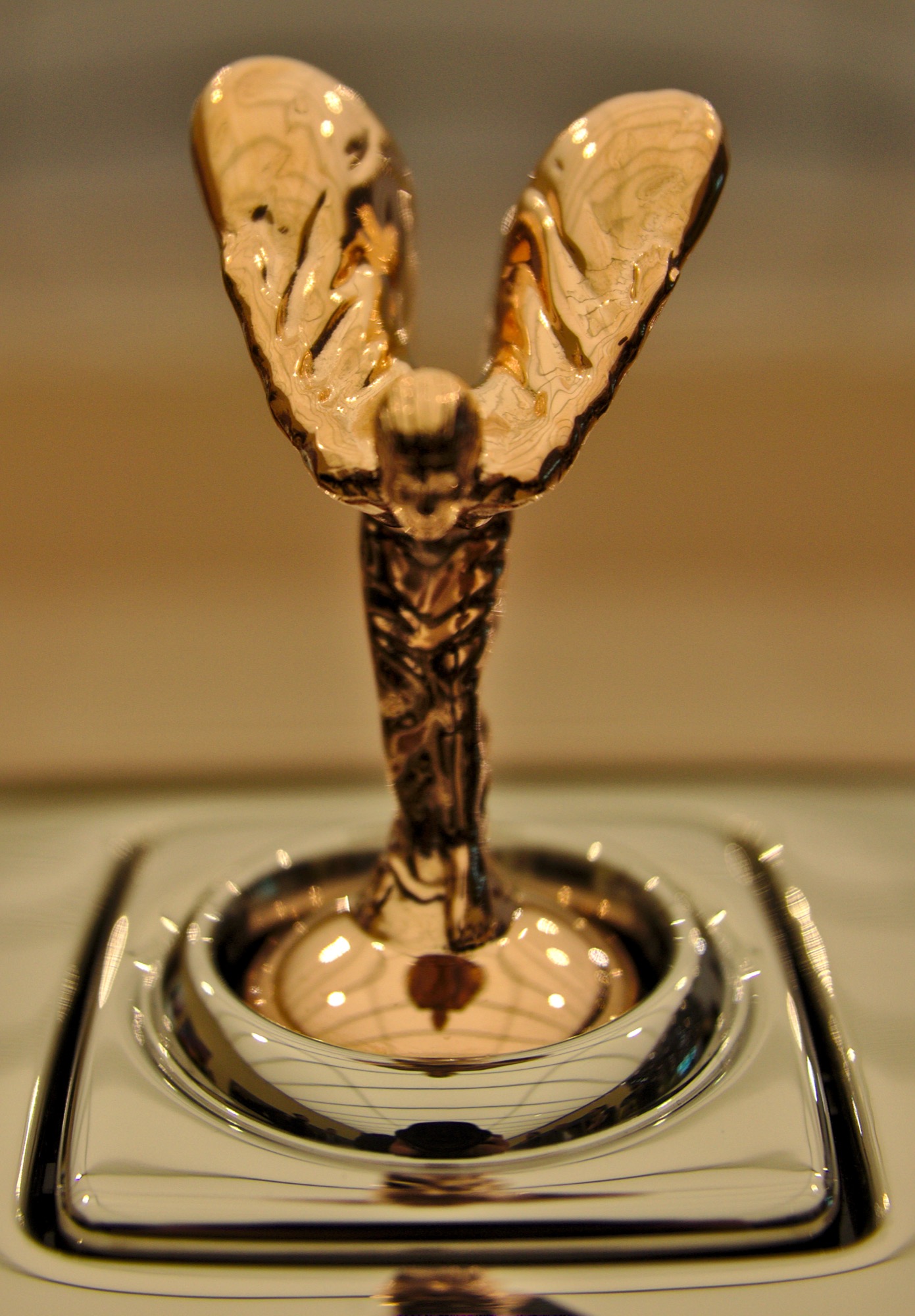
The Spirit of Ecstasy is the bonnet ornament (hood ornament, in American English) on the radiator of Rolls-Royce cars: a small figurine of a woman leaning into the wind with her robes streaming out behind her arms. The British sculptor Charles Sykes made it for Rolls-Royce, and the car maker registered the design on 6 February 1911. Most accounts trace it to The Whisper, an earlier mascot Sykes made for Lord Montagu with Eleanor Thornton as his model; Rolls-Royce's own history says The Whisper as the inspiration is the conventional wisdom, and that the face may be Sykes's mother's.
The Spirit of Ecstasy has been offered on the company's cars since then (as an extra-cost option until 1939), from the Silver Ghost through the Phantom, Silver Cloud and Silver Shadow to the Ghost, Cullinan and electric Spectre built at Goodwood today. The company counts eight versions by the 1960s alone, and the figure has shrunk from 6 7/8in in 1911 to 82.73mm on the Spectre. On a new car it drops into the radiator grille at a touch.
The Whisper: the mascot before the Spirit of Ecstasy
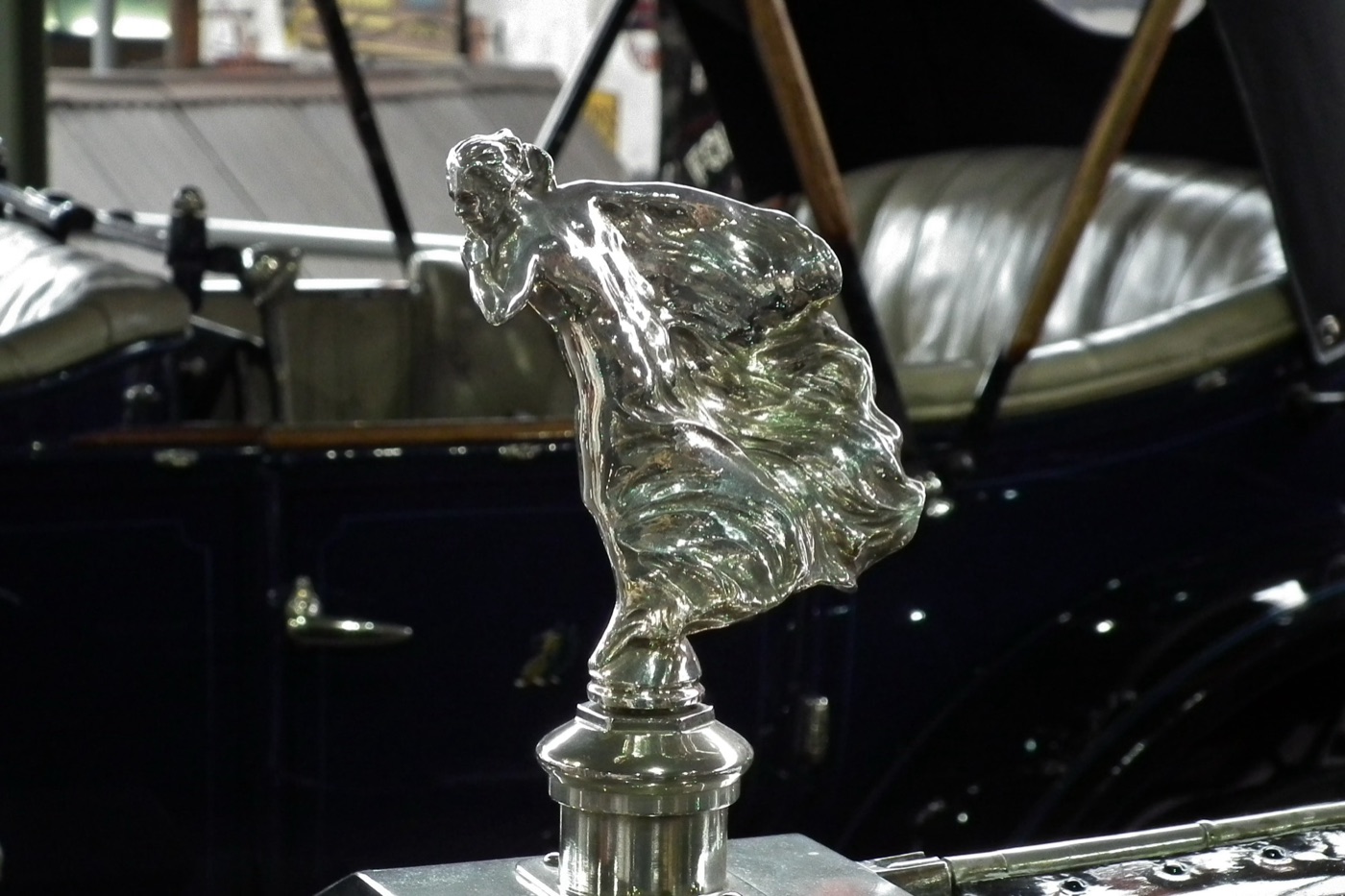
The Whisper is the mascot Charles Sykes made for John Montagu's Rolls-Royce Silver Ghost before the Spirit of Ecstasy existed. In its 2022 account of the mascot's history, "Spirit of Ecstasy: the human drama behind the legend", Rolls-Royce describes it as "a small aluminium statuette of a young woman in fluttering robes with a forefinger to her lips" and says the precise date is unknown. A 2018 JustCollecting report puts the commission in 1909; RM Sotheby's dates it to about 1904.
Montagu (John Walter Edward Douglas-Scott-Montagu, the 2nd Baron Montagu of Beaulieu from 1905) had founded The Car Illustrated in 1902 and employed Sykes there as an illustrator. The company says it has been confirmed that Eleanor Thornton was the model, and that nobody knows whether the mascot was Sykes's gift to his employer or Eleanor's gift to her lover. Montagu fitted it to every Rolls-Royce he owned until his death in 1929.
Where is The Whisper today?
At the National Motor Museum in Beaulieu, Hampshire, the museum built on Montagu's family estate. Its display label, photographed in 2011, shows The Whisper on a 1925 Phantom I owned by the Montagu Collection and says "only three or four castings were ever made, and only two are believed to have survived."
Who was the Spirit of Ecstasy modelled on?
Eleanor Velasco Thornton, Montagu's assistant and his lover for 13 years, is the model most sources name, and Rolls-Royce calls her "the pivotal figure in the Spirit of Ecstasy story". The company also names a second possible model for the face: Sykes's mother.
Eleanor Thornton and Lord Montagu
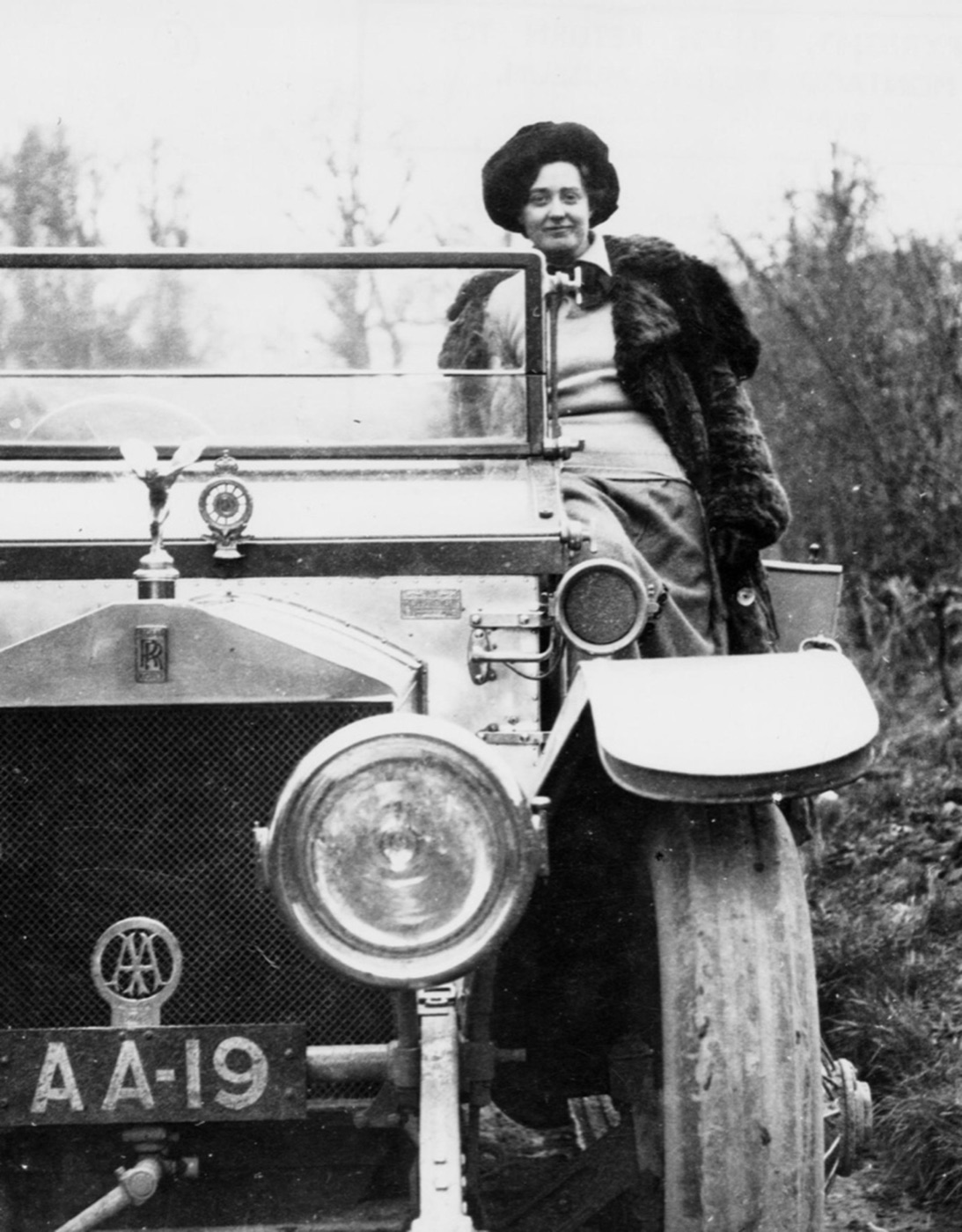
Thornton was born in London on 15 April 1880, according to the National Motor Museum's article on her life. She worked for Claude Johnson at the Automobile Club (later the Royal Automobile Club), where Johnson was general secretary, and in 1902 Montagu hired her to run the office of The Car Illustrated. She was 14 years younger than Montagu and came from a modest family in south London.
Rolls-Royce's 2022 history fills in the rest. Eleanor became pregnant in 1903, and the baby, Joan, was adopted at birth; Montagu paid for her upbringing and visited her as "Uncle John". Eleanor knew Sykes before he joined the magazine: she had taken rooms at The Pheasantry, an artists' house on the King's Road in Chelsea, and posed for him as a life model. In 1903 Sykes sculpted a trophy modelled on her for Montagu to present at the Gordon Bennett race.
The sinking of the SS Persia
Eleanor Thornton died on 30 December 1915, when a German U-boat torpedoed the P&O liner SS Persia off Crete. Montagu was going out to India as the army's head of mechanical transport, and she was to leave the ship at Port Said. Rolls-Royce says the ship sank in less than five minutes; the National Motor Museum puts the dead at over 300.
Montagu survived. The company gives 38 hours adrift in a lifeboat, with a broken shoulder and a damaged lung; the museum says three days, and credits the inflatable Gieve waistcoat he was wearing. He read his own obituaries while recovering in Malta. A tablet he put up afterwards remembers "Eleanor Velasco Thornton, who served him devotedly for fifteen years."
Was it Sykes's mother's face?
The Spirit of Ecstasy's face, Rolls-Royce says, "could be that of another": it is an excellent likeness of Sykes's mother, Hannah Robinson Sykes. The same history calls it "highly probable" that Thornton was the model for the figure's overall form, and notes the theory that Sykes worked from his imagination.
How Rolls-Royce commissioned the Spirit of Ecstasy
Claude Johnson, by then managing director of Rolls-Royce, commissioned the Spirit of Ecstasy to put an end to the mascots owners were fixing to their radiators. Henry Royce, Rolls-Royce says, was irritated by the "black cats, devils and a jovial policeman" on his cars and disliked mascots of any kind; Johnson argued that the company should make its own, and Royce agreed.
The brief and the Nike of Samothrace
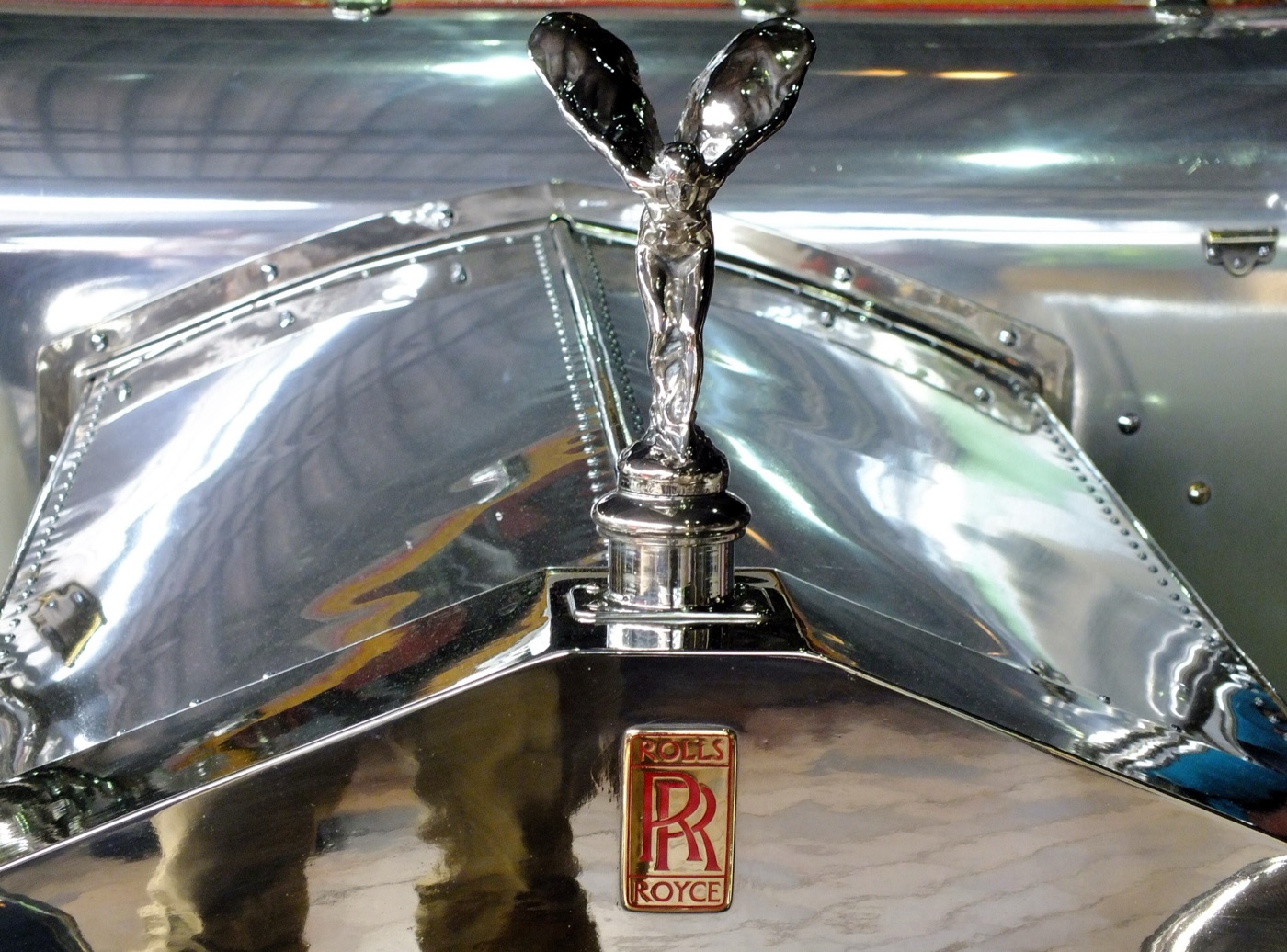
Johnson had seen the Nike of Samothrace, the 2.75m Greek marble of Nike, the winged goddess of victory, in the Louvre. "I want something beautiful, like Nike," he told Sykes. Sykes went to look at the statue and, in Rolls-Royce's account, decided Nike was too martial for a car; having travelled often in Montagu's Silver Ghosts, he drew a lighter figure, "almost certainly" with Thornton again as his muse.
Why is it called the Spirit of Ecstasy?
The name comes from a Rolls-Royce letter to Montagu describing the commission. Quoted in Rolls-Royce's 2022 history, and again in RM Sotheby's 2026 catalogue entry for a large Sykes bronze, the company wanted a mascot to convey "the spirit of the Rolls-Royce, namely, speed with silence, absence of vibration, the mysterious harnessing of great energy, a beautiful living organism of superb grace like a sailing yacht." Sykes, the letter says, had in mind "the Spirit of Ecstasy, who has selected road travel as her supreme delight and alighted on the prow of a Rolls-Royce car to revel in the freshness of the air, and the musical sound of her fluttering draperies." The figure was first called The Spirit of Speed.
When was the Spirit of Ecstasy first used?
In 1911. The Spirit of Ecstasy was registered as Rolls-Royce's property on 6 February 1911, the date it gives in its February 2022 press release on the Spectre mascot. Charles Rolls never saw it: he had been killed in a flying accident in June 1910.
The Spirit of Ecstasy was an extra-cost option until 1939. Rolls-Royce says only about 40% of the 20,000 or so cars delivered by then left with one, though many were fitted later. In 1920 the company entered it in a competition in Paris for the best car mascot; it won, and Sykes received a gold medal.
Who made the Spirit of Ecstasy mascots?
Sykes's own workshop made every Spirit of Ecstasy until 1939, and the car maker has had them made since the war. According to the company, Sykes cast, inscribed and finished every figure himself from 1911; his daughter Josephine took over in 1928 and carried on until war stopped production in 1939, so every mascot of that period differs slightly from the next. RM Sotheby's catalogue for a ten-mascot collection sold at Amelia Island in 2019 says Rolls-Royce made them itself after 1940, and that its mascots are unsigned.
Today Rolls-Royce Motor Cars has each figurine cast by specialists in Southampton by lost-wax casting and finished by hand. Each starts from a 3D computer model mapped from the original, cut into a hard tool with 0.2mm cutters; the wax model taken from it is coated in ceramic, the wax melted out, and stainless steel poured into the mould at 1,600°C. The casting is then peened with stainless-steel balls 0.04mm across, machined and mirror-polished.
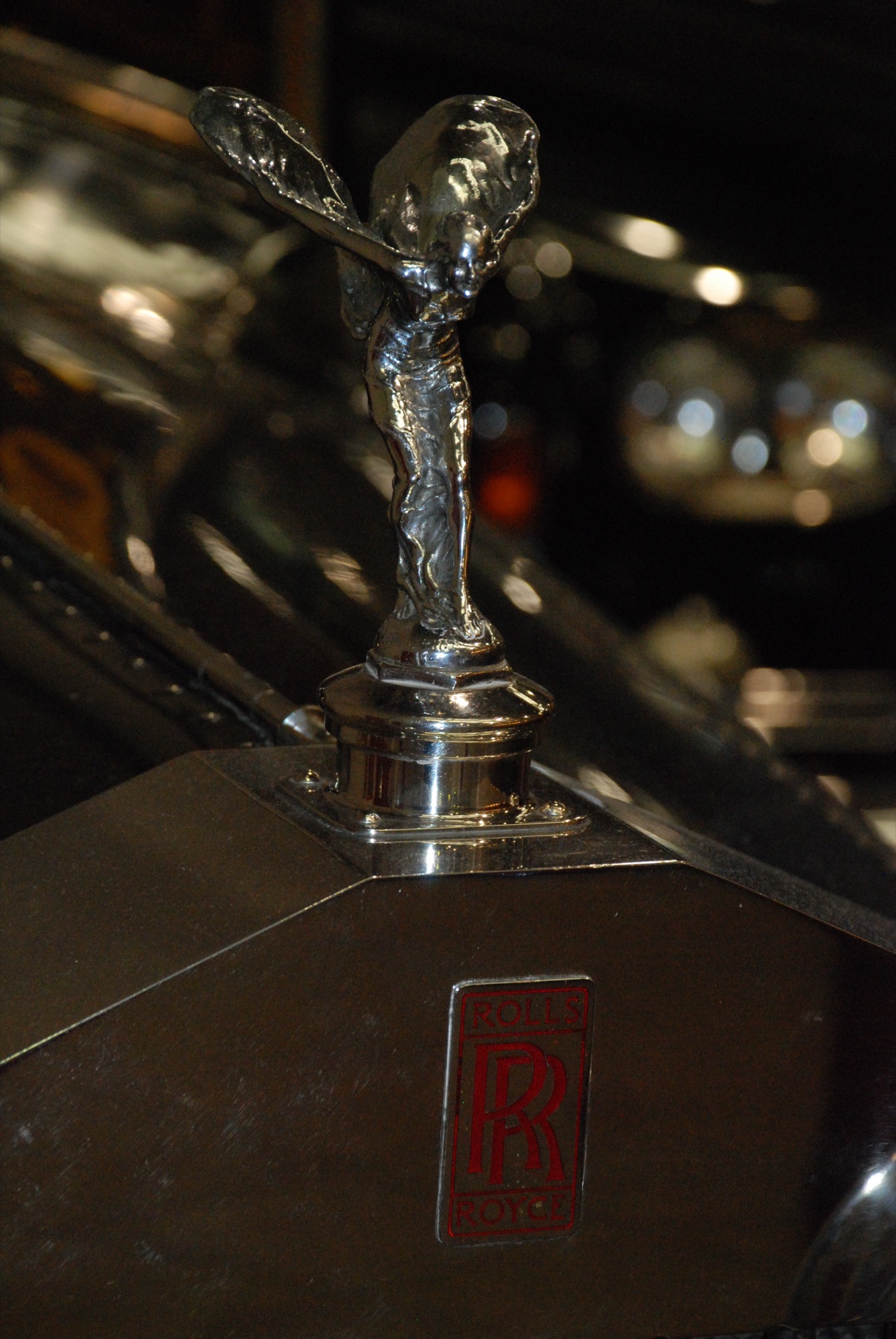
Spirit of Ecstasy versions since 1911
Rolls-Royce says the Spirit of Ecstasy stood 6 7/8in (about 18cm) in 1911 and had passed through eight versions to 4 5/16in (about 11cm) by the 1960s, while the distance from her nose to the tips of her robes fell from five inches to three. The figure the Spectre version replaced was 100.01mm tall; the Spectre's is 82.73mm.
| Version | Made | Cars | Height | Marks and material |
|---|---|---|---|---|
| Silver Ghost, first type | 1911–14 | 40/50hp Silver Ghost | About 17.8cm | "Rolls-Royce Limited February 1911" and "Charles Sykes" on top of the base; silver or nickel plated |
| Silver Ghost, later type | 1918–25 | 40/50hp Silver Ghost | About 14.9cm | "Rolls-Royce Limited Feb 6 1911" |
| Phantom II type | From 1929 | Phantom II | 14.5cm (one sold in 2010) | "C. Sykes, R.R. Ltd. 6.2.11"; "Reg. Us. Pat. Off." under the left wing, "Trade Mark Reg." under the right |
| 20/25hp type | 1929–35 | 20/25hp | 11.5cm (one sold in 2010) | Solid nickel or bronze, silver or chrome plated |
| Kneeling | 1933–55 | Phantom III, Wraith, Silver Wraith, Phantom IV | Not given | "C Sykes" on the base, the earliest with a headband; solid nickel, silver-plated bronze or chrome-plated brass |
| Rolls-Royce made, standing | After 1940 | Post-war cars | About 11cm by the 1960s | Unsigned; wing marks on both wings, later on one; stainless examples unmarked |
| Later export type | From 1971 (RM Sotheby's says post-1965) | Silver Shadow and Corniche era | Not given | "Rolls-Royce Motors Limited" stamped on the base |
| Modern, before the Spectre | To 2022 | Phantom, Ghost, Wraith, Dawn, Cullinan (as listed in 2022) | 100.01mm | Polished stainless steel; retracts |
| Spectre type | 2022 on | Spectre and later new models | 82.73mm | Stainless steel, one leg forward, body lower |
Sources: RM Sotheby's Amelia Island 2019 catalogue (types, dates, marks); Bonhams, 19 June 2010 (Phantom II and 20/25hp heights); Rolls-Royce press releases of 6 February 2022 (1911 and 1960s heights, pre-Spectre and Spectre heights); Grace's Guide (Rolls-Royce Motors Limited, 1971). RM Sotheby's also lists a "Phantom I" type made in various sizes from 1929 to 1936; those dates fall after the Phantom I, so the type is left out of the table.
Silver Ghost to Phantom II
The first figures were the tallest, made for the 40/50hp Silver Ghost. RM Sotheby's measures a 1911–14 example at about 17.8cm and a 1918–25 one at 14.9cm. A circa 1919 nickel mascot sold by Bonhams in 2010 measured about 15cm without its cap and base, signed "Charles Sykes" with "Trade mark Reg." and "Reg pat." under the wings.
The kneeling Spirit of Ecstasy
The kneeling Spirit of Ecstasy is a lower version, inscribed "C Sykes", offered from the 1930s to the 1950s. RM Sotheby's dates it 1933–55; Rolls-Royce says buyers could choose it from 1934 until 1959. It went on the Phantom III, Wraith, Silver Wraith and Phantom IV, and, says Rolls-Royce, some owners thought it suited the coachwork of the period better.
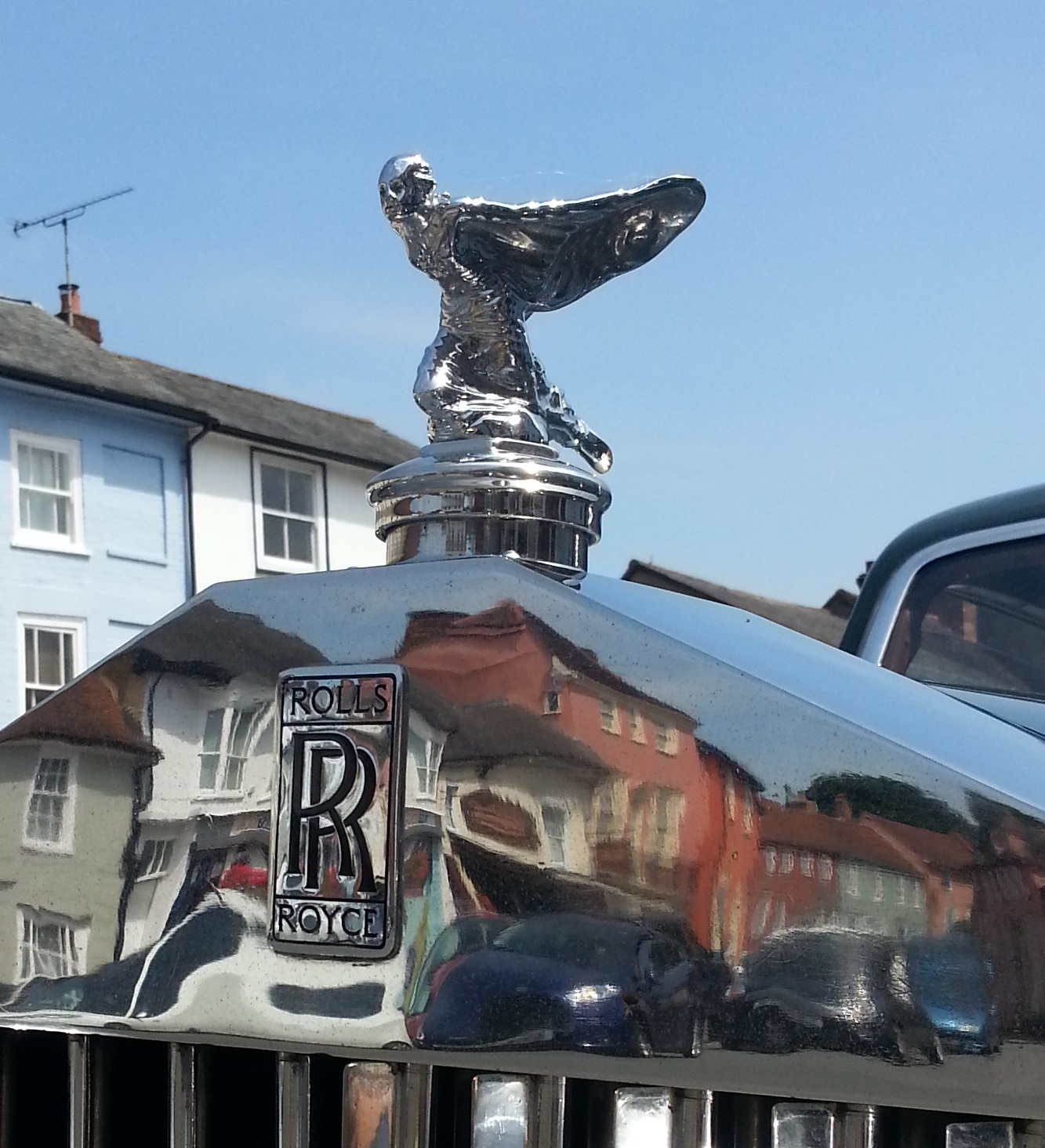
Post-war standing mascots
After the war the standing Spirit of Ecstasy returned, smaller than the Edwardian figure. The Silver Cloud, Silver Shadow and Corniche carried it, unsigned now that the factory made it. RM Sotheby's dates export mascots stamped "Rolls-Royce Motors Limited" to after 1965, but that company was formed only in 1971, when the receiver of the bankrupt Rolls-Royce Limited put the car business into it (Grace's Guide, citing The Times of 23 March 1971), so the stamp dates from 1971 or later. RM Sotheby's also notes that the standing type fits the Silver Shadow and Corniche but not the later cars whose mascot drops into the radiator shell.
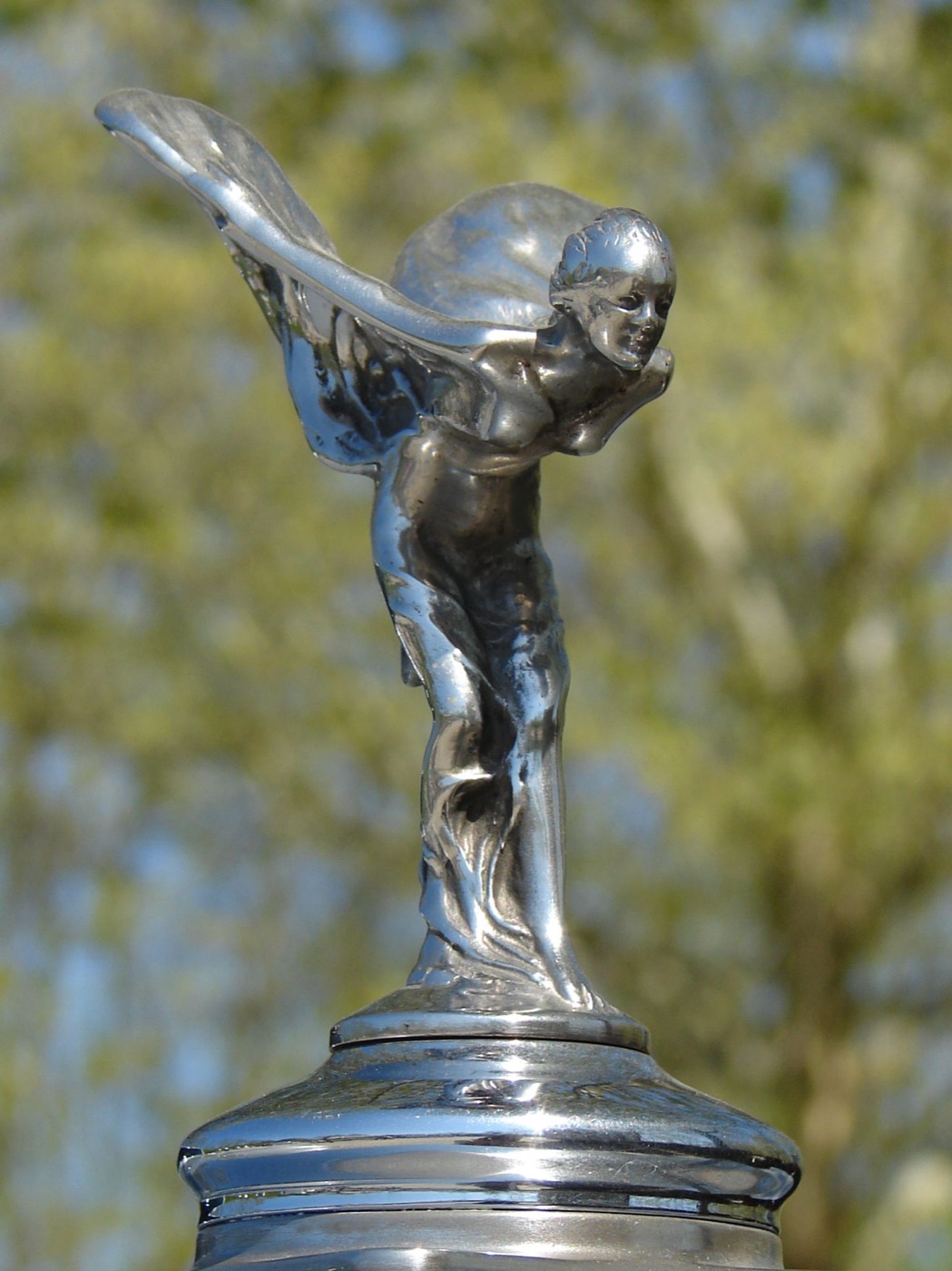
The Spectre redesign
For the Spectre, the marque's first electric car, the Spirit of Ecstasy was redrawn in 2022, 111 years to the day after registration. The stance changed most: she used to stand with her feet together, legs straight and tilting at the waist; now she has one leg forward and her body tucked low. Torsten Müller-Ötvös, the chief executive, called her "the embodiment of our brand, and a constant source of inspiration and pride for the marque and its clients". The robes, "often but erroneously characterised as 'wings'", were reshaped to be more aerodynamic, and the early Spectre prototypes had a drag coefficient of 0.26. A Goodwood computer modeller sculpted her digitally, and the work took 830 hours of design modelling and wind tunnel testing. Rolls-Royce said in 2022 that the new figure would go on all its future models, and that the older one stayed on the rest of the range then in production: the Phantom, Ghost, Wraith, Dawn and Cullinan. The Cullinan Series II, announced on 7 May 2024, added a second Spirit of Ecstasy inside the car: an up-lit figurine of solid stainless steel in a clock cabinet on the passenger side of the dashboard, which Rolls-Royce's release says took four years to develop. In 2020 the company also redrew her as a graphic symbol for its brand, the Spirit of Ecstasy Expression, a ribbon of parallel lines used in its corporate identity.
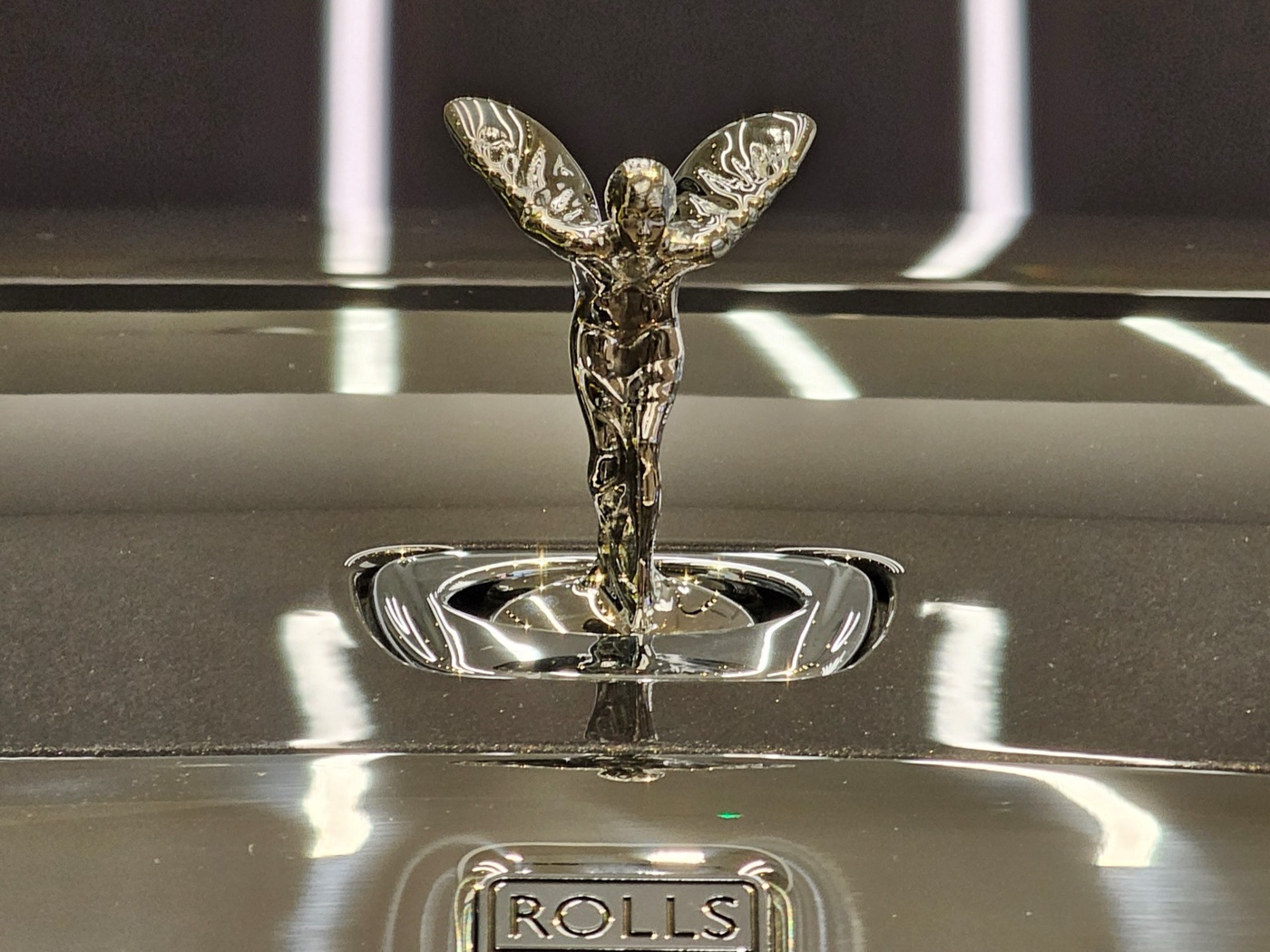
Why does the Spirit of Ecstasy retract?
To protect people and to stop theft. Safety was the first reason: Rolls-Royce says that in the 1970s some countries tried to ban the mascot on safety grounds; Swiss owners were not allowed to display the ornament and found theirs in the glovebox when the car was delivered. The company's answer was a spring-loaded base that lets the figure sink into the radiator shell at a touch. The movement, which the company now calls "the rise", is standard on every car built at Goodwood.
On current cars the Spirit of Ecstasy drops away on its own. CarBuzz reported in January 2013 that it retracts automatically when the car is parked, retracts at once if any force is detected, and can be lowered with a button inside the car.
What is the Spirit of Ecstasy made of?
Polished stainless steel on new cars, cast as described above. The early figures were silver or nickel plated, and RM Sotheby's lists solid nickel, bronze, silver-plated bronze and chrome-plated brass among the inter-war materials. CarBuzz's 2013 report lists silver-plated, gold-plated and solid silver or gold versions as options on the Phantom and Ghost.
The illuminated Spirit of Ecstasy
A lit mascot in frosted polycarbonate first appeared on the 102EX, an electric Phantom prototype, and from January 2013 buyers of a Phantom or Ghost could order it or have it retrofitted, CarBuzz reported. In October 2020 BMWBlog reported that European rules had ended it there. A Rolls-Royce spokesperson told the site: "We shall write to make an offer of a full refund, a replacement silver-plated Spirit of Ecstasy, or another option from our list."
The Spirit of Ecstasy Fabergé egg
In 2018 Rolls-Royce and Fabergé made a single egg around the Spirit of Ecstasy for one buyer, premiered at Goodwood on 23 October, according to Rolls-Royce's announcement. It measures 160mm and weighs 400g; a lever opens rose-gold vanes set with nearly 10 carats of diamonds to show a Spirit of Ecstasy in frosted rock crystal. Fabergé counts it the second egg in its "Imperial Class" since 1917.
How to date a Spirit of Ecstasy mascot
Read the base and the undersides of the robes first, then match the figure to the car. The marks below come from RM Sotheby's 2019 catalogue and Bonhams' 2010 lot descriptions.
Inscriptions on the base
The first Silver Ghost figures (1911–14) read "Rolls-Royce Limited February 1911" with "Charles Sykes" on the top of the base. Later Silver Ghost figures (1918–25) read "Rolls-Royce Limited Feb 6 1911". Phantom II figures read "C. Sykes, R.R. Ltd. 6.2.11", and a 1929 Phantom II mascot Bonhams sold in 2010 was marked "RR Ltd 6-2-11". Kneeling figures carry "C Sykes" on the base. Rolls-Royce's own post-war figures are unsigned, and some are marked "Rolls Royce Motors Ltd." around the base. Toovey's, cataloguing a Phantom II-type mascot in January 2025, notes that most Phantom I mascots read "Rolls-Royce Ltd Feb 6 1911", and that in 1929, with the Phantom II, the shape of the base and its lettering changed to "R.R Ltd 6.2.11" on all mascots. RM Sotheby's notes that early reproductions of the 1911–14 figure are inscribed "FEB" in place of "February".
Marks under the wings
Many figures from about 1919 on have registration marks under the robes: a circa 1919 40/50hp mascot sold by Bonhams reads "Trade mark Reg." and "Reg pat.", and RM Sotheby's Phantom II figure has "Reg. Us. Pat. Off." under the left robe and "Trade Mark Reg." under the right. Early post-war Rolls-Royce figures kept marks under both; later ones have "Reg pat off" under one only, and stainless-steel figures have none.
How much is a Spirit of Ecstasy worth?
Period mascots sold for £299 to £690 at Bonhams in 2010, and one made a £260 hammer price at Toovey's in January 2025; Sykes's signed drawing made £7,875 in 2018. At Bonhams' Rockingham Castle sale on 19 June 2010, a signed nickel 1929 Phantom II mascot made £690 with premium, a signed circa 1919 40/50hp mascot £437, and a signed 11.5cm 20/25hp mascot sold together with a die-cast chromed RAC badge, catalogued as a Phantom I type and corrected in a saleroom notice, £299 (Bonhams described the lot as weathered). In January 2025 Toovey's sold a nickel-plated mascot catalogued as made "after" Charles Sykes, probably for a Phantom II of about 1929, 14cm high and marked "R.R. Ltd 6.2.11", for a hammer price of £260 before its 24.5% premium plus VAT.
| Sale | Item | Result |
|---|---|---|
| Bonhams, Rockingham Castle, June 2010 | 1929 Phantom II mascot, signed, nickel, 14.5cm | £690 |
| Bonhams, Rockingham Castle, June 2010 | 40/50hp mascot, circa 1919, signed | £437 |
| Bonhams, Rockingham Castle, June 2010 | 20/25hp mascot, signed, 11.5cm, with a chromed RAC badge | £299 |
| H&H Classics, online, July 2018 | Sykes's signed drawing of the mascot | £7,875 |
| RM Sotheby's, Amelia Island, 2019 | Ten mascots from 1911 to after 1965, in a radiator shell display | $16,800 |
| Toovey's, Washington (West Sussex), 23 January 2025 | Nickel-plated Phantom II-type mascot "after" Sykes, 14cm | £260 hammer |
| Bonhams, online, May–June 2025 | Large bronze after Sykes, 57.5cm high | £1,088 |
| RM Sotheby's, Miami, 2026 | Bronze sculpture signed by Sykes, 28.5in tall including its marble plinth | $8,400 |
Results include buyer's premium except Toovey's, a hammer price. Sources: the auction houses' lot pages; JustCollecting for the H&H result.
The drawing, from the family of Sykes's gardener, sold for £7,875 on 8 July 2018, JustCollecting reported; a week earlier the same site had put mascots at "up to £500" in a typical sale.
Spirit of Ecstasy anniversaries
The Spirit of Ecstasy's anniversary falls on 6 February, the date of registration. For the centenary in 2011 every Ghost and Phantom built at Goodwood that year carried a figure with "Spirit of Ecstasy Centenary – 2011" etched into its base in the typeface ITC Willow, a SkiddMark report of January 2011 recorded. Torsten Müller-Ötvös said in Rolls-Royce's announcement that the emblem was "perhaps the most famous automotive icon".
On 6 February 2011, 100 Rolls-Royce cars drove from Belgravia to Syon House in west London, past Hill Street in Mayfair where Charles Rolls was born and the Brompton Road site of the studio where Sykes is said to have made the figure, according to Rolls-Royce's release on the drive. Rolls-Royce supplied 15 new Phantoms and Ghosts; members of the Rolls-Royce Enthusiasts' Club drove the other 85, from Silver Ghosts to Silver Spurs. The Spectre figure was announced on the 111th anniversary in 2022, and in its release for the 112th, on 6 February 2023, Rolls-Royce said she now more closely resembles Sykes's drawings of 1911.
Questions
Who designed the Spirit of Ecstasy?
Charles Sykes (1875–1950), a British sculptor and illustrator trained at the Royal College of Art, who worked for Lord Montagu's magazine The Car Illustrated. He presented it to Rolls-Royce in 1911 and cast the figures himself until 1928.
Does the Spirit of Ecstasy have wings?
No. What look like wings are her robes streaming behind her arms; Rolls-Royce's 2022 release calls them "often but erroneously characterised as 'wings'".
Why is the Spirit of Ecstasy called the Flying Lady?
It is a nickname for the figure, whose robes spread out like wings; the National Motor Museum notes that she is sometimes called The Flying Lady. Rolls-Royce's own first name for it was The Spirit of Speed.
How tall is the Spirit of Ecstasy?
The version made for the Spectre in 2022 is 82.73mm tall; the one it replaced is 100.01mm. The 1911 original stood 6 7/8in, about 18cm.
Did Henry Royce like the Spirit of Ecstasy?
No. Rolls-Royce says Royce disliked mascots of any kind and agreed to an official one only to replace the novelty mascots owners were fitting. Charles Rolls never saw it: he died in June 1910.
Is the Spirit of Ecstasy solid silver?
Not as standard. New cars have a polished stainless-steel figure; the earliest were silver or nickel plated. Silver-plated, gold-plated and solid silver or gold figures have been offered as options.
Sources
- Rolls-Royce Motor Cars, "Spirit of Ecstasy: the human drama behind the legend", press release, 6 February 2022: The Whisper and the conventional wisdom about it, Thornton, the 1911 letter, the 2020 Expression, Johnson and the commission, Sykes's workshop, heights, the kneeling option, retraction, modern casting, the SS Persia.
- Rolls-Royce Motor Cars, "Spirit of Ecstasy redesigned for most aerodynamic Rolls-Royce ever", press release, 6 February 2022: registration date, the Spectre figure and its height.
- Rolls-Royce Motor Cars, "Rolls-Royce celebrates 112 years of the Spirit of Ecstasy", press release, 6 February 2023: the 2022 figure and Sykes's drawings.
- Rolls-Royce Motor Cars, "Rolls-Royce debuts 'Spirit of Ecstasy' Fabergé egg", press release, 23 October 2018: the egg.
- Rolls-Royce Motor Cars via PR Newswire, "London hosts Spirit of Ecstasy centenary drive", 7 February 2011: the centenary drive.
- National Motor Museum, Beaulieu, "Women in Motorsport & Social History: Eleanor Thornton", by Sarah Crofts: Thornton's life, the SS Persia, the memorial tablet. The museum's display label for The Whisper, photographed by sv1ambo on 7 June 2011 (Wikimedia Commons): castings and survivors.
- RM Sotheby's, "Rolls-Royce Spirit of Ecstasy mascot collection", Amelia Island, 2019, lot 203: versions, dates, marks, materials and result.
- RM Sotheby's, "Rolls-Royce 'Spirit of Ecstasy' by Charles Sykes", Miami, 2026: the 1911 letter (second source), The Whisper's date, result.
- Bonhams, Rolls-Royce, Bentley Motor Cars and Automobilia, Rockingham Castle, 19 June 2010: lots 273, 278 and 249: marks, heights, results.
- Bonhams, "After Charles Sykes (1875–1950), a large bronze model of the Spirit of Ecstasy", online sale, 20 May to 3 June 2025: result and Sykes's dates.
- Grace's Guide to British Industrial History, "Rolls-Royce Motors", citing The Times of 23 March 1971 and 4 May 1973: the company's formation in 1971 and flotation in 1973.
- Rolls-Royce Motor Cars, Cullinan Series II press release, 7 May 2024: the Spirit of Ecstasy clock cabinet.
- Toovey's, Automobilia & Aeronautica, 23 January 2025, lot 2501: the 1929 change of base and lettering, result.
- JustCollecting, "Spirit of Ecstasy drawing sells for $10,500", 9 July 2018, and its preview, 2 July 2018: the H&H drawing, The Whisper's date, typical mascot prices.
- CarBuzz, "Rolls-Royce offers illuminated Spirit of Ecstasy", 7 January 2013: materials, the lit mascot, automatic retraction.
- BMWBlog, "European Union bans Rolls-Royce illuminated Spirit of Ecstasy", 12 October 2020: the end of the lit mascot in Europe.
- SkiddMark, "Inspired by the Spirit of Ecstasy", January 2011: the centenary inscription.
