Zenos E10: the Norfolk sports car, its makers and its return
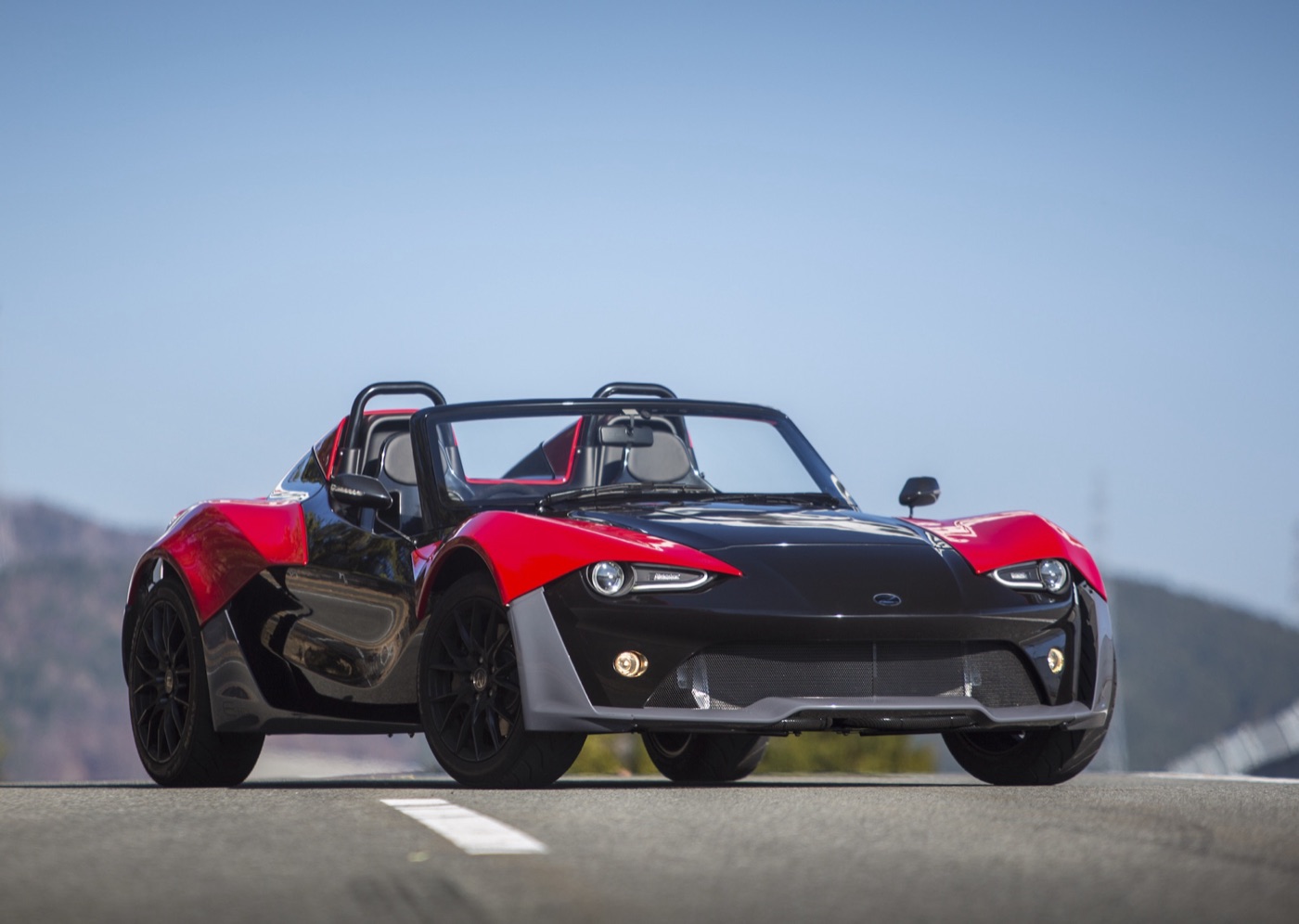
The Zenos E10 is a mid-engined, two-seat British sports car built around a single aluminium spine and a tub of recycled carbon fibre, made by Zenos Cars of Wymondham, Norfolk, from January 2015 until the company went into administration in January 2017. Its makers, the former Caterham bosses Ansar Ali and Mark Edwards, priced it from £24,995 and sold just over 100 in three versions: the 200bhp E10, the turbocharged E10 S and the 350bhp E10 R. AC Cars bought the business in 2017, and in October 2026 the revived Zenos showed a re-engineered E10 rZ and E10 r2, from £115,900, with deliveries due from the second quarter of 2027.
Zenos Cars: who built the E10
Zenos Cars was a small Norfolk company set up in 2012 by Ansar Ali and Mark Edwards, who had worked together at Lotus and then ran Caterham Cars. Ali was Caterham’s chief executive from 2005 to 2012 and Edwards its chief operating officer; both left in 2012, after Tony Fernandes’s group had bought Caterham and taken its name into Formula One, as Steve Sutcliffe’s Autocar report of 7 October 2014 tells it.
The founders and the team
Ali and Edwards met at Lotus in about 2001, according to a SkiddMark profile of the company published in January 2014. A third Caterham engineer, Chris Weston, joined them; evo’s first drive of the E10 S in March 2015 names all three as founders. Speaking to SkiddMark in the summer of 2013, Edwards said he and Ali had paid for the start-up with their own money. Autocar reported in October 2015 that the company was funded by a group of venture capitalists and counted the actor Hugh Grant among its investors.
The company was registered at Companies House on 22 May 2012 as Niche Vehicle Services Limited and took the name Zenos Cars Limited on 12 June 2014, its Companies House record shows. The Eastern Daily Press of 24 March 2017 records that it began at the Hethel Engineering Centre, next to the Lotus factory, and moved to Wymondham Business Park.
Where the Zenos and E10 names come from
Ali told Autocar in 2014 that the name joins “Zen”, a state of enlightenment, with “Os”, which he loosely translated as spine, after the car’s aluminium backbone. After a factory visit in November 2015, MotorPunk reported that the E in E10 stands for Edwards, and that the car was the tenth design he had worked on (an earlier E was the Lotus Exige).
Funding and the Norfolk factory
Development money came from the Niche Vehicle Network, backed by the Department for Business, Innovation and Skills. SkiddMark reported that the grant was presented at a ceremony at Millbrook on 5 September 2013. In July 2014 Zenos won a further £240,000 from the New Anglia Local Enterprise Partnership towards a £1.2m project that was to create 24 engineering jobs at Wymondham, BBC News reported on 30 July 2014. “The E10 is the culmination of two years of hard work,” Ali told the BBC. In May 2016 the company opened a £750,000 crowdfunding round on Seedrs to pay for its next models (Business Matters, 12 May 2016).
Zenos E10 history: from sketch to production
The E10 went from first sketches in September 2013 to a show car in January 2014 and customer cars in early 2015, and Zenos built cars until the end of 2016.
The 2013 announcement
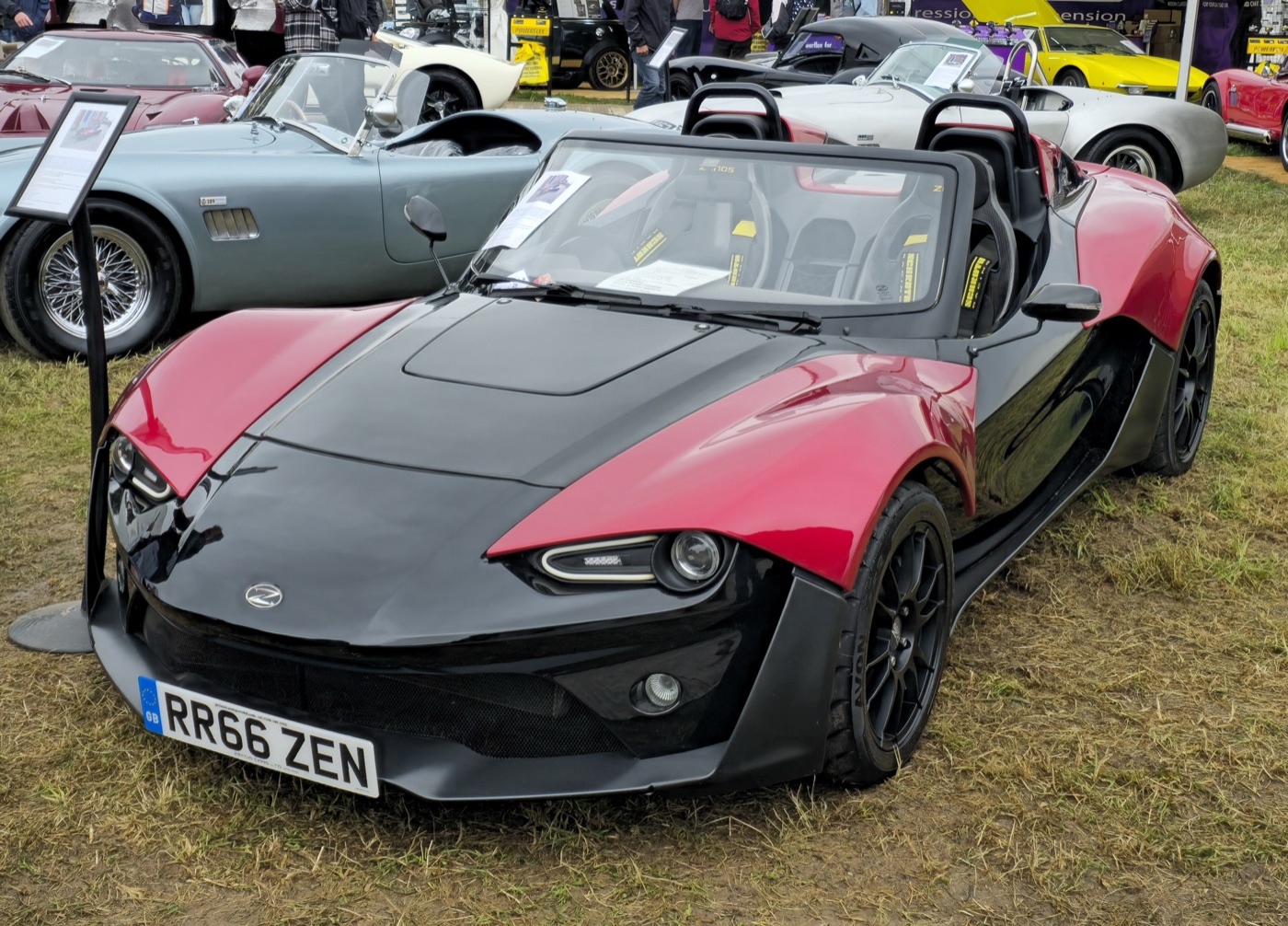
Zenos showed its first design sketches in September 2013. Autocar’s report of 19 September 2013 described a Lotus Elise-sized car with a 197bhp 2.0-litre Ford engine in the middle, a five-speed gearbox and a target weight of 650kg, and quoted Ali calling it a “road-legal, but track-focused, step-in two-seater”. The plan already had two more models: the E11, an open car due in 2016, and the E12 coupé for 2018.
Zenos fixed the entry price first and engineered the car to meet it, costing every part before taking an order; PistonHeads described the method in September 2013, before the price itself was public.
Launch at Autosport International in January 2014
The E10 was shown at the Autosport International show at the NEC in Birmingham in January 2014, where Zenos announced the £24,995 price. SkiddMark reported on 9 January 2014 that orders would be taken for 75 Launch Edition cars at £28,995, with production to start in the autumn of 2014 and the first deliveries in early 2015, and on 26 March 2014 that more than a dozen orders were taken over the show weekend. Buyers with deposits drove the test cars before production, a practice Autocar’s Steve Sutcliffe said in October 2014 he had not seen in 20-odd years of writing about cars.
Production from 2015 to 2016
Production of the E10 and E10 S began at Wymondham in January 2015, according to Business Matters, and Autocar reported in October 2015 that all 80 cars planned that year had buyers. The E10 R followed in January 2016.
How many Zenos E10s were made?
Just over 100 Zenos E10s were sold by the original company, the figure Autocar gave in September 2025. Zenos marked its 100th sale in September 2016 with an E10 R bought by two existing owners and fitted with a commemorative plaque, 18 months after selling its first, PistonHeads reported on 23 September 2016; at that point every 2016 build slot was taken. When AC Cars bought the business in March 2017 it took over a stock of 10 new cars as well, according to Autocar of 24 March 2017. No breakdown by version has been published.
| Date | Event |
|---|---|
| 22 May 2012 | Company registered as Niche Vehicle Services Ltd (renamed Zenos Cars Ltd in June 2014) |
| September 2013 | Zenos announced; E10 design sketches published |
| January 2014 | E10 shown at Autosport International, priced from £24,995 |
| March 2014 | Zenos Cars USA set up; US prices from $39,500 |
| October 2014 | First pre-production car driven by the press |
| January 2015 | Production of the E10 and E10 S begins in Wymondham |
| January 2016 | E10 R launched at the Performance Car Show |
| September 2016 | 100th car sold, an E10 R |
| 16 January 2017 | Zenos Cars enters administration |
| 24 March 2017 | Assets bought by a consortium led by AC Cars |
| 24 September 2025 | Zenos revival announced with an E10 RZ prototype |
| 14 October 2026 | E10 rZ and E10 r2 shown in production form, from £115,900 |
Zenos E10 design and engineering
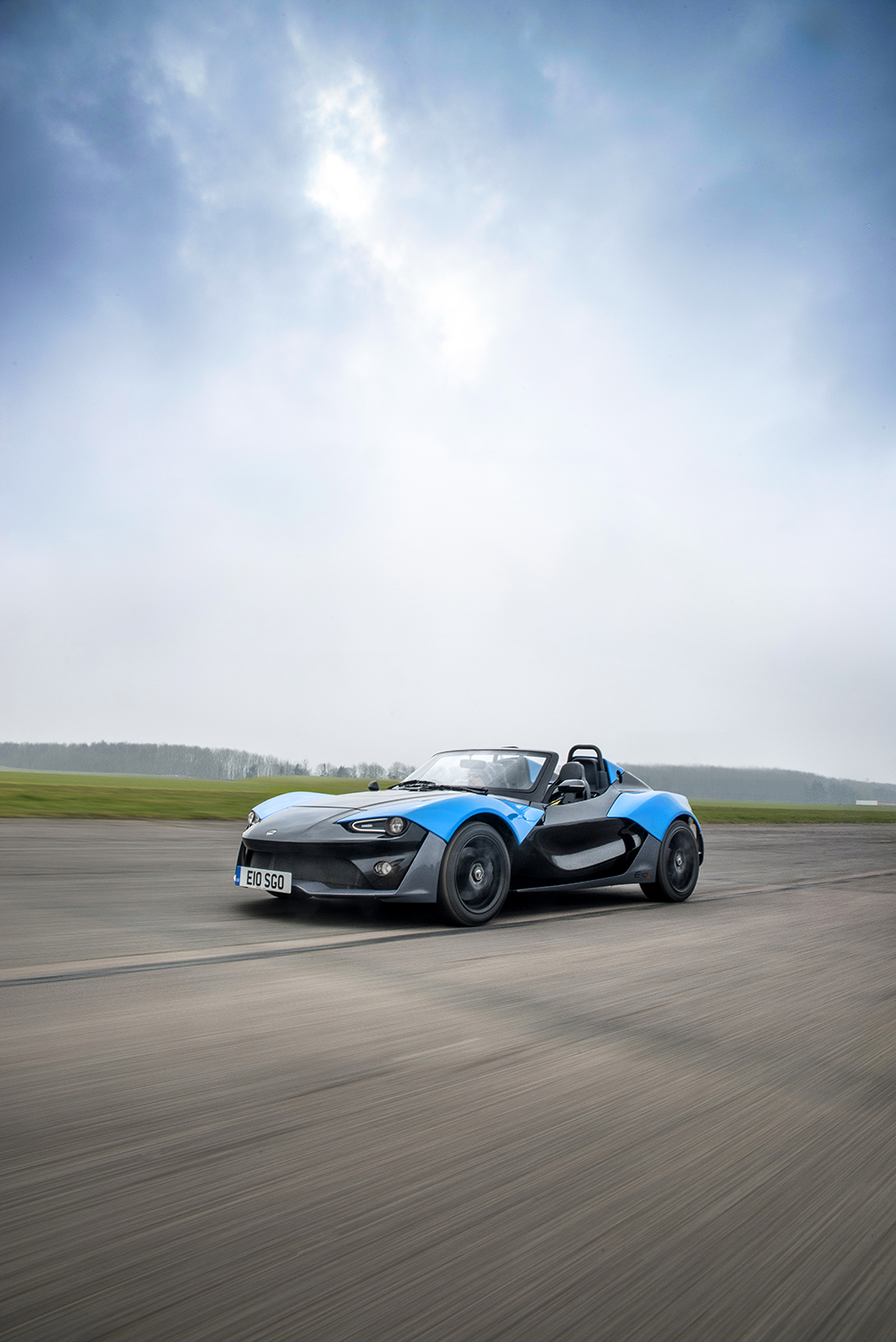
The E10 is built on a single extruded aluminium beam that runs the length of the car, with a passenger tub of recycled carbon fibre bonded over it and a removable rear subframe carrying the engine and gearbox.
The aluminium spine and recycled carbon tub
PistonHeads reported in 2013 that the spine was the longest single aluminium extrusion used in a car, and that it cost about £200; a bent spine would cost about a third as much to replace as the bonded aluminium tub of a Lotus Elise. The tub saddles the spine. Its skins are recycled carbon fibre around a thermoset honeycomb core, a material developed by the former Bentley engineer Anthony Dodworth, which Zenos said kept 70 per cent of the strength of new carbon fibre at much lower cost, The Engineer reported in August 2014. Top Gear named the supplier as Bright Lite Structures, near Peterborough. The Engineer gave the whole structure, roll hoops included, as 155kg with a torsional stiffness of 10,000Nm per degree; Autocar’s road test of October 2015 quoted Zenos’s figure of 12,000Nm per degree and 75 per cent of the rigidity of a pure carbon tub.
A SkiddMark report of 26 March 2014 gave Zenos’s description of a steel safety cell, with twin roll hoops and side-impact bars, built into the carbon tub, and an engine subframe that unbolts to make assembly and repairs easier.
Suspension, brakes and body panels
The E10 has double wishbones at each corner, developed with Multimatic, and the front Bilstein dampers sit inboard, worked by pushrods. Ali told evo in June 2014 that this was “not because we want to replicate being an F1 car, but because they are out of harm’s way, so if you do damage a front corner, you hope you won’t be replacing a damper”. The outer bodywork is 18 glassfibre panels, and the tub is made in five parts, so a damaged section can be replaced on its own, Autocar’s road test reported. Neither the steering nor the brakes are power-assisted, and the car has no ABS or traction control.
The Ford engine and manual gearbox came through the powertrain supplier Hendy Power, along with Ford components for the driveshafts, hubs and bearings, and the styling was done by the consultancy Drive, in Ripley, Surrey, according to Autocar.
The cabin
There are no doors: you step over the side of the tub. Zenos said in March 2014 that the cockpit fitted drivers from 5ft 1in to 6ft 3in tall (1.55m to 1.91m), SkiddMark reported on 26 March 2014. A screen behind the steering wheel shows the driver’s instruments, and a larger one in the middle of the dashboard shows road or track data that the passenger can see too. There is no heater; heated seats were part of an option pack, and the optional £1,695 windscreen has a heated element and wipers, Autocar found. A “get home” hood was an extra.
Zenos E10 specs and performance
The original E10 used a 2.0-litre Ford four-cylinder engine of 200bhp, the E10 S a turbocharged 2.0-litre Ford EcoBoost of 250bhp and the E10 R a 2.3-litre EcoBoost of 350bhp, all mounted transversely behind the seats and driving the rear wheels.
| Version | Engine | Power | Torque | Weight | 0–60 mph | Top speed | Price new |
|---|---|---|---|---|---|---|---|
| E10 (2015–16) | 1,999cc Ford four, naturally aspirated | 200bhp at 6,800rpm | 210Nm at 6,100rpm | 690kg kerb | 4.5sec | 135mph | £24,995 (2014); £26,995 (2016) |
| E10 S (2015–16) | 1,999cc Ford EcoBoost, turbo | 250bhp at 7,000rpm | 400Nm at 2,500rpm | 725kg dry | 4.0sec | 145mph | £29,995 (2015); £32,995 (2016) |
| E10 R (2016) | 2.3-litre Ford EcoBoost, turbo | 350bhp | 350lb ft (475Nm) | 700kg dry | 3.0sec (0–62) | 155mph | £39,995 |
| E10 rZ (from 2027) | 1,969cc Volvo four, turbo | 380bhp at 6,000rpm | 510Nm at 3,000–4,500rpm | 790kg kerb | 3.2sec (0–62) | 150mph | £129,900 |
| E10 r2 (from 2027) | 2,261cc Ford four, turbo | 300bhp at 6,000rpm | 425Nm at 3,500rpm | 790kg kerb | 3.8sec (0–62) | 150mph | £115,900 |
Weights were quoted differently over the years: Zenos’s 2013 target was 650kg, Autocar’s 2014 data gave 690kg kerb for the E10, Zenos’s 2016 website 700kg, and the E10 S Autocar road-tested in 2015, a pre-production car with fuel on board, weighed about 900kg.
Gearboxes were a five-speed manual as standard on the E10 and E10 S with a six-speed manual as an option (£1,495 on the E10 S in 2015), and a six-speed manual on the E10 R. A limited-slip differential was optional; Zenos told evo it considered the standard open differential adequate even on the E10 R.
E10, E10 S and E10 R: the versions
Zenos sold three versions of the E10 on one chassis, each with more power than the last, plus a run of Launch Edition cars and an engine upgrade kit.
E10 and the Launch Edition
The entry car had the naturally aspirated 2.0-litre Ford engine, five-speed gearbox and an open differential. SkiddMark reported in January 2014 that Zenos would offer 75 Launch Editions at £28,995 with the six-speed gearbox, limited-slip differential, quick-release steering wheel, Zenos composite seats, a four-point harness, OZ wheels on Avon ZZR tyres, footwell heating and red wings. By June 2014 most had been sold, evo said.
E10 S
The E10 S added a turbocharged 2.0-litre EcoBoost of 250bhp and became the best seller. evo’s test car in 2015 cost £35,535 with £5,500 of options, among them the windscreen, six-speed gearbox (£1,495) and uprated Alcon brakes (£1,195). Autocar reported on 7 September 2016 that Zenos had launched a £1,995 kit for new or used E10 S cars, with a new air intake, modified intercooler and an ECU remap from the engine-control supplier SCS, that raised power to 280bhp at 6,500rpm and torque to 310lb ft. Zenos recommended 97 RON fuel once it was fitted.
E10 R
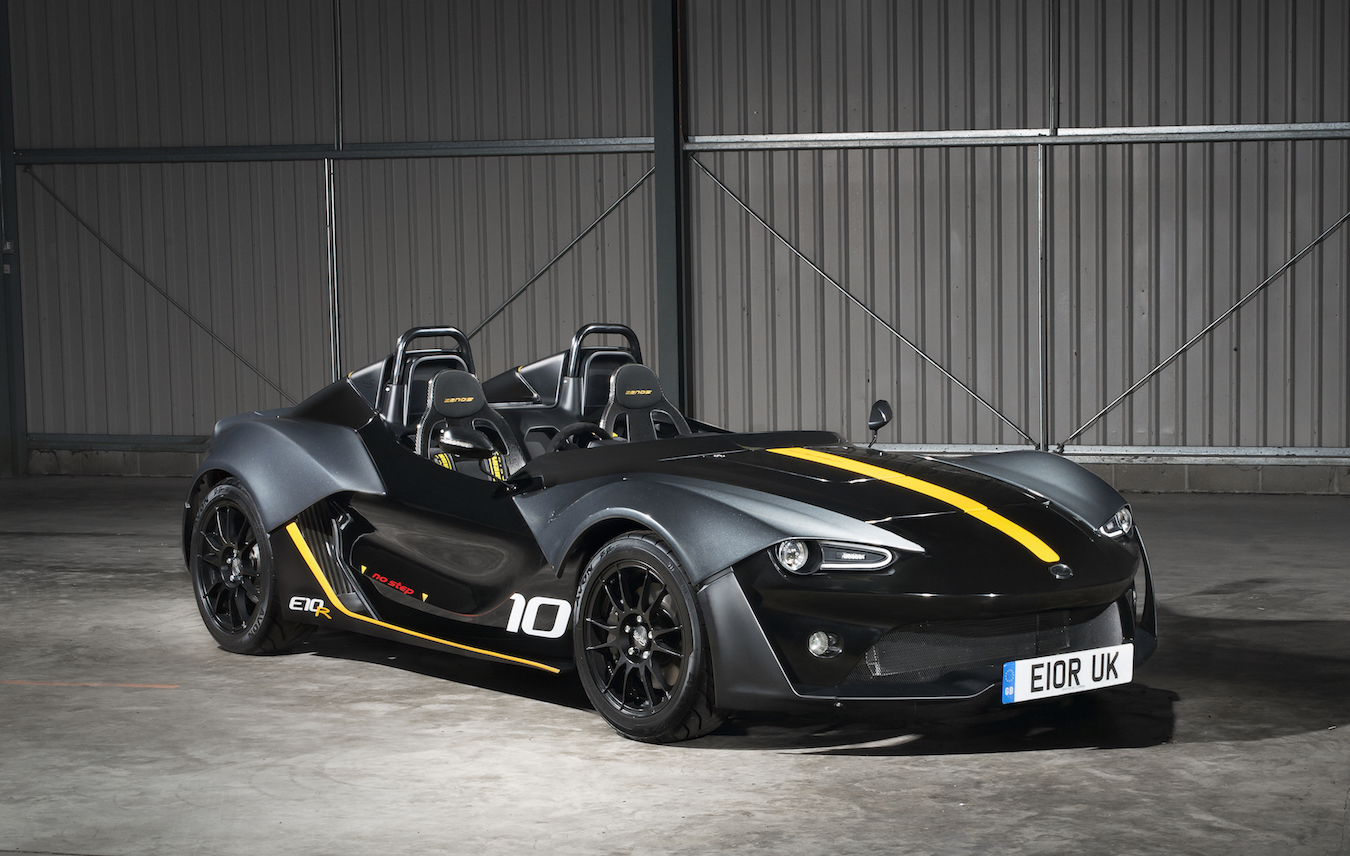
The E10 R used a 2.3-litre EcoBoost similar to the Ford Focus RS engine, giving 350bhp and 350lb ft in a car of 700kg dry: about 500bhp per tonne. Edwards told evo in June 2016 that the team hit its power target on the first day on the dynamometer: “We could have had even more power, but we don’t want owners to have to rebuild their engines every year.” The R had springs 10 per cent stiffer at the front and 20 per cent at the rear, a new brake master cylinder and pads, and carbon composite seats, according to Top Gear, which tested a £43,995 Drive Edition with adjustable Bilstein dampers and graphite body panels in May 2016.
The E11 and E12 that were never built
Zenos planned two more models on the same platform: the E11, a roadster with doors, and the E12, a coupé in the manner of the Lotus Exige. In 2013 they were due in 2016 and 2018; in 2015 Autocar said work was well advanced, and in 2016 the Seedrs round was opened to pay for them. Neither reached production before the company failed.
The Zenos E10 in the US and other markets
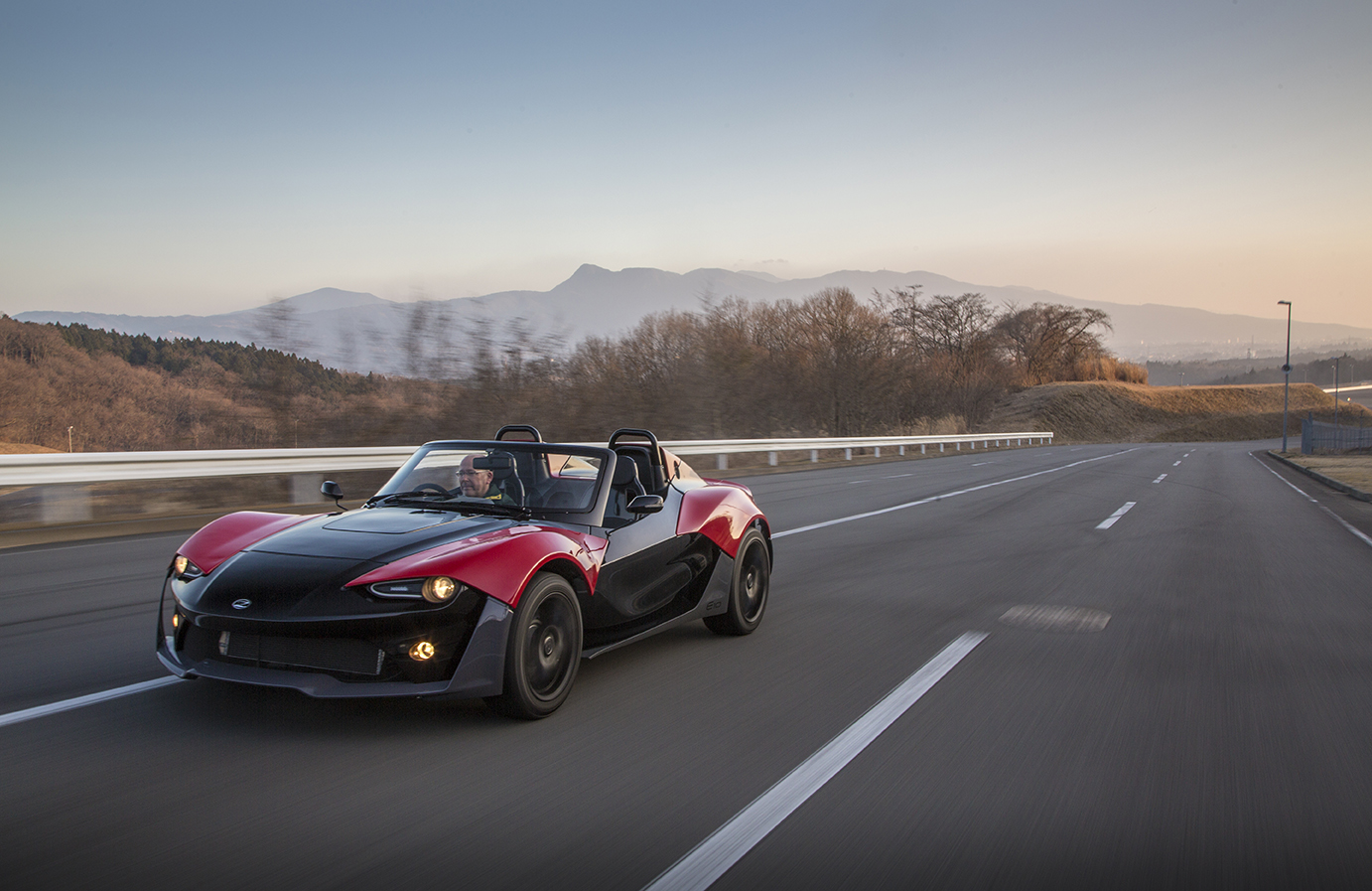
Zenos announced a US company, Zenos Cars USA, in March 2014, and by 2016 the E10 was sold in 10 countries, with half of all cars going abroad.
Zenos Cars USA
Zenos Cars USA was co-founded by Randy Chase, who had founded the data and video recording firm ChaseCam, and Joe Schroeter, SkiddMark reported on 26 March 2014. The E10 was priced from $39,500 and the Launch Edition from $43,750, plus shipping and taxes, according to Zenos’s press release as printed by Autoblog on 28 March 2014, with first cars due in early 2015. Ali said the brand would “sit easily with the US motoring community of ‘light is right’ aficionados”.
US cars were supplied without an engine so that they could be registered as component cars, which escape many of the rules for mass-produced cars. SkiddMark reported that the cars would ship otherwise fully assembled for dealers to fit the engine; Motor Authority, reprinted by the Christian Science Monitor on 29 March 2014, described a “roller” without engine or gearbox, and put the cost of having them sourced and fitted at about $5,000. Autocar reported in October 2015 that 10 cars would go to the US, and 10 to China, by the end of that year.
Europe and Asia
By May 2016 the E10 range was on sale in the UK, US, France, the Netherlands, Belgium, Japan, China, Switzerland and Italy, and half of Zenos’s sales came from outside Britain, according to Business Matters. Zenos’s dealer list of mid-2016 named UK dealers in Cheshire, Edinburgh, Hampshire, Leicestershire, Kent and Northumberland.
What happened to Zenos Cars?
Zenos Cars went into administration on 16 January 2017 after export orders were cancelled late in 2016, and in March 2017 a consortium led by AC Cars bought its assets.
Administration in January 2017
The directors appointed Irvin Cohen and Gary Shankland of Begbies Traynor as joint administrators on 16 January 2017 “after cancelled export orders in late 2016 resulted in a shortfall in funding, forcing the business to cease trading”, the administrators said in a statement printed by Car Dealer Magazine on 24 March 2017. The Eastern Daily Press reported that when the administrators were called in, Edwards said the company had been developing the E11, by then planned as a higher-volume fixed-roof coupé.
The AC Cars rescue
On 24 March 2017 an investor consortium led by AC Cars, the maker of the reborn Cobra, bought Zenos’s assets for an undisclosed sum, including its intellectual property and the 10 unsold new cars; 25 jobs were lost, the Eastern Daily Press reported. AC’s owner, Alan Lubinsky, told Autocar that a central problem for Zenos was “that the cars cost too much to build”, and that future cars might be built alongside AC’s Cobras in South Africa. The old company was renamed Project Exhaust Limited in May 2017 and dissolved on 5 April 2019; a new Zenos Cars Ltd, with Lubinsky as director, was registered on 22 May 2017, Companies House records show.
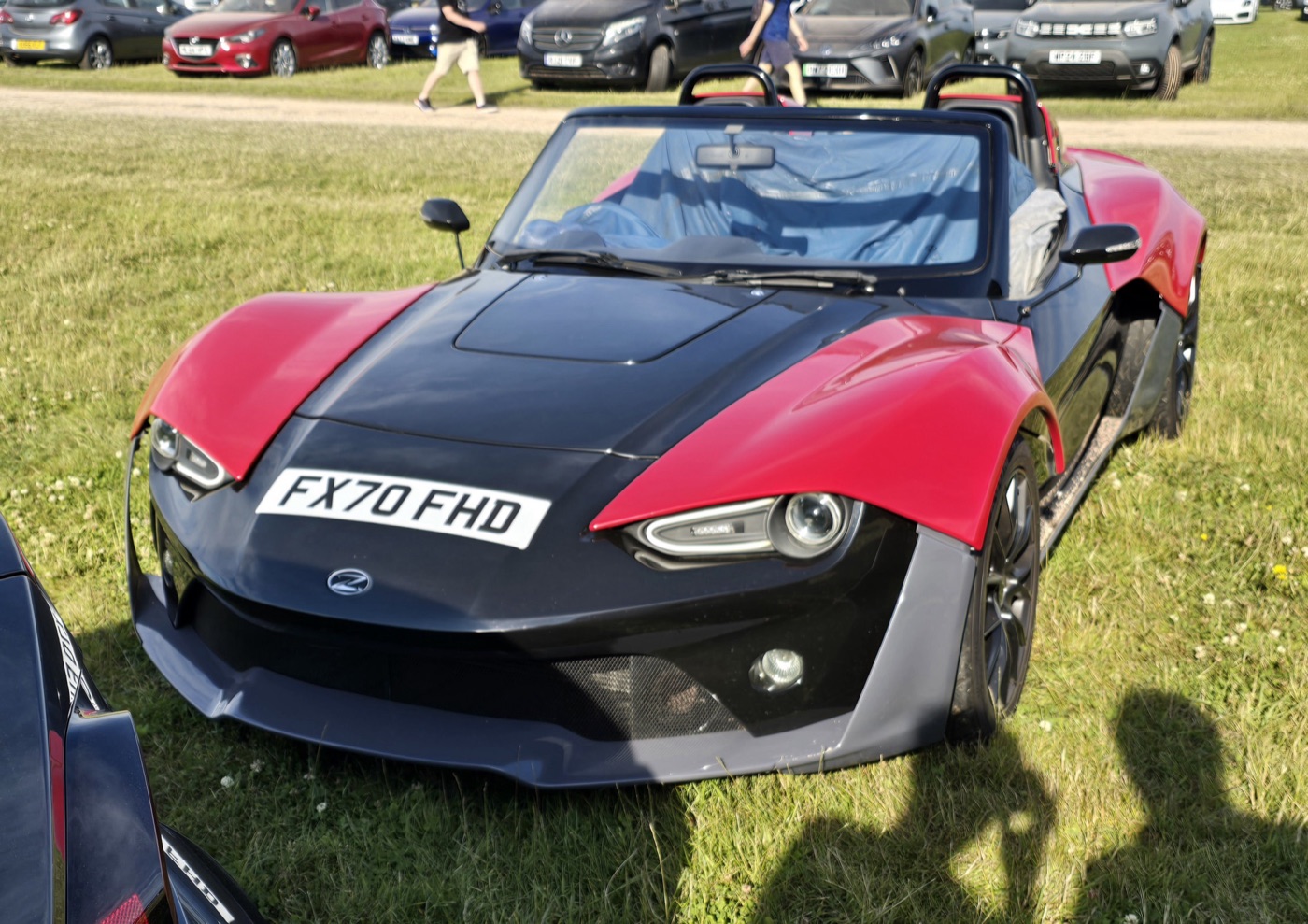
Autocar’s report of 24 September 2025 says AC first sold a handful of unfinished E10s and then shelved the project.
The new Zenos E10 rZ and r2
The revived Zenos announced a new E10 in September 2025 and showed it in production form on 14 October 2026, in two versions: the 380bhp E10 rZ at £129,900 and the 300bhp E10 r2 at £115,900, with deliveries from the second quarter of 2027.
The 2025 revival and the E10 RZ prototype
AC had spent 10 months reviving the brand when it announced the return in September 2025, with one working prototype, Autocar reported. That prototype used Volvo’s 2.0-litre turbocharged four-cylinder in place of the discontinued Ford EcoBoost, with 380bhp and 376lb ft through a six-speed manual gearbox, new carbon fibre bodywork made by AC in West Sussex, and a rear subframe due to change from aluminium to steel for the extra torque. The RZ was then expected at about £140,000 with first cars in the second quarter of 2026, and Octane reported on 29 September 2025 that a 2.3-litre R2 of 325bhp would follow at about £120,000, with fewer than 50 cars in the first year. evo reported that Zenos had joined Lotus’s new Hethel Performance Hub, which lets outside makers use Lotus’s design, testing and manufacturing services.
The 2027 production cars
The production cars keep the aluminium spine and carbon tub but have a full carbon fibre body, a wider track front and rear, new headlights, side skirts with winglets, larger brakes with four-piston front callipers, new control systems with CAN bus engine management, new induction and chargecooler packages on both engines, and a revised gear linkage, according to Zenos’s press release of 14 October 2026. Both weigh 790kg. The rZ’s 1,969cc engine is a Volvo unit supplied by Horse Powertrain, and the r2 uses Ford’s 2.3-litre turbo, turned down from the old E10 R’s 350bhp to 300bhp, Autocar reported. A new dashboard carries an AiM display and new weatherproof switchgear, the seats are carbon fibre made by Zenos, and a full windscreen and wipers are an option. There are still no doors, roof or boot.
Zenos says the cars can be delivered in the UK as road-registered vehicles or for the track only, and abroad as track-only cars in right- or left-hand drive, and its website says 50 cars will be delivered in the first full year of production. UK cars are made road legal through the DVSA’s Individual Vehicle Approval test, PistonHeads reported in its r2 review of October 2026. Accounts differ on where the cars are built: Autocar and PistonHeads report hand assembly and in-house carbon work at Bognor Regis, West Sussex, with the aluminium extrusions now sourced from China, while Auto Express reports that the cars will be built at Zenos’s base in Wymondham. The showroom is at Donington Park, where the company, Zenos Automotive Ltd (formerly AC Cars (EU) Ltd), has its registered office.
Zenos E10 prices and values today
Original Zenos E10s have sold for about £18,000 to £24,000 at UK auctions and on online sale sites since 2020, well below their prices when new.
| Car | Mileage | Sale | Price |
|---|---|---|---|
| 2016 E10 R | 103 miles | Silverstone Auctions (now Iconic Auctioneers), Stoneleigh Park, 31 July 2020 | £20,250 (VAT qualifying) |
| 2016 E10 S | 2,287 miles | Iconic Auctioneers, Stoneleigh Park, 22 May 2021 | £20,250 |
| E10 (two cars, 2016) | 933 and 1,250 miles | Online sales recorded by The Classic Valuer | £18,245 and £18,492 |
| E10 R (five cars) | Various | Online sales recorded by The Classic Valuer | £20,904 to £24,187 (median £23,171) |
The E10 R sold by Iconic Auctioneers in July 2020 had been recommissioned by a Zenos factory technician, and VAT at 20 per cent was added to its hammer price. The E10 S at Iconic’s May 2021 sale had a fresh MOT. The Classic Valuer’s records show every E10 and E10 R offered on the sites it tracks as sold.
Auto Express noted that the new r2’s £115,900 is almost five times the original E10’s price.
Owning a Zenos E10
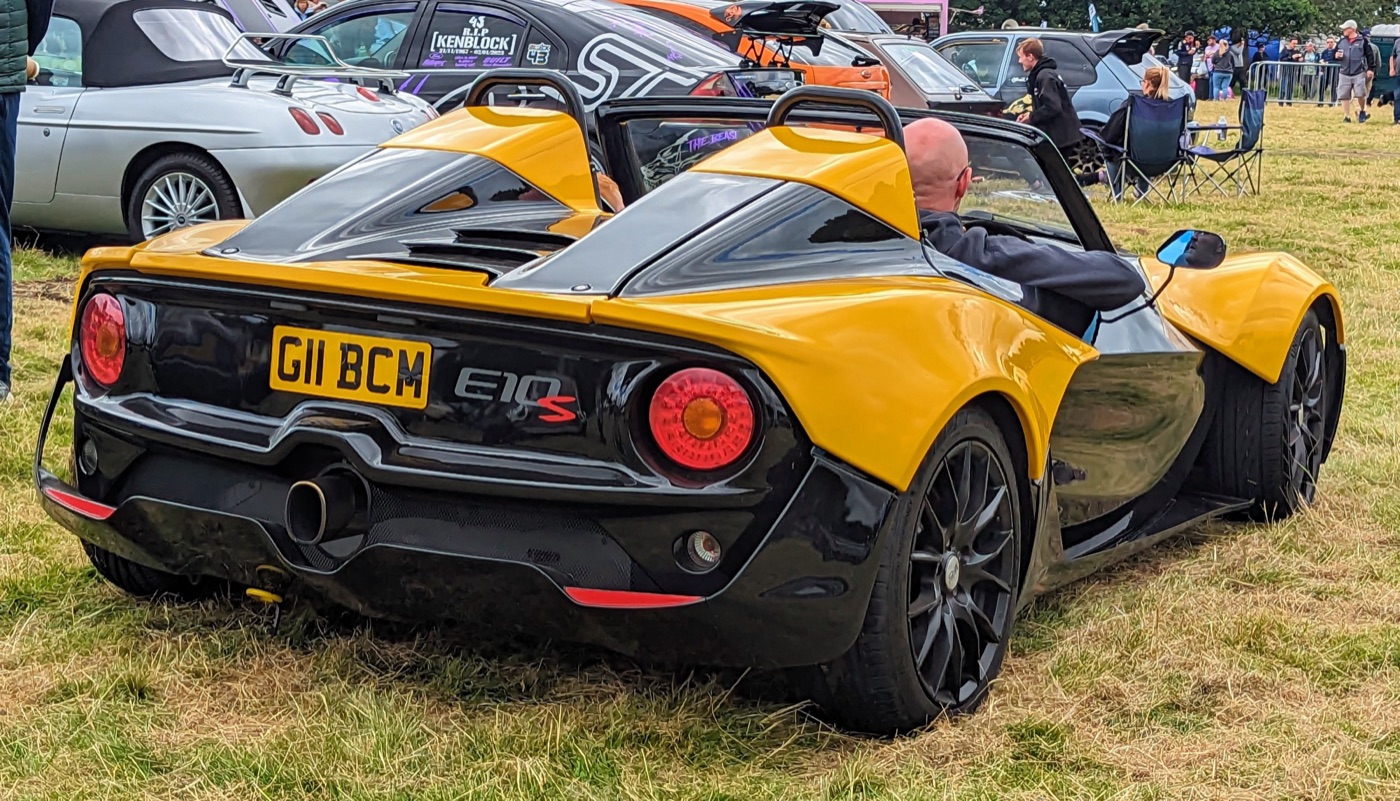
Zenos designed the E10 to be cheap to run and repair, but it is an open car with no heater, no ABS and no power assistance.
Running costs and repairs
Accident repair was the cost Zenos worked hardest to keep down. “Customers quickly lose faith with the product if every time they prang something the repair bill is a few thousand pounds,” Ali told evo in 2014; hence the bolt-on panels, the tub in sections and the front dampers mounted out of harm’s way. Autocar estimated 30–35mpg for the E10 in 2014. Autocar’s road test reported that Zenos offered a factory warranty extension covering track use, and kept its dealer network small with a promised trade-in price for returning owners.
Weather, comfort and daily use
The car has no boot, no doors and no heater. With the optional windscreen fitted, evo found the cockpit “uncannily tranquil” at speed in 2015, but on the North York Moors in winter its testers’ legs and feet got very cold. Autocar’s road test found the headlights weak and the Avon tyres poor in standing water, and noted that the brakes could lock easily on cold tyres without ABS.
Engines, parts and known weak points
The Ford engines are widely used units; Edwards told evo that Ford had “tested these engines to the moon and back”. In 2026 company insiders told Autocar that the old E10 R’s engine had been “a bomb waiting to detonate”, and that the new cars’ charge coolers, in place of the old intercoolers, should hold up better in long track sessions.
Zenos E10 rivals
The E10 was aimed at the Caterham Seven, Ariel’s Atom, the Lotus Elise and the KTM X-Bow. At £24,995 it cost more than £5,000 less than an entry-level Elise, Autocar noted in 2015.
At launch Autocar named the KTM X-Bow, the Vühl 05 and Caterham’s Seven 620R as targets. evo compared the E10 S with the Ariel Atom, Caterham Seven and Lotus Elise in 2015, and noted that the Seven and Elise offered full weather protection. At £39,995 the E10 R was £5,000 cheaper than a similarly fast Caterham 620S, a little dearer than an Ariel Atom 3.5, and gave away 130bhp to a £43,800 Lotus Elise, evo found in 2016. In the US, Autoblog put the E10’s $39,500 against $40,900 for a Caterham Seven 280 and $65,000 for the cheapest Radical, the SR4 Clubsport.
The new car costs far more than those rivals. Autocar compared what it called the new E10’s “£120k–130k” price in 2026 with a factory-built fast Caterham Seven at £50,000 to £60,000, an Ariel Atom 4 at about £70,000, a Morgan Plus Four at £80,000 and a Lotus Emira at £90,000, and placed it in competition with the Porsche 911.
What the press said about the E10
Reviews of the original E10 were warm about its ride, steering and value, and critical of its gearshift, brake feel on early cars and lack of weather protection.
After driving the first pre-production car, Sutcliffe wrote in Autocar that he was “not a lot less than gobsmacked by how good it was”, with a ride “a bit like an early Lotus Elise”. evo summed up the E10 S in 2015 in a word, “impressive”, and called the E10 R “comfortably the best Zenos we’ve driven” in 2016, singling out its improved brakes. Autocar’s 2015 road test judged the E10 “an outstanding ownership proposition” but found the six-speed gearshift “nowhere near as enticing as that of a Caterham”. Top Gear found the E10 R closer in spirit to “an ultra-hardcore Mazda MX-5 Clubsport” than to an Ariel or Caterham, with sublime steering and a gearbox that could shift more sweetly.
Of the new car, Matt Saunders of Autocar found the r2’s ride “fully Lotus-like in its suppleness” in October 2026 but criticised its “flat, boosty” 2.3-litre engine and called the price ambitious. PistonHeads praised the r2’s “wonderfully chatty steering” and wrote that for road use “this is definitely the motor to go for”, while finding the Volvo-engined rZ the more throttle-adjustable of the two.
Questions
Is the Zenos E10 road legal?
Yes. The original E10 was sold as a road-legal car in the UK, and new UK cars are made road legal through the DVSA’s Individual Vehicle Approval test. Outside the UK the 2027 E10 is sold as a track-only car.
How fast is the Zenos E10 R?
Zenos claimed 0–62mph in 3.0 seconds and a top speed of 155mph for the 350bhp E10 R of 2016. The new E10 rZ is quoted at 3.2 seconds to 62mph and about 150mph.
What engine does the Zenos E10 use?
The original cars used Ford engines: a 2.0-litre naturally aspirated four (E10), a 2.0-litre EcoBoost turbo (E10 S) and a 2.3-litre EcoBoost (E10 R). The 2027 E10 rZ uses a turbocharged 2.0-litre Volvo four and the E10 r2 Ford’s 2.3-litre turbo.
Does the Zenos E10 have doors or a roof?
No. You step over the side of the carbon tub to get in. The original car offered a windscreen and a “get home” hood as options; the new car has a wind deflector or an optional windscreen and no roof.
Who owns Zenos now?
Zenos belongs to Alan Lubinsky’s AC Cars group, whose consortium bought the assets in March 2017. The company is Zenos Automotive Ltd, registered at Donington Park.
How much did a Zenos E10 cost new?
The E10 was launched at £24,995 in January 2014 and cost £26,995 by 2016; the E10 S cost £29,995 to £32,995 and the E10 R £39,995. The 2027 E10 r2 costs £115,900 and the rZ £129,900.
Was Hugh Grant an investor in Zenos?
Autocar reported in October 2015 that Zenos, funded by a network of venture capitalists, counted the actor Hugh Grant as an investor.
Where was the Zenos E10 made?
The original E10 was made at Wymondham Business Park in Norfolk. Autocar and PistonHeads report that the 2027 cars are assembled at Bognor Regis in West Sussex, while Auto Express reports Wymondham.
Sources
- Autocar, “Zenos E10 design sketches revealed”, 19 September 2013: first specification, target weight, planned E11 and E12, Niche Vehicle Network funding, rivals.
- PistonHeads, “Zenos Cars: the full story”, 6 September 2013: price-first method, spine extrusion and its cost.
- SkiddMark, reports of 6 and 18 September 2013, 2 October 2013, 6 and 9 January 2014 and 26 March 2014 (“Zenos Cars sets up shop in the U.S.”): founders’ funding, Millbrook grant, Launch Edition, Autosport orders, cabin size range, US company, prices and component-car supply.
- evo, “Zenos E10 news, price and specs”, 5 June 2014: Launch Edition, inboard dampers, sacrificial panels, Ali quotes.
- BBC News, “New Zenos E10 sports car to create jobs in Norfolk”, 30 July 2014: £240,000 LEP grant, £1.2m project, 24 jobs.
- The Engineer, “Innovation in the UK niche vehicles sector”, August 2014 (archived): recycled carbon material, structure weight and stiffness.
- Autocar, “Zenos E10 driven: is this a Lotus beater?”, 7 October 2014: founders’ history, name, first drive, E10 data.
- Autoblog, “Zenos E10 USA pricing official”, 28 March 2014: Zenos Cars USA press release and US prices.
- Christian Science Monitor (Motor Authority), 29 March 2014: US component-car supply and options.
- evo, “Zenos E10 S review”, 6 March 2015: founders, E10 S data, options, verdict.
- Autocar, Zenos E10 road test, 7 October 2015: structure, panels, cabin, performance, ownership, verdict.
- Autocar, “Zenos E10 sells out in first year”, October 2015: 2015 production, exports, investors, partners.
- MotorPunk, “Clever Zenos”, 2 November 2015 (archived): origin of the E10 name.
- Business Matters, “Zenos Cars launches £750,000 funding round with Seedrs”, 12 May 2016: start of production, E10 R launch, markets, export share.
- Zenos Cars, E10 and E10 S pages, May 2016 (archived) and dealer list, June 2016 (archived): 2016 prices, engine data, equipment, dealers.
- Top Gear, “Review: the 500bhp per tonne Zenos E10 R”, 17 May 2016: E10 R changes, Drive Edition, tub supplier, verdict.
- evo, “Zenos E10 R review”, 29 June 2016: E10 R data, Edwards quotes, rival prices.
- Autocar, “Zenos E10 S boosted to 280bhp with upgrade kit”, 7 September 2016: upgrade kit, 2016 prices.
- PistonHeads, “Zenos sells 100th car”, 23 September 2016: 100th car, build slots.
- Car Dealer Magazine, “Consortium purchase saves Zenos from administration”, 24 March 2017: administrators’ statement and dates.
- Autocar, “Zenos saved from administration by AC Cars-led consortium”, 24 March 2017: sale, stock of 10 cars, Lubinsky quotes.
- Eastern Daily Press, “Deal unveiled to save Norfolk’s Zenos Cars, but 25 jobs are lost”, 24 March 2017 (archived): jobs lost, Hethel origins, export share.
- Companies House, company 08077623, company 10782982 and company 06335660, checked October 2026: incorporation, names, dissolution, current companies.
- Autocar, “Zenos brand reborn with £140,000 380bhp roadster”, 24 September 2025: revival, prototype, sales of the original.
- Octane, “Zenos revival: E10 RZ previewed”, 29 September 2025: 2025 plans for RZ and R2.
- evo, “Zenos E10 returns, but it’s Porsche 911 money”, updated October 2026: Lotus Hethel Performance Hub.
- Zenos, “The return of the celebrated Zenos E10”, press release, 14 October 2026: 2027 specifications, prices, deliveries.
- Autocar, Zenos E10 review by Matt Saunders, 14 October 2026: engine suppliers, build location, rivals’ prices, verdict.
- PistonHeads, “2027 Zenos E10 r2 review”, October 2026: build location, road approval, verdict.
- Auto Express, “New Zenos E10 gets ‘nose-to-tail’ revisions, and a £116k starting price”, updated 14 October 2026: price comparison, Wymondham base.
- Iconic Auctioneers, lot 301, 31 July 2020 and lot 740, 22 May 2021: auction results.
- The Classic Valuer, Zenos E10 and Zenos E10 R sold records, checked October 2026: online sale prices.