Lexus LFA: the V10 supercar's history, specification and values
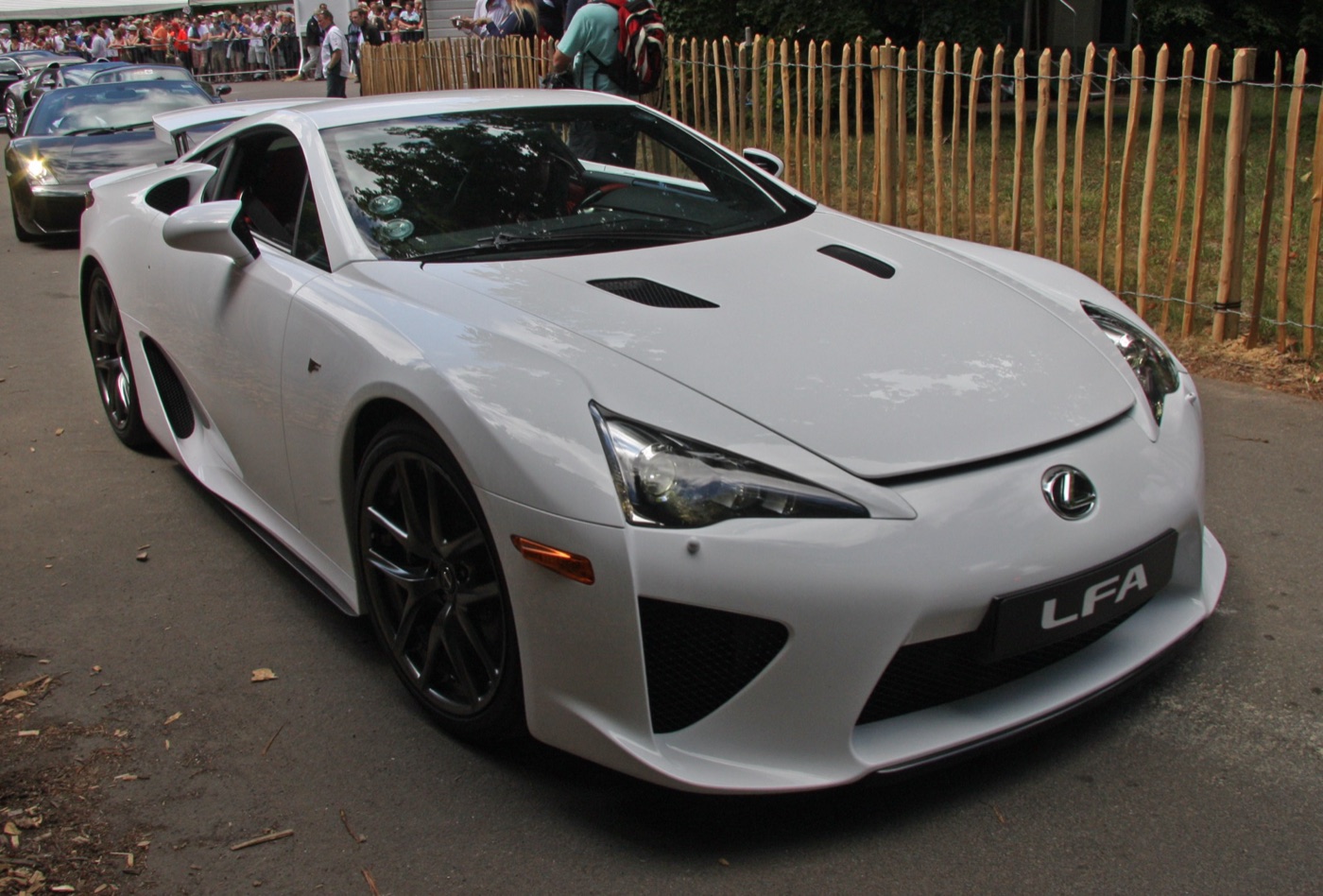
The Lexus LFA is the two-seat, front-engined V10 supercar that Toyota built under its Lexus brand from December 2010 to December 2012. Only 500 were made, by hand, at a rate of one a day, each with a carbon fibre body and a 552bhp 4.8-litre V10 developed with Yamaha that revs to 9,000rpm. It cost about £336,000 new in the UK, and the best have since sold for more than $1.6 million.
People still look it up for the sound of that engine, for the lap of the Nürburgring Nordschleife in 7 minutes 14.64 seconds that made the LFA Nürburgring Package the fastest production car round the track in 2011, and for what the cars are worth now. SkiddMark reported on the car throughout its life, from the 2009 Nürburgring 24 Hours to the last car off the line in 2012.
History and development of the Lexus LFA
The LFA took almost ten years to go from an idea to a production model, and Lexus developed it at the Nürburgring in Germany. "The LFA is a thoroughbred supercar, a machine engineered to achieve a single goal: to deliver a supreme driving experience," Tanahashi said at its launch. Lexus's own account, in its October 2009 UK press kit, says the programme began in 2000 as a research project, produced its first prototype in 2003 and showed a design study at the 2005 North American International Auto Show in Detroit.
A study approved in a bar in 2000
Chief engineer Haruhiko Tanahashi told the story to Bertel Schmitt for The Truth About Cars in July 2012. He described his dream of an "ultimate sports car" to his boss, Tetsuo Hattori, then Toyota's top vehicle engineer, in a bar in Hokkaido. The first line of Tanahashi's project diary reads "February 10, 2000. In Shibetsu, Hattori approves study of a real sports car." Shibetsu is Toyota's proving ground in the north of Japan, and a year later the team was back there with the first prototype for winter testing.
The project nearly died every year. "Each fall, there is a big company review at TMC," Tanahashi said. "Each year, we were about to be kicked off the cliff."
From aluminium to carbon fibre
All the LFA prototypes up to 2005 were built from aluminium alloy. The team tested other sports cars, among them a carbon-tubbed McLaren F1, but Tanahashi chose to stay with the aluminium he knew. Testing on the Nordschleife showed the car had to lose weight, and the only way left was carbon fibre reinforced plastic (CFRP), which promised a saving of about 100kg. Tanahashi told The Truth About Cars that Toyota had begun research into CFRP only in 2003, and that engineers at Fuji Heavy Industries called the plan to develop it in-house in a year insane. Lexus made the switch, built its own looms to weave the material, and the LFA went on sale with a body that is 65 per cent CFRP. SkiddMark's 2012 report on the end of production put the change in money terms: the projected price, it said, rose from $100,000 to $375,000 as the car moved to carbon fibre and a hybrid version was dropped.
The LF-A concepts, 2005 to 2008
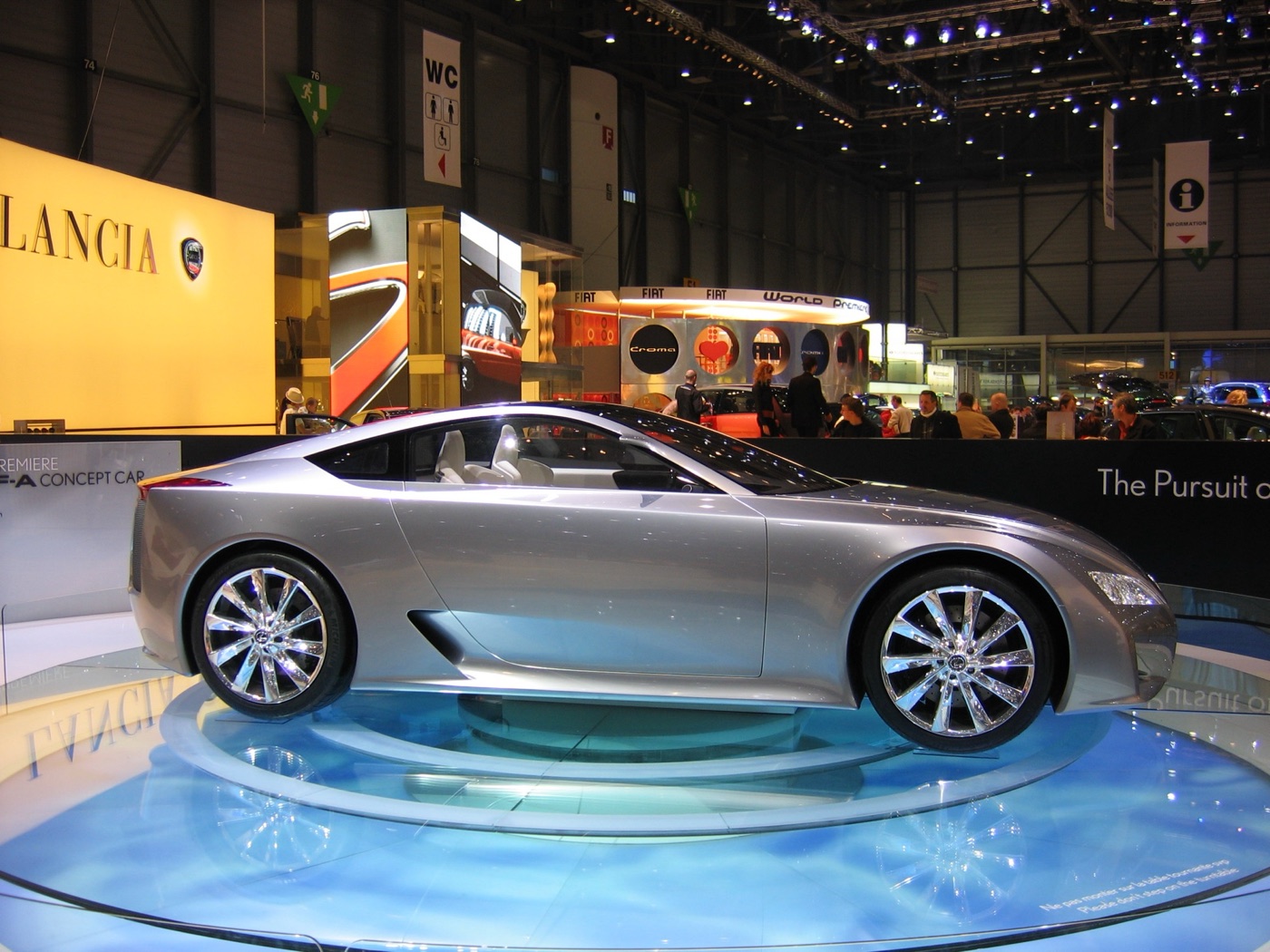
The first concept, the LF-A, was shown at Detroit in January 2005 and then at Geneva in March. An LF-A Roadster followed at the 2008 Detroit show; SkiddMark noted in 2012 that it never reached production. Development cars were raced in the Nürburgring 24 Hours in 2008 and 2009, which Lexus said was to "push the car hard under testing conditions" before launch.
Unveiled at the 2009 Tokyo Motor Show
The production car was unveiled at the Tokyo Motor Show on 21 October 2009, and SkiddMark ran its first report, "Lexus LFA breaks cover", the same month. Lexus said 500 units would be built, at a maximum of 20 a month, each V10 assembled by one engineer who signed it. By January 2010 Lexus said formal expressions of interest already outnumbered the 500 cars, which were allocated across the 56 countries where the LFA was sold.
What does LFA stand for?
Officially, nothing. Tanahashi told The Truth About Cars in 2012 that stories of it meaning "Lexus Future Advance" were "all nonsense". Lexus concept names follow a fixed form, LF for "Lexus future", a dash and two letters; he could not find a second letter he liked for the 2005 car and settled on A. "In 2009, we announced the car at the Tokyo motor show, and we needed a real name. Again, I had a hard time. I thought, why not simply remove the hyphen? The LFA was born."
Design and engineering
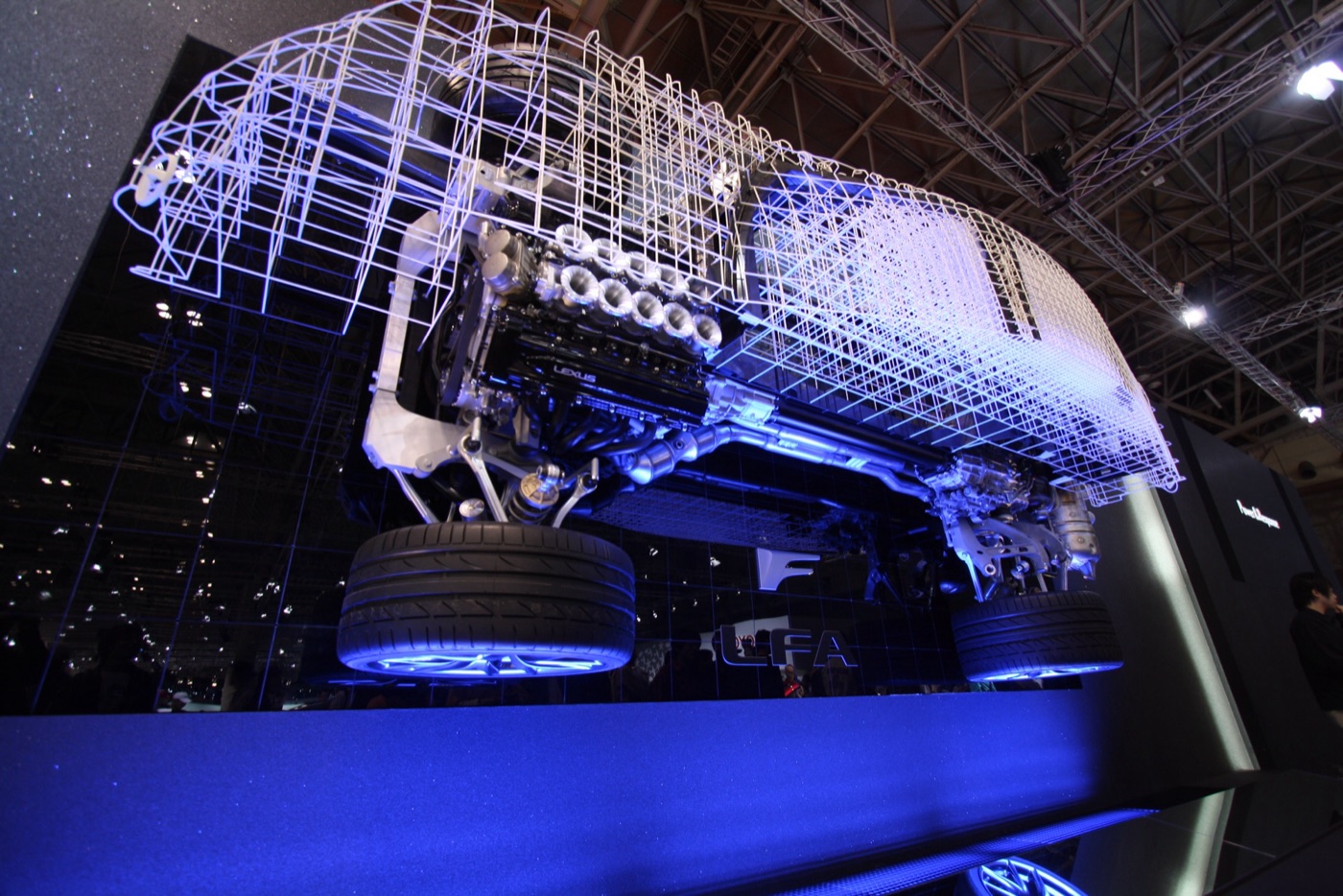
The LFA is a front-mid-engined, rear-wheel-drive coupé: the V10 sits behind the front axle, the gearbox sits over the rear axle, and the two are joined by a torque tube, which gives the 48:52 front-to-rear weight distribution Lexus aimed for. Bring a Trailer's listings name Kengo Matsumoto as the design lead.
Carbon fibre body
CFRP makes up 65 per cent of the body-in-white and aluminium alloy the other 35 per cent, used for the front and rear subframes and the crash structures. Lexus's February 2011 release lists three ways the parts are made: pre-preg sheet for the main structure, resin transfer moulding for the crash boxes, roof rails and floor, and carbon sheet moulding compound for complex upper-body parts. The main body is bonded together with adhesive, a first for Lexus. Tanahashi would not let anyone call it a monocoque: the load is carried by a rigid centre cell with subframes attached, and the outer panels carry none of it. The side panels are glass fibre: CAR magazine reported that the planned carbon panels would not take the Lexus paint finish, and Lexus's kit describes door outer skins of glass-fibre sheet moulding compound.
The 4.8-litre V10 engine
The engine is a V10 with a displacement of 4,805cc and its banks at 72 degrees, dry-sump lubrication, a separate electronically controlled throttle body for each cylinder and a 12.0:1 compression ratio. It makes 552bhp at 8,700rpm and 480Nm of torque at 6,800rpm, 90 per cent of which is there from 3,700rpm to the 9,000rpm red line. Lexus says it is about the size of a V8 and weighs about as much as a V6, and it met the Euro 5 emissions standard. According to evo it is built from aluminium, magnesium and titanium, with its 40 valves and its connecting rods in titanium. Evo and Bring a Trailer give Toyota's code for it as 1LR-GUE; Lexus GB's 2009 press kit printed 1LR-GSE. It was developed with Yamaha, Toyota's long-standing engineering partner. Evo quoted Tanahashi saying no tachometer with a physical needle can keep up with it, which is why the LFA has a digital rev counter.
Why does the Lexus LFA sound the way it does?
Lexus's acoustic team tuned the exhaust and intake to a target sound; its December 2009 release on the car's sound says the acoustic team studied a Formula 1 engine at full revs. In the exhaust system, the titanium silencer has a valve that stays shut below 3,000rpm, sending the exhaust through several chambers, and opens above it into a single resonance chamber before the three stacked tailpipes. The resin intake surge tank was shaped like the sound chamber of a string instrument: it emits the firing frequency of 300Hz up to 4,000rpm, 400 to 500Hz by 6,000rpm, and peaks at 600Hz near the red line. Three channels carry the induction sound into the cabin. In December 2009 SkiddMark cut Lexus Japan's sound recordings to its own detail shots for a 1 minute 25 second video; by December 2012 it had 1.15 million views on YouTube.
Gearbox, chassis and brakes
The transmission is a six-speed single-clutch automated sequential gearbox by Aisin, worked by paddles on the steering column, with an upshift time of 0.2 seconds and four modes: Auto, Sport, Normal and Wet. Evo reported that Lexus and Aisin turned down a double-clutch gearbox because they wanted the mechanical feel of a conventional one. The suspension is double wishbones at the front and multi-link at the rear, with coil-over aluminium monotube dampers of the type used on the LFA race cars, and it was tuned on the Nordschleife. The brakes are carbon-ceramic: 390mm front discs with six-piston Brembo monobloc brake calipers and 360mm rears with four-piston calipers. The car rides on 20-inch forged BBS wheels with Bridgestone tyres, 265/35 front and 305/30 rear. For aerodynamics, Lexus quoted a drag coefficient of 0.31; a flat underbody, a carbon rear diffuser and a rear wing with a Gurney flap, which rises at speed, provide the downforce.
Interior and instruments
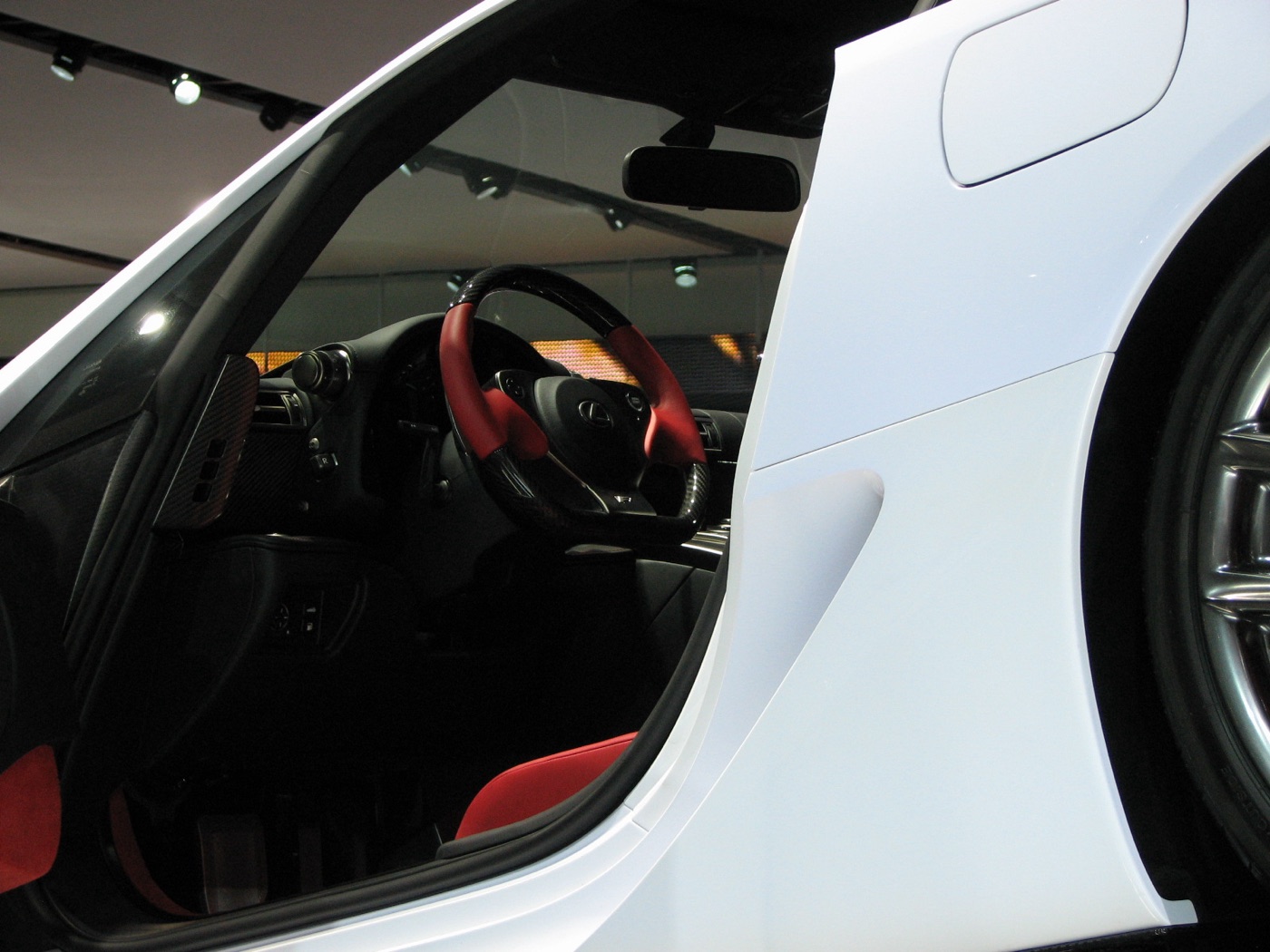
The cabin is hand-built and trimmed in leather, Alcantara, and matt and gloss carbon fibre, with forged aluminium floor-hinged pedals. A single round dial combines an LCD rev counter, a digital speedometer and a ring that moves electrically across the display when the driver calls up a menu; the dial turns red above 9,000rpm. The steering wheel is carbon fibre with a flat bottom, and carries the starter button. The two seats are set low in the middle of the car. Lexus offered 30 paint finishes and let buyers delete items such as the audio system to save weight. The Truth About Cars was told in 2012 that Whitest White was the colour most often ordered, ahead of pearl white, black and red.
Lexus LFA specs and performance
Lexus quoted 552bhp, 0 to 62mph in 3.7 seconds and a top speed of 202mph for the LFA, and kept the acceleration and top speed the same for the Nürburgring Package despite its extra drag.
| Item | LFA | LFA Nürburgring Package |
|---|---|---|
| Engine | 4,805cc 72-degree V10, 40-valve DOHC, dual VVT-i | Same, revised |
| Bore x stroke | 88.0 x 79.0mm | Same |
| Compression ratio | 12.0:1 | Same |
| Maximum power | 552bhp (412kW) at 8,700rpm | 562bhp (420kW) |
| Maximum torque | 480Nm (354lb ft) at 6,800rpm | Not changed by Lexus |
| Red line | 9,000rpm | 9,000rpm |
| Gearbox | Six-speed automated sequential, 0.2-second upshift | Six-speed, 0.15-second shifts |
| 0 to 62mph | 3.7sec | 3.7sec |
| Top speed | 202mph | 202mph |
| Length / width / height | 4,505 / 1,895 / 1,220mm | Ride height 10mm lower |
| Wheelbase | 2,605mm | Same |
| Kerb weight | 1,480 to 1,580kg | Not published |
| Weight distribution | 48:52 front to rear | Not published |
| Drag coefficient | 0.31 | Not published |
| Fuel tank | 73 litres | Same |
| Brakes | Carbon-ceramic, 390 x 34mm front, 360 x 28mm rear | Same |
| Wheels and tyres | 20in BBS, 265/35 R20 front, 305/30 R20 rear | Mesh-type wheels, dedicated high-grip tyres |
How fast is the Lexus LFA?
Lexus gives a top speed of 202mph and 0 to 62mph in 3.7 seconds. Lexus's press kit lists 52mph in first, 104mph in third and 172mph in fifth, with 202mph reached in sixth. Autocar's road test of a prototype without launch control recorded 0 to 100mph in 8.2 seconds and 30 to 100mph in 6.2 seconds, and noted that the V10 has to be kept in the last third of its rev range for that pace.
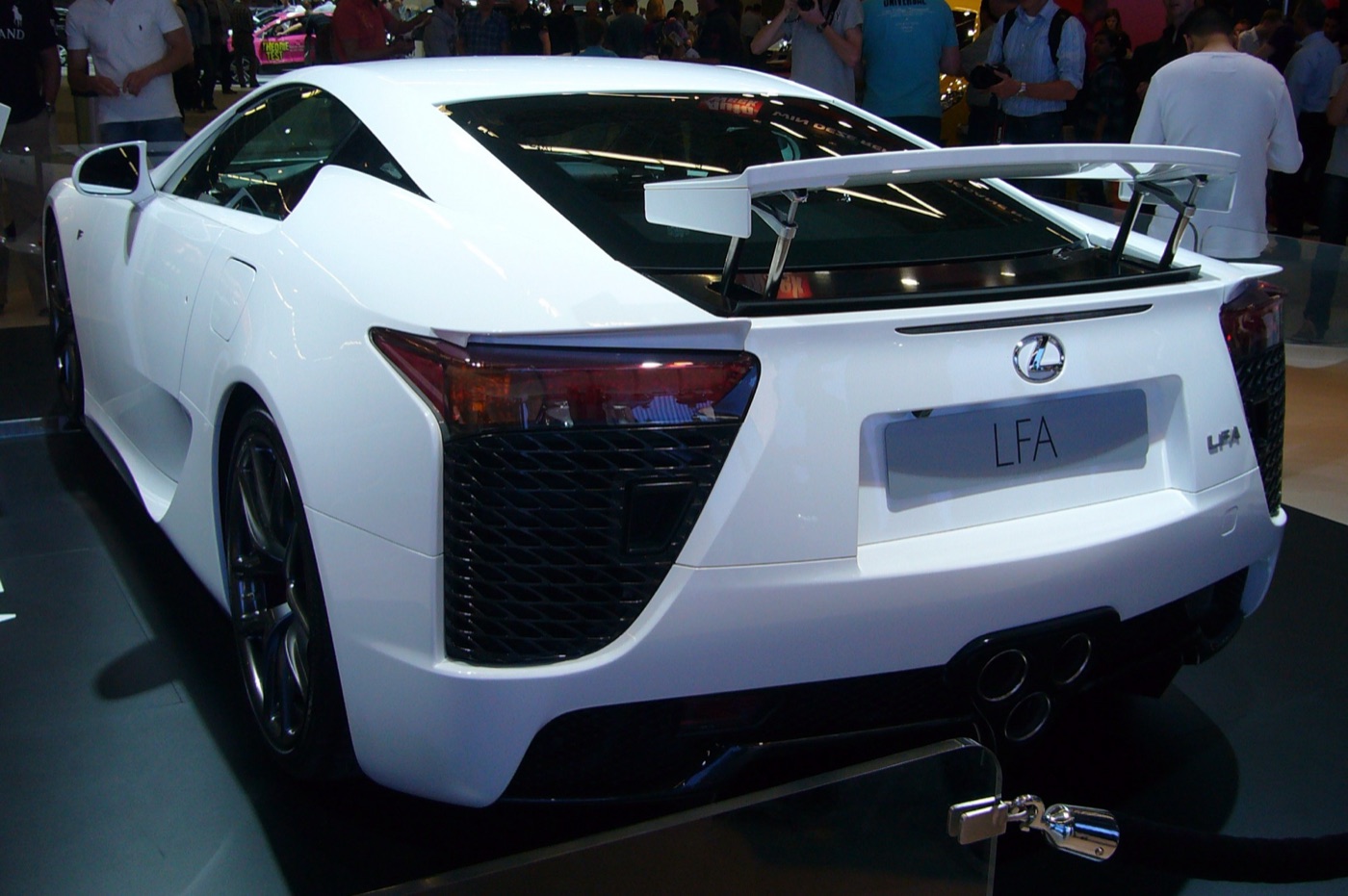
The LFA Nürburgring Package
The Nürburgring Package is the track version of the LFA, offered on 50 of the 500 cars and named after the circuit where the car was developed. Lexus announced it in March 2010, showed it in public at the Geneva motor show in March 2011, and built the cars in 2012.
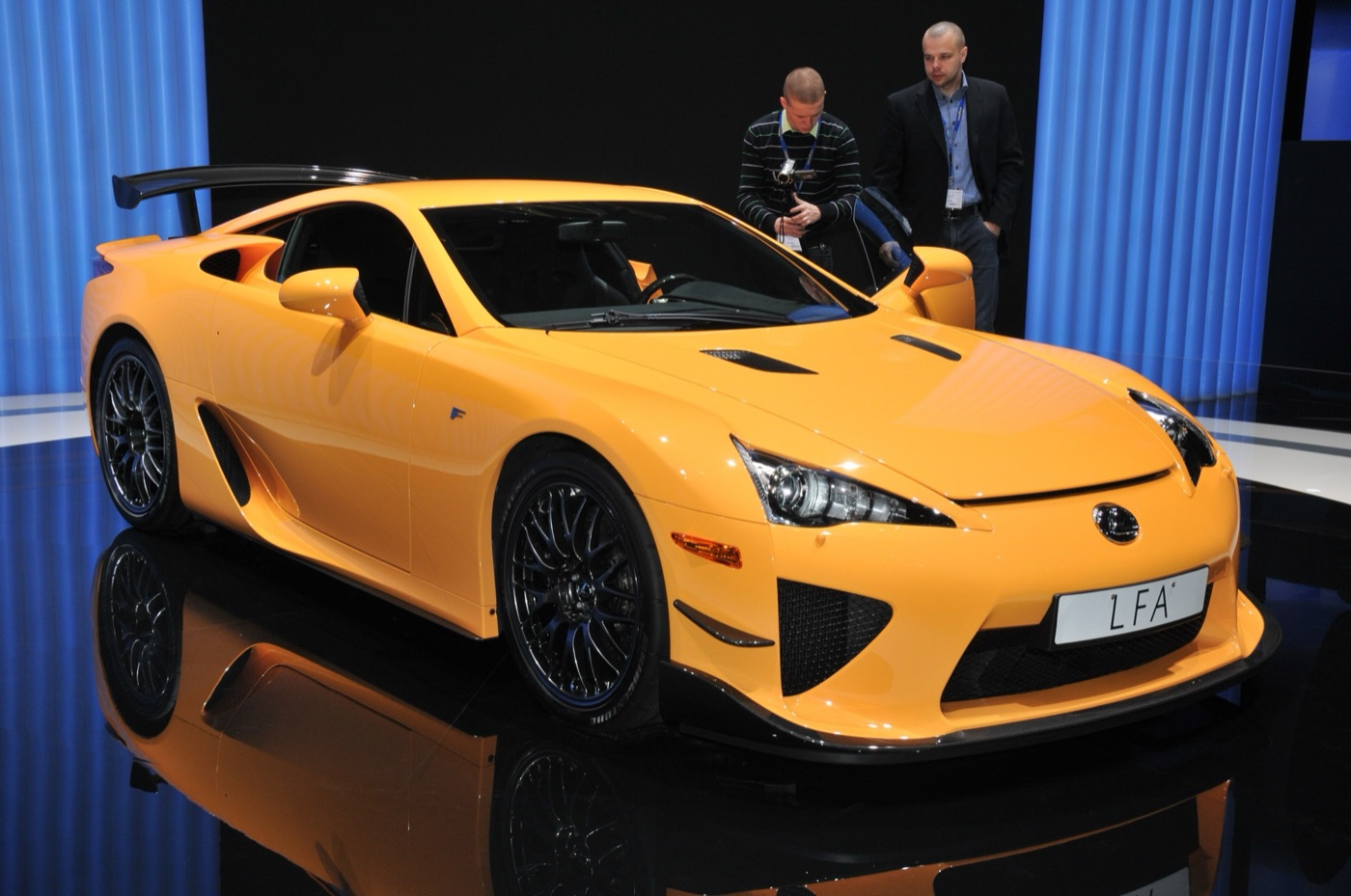
What the package changed
Lexus's March 2010 announcement and its 2011 update list a larger CFRP front spoiler, fin-type side spoilers, canard fins and a fixed rear wing; 10bhp more, for 562bhp; gearshifts cut to 0.15 seconds; suspension tuning with a 10mm lower ride height; and mesh-type wheels with dedicated high-grip tyres. Paint was limited to matte black, black, white or orange, with black and red, black and purple, or all-black interiors. European cars had a carbon centre console and door trims and carbon sports seats in Alcantara. Buyers were offered one-to-one tuition on the Nordschleife from a Nürburgring chief instructor and a year's pass to drive the track. Europe's first customer car, in orange with a black interior, was delivered in the UK in April 2012.
The 7:14.64 Nürburgring lap record
On 31 August 2011 Lexus test driver Akira Iida lapped the 20.6km Nordschleife in 7 minutes 14.64 seconds in a road-legal LFA Nürburgring Package on its standard Bridgestone Potenza RE070 tyres. Lexus announced the time in its release of 7 September 2011 as "a new fastest lap for a current, regular production car". Toyota's own release called the run "a final-phase test" and gave the output as 420kW (571PS).
SkiddMark reported the lap on 2 September 2011, five days before Lexus's release. Iida had already lapped in 7:22.85 in June, a time Lexus chose not to promote, and SkiddMark took that as a sign Lexus expected more: the target was the 7:19 production car record held by the 2011 Chevrolet Corvette ZR1 on Michelin Pilot Sport Cup tyres. "We are delighted with this achievement," Iida said in Lexus's release. "Our on-going development of the LFA and our recent outings at the Nürburgring 24 Hour race have enabled us to continue to tune the vehicle."
The Nürburgring record stood for two weeks. On 14 September 2011 Dominik Farnbacher lapped in 7:12.13 in a 600bhp Dodge Viper SRT10 ACR, according to Chrysler's SRT release.
A year later Lexus raced an LFA Nürburgring against a jet. SkiddMark reported in October 2012 that on 8 October, on the 1.45km runway at Longmont airport in Colorado, Scott Pruett drove the car against Marc Arnold's Eclipse 500, which crossed the start already flying at 150mph. Both ran to the far end and back; the LFA finished in 56 seconds, 2.1 seconds ahead of the jet. The car made its North American debut at the SEMA show in Las Vegas on 30 October 2012.
The LFA in the Nürburgring 24 Hours
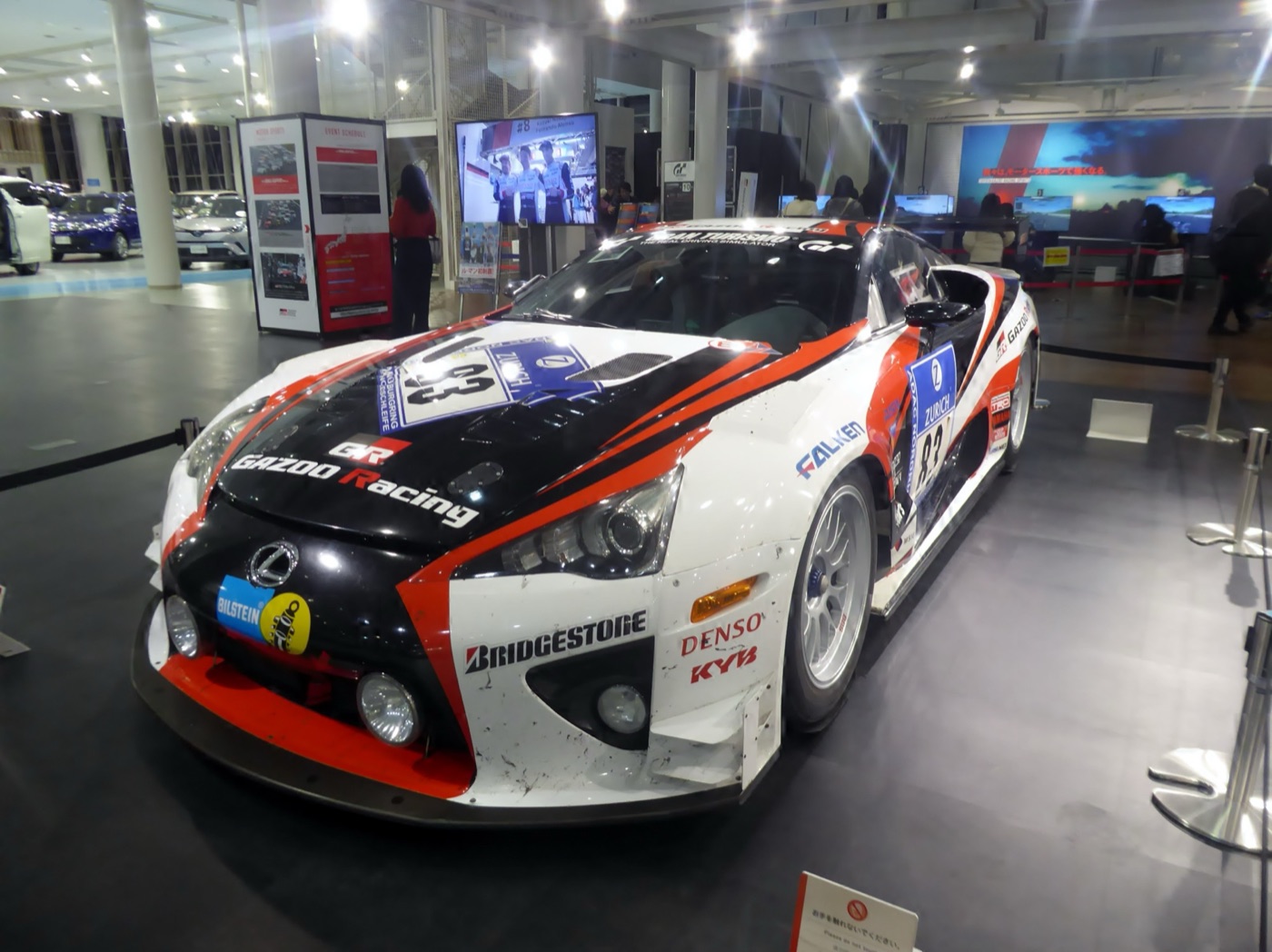
Toyota's Gazoo Racing team entered LF-A development cars in the Nürburgring 24 Hours in 2008 and 2009 and production-based LFAs from 2010 to 2014, winning its class in 2010, 2012 and 2014. Its pit crews were mostly Toyota employees, and the team treated the race as a development test.
| Year | Car | Result |
|---|---|---|
| 2008 | LF-A No. 14 | 121st overall, 7th in SP8 (106 laps) |
| 2009 | LF-A No. 14 | 87th overall, 4th in SP8 (114 laps) |
| 2010 | LFA No. 50 | 18th overall, SP8 class win (142 laps) |
| 2010 | LFA No. 51 | Not classified (67 laps) |
| 2011 | LFA No. 88 | 41st overall, 3rd in SP8 (133 laps) |
| 2011 | LFA No. 87 | 134th or 137th overall (the source gives both), 8th in SP8 (83 laps) |
| 2012 | LFA No. 83 | 15th overall, SP8 class win (147 laps) |
| 2013 | LFA No. 79 | 36th or 37th overall (the source gives both), 2nd in SP8 (79 laps, race stopped for about nine hours by rain) |
| 2014 | LFA Code X | 11th overall, SP-PRO class win |
| 2014 | LFA | 13th overall, class win |
The 2012 car, driven by Takayuki Kinoshita, Akira Iida and Juichi Wakisaka, set a fastest lap of 8 minutes 44 seconds, 11 seconds quicker than in 2011, according to Lexus GB. In 2011 the team's drivers had included André Lotterer, who won Le Mans for Audi that year. The 2013 car was 110kg lighter than the 2012 one, and Akio Toyoda, Toyota's president, raced under his "Morizo" name.
SkiddMark at the 2009 race
SkiddMark followed the 2009 race live from inside the paddock through Dickie Meaden, who was driving an Aston Martin V12 Vantage in the same SP8 class and posting as he went. "Lexus LF-A looking more awesome than ever. You have to hear these things to believe it. Shares garage 10 with Astons," he posted on Twitter on day one. Forty-five minutes into the race he reported that "the quickest Lexus LF-A suffered driveshaft failure", and at midnight the No. 14 LF-A lay third in SP8 behind a Corvette C6 and the Aston. In May 2010 SkiddMark previewed the first race for the production car, with Gazoo's mix of Japanese and German drivers led by Toyota master test driver Hiromu Naruse.
The death of Hiromu Naruse
Hiromu Naruse, Toyota's chief test driver, was killed on 23 June 2010 when the LFA Nürburgring prototype he was driving collided head-on with a BMW on a road near Toyota's workshop by the Nürburgring. Autocar reported that the BMW was also driven by a test driver and that he and his passenger were seriously injured. Naruse was 67. He had joined Toyota's vehicle evaluation and engineering division in 1963, worked on its motorsport programme from 1970, and had a hand in its sporting cars from the 2000GT to the MR-S. In 2012 Ben Barry wrote in CAR that Toyota sources said Naruse did not appear to have been wearing a seatbelt and appeared to have been on the wrong side of the road, and that the prototype's airbags were not working.
How many Lexus LFAs were made?
Lexus made 500 LFAs. The first left LFA Works, the dedicated workshop in Toyota's Motomachi plant in Toyota City, on 15 December 2010 and the last on 14 December 2012, at a rate of one a day, according to Lexus's release of 17 December 2012. About 170 hand-picked takumi craftsmen made the parts, assembled and painted the cars, and the last one was a white Nürburgring Package. SkiddMark reported that Akio Toyoda sat in that car, LFA No. 500, at the closing ceremony. Lexus said the technology learned in making the carbon fibre parts would be used in future Lexus models.
The Nürburgring Package was announced for 50 cars. The enthusiast-run LFA Registry, which lists every car by chassis number, counts 64, and Bring a Trailer's 2022 listing of chassis No. 349 also gives 64, about 15 of them to US specification.
Where the cars went
Lexus sold its European cars through one showroom, Lexus Park Lane in London, with one personal liaison manager, Devshi Varsani, who handled every sale. Europe took 40 cars, four of them Nürburgring Packages: Germany 15, Switzerland 6, the UK 5, the Netherlands 4 and France 3, according to Lexus's release of 26 March 2013. The first European delivery was in February 2011 and the last, chassis No. 493 in Whitest White, went to a customer in Switzerland that day. One European buyer took three cars, the only person in the world to do so. In October 2009 Autocar had reported that Toyota UK expected to sell 17.
In the US, SkiddMark reported in November 2009 that Lexus planned to lease the cars for up to two years before offering them for sale, to stop buyers storing them for a quick profit; European cars, Lexus GB said, would be "fully sold to the customer".
Lexus LFA price new and values today
An LFA cost about £336,000 in the UK when it was launched and $375,000 in the US; standard cars have sold for $725,000 to $951,000 in America, and a near-new car made $1.81 million in April 2026.
How much did the LFA cost new?
Lexus GB gave the UK launch price as €368,000, "approximately £336,000", in October 2009; Autocar quoted £343,000 the next day, and CAR put the car at about £346,000 in 2012, with the Nürburgring Package car at £411,752. In the US the base price was $375,000. The window sticker of one US car, chassis No. 487, totals $383,900, and that of Nürburgring Package No. 349 totals $454,400. Autocar reported in 2009 that Toyota would not make a profit on the car even at that price, as it shared only five parts with any other Toyota or Lexus.
How much is a Lexus LFA worth now?
Most public sales are in the US, where Bring a Trailer has sold more than 20 LFAs since 2021. Standard cars have mostly sold for $725,000 to $951,000. The exceptions are a car with a flood-damaged, restored salvage title, which made $676,000 in November 2025, and chassis No. 487 with 748 miles, which made $1.81 million on 29 April 2026. In the UK, evo reported that cars now sell for about £800,000 and that Nürburgring Package cars can be worth double that.
| Date | Car | Sold for |
|---|---|---|
| 2 July 2021 | LFA, 72 miles | $808,000 |
| 18 March 2022 | LFA Nürburgring Package, 2,000 miles | $1,625,000 |
| 13 April 2023 | LFA, 3,900 miles | $755,000 |
| 8 April 2024 | LFA, 2,600 miles | $903,111 |
| 13 March 2025 | LFA, 952 miles | $951,000 |
| 13 August 2025 | LFA, 4,400 miles | $810,000 |
| 14 November 2025 | LFA, 14,000 miles, restored salvage title | $676,000 |
| 29 April 2026 | LFA No. 487, 748 miles | $1,810,000 |
Two Nürburgring Package cars failed to sell on the site: one bid to $1,225,000 in June 2022 and another to $1,720,000 in December 2023.
Owning and servicing a Lexus LFA
The people Lexus put in charge of servicing the LFA say it is closer to looking after a racing car than a road car.
Servicing at the LFA Centre of Excellence
LFAs in Europe are looked after by the LFA Centre of Excellence at Toyota Motorsport's base in Cologne, which in 2014 cared for 38 cars, according to Lexus's March 2014 release. "We treat an LFA more or less like a Le Mans car," said its workshop manager, Peter Dresen. A scheduled service took four days: the body panels come off for access to the suspension, steering and subframes, the carbon-ceramic brake discs are checked by fingertip for cracks, an X-ray machine is on hand, and the CFRP body shell is inspected. The first road test is done without the underbody panels because they take about two hours to refit. "It's a fantastic car to drive," Dresen said. "The power and handling are incredible, but you can drive it every day." The team also travels to local Lexus dealers, so owners need not send their cars to Cologne. Lexus UK's own car, GU11VLL, had covered 6,600 miles by then.
Reliability and running costs
Lexus's press kit calls the V10 "as reliable and refined as any other Lexus power plant". Autocar's test car averaged 14.9mpg, and its road test said running costs "will be astronomical". Auto Express warned of poor visibility, almost no space behind the seats and room under the tailgate for only a small overnight bag. The Nürburgring Package car Bring a Trailer sold in 2022 had a battery charging port added in 2019 and a new battery in December 2021.
Lexus LFA rivals
Evo named the Ferrari 599 GTO as the LFA's closest rival on price, ability and rarity: 599 were made, at £305,000, with more performance from its V12. The Lamborghini Aventador arrived about a year after the LFA with more power for about £100,000 less, and the Nissan GT-R cost a sixth as much. Against the other supercars of 2010, Autocar's road test found the LFA slower against the clock than Ferrari's 458 Italia, the Lamborghini Gallardo LP560-4, the Mercedes-Benz SLS AMG and the Porsche 911 Turbo S, though Autocar said the standing-start times undersold it, because its prototype had no launch control: from 30 to 100mph it was 0.1 seconds behind the SLS and the Gallardo.
What is the Lexus LFA like to drive?
On a smooth road or a track it is quick and approachable; on a bumpy British B-road it is less settled, and the gearbox is its weak point. Evo's review describes direct but calm steering, taut fixed-rate suspension and a chassis that stays "benign and progressive even as you lean into its limits". Comparing it with the Porsche Carrera GT, evo found the throttle response "totally insane, to the point where even the Carrera GT's motor feels a little tardy by comparison", and the LFA "every bit as involving, but more exploitable".
Autocar's road test found that on a track the LFA "turns with a remarkable absence of slack", but that on uneven roads a bump under one wheel could deflect it under braking, mid-corner lumps upset its traction and the quick steering suffered kickback. Both magazines criticised the single-clutch transmission: Autocar called its fastest setting "swift enough but brutal" and its slower ones "ponderous and clumsy", and evo called it "disappointingly hesitant" next to modern double-clutch gearboxes.
What the press said
Autocar wrote that "in 30 years' time, we'll remember the LFA's engine as one of the greatest petrol powerplants in existence", and called the LFA "an occasional car, even by supercar standards". In CAR in 2012, Ben Barry, driving the Nürburgring Package, wrote: "In many ways, the LFA is Japan's Bugatti Veyron."
On television, SkiddMark reported in December 2009 that the only LFA in the UK had been to the Top Gear studio for The Stig to set a lap of the Dunsfold test track, for the episode broadcast on BBC Two on 3 January 2010. A month earlier Justin Bell, son of Derek Bell, had driven one round California Speedway at Fontana for Jay Leno's Garage, and Lexus UK had taken delivery of its demonstrator.
The electric Lexus LFA Concept
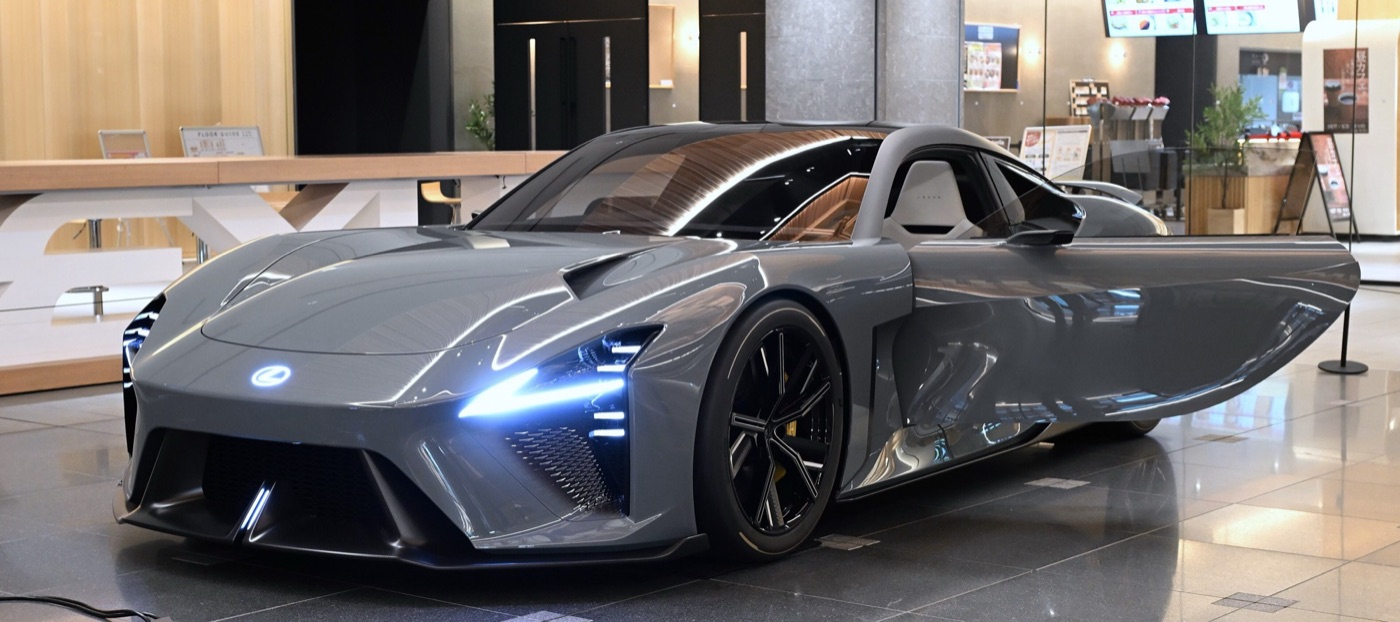
Lexus revived the LFA name on 5 December 2025 for a battery electric two-seat concept, the Lexus LFA Concept, which Toyota's release says is being developed alongside the Toyota Gazoo Racing GR GT and GR GT3 and shares their all-aluminium body frame. It had been shown earlier in 2025 as the Lexus Sport Concept at Monterey Car Week and the Japan Mobility Show. It is 4,690mm long, 2,040mm wide and 1,195mm high on a 2,725mm wheelbase, so it is longer, wider and lower than the original. Lexus has published no power, battery or price figures. Toyota says the concept carries on the 2000GT and LFA's practice of passing car-making skills from veteran engineers to younger ones.
Questions
Is the Lexus LFA street legal?
Yes. Every LFA was sold as a road car, and Lexus set its 7:14.64 Nürburgring lap in 2011 in a fully road-legal Nürburgring Package car on standard Bridgestone tyres.
Who designed the Lexus LFA?
Haruhiko Tanahashi, who proposed the project to his boss in 2000, was its chief engineer; Bring a Trailer's listings name Kengo Matsumoto as the design lead.
Who made the Lexus LFA engine?
Toyota developed the 4.8-litre V10 together with Yamaha, and each engine was assembled by a single engineer, who signed it.
Why was the Lexus LFA discontinued?
It was always planned as a limited run of 500 cars. Production started on 15 December 2010 and the 500th car, a white Nürburgring Package, was finished on 14 December 2012.
Is there a Lexus LFA convertible?
Not as a production car. Lexus showed an LF-A Roadster concept at the 2008 Detroit motor show, but it never went on sale.
Did Toyota make money on the LFA?
No. Autocar reported in October 2009 that Toyota conceded the car was unprofitable even at £343,000, partly because it shared only five parts with any other Toyota or Lexus.
How many Lexus LFAs are in the UK?
Lexus delivered five LFAs to UK customers, and Lexus UK ran its own car, registered GU11VLL, for press drives and displays.
Sources
- Lexus GB, "Lexus LFA", press kit, 21 October 2009: development dates, engineering, technical specification, UK price.
- Lexus GB, "Sounds Spectacular", 11 December 2009: exhaust and intake acoustics.
- Lexus GB, "Lexus LFA Powers Into the Heart of London", 30 November 2009, and "Lexus LFA Is The 'Must Have' Supercar", 20 January 2010: European sales through Lexus Park Lane, interest and allocation.
- Lexus GB, "Lexus LFA To Take On The 'Ring", 15 March 2010: 2010 Nürburgring 24 Hours team led by Hiromu Naruse.
- Lexus GB, "Lexus Unleashes The Ultimate LFA", 29 March 2010, and "Lexus Presents LFA Nürburgring Package", 23 February 2011: Nürburgring Package specification, colours, CFRP manufacture.
- Lexus GB, "Le Mans Winner Lotterer To Drive Lexus LFA At Nürburgring", 21 June 2011: 2011 driver line-up, 2010 result.
- Lexus GB, "Nürburgring by Name and by Nature", 7 September 2011, and Toyota Motor Corporation, "Lexus Conducts Final-phase Test of 'LFA Nürburgring Package' at Nürburgring", 7 September 2011: the 7:14.64 lap.
- Chrysler Group SRT, "Dodge Viper SRT10 ACR Reclaims Production Car Lap Record at Nürburgring with 7:12.13", September 2011.
- Lexus GB, "Destination UK For Europe's First Lexus LFA With Nürburgring Package", 13 April 2012.
- Lexus GB, "GAZOO Racing Lexus LFA", 20 June 2012: 2012 race result and fastest lap.
- Lexus GB, "Lexus Signs Off On Final LFA", 17 December 2012: production dates, workforce, last car.
- Lexus GB, "Final Lexus LFA Delivery In Europe", 26 March 2013: European deliveries by country.
- Lexus GB, "Supercar Super Care: Inside the LFA Centre of Excellence", 31 March 2014: servicing.
- TOYOTA GAZOO Racing, "Challenge to Nürburgring: History" and "'11–'13": Nürburgring 24 Hours results 2008–2013.
- Toyota Motor Corporation, "Toyota and Lexus Top of the Class at Nürburgring", 20 June 2014: 2014 results.
- Toyota Motor Corporation, "World premiere of the Lexus LFA Concept", 5 December 2025: the electric concept and its dimensions.
- Bertel Schmitt, The Truth About Cars, "The Making Of The Lexus LFA Supercar", chapter 1 and chapter 3, July 2012: Tanahashi on the project's origins, carbon fibre, the name and paint colours.
- Autocar, "Toyota's chief tester killed", 23 June 2010, and "Two Lexus LFAs sold in UK", 22 October 2009: Naruse's death; UK price, sales forecast and profitability.
- Ben Barry, CAR, "Lexus LF-A Nürburgring (2012) CAR review", 13 February 2012: prices, glass-fibre panels, Naruse crash.
- LFA Registry, "Nürburgring Package production numbers": 64 cars.
- Bring a Trailer, Lexus LFA results, with the listings for chassis No. 487, the restored salvage car and Nürburgring Package No. 349, read 27 October 2026: sale prices, window stickers, design lead, engine code.
- Evo, Lexus LFA (2009–2012) review, and Autocar, Lexus LFA road test: rivals, UK values, test figures and verdicts.
- SkiddMark's own reports, 2009–2012: Lexus LFA breaks cover (October 2009); the 2009 Nürburgring 24 Hours live coverage (May 2009); Lexus LFA lease and buy mixup (November 2009); Justin Bell drives the Lexus LFA for Jay Leno's Garage (November 2009); The Stig gets his hands on the LFA (December 2009); the 2010 Nürburgring 24 Hours preview (May 2010); the 7:14 record (September 2011); the LFA against the Eclipse 500 jet (October 2012); the end of production (December 2012).
This article was written in October 2026 to replace SkiddMark's original report of September 2011, "Lexus LFA Nurburgring Package edition sets new production car record of 7 min 14 seconds", with every figure checked against Lexus's and Toyota's own releases. Values checked 27 October 2026.