McLaren F1: the 1990s road car's history, specification and values
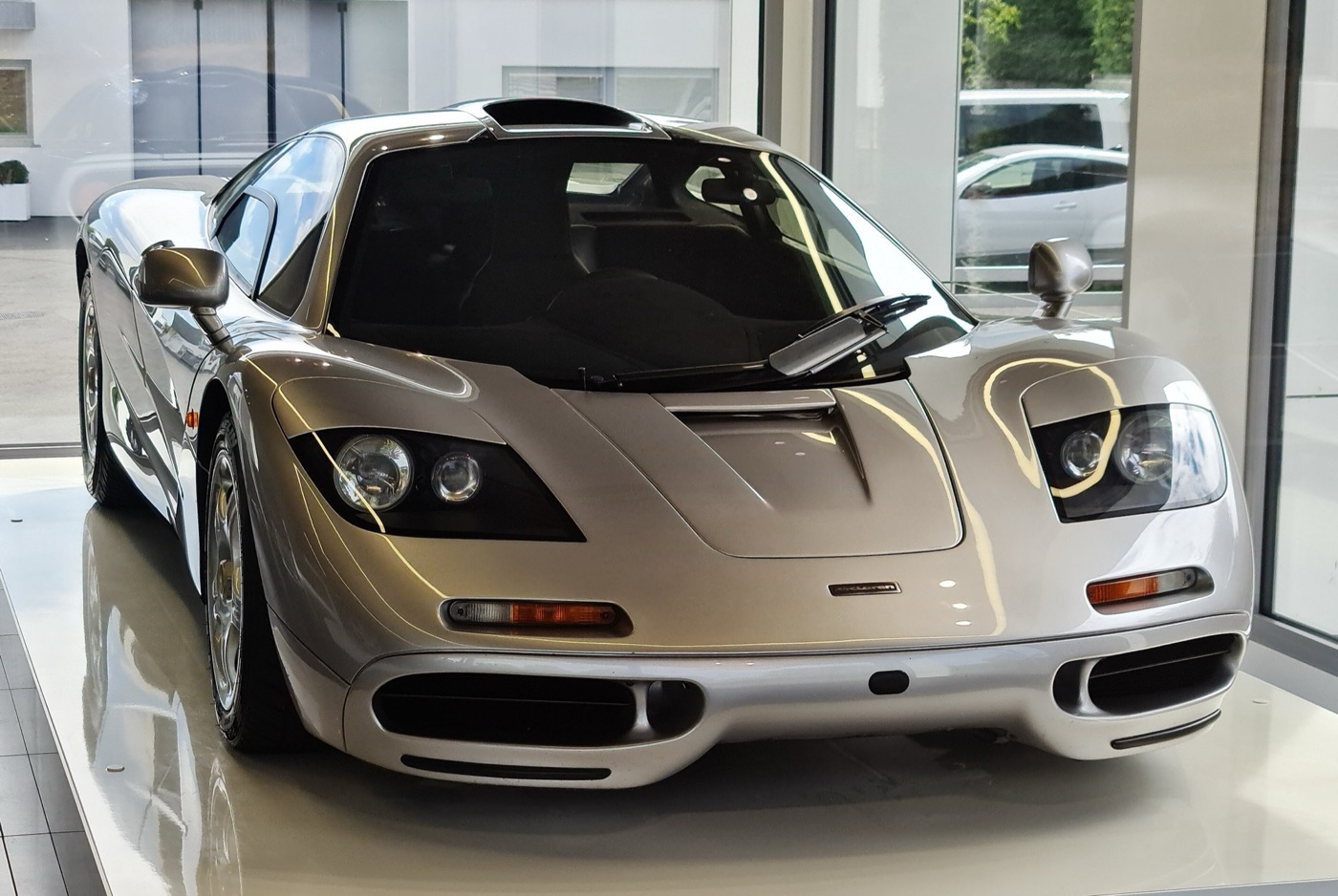
The McLaren F1 is the three-seat, mid-engined supercar that McLaren Cars built at Woking from 1993 to 1998, with the driver in the middle and a 627bhp 6.1-litre BMW V12 behind. McLaren made 106 cars of every kind, only 64 of them standard road cars, and in 1998 a prototype reached 240.1mph, still the highest speed for a production car without a turbocharger or supercharger. It cost about £540,000 new; a road car sold for $25,317,500 in December 2025.
Its racing version, the F1 GTR, won the 24 Hours of Le Mans at its first attempt in 1995, and a GTR sold for $34,655,000 in August 2026, the highest price paid for a British car at auction. SkiddMark wrote about the F1 through its later life: the 20th anniversary in 2010, the Le Mans cars at Goodwood in 2013, and Rowan Atkinson's crash in his F1 on the A605 in August 2011.
History and development of the McLaren F1
The F1 began as an idea in an airport lounge in 1988 and went on sale in 1993, four years after McLaren set up a separate company, McLaren Cars, to build it. Gordon Murray, the South African who had designed Nelson Piquet's championship-winning Brabhams, was its technical director, Creighton Brown its commercial director and Peter Stevens, formerly a Lotus stylist, its designer of the body. TAG's Mansour Ojjeh, McLaren's co-owner and then chairman, wrote the foreword to the 1992 press release, and RM Sotheby's says the design had input from him and from Ron Dennis, who ran McLaren.
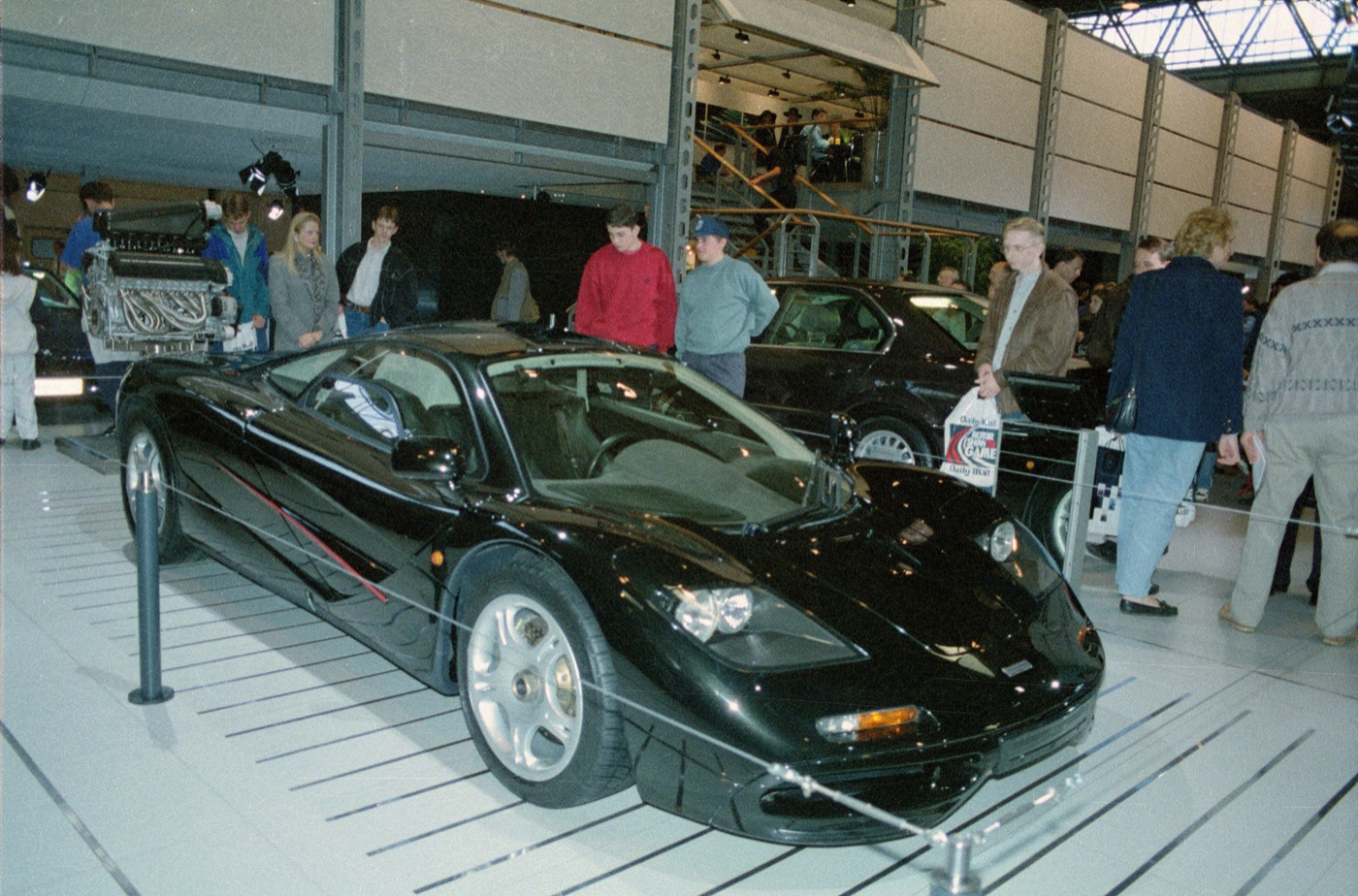
An idea in the Linate airport lounge
The idea came at the 1988 Italian Grand Prix, the only race of the season that McLaren's MP4/4 did not win. Andrew Frankel, writing in Motor Sport in August 1997, says Ron Dennis and Gordon Murray "hatched an idea to build a road car" in the departure lounge at Linate airport in Milan while they waited for the flight home. McLaren's 1992 press release says Murray had "harboured its one-plus-two seating concept since the 1960s".
Prototypes and the Monaco launch
McLaren Cars was formed in 1989, and its three-year prototype programme began in January 1990 in a purpose-built workshop next to the Formula 1 team's headquarters in Woking, Surrey, according to the original 1992 press release, republished by evo in 2016. The car was shown to journalists and buyers at the Sporting Club in Monte Carlo during the Monaco Grand Prix weekend of May 1992. Motor Sport's report of July 1992 describes "dry ice and cacophonous rock music", gives the price as £535,000 and the plan as 50 cars a year until 2000. Niki Lauda saw the three seats and said: "So you can take the wife and the girlfriend and get aggravation from both sides." Buyers who put down a deposit before seeing the car could have it back if they did not like it, Creighton Brown told the magazine.
Test mules and the XP prototypes
Before any F1 existed, McLaren tested its parts in two Ultima Mk3 kit cars. Ultima's own history says the TAG McLaren Group bought two Mk3 kits, chassis 12 and 13, from Noble Motorsport in 1991. Chassis 12, which McLaren named Albert, had a Chevrolet V8 "to mimic the torque of the BMW V12" and was used to test the new gearbox, the central driving position and carbon brakes; chassis 13, Edward, tested the BMW V12 with its exhaust and cooling systems. Both were later destroyed, Ultima says, because "the specialist magazines were still offering a fortune for sneak preview pictures".
Then came five prototypes, XP1 to XP5. In Autocar's feature on its road test, published in 2019, Andrew Frankel records that XP1 "got rolled into a ball while testing in the Namibian desert", XP2 was crushed in crash tests, XP3 and XP4 went to private collections, and XP5 stayed with McLaren. "There is no XP6."
Production at Woking
McLaren promised "entirely new standards of build quality" for the production car. Series production was to start at the end of 1993, Motor Sport reported at the launch, and in March 1998 McLaren expected the last car to leave the line at the end of that May, according to its account of the 1998 speed record. By the time it went on sale in 1993, Frankel wrote in 1997, "deep depression hung over the economic climate"; "it is no secret that McLaren lost money on every one of the road cars it made", and 100 of "the originally planned 350" would be built. Harold Dermott, McLaren Cars' customer care manager, said in 1998: "McLaren did state, early on, that it wouldn't build more than 300 F1s. Well, it hasn't!"
Design and engineering
Murray's aim, in the press release's words, was "the finest high-performance sports car ever made", and his means were low weight and no electronic aids: "mass is the essential enemy of dynamic performance", it says, and it set a target of 1,018kg. The same aim set the choice of materials: McLaren's heritage page on the design says each carbon chassis took more than 3,000 hours to make, the throttle pedal was made from six pieces of titanium, and the tool kit, in titanium, was half the weight of a steel one. There is no anti-lock braking, no traction control and no power steering, and the brakes are unassisted.
Why does the McLaren F1 have three seats?
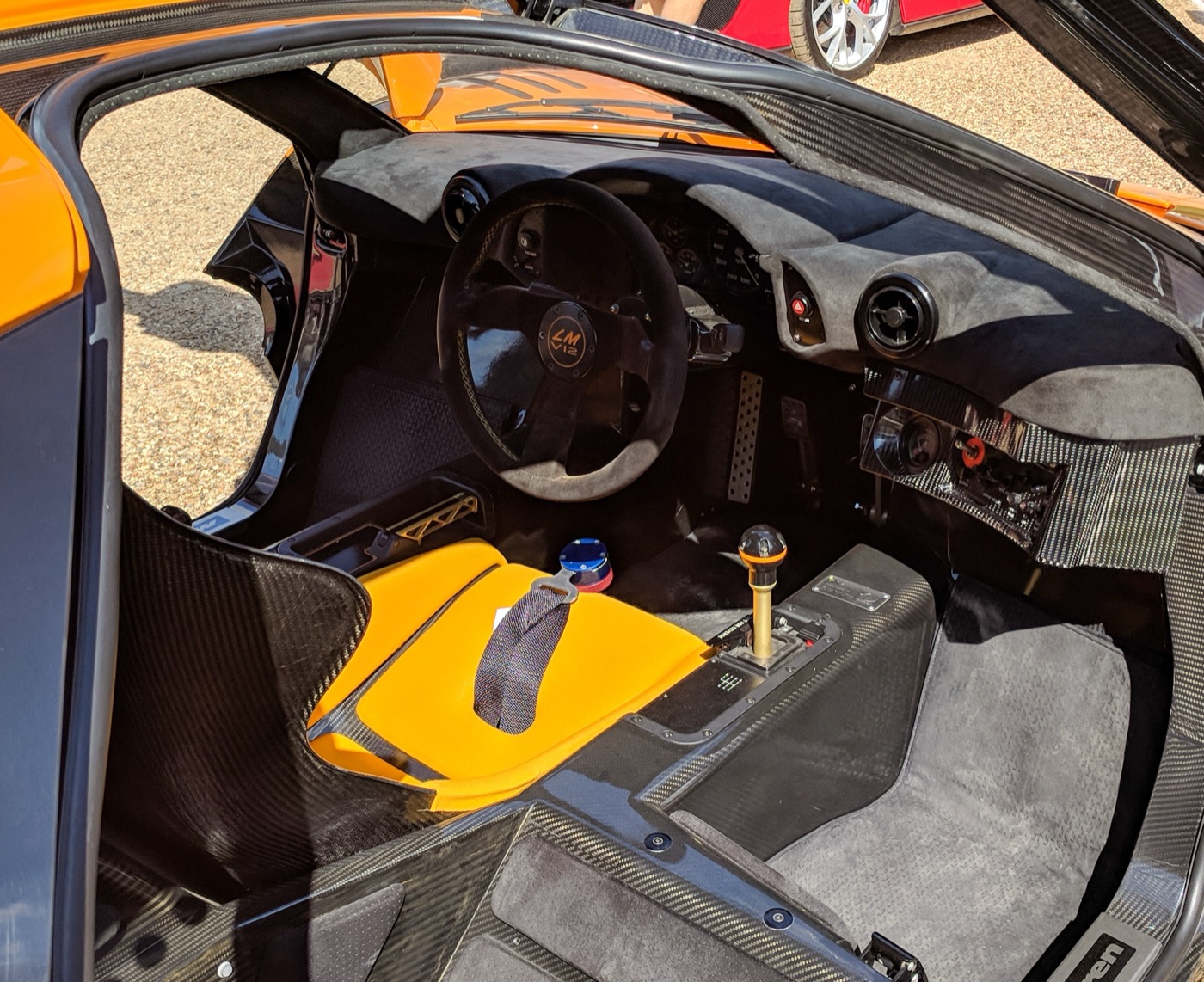
The driver's seat is on the centre line of the car, well forward, with the two passenger seats either side and slightly behind, and Autocar found the car would seat three adults in comfort. Murray had worked on this one-plus-two concept since 1969, McLaren says, and wanted the view and the control layout of a single-seater: Autocar's road test found "no pedal offset, no wheelarch to negotiate" and room for drivers up to 6ft 4in. The seat, pedals and steering wheel were made to fit each owner at the factory and could not be adjusted afterwards except for the seat's fore and aft travel. Autocar's buyer's notes describe the way in: enter from the left, sit on the corner of the passenger seat, put one leg in the driver's footwell, then lift yourself across and slide in. Access is through two "dihedral" doors that open up and forward and take part of the roof and floor with them, and the luggage goes in two compartments, one on each flank ahead of the rear wheels: 227 litres with three on board, McLaren said.
Interior, luggage and equipment
For a car built around low weight, the F1 came well equipped: air conditioning, electric windows, remote central locking, a heated windscreen and side windows, a titanium tool kit by Facom and a Kenwood 10-disc CD player that RM Sotheby's describes as "specially created" and "ultra-lightweight". The seats are trimmed in Connolly leather, and Motor Sport reported in 1992 that the fitted luggage was handmade in leather by Golf Brothers. McLaren would paint an F1 in any colour the buyer asked for; Autocar lists the standard ones as Magnesium (silver), International (grey), Silverstone (green), Grand Prix (red), Black 235 and carbon. The visibility "all round is superb", Frankel wrote in 2019, but Autocar's 1994 test said the view behind was poor and that reversing without help "could be a heart-in-mouth affair".
Carbon fibre monocoque
The whole structure is moulded carbon composite. McLaren was the first team in Formula 1 to use a carbon-fibre chassis, the MP4/1 of 1981, and the press release calls the F1 "the world's first full advanced-composite production car". McLaren's 2010 anniversary statement, which SkiddMark reported, gives the monocoque's weight as 100kg and each bare carbon door, side-impact beam included, as 7kg. Frankel wrote that each structure "takes over a man-year to create", and Autocar found that the carbon construction gave the car "a sense of indomitable strength". The press release says its aerodynamics "derive directly from Formula 1 technology": it was the first production car developed in a moving-ground wind tunnel by Formula 1 aerodynamicists.
The BMW S70/2 V12 engine and the gold foil
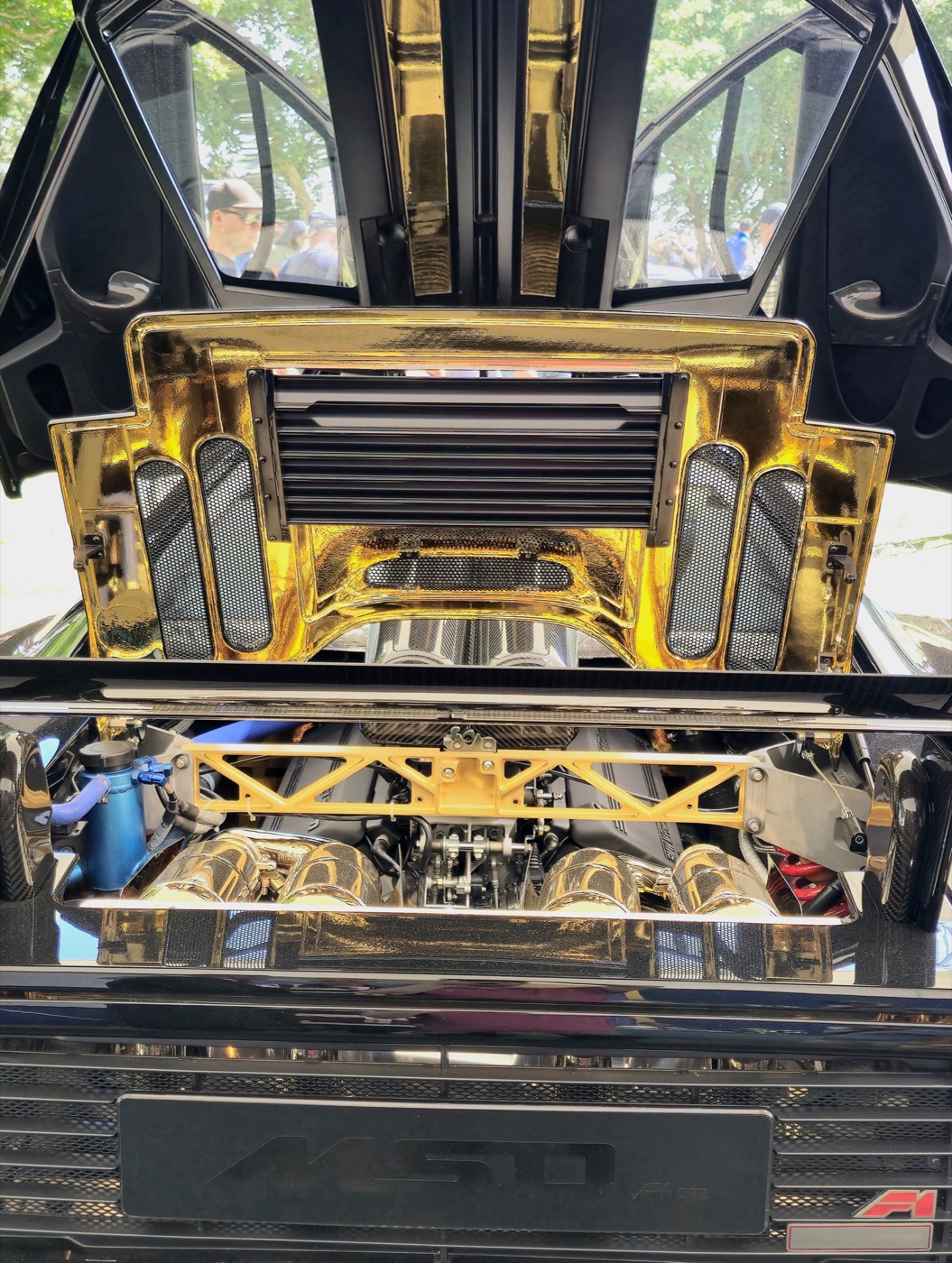
The engine is a 6,064cc 60-degree V12 with four camshafts and 48 valves, designed for the F1 by Paul Rosche at BMW Motorsport, an old colleague of Murray's from the Brabham-BMW years. McLaren had first talked to Honda, its Formula 1 engine supplier, but those talks "eventually fizzled" when McLaren held out for a larger naturally aspirated engine, RM Sotheby's says. BMW built the engines by hand and tested each on the dynamometer for its owner. Its inlet camshafts have variable valve timing. It has dry-sump lubrication and a magnesium sump and cam covers; each cylinder has its own ignition coil and each bank its own water pump, and the four catalytic converters are cased in Inconel sheet 0.8mm thick, which doubles as the rear crash structure. In 1992 McLaren quoted "over 550bhp"; the production engine made 627bhp at 7,400rpm, Autocar found.
The engine compartment is lined with gold foil, which McLaren calls the best heat reflector available, as a heat shield for the carbon fibre and the fuel tank around it. Autocar's republished road test notes that the foil is often replaced when the engine is out for a service and that the job takes up to 18 hours.
Aerodynamics without a wing
The standard F1 has no fixed spoiler. Its floor rises under the tail into a diffuser, and two electric fans draw off the slow boundary-layer air from it to add downforce. A small flap in the tail, the "Brake and Balance 'Foil", rises automatically under hard braking to keep the centre of pressure in place and to open ducts that cool the rear brakes. Motor Sport reported in 1992 that the system let Murray do without anti-lock brakes, "something he believes detracts from the driver's enjoyment". Autocar measured a drag coefficient of 0.32.
Suspension, brakes and tyres
The car has double wishbones at each corner. McLaren patented its mountings for them: Ground Plane Shear Centre (GPSC) subframes at the front, on plain bearings and rubber bushes, and an Inclined Shear Axis (ISA) system at the rear. The brakes are ventilated Brembo discs, 332mm at the front and 305mm at the rear, with four-piston calipers, and the clutch is an AP triple-plate carbon unit. The tyres were Goodyears made for the car, 235/45 ZR17 at the front and 315/45 ZR17 at the rear, on magnesium wheels.
McLaren F1 specification and performance
The production F1 weighs 1,138kg at the kerb and has 627bhp, which gave it 550bhp per tonne, the figures in Autocar's road test.
| Item | McLaren, May 1992 | Production car, 1994 |
|---|---|---|
| Engine | BMW S70/2 60-degree V12, 6,064cc, 86 x 87mm, 48 valves | As 1992 |
| Power | Over 550bhp (404kW) at 7,000–7,500rpm | 627bhp at 7,400rpm |
| Torque | Over 600Nm from 4,000 to 7,000rpm | Over 479lb ft (650Nm) from 4,000 to 7,000rpm |
| Rev limit | 7,500rpm | 7,500rpm |
| Gearbox | Six-speed manual, transverse, limited-slip differential | As 1992 |
| Weight | 1,018kg dry (target) | 1,138kg kerb |
| Length, width, height | 4,288mm, 1,820mm, 1,140mm | - |
| Wheelbase | 2,718mm | - |
| Fuel tank | 85 litres | 90 litres (Autocar) |
| 0–60mph | - | 3.2sec |
| 0–100mph | - | 6.3sec |
| 0–120mph | - | 9.2sec |
| 0–200mph | - | 28sec (Motor Sport) |
| Fuel economy | - | 15.2mpg overall, 9mpg to 23.4mpg |
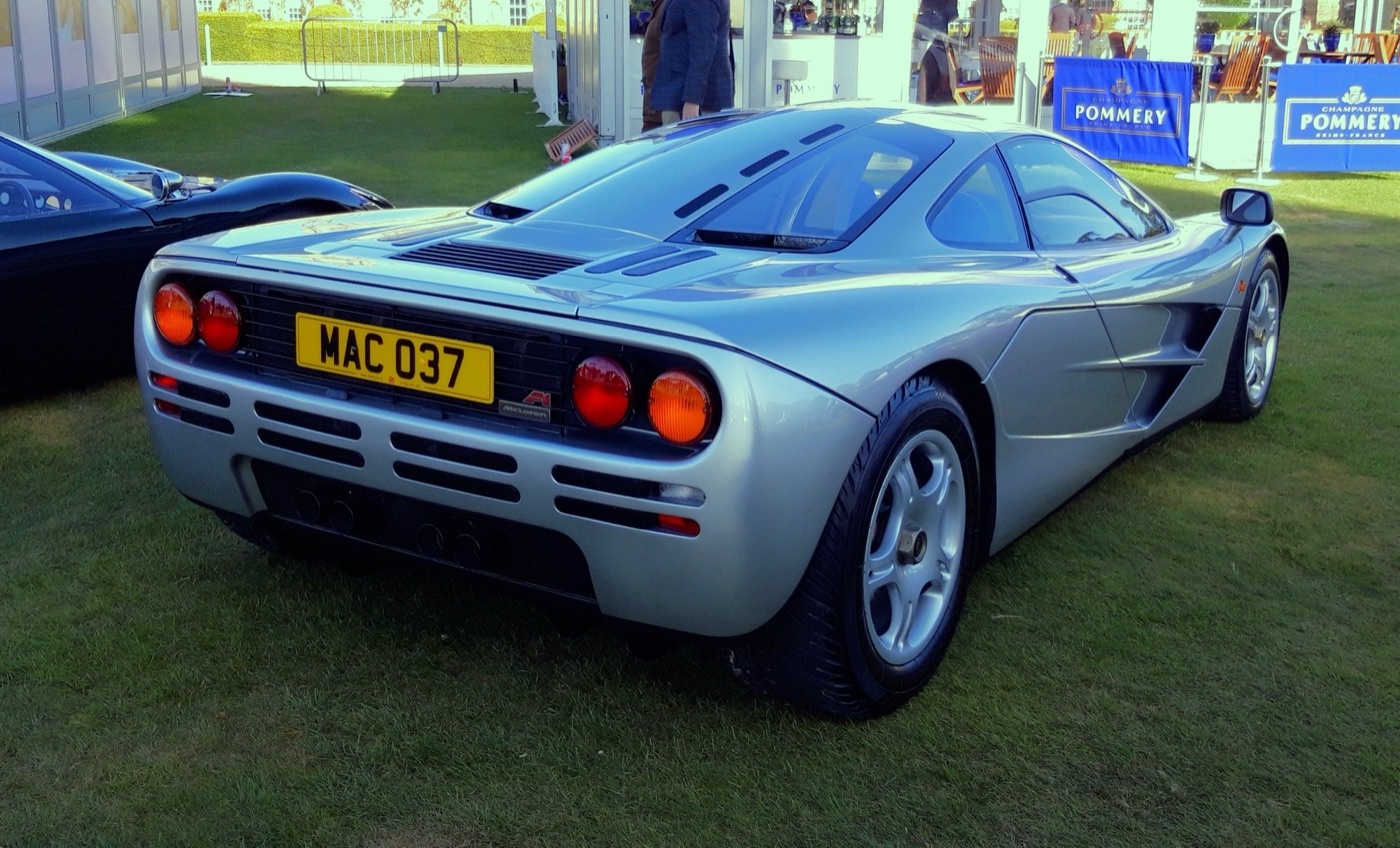
Autocar's road test figures
McLaren allowed one set of performance figures to be taken from the F1, and Autocar took them on Monday 2 May 1994, the day after Ayrton Senna was killed at the San Marino Grand Prix, at Bruntingthorpe, and on 3 May at Millbrook Proving Ground. Frankel, then Autocar's road test editor, used XP5 for the evaluation and XP4 for the timing runs, and the test also used production car 003. To 100mph the Jaguar XJ220, the next fastest car Autocar had tested, took 7.9 seconds against the F1's 6.3, and in sixth it covered 180–200mph in 7.6 seconds. For top-gear flexibility Autocar timed 50–70mph in sixth at 3.7 seconds, 1.7 seconds quicker than the next best car it had tested, a TVR Griffith 500. "Until we strapped our equipment to the McLaren F1 no one knew how fast it would go," the test began.
How fast is the McLaren F1?
The McLaren F1's recorded top speed is 240.1mph (386.4km/h), set by Andy Wallace in XP5 on Volkswagen's high-speed circuit at Ehra-Lessien in Germany on 31 March 1998; RM Sotheby's gives the peak as 391km/h (243mph). McLaren's own account, written by Peter Dron, gives the time as 3.08pm and the speed as "386.7km/h, 240.3mph". The rev limiter, normally set at 7,500rpm ("about 236mph with tyre growth"), was raised in stages to 8,300rpm for the run. McLaren had first established 231mph at the Nardò test track in Italy on 8 August 1993.
Ron Dennis said the attempt came about after his son was given a Guinness Book of Records for Christmas: "I was most surprised to find the F1 was not recognised as the fastest production road car. It seems the original Autocar test results were not official." Wallace wore jeans and a blue shirt: "It's a road car, isn't it?" he said when asked about overalls. Above 340km/h (211mph) the car wandered slightly, he said, but at higher speeds "it's as stable as at 340, perhaps more so". Murray offered a wager that it "remains the record speed for a true production car for a very long time"; Autocar notes that the F1 later lost the title to the Bugatti Veyron and then the Chiron. RM Sotheby's, in its catalogue for chassis 014 in 2025, calls Wallace's run "the fastest run ever set by a naturally aspirated road car". SkiddMark posted the in-car video of it in 2009, as McLaren F1 at 391km/h, the peak speed of the run.
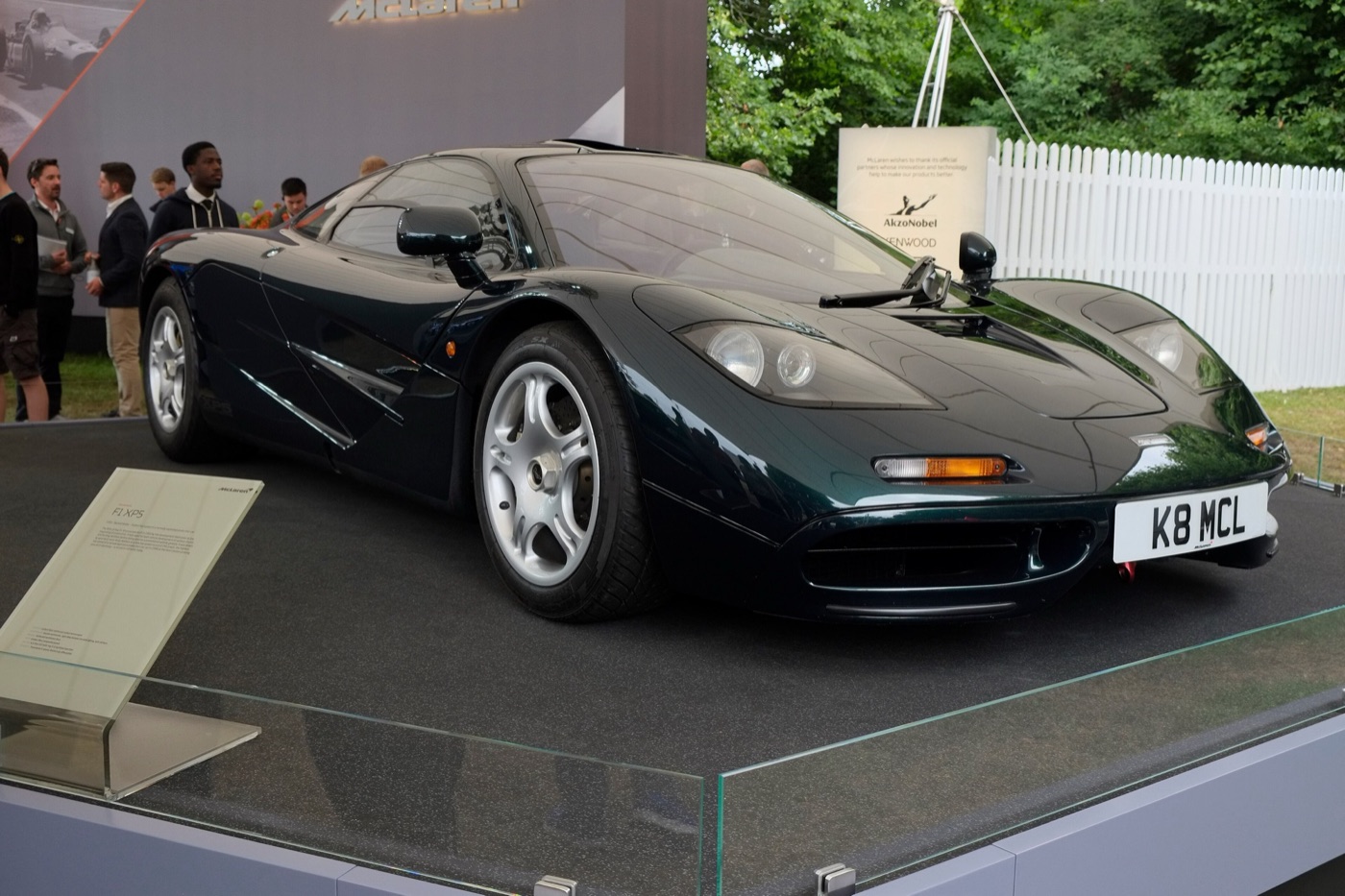
How many McLaren F1s were made?
McLaren made 106 F1s of all types between 1992 and 1998, and 64 of them are standard road cars. McLaren's own count of 2010 and RM Sotheby's of 2019 put one car in different rows, the GT and the prototypes.
| Type | McLaren, 2010 | RM Sotheby's, 2019 |
|---|---|---|
| F1 road car | 64 | 64 |
| F1 LM | 5 | 5 |
| F1 GT | 3 | 2 |
| F1 GTR race car | 28 | 28 |
| Prototypes and development cars | 6 | 7 |
| Total | 106 | 106 |
Fewer than 10% of the 64 road cars are in regular use, McLaren estimated for Autocar in 2019.
McLaren F1 variants and special editions
Besides the road car and the GTR racer, McLaren built two road-going derivatives, the LM and the GT, and later upgraded some road cars to their specification.
McLaren F1 LM
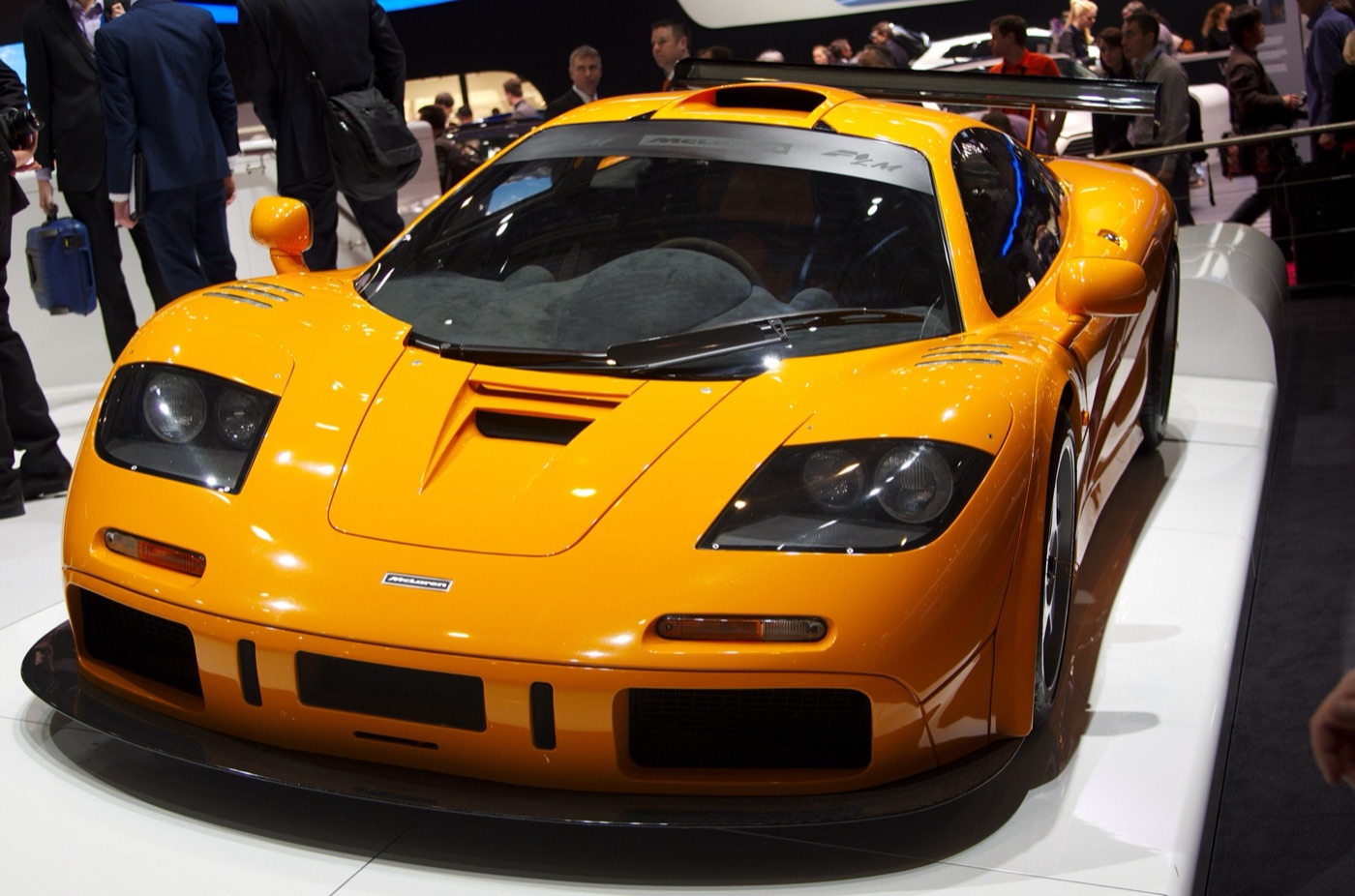
The F1 LM marks the 1995 Le Mans victory: McLaren built five, one for each F1 GTR that finished the race, plus the prototype XP1 LM. They are painted in papaya orange, the colour of Bruce McLaren's racing cars of the 1960s, and have the GTR's engine without its air restrictors, rated at 680hp by RM Sotheby's, and the High-Downforce Kit's vented nose and large rear wing. McLaren's 2010 statement called the LM "the most powerful of all F1 variants" and "the most valuable".
McLaren F1 GT, the longtail
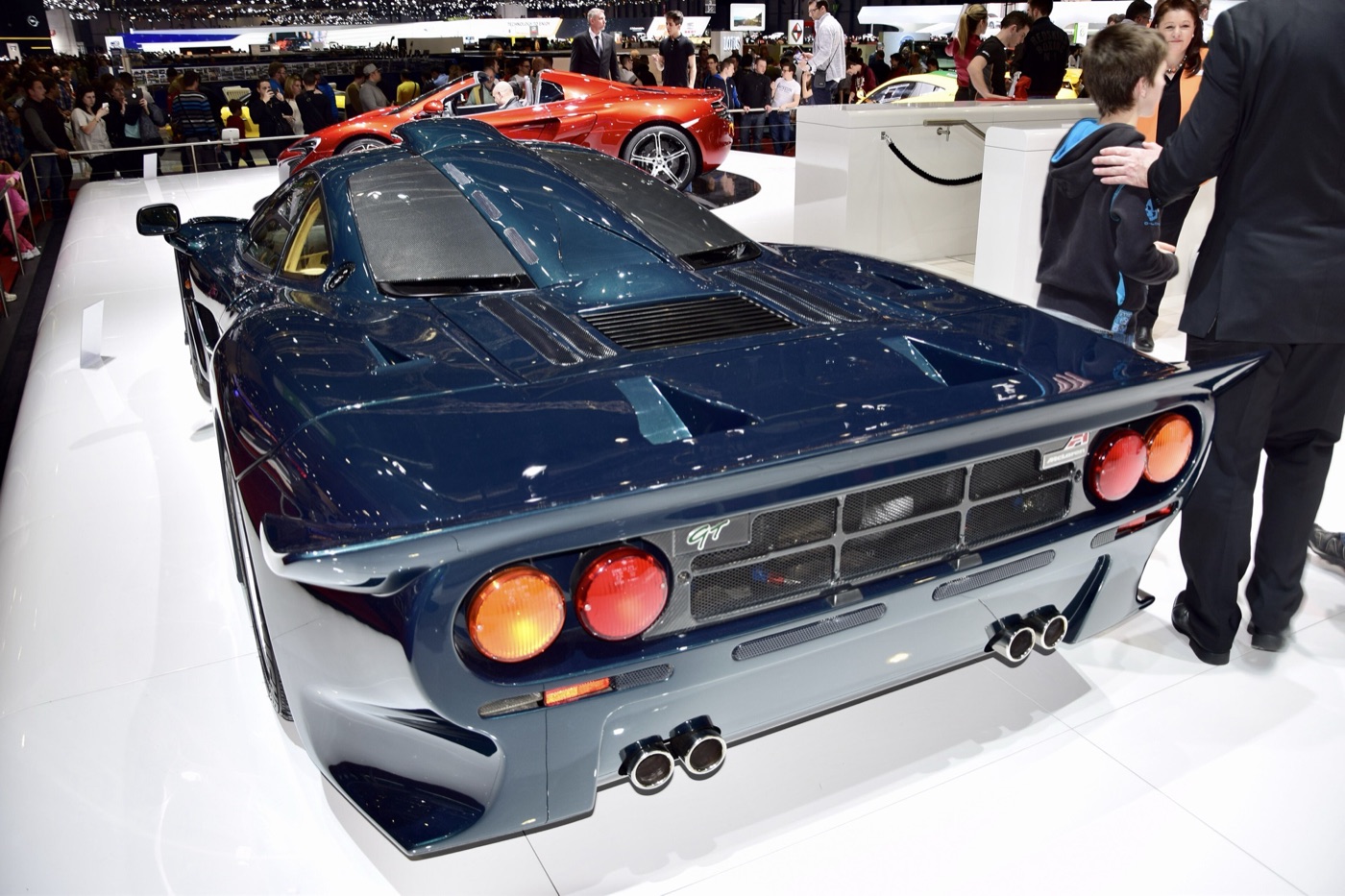
The GT of 1997 was built for the homologation of the long-tailed F1 GTR for that season's racing. McLaren needed one car and built three after requests from existing owners, according to its 2010 statement; both the road car and the 1997 GTR became known as the "Longtail" for their longer overhangs. SkiddMark's report of July 2011 on Unit 2, McLaren's store for its old racing cars, described Darren Heath's photographs for McLaren of an F1 GT under a cover there, "one of only three in existence".
High-Downforce Kit and LM-specification road cars
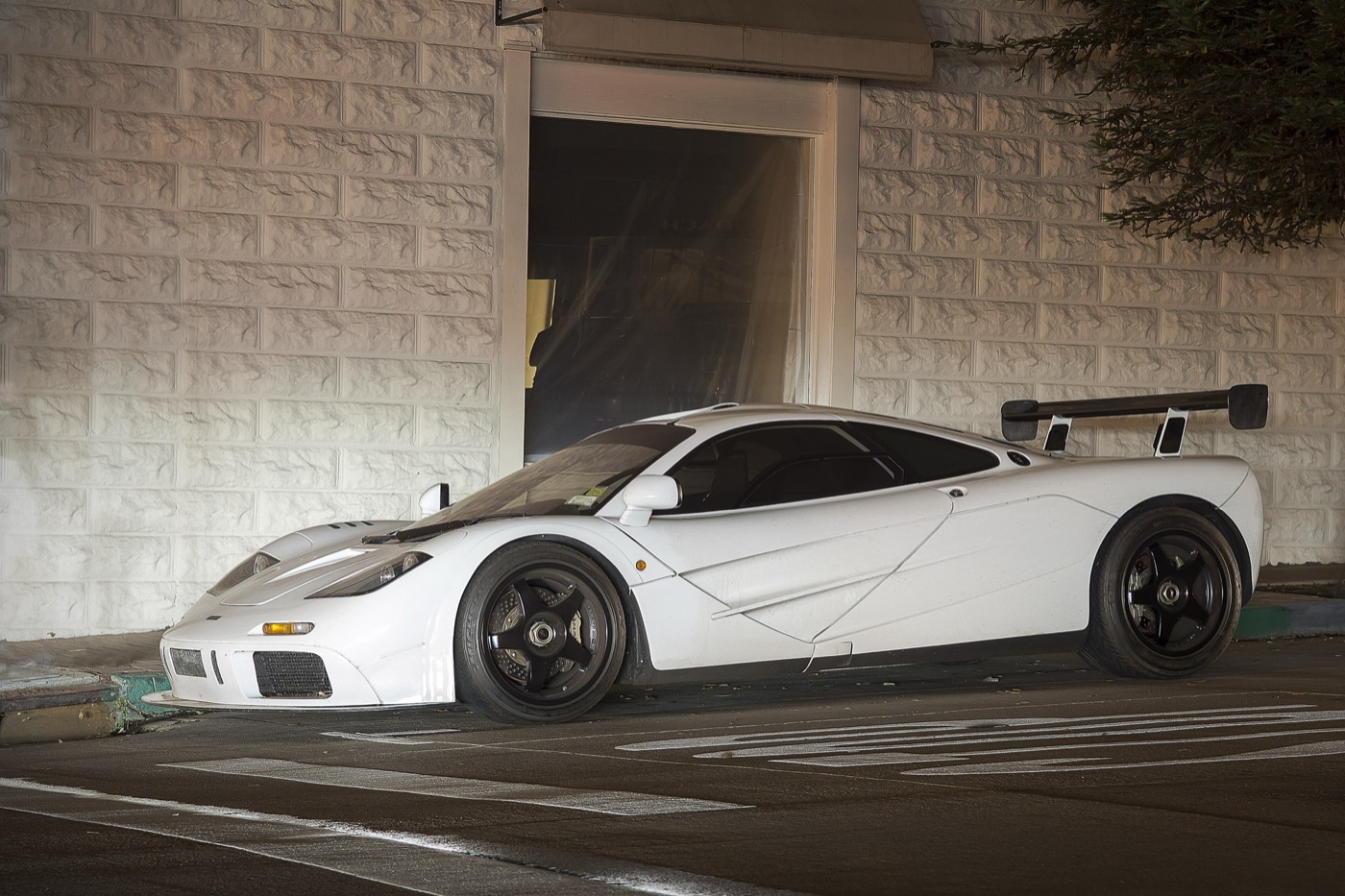
RM Sotheby's catalogues describe the later factory upgrades. The High-Downforce Kit replaced the active flap with a fixed rear wing and added a GTR-style front bumper and splitter and LM louvres on the front wings; chassis 014 was "the last of only eight F1s to gain the High-Downforce Kit treatment", in 2007. Two road cars, 018 and 073, were taken further after production ended (018 went back to the factory in 2000 for its upgrades), with the unrestricted 680hp engine and an Extra-High Downforce Kit, while keeping the road car's trim.
The McLaren F1 in racing: the F1 GTR
The F1 was not designed to race, but owners asked for a racing version, and the F1 GTR won the 24 Hours of Le Mans at its first attempt in 1995. Ray Bellm, who ordered chassis 46 after the launch, told Autocar that Ron Dennis first refused to let him convert it, then told him "to go and find three other customers who wanted a racing car, and he'd charge us £650,000 plus VAT".
The BPR series and the Le Mans win
The first F1 GTR cars were lightened road cars with new bodywork, a large rear wing and carbon-ceramic brakes, and kept the standard gearbox, RM Sotheby's catalogue for chassis 10R says. Air restrictors required by the rules cut the engine's power below the road car's. Motor Sport says the GTR won its first six races in the BPR Global GT Series, "a championship it never failed to win". Nine were built in 1995, three times as many as planned, and the results list seven F1 GTRs among the Le Mans starters.
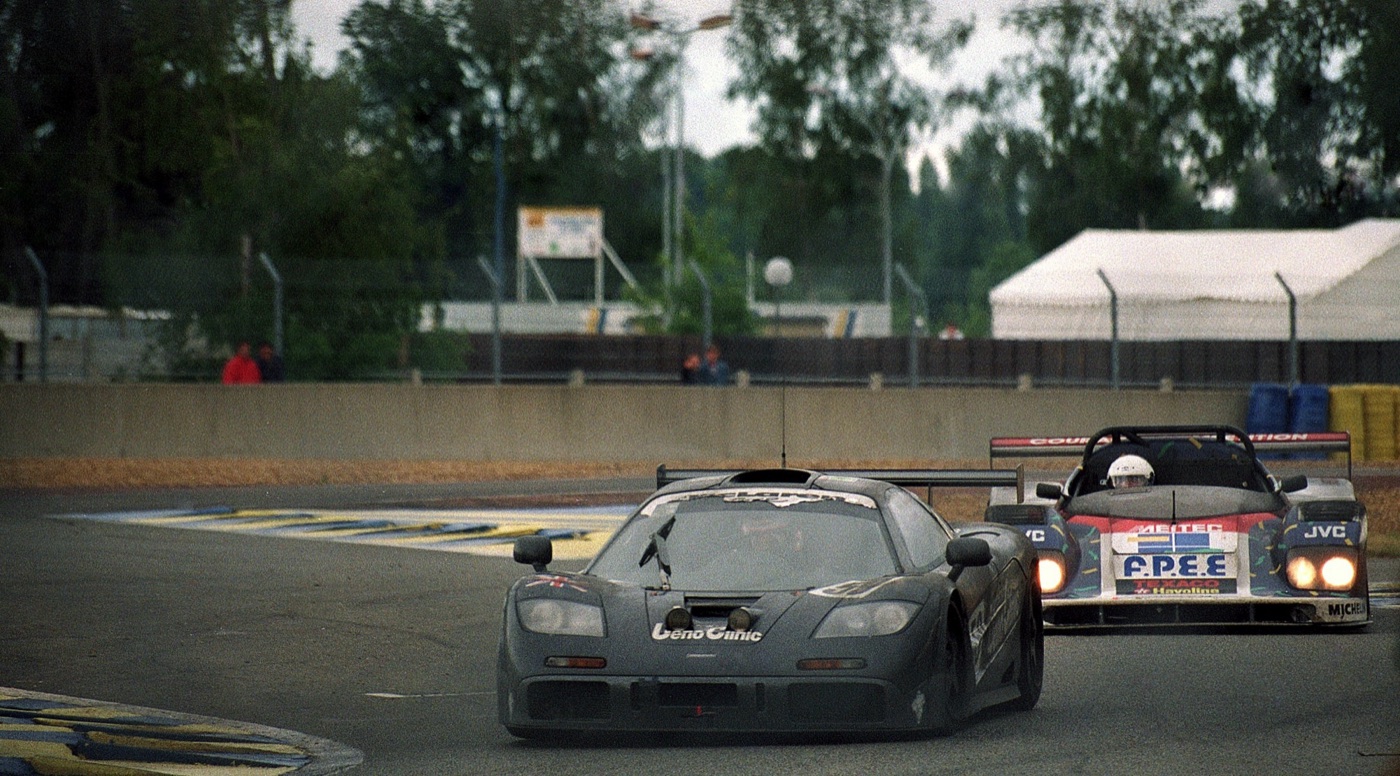
The race ran in wet conditions for much of the night, and JJ Lehto lapped up to 10 seconds faster than the cars around him, according to Motor Sport and McLaren's 2010 statement. The black No. 59 car of Kokusai Kaihatsu Racing, run by Paul Lanzante's team and sponsored by Ueno Clinic, won by one lap from a Courage prototype.
| Position | No. | Drivers | Entrant | Laps |
|---|---|---|---|---|
| 1st | 59 | Yannick Dalmas, Masanori Sekiya, JJ Lehto | Kokusai Kaihatsu Racing | 299 |
| 3rd | 51 | Andy Wallace, Derek Bell, Justin Bell | Mach One Racing | 297 |
| 4th | 24 | Mark Blundell, Ray Bellm, Maurizio Sandro Sala | Gulf Racing | 292 |
| 5th | 50 | Jean-Denis Delétraz, Fabien Giroix, Olivier Grouillard | Giroix Racing Team | 291 |
| 13th | 42 | Maury-Laribière, Sourd, Poulain | Société BBA Compétition | 267 |
The winning car is 01R, McLaren's own development chassis, and McLaren keeps it at the McLaren Technology Centre in the condition in which it finished. With the win, McLaren became the only maker to have won the Formula 1 world championship, the Indianapolis 500 and Le Mans, the company said in 2010. RM Sotheby's quotes Murray as saying that winning Le Mans first time was harder than winning back-to-back Formula 1 championships.
Later GTRs and the Longtail
Nine more GTRs were built to 1996 specification, the version RM Sotheby's says "offers collectors and drivers the most", with longer bodywork front and rear, a bigger splitter and a magnesium gearbox casing, 38kg lighter than the 1995 car. The first of them, 10R, stayed with McLaren as a test car, went to Nick Mason of Pink Floyd in 1999 and was converted for the road. In 2009, after Autocar's testing, another of the journalists who drove it put it into a field of wheat. In August 2026 it sold for $34,655,000 (see values below). The 1997 GTR, the Longtail, had new long-tail bodywork for more downforce and less drag. A Gulf-liveried Longtail, chassis 20R, driven by Pierre-Henri Raphanel, Jean-Marc Gounon and Anders Olofsson, finished second overall at Le Mans in 1997 and won the GT1 class, one lap behind the winning Joest Porsche. McLaren showed it at Goodwood in 2013 with 01R and XP1 LM, which SkiddMark reported in June 2013. RM Sotheby's records GTR finishes at Le Mans of fourth in 1996 and fourth in 1998.
How much is a McLaren F1 worth?
A standard McLaren F1 road car is worth more than $20 million: the highest public sale is $25,317,500, paid for chassis 014 at RM Sotheby's first Abu Dhabi sale on 5 December 2025. New, its price tag was £540,000 in Autocar's 1994 road test; Motor Sport gave £535,000 at the 1992 launch, and Frankel wrote in 1997 that it "cost £634,500" when it went on sale in 1993.
| Date | Car | Where | Price |
|---|---|---|---|
| October 2008 | Delivery-mileage road car | Auction (McLaren's figure) | £2.53 million |
| August 2013 | Road car | Pebble Beach auction (evo) | $8.47 million |
| June 2015 | Rowan Atkinson's road car | Private sale, Taylor & Crawley | Reported £8 million |
| August 2017 | Chassis 044, first F1 imported to the US | Bonhams, Quail Lodge (Hagerty) | $15,620,000 |
| August 2019 | Chassis 018, LM specification | RM Sotheby's, Monterey | $19,805,000 |
| August 2021 | Chassis 029, under 390km from new | Gooding, Pebble Beach | $20,465,000 |
| December 2025 | Chassis 014, High-Downforce Kit | RM Sotheby's, Abu Dhabi | $25,317,500 |
| August 2026 | F1 GTR 10R, converted for road use | RM Sotheby's, Monterey | $34,655,000 |
Chassis 044, sold by Bonhams at Quail Lodge in August 2017, was the first F1 imported into the United States and had 9,600 miles with its original owner, about half of them from a drive straight from the factory through Europe; its $15.62 million was "almost $2 million more than the last F1 that went up for auction", Hagerty reported. Chassis 029, sold by Gooding at Pebble Beach in 2021, was delivered new to Japan in a "singular" Creighton Brown and had covered less than 390km since delivery. Chassis 014, rebuilt by McLaren in 2007 for more than $500,000, had a mileage of 13,711 when it sold. The GTR 10R's $34,655,000 is, in RM Sotheby's words, a record for "the most valuable McLaren F1 and British car ever sold at auction".
Owning a McLaren F1: servicing and running costs
McLaren still services the F1 itself, through the department now called McLaren Special Operations, and the work is slow; Autocar says "the cost to run one is eye-wateringly expensive". On reliability, Autocar rates it "generally a reliable car that shouldn't suffer from any major issues", but its maintenance "can only be carried out by McLaren". McLaren's 1998 account mentions "the standard, major 18-month service" and a preventative maintenance programme under which "anything new that we develop is fitted free for three years". Autocar's buyer's notes say a routine service can take about 85 hours: the engine comes out, the fuel tank, fuel hoses and other parts are replaced, and the car is signed off with a test at Millbrook.
The rubber fuel cells need replacing every five years, though Lanzante can fit an aluminium cell that lasts the life of the car. The clutch, a carbon unit, "doesn't like to be slipped", and replacing it costs "around a five-figure sum", and the brake pads last about 15,000 miles. Chassis 014's 2018 engine-out service at McLaren Philadelphia, with a new fuel cell, cost more than $50,000, its catalogue says. Each car has an on-board modem, and in 1994 Autocar reported that if it could not reach the Woking factory, McLaren would "immediately dispatch a mechanic, by plane if necessary".
Notable McLaren F1 owners
Chassis 014 was delivered new to the royal family of Brunei in Titanium Yellow, RM Sotheby's records. Ron Dennis owned one, as he said in 2010. Nick Mason, the Pink Floyd drummer whom RM Sotheby's calls a "renowned collector", owned the GTR 10R for 25 years, from 1999 until a private sale in spring 2024, and the first F1 imported into the US, chassis 044, stayed with its original owner until 2017.
Rowan Atkinson's McLaren F1
The actor Rowan Atkinson bought an F1 in dark maroon paint in 1997 and drove it more than most owners: 41,000 miles by the time he sold it in 2015, evo reported. Reports of his purchase price vary: CNBC said he may have paid up to £640,000, Insurance Times "roughly £647,000". Top Gear's news story of the 2011 crash says that "soon after buying it, he had a collision with a Rover Metro"; CNBC's 2015 report dates that to 1999 and says he drove into the back of the Metro.
The crash on the A605 at Haddon
On the evening of Thursday 4 August 2011, Atkinson's F1 left the A605 at Haddon, near Peterborough, and caught fire. SkiddMark reported the next day that the car had hit a road traffic sign, and that a spokesman for Cambridgeshire Fire and Rescue Service told the local paper: "The driver of the vehicle was out of the car before the arrival of firefighters and crews extinguished the fire using just one hose reel." Crews from Stanground and Dogsthorpe attended. Associated Press, in a report carried by the Christian Science Monitor, said the car struck a tree and a lamppost and that Atkinson would face no criminal charges.
Atkinson was treated at Peterborough City Hospital for a shoulder injury and left on Friday 5 August by a back door, with four security guards, without comment. At the time SkiddMark noted that he had owned the car for 14 years and covered more than 37,000 miles in it, and that a few weeks earlier he had set the fastest time in Top Gear's Star in a Reasonably Priced Car. Classic & Sports Car's account of the rebuild says he was "accelerating hard in fourth gear" when the car crossed a damp patch, spun and hit a tree, that the damage tore the engine and drivetrain out of the car and left them nearly 20 yards from the wreck, and that he broke a shoulder blade.
The £910,000 repair and the sale
McLaren's assessment took four weeks and the bill was £910,000, Classic & Sports Car says; Insurance Times later called it "Britain's biggest car insurance claim". The rebuild took 16 months, and Atkinson told the magazine that getting back in "was like putting on an old sweater". He sold the car in June 2015 through the London dealer Taylor & Crawley; no price was published, and evo and CNBC reported about £8 million. The buyer also received an original wind-tunnel model, a Facom tool chest and titanium tool roll, and a TAG Heuer watch engraved with the chassis number, evo said.
Rivals and successors of the McLaren F1
The F1's rivals on sale were the Ferrari F40, Bugatti EB110 and Jaguar XJ220; its successors came from McLaren Automotive, the road car company McLaren launched in 2010, and from Murray's own firm.
McLaren F1 vs Ferrari F40, Jaguar XJ220 and Bugatti EB110
When the F1 was conceived in 1989 the Ferrari F40 was the supercar to beat, Motor Sport wrote at the launch, and by 1992 the Bugatti EB110 and Jaguar XJ220 had joined it. Autocar's 1994 test priced Bugatti's EB110 GT at £238,000 and the Jaguar XJ220 at £403,000 against the McLaren's £540,000. The Bugatti "would not even allow you a glimpse at the world of the F1", it said, and you could drive the Jaguar "for a year and never know" where the McLaren would take you. Frankel noted in 1997 that unsold XJ220s were still being offered with £150,000 off.
Successors: P1, Speedtail and the GMA T.50
The F1's first successor at McLaren is the P1 hybrid, shown in 2012. Ron Dennis said then that McLaren had "raised the performance bar for supercars with the McLaren F1" twenty years earlier, as SkiddMark reported under the headline The King is Dead: Long live the McLaren P1.
The Speedtail of 2018 brought back the F1's layout. McLaren's release naming the car described "a three-seat cockpit design with a central driving position – the same layout as the F1", a petrol-electric hybrid powertrain, a top speed above "the 243mph peak speed of the legendary McLaren F1 road car", and 106 customers who had reserved one.
Murray's own successor is the Gordon Murray Automotive T.50. Goodwood's report of its announcement in 2019 gives it a three-seat cabin with a central driving position, a fan under the car taken from the Brabham BT46B "fan car", and a 4.0-litre Cosworth V12 of 650PS that revs to 12,100rpm, in a car weighing under a tonne. "I have absolutely no interest in chasing records for top speed or acceleration," Murray said. RM Sotheby's sold a 2025 T.50 for $5,630,000 at the same Abu Dhabi sale as chassis 014, and called it the F1's "spiritual successor".
Reception of the McLaren F1
Autocar's 1994 verdict was that "the McLaren F1 was the finest driving machine built for the public road" and that it "would be remembered as one of the great events in the history of the car, one to rival the launch of the Mini and Jaguar E-type". It criticised the minor switches (too far from the driver's line of sight), the rear view and a reverse gear that was hard to engage. Frankel, in Motor Sport in 1997, wrote that on his first drive north to Yorkshire he "fought to keep control, not of the F1, but of myself", and that several had "collided with the scenery while being driven by unusually able drivers". To true car enthusiasts, he concluded, "there is something wonderful about the F1".
In 2015 the F1 was on Classic & Sports Car's shortlist of ten for the best British car ever, chosen from nominations by more than 100 people including Murray and Nick Mason. At the 20th-anniversary gathering in April 2010, when 21 F1 road and race cars met at the McLaren Technology Centre, Ron Dennis said: "I enjoy driving mine more today than ever before because I find its technical purity highly satisfying." SkiddMark's report of the day, McLaren celebrates the 20th anniversary of its legendary McLaren F1, recalled Tiff Needell driving an F1 hard round the Goodwood circuit for Top Gear and Gordon Murray explaining "his sketch on a napkin".
What is the McLaren F1 like to drive?
Andrew Frankel drove XP5 again for Autocar in 2019. The F1 has no downforce to speak of and its body moves far more than a modern supercar's, "but only minimal weight and ... it grips. And steers." The feel through the wheel "may just be the best thing about this car", and the handling reminded Autocar's Matt Prior of a 600bhp Lotus Elise. The ride quality makes it and McLaren's 720S "gorgeous long-distance machines", though the F1 is smaller in all its significant dimensions except wheelbase, and no modern car could copy its packaging once crash structures, airbags and infotainment had taken their space. Road car performance did not return to the F1's level until the Porsche 918, LaFerrari and McLaren P1, about 20 years later, when the word hypercar came into use. The brakes are "the only part that feels its age", and on narrow public roads the F1 "felt four times quicker" than on the open runway. In 1997 Frankel had written that it made the fastest Lamborghini, Ferrari and Jaguar "instantly and utterly obsolete".
Questions
Who designed the McLaren F1?
Gordon Murray, McLaren Cars' technical director, designed it, with Peter Stevens as stylist; Paul Rosche of BMW Motorsport designed its V12.
What engine is in the McLaren F1?
A 6,064cc BMW S70/2 V12 with 48 valves, built for the car by BMW Motorsport. In the production car it made 627bhp at 7,400rpm.
How much did a McLaren F1 cost new?
Motor Sport gave £535,000 at the 1992 launch and Autocar £540,000 in its 1994 road test; Andrew Frankel wrote in 1997 that it cost £634,500 when it went on sale.
Is the McLaren F1 street legal?
Yes. It was built as a road car, and Autocar drove one from the test track to the North Yorkshire moors in 1994. Some F1 GTR race cars were converted later: 10R was registered K40 MCL in 1999.
Is the McLaren F1 still the fastest naturally aspirated car?
Yes, as a production car: RM Sotheby's described Andy Wallace's 240.1mph run of 1998 in 2025 as "the fastest run ever set by a naturally aspirated road car".
Where was the McLaren F1 built?
At McLaren Cars in Woking, Surrey, next to the Formula 1 team's base; the prototype programme began there in January 1990.
Why is there gold in the McLaren F1 engine bay?
Gold foil reflects the engine's heat away from the carbon fibre structure. Replacing it takes up to 18 hours, Autocar says.
Sources
- McLaren Cars, McLaren F1 press release, May 1992, republished in full by evo as "The original McLaren F1 press release in full", 31 May 2016: company history, design aims, 1992 specification, patents.
- McLaren, "McLaren F1 Design" (archived November 2025): one-plus-two seating since 1969, chassis hours, titanium parts, gold heat reflector.
- Ultima Sports, "History: McLaren" (archived February 2025): the Albert and Edward test mules.
- McLaren, Peter Dron, account of the 1998 production car speed record (archived February 2001): Ehra-Lessien run, rev limits, Nardò 1993, end of production, quotes from Wallace, Murray, Dennis and Dermott.
- Motor Sport, "Is this the world's most desirable sportscar?", July 1992: Monaco launch, price, production plan, engineering, Lauda's remark.
- Andrew Frankel, Motor Sport, "The best goes west", August 1997: Linate, price, losses, planned production, test figures, driving impressions.
- Motor Sport, "A quarter century of the McLaren F1", 2017: GTR in 1995, BPR record, Lehto at Le Mans.
- Autocar, McLaren F1 road test, May 1994, republished on Autocar's site (read 27 October 2026): production figures, kerb weight, performance, economy, prices of rivals, verdict, buyer's notes on servicing and costs, Ray Bellm's account.
- Andrew Frankel, Autocar, "Autocar's exclusive McLaren F1 road test", 2019: test dates, prototypes, cars in regular use.
- racingsportscars.com, Le Mans 24 Hours 1995 results and 1997 results: finishing order, drivers, entrants, laps.
- RM Sotheby's lot pages: 1994 McLaren F1, chassis 014 (Abu Dhabi, December 2025); 1994 McLaren F1 LM-Specification, chassis 018 (Monterey, 2019); 1996 McLaren F1 GTR, chassis 10R (Monterey, 2026): prices, histories, production counts, LM and GTR details.
- RM Sotheby's, Monterey results release, 17 August 2026: the 10R record.
- Hagerty, "A perfect McLaren F1 now costs $15.62 million", August 2017: the sale of chassis 044 at Bonhams.
- RM Sotheby's, Abu Dhabi results release, 8 December 2025: chassis 014 sold on 5 December; the T.50.
- McLaren Automotive, "McLaren Speedtail revealed as name of world's first Hyper-GT", 2018 (release as carried by Automotive World): the Speedtail's layout.
- Goodwood Road & Racing, "The T.50 is Gordon Murray's McLaren F1 successor", 2019: the T.50's specification and Murray's quote.
- Gooding & Company, 1995 McLaren F1, chassis 029, Pebble Beach 2021: price and description.
- Associated Press via the Christian Science Monitor, "$1 million supercar crashed by Mr. Bean", August 2011; Top Gear, "Rowan Atkinson involved in F1 crash", 5 August 2011: the 2011 crash and the 1999 collision.
- Classic & Sports Car, "Rowan Atkinson's McLaren rebuild": crash, repair bill, rebuild, Atkinson's quote; and best British car shortlist, 2015.
- Insurance Times, "Rowan Atkinson sells 'biggest insurance claim' car", June 2015; evo, "Rowan Atkinson's McLaren F1 sells for estimated £8million", June 2015; CNBC, report of 9 June 2015: the sale, mileage, 2013 auction price.
- SkiddMark's own reports: McLaren F1 at 391km/h (March 2009); McLaren celebrates the 20th anniversary of its legendary McLaren F1 (April 2010, with McLaren's statement of production, prices and quotes); Unit 2 – where McLaren's racing cars go to retire (July 2011, on Darren Heath's photographs); Rowan Atkinson's crash (5 August 2011); The King is Dead: Long live the McLaren P1 (September 2012); McLaren celebrates its Le Mans success at the Goodwood Festival of Speed (June 2013).
This article was written in October 2026 to replace SkiddMark's original report of 5 August 2011, "Comedian Rowan Atkinson crashes his McLaren F1 (UPDATED)", whose facts are kept in the section on Atkinson's car. Values checked 27 October 2026.