Red Bull Stratos Mission: Felix Baumgartner makes one giant leap for mankind..
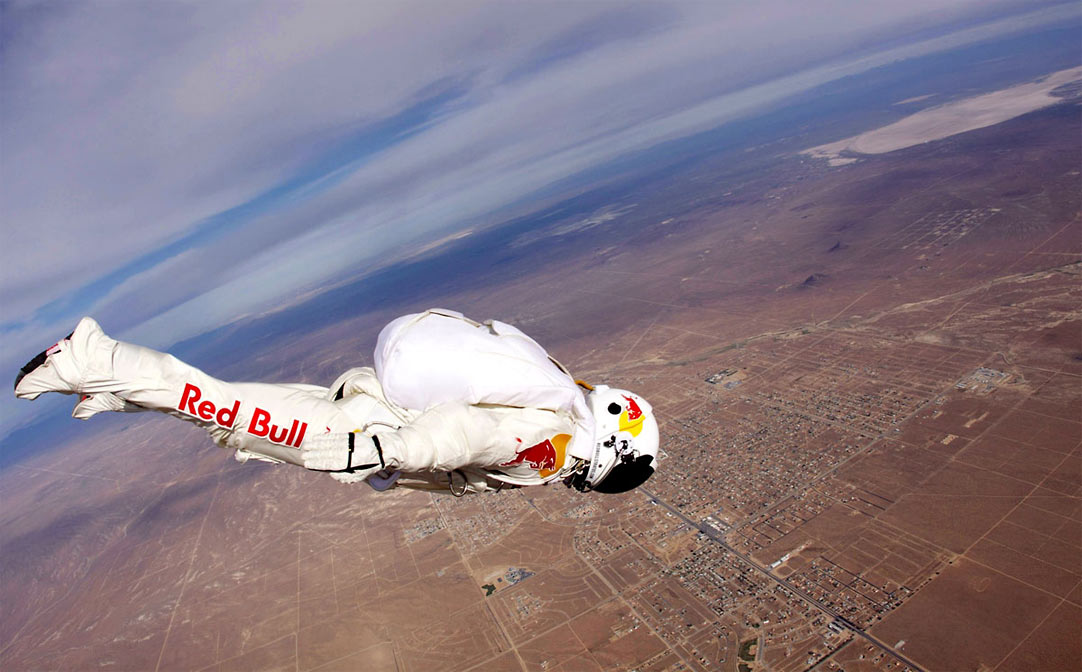
When in 1969 Neil Armstrong stepped foot on the Moon and said “That’s one small step for (a) man, one giant leap for mankind”, Felix Baumgartner was just 3 months old. Who would have thought that 43 years later the Austrian skydiver would be making the biggest leap any man has made when he attempts a supersonic freefall from 120,000 ft (almost 36km) this afternoon.
Red Bull Stratos, created by Red Bull and Felix Baumgartner, is a mission to the edge of space that will try to surpass human limits that have existed for more than 50 years. Baumgartner will aim to beat Joe Kittinger’s 52 year-old record of 102,800 ft, for the highest free-fall in history. Interestingly, Kittinger will be seated in mission control throughout and will guide Baumgartner’s space jump.
READ the article with Baumgartner’s thoughts from after the successful jump.
Supported by a team of experts, Felix Baumgartner will undertake a stratospheric balloon flight to more than 120,000 feet / 36,576 meters and make a record-breaking freefall jump in the attempt to become the first man to break the speed of sound in freefall (an estimated 690 miles / 1,110 kilometres per hour).
Mission: Schedule
-
UPDATE (19:00 BST): | The launch was aborted due to gusty weather conditions – tune back in tomorrow, when (weather depending) the Red Bull Stratos team will make another attempt.
13:30 GMT – Baumgartner will begin his ascent, which is expected to take approximately 2.5 hours, in a high-altitude helium balloon from Roswell, New Mexico. The 30-million-cubic-foot helium balloon is 1/10th the thickness of a Ziploc bag, yet weighs more than 1,333 kg. Stretched out it would cover about 40 acres.
16:00 GMT – After reaching the edge of space (120,000 ft) he will run through a final check-list, before stepping onto the edge of the capsule, looking down to earth. Before Baumgartner leaves the safety of his pressurized capsule, he will wait for a final “clear to jump” from mission control. Once he depressurizes and detaches the hoses, he must jump. In an emergency he could ride the capsule back to earth unpressurized but with limited oxygen reserves.
16:30 GMT – One he finally steps off from the capsule he will reach the speed of sound within 40 seconds. He will enter into the delta position (head down), which is best for stability, decreased drag, and his attempt to break the speed of sound.
As Baumgartner falls closer to the troposphere, where airplanes fly, he should be travelling at just under 800mph. At this point the air molecules are multiplying, acting as a gentle brake to slow him down. The temperature at this point is around -45 degrees celsius.
16:35 GMT – Baumgartner deploys his parachute at 5,000 ft. From this point he has 10-15 minutes before reaching the ground. His total time in the air from the edge of space to Earth will have been around 15-20 minutes.
16:50 GMT – 10 minutes later and Baumgartner should be safely back on the ground. Mission accomplished.
* * *
The mission, which was delayed by 24 hours due to bad weather will now go ahead at 13:30 BST this afternoon – with the team hoping to capture valuable data for medical and scientific advancement.
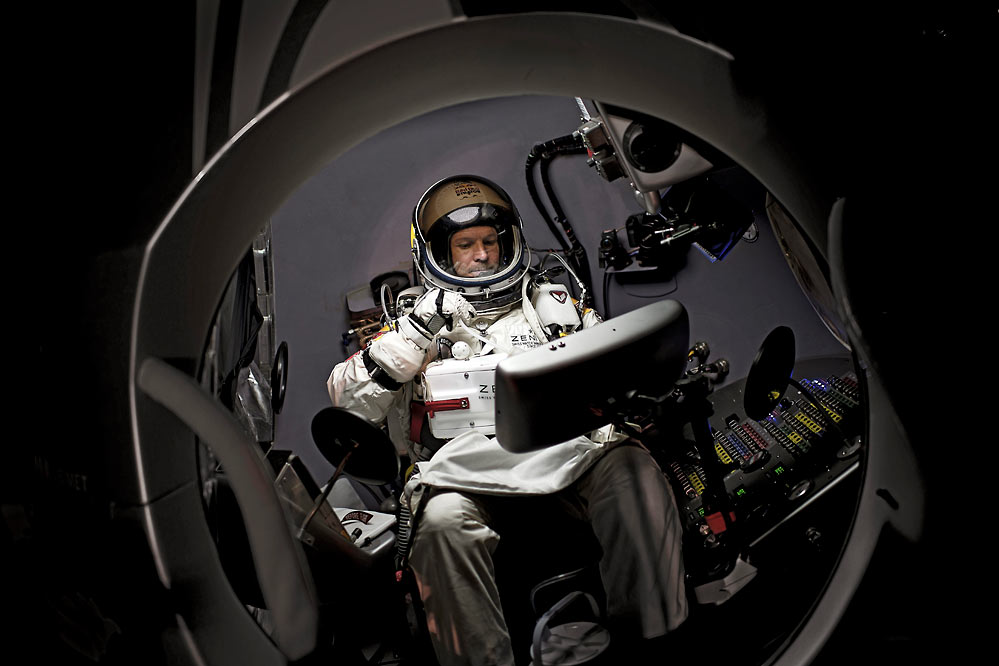
Yesterday, the team conducted a step by step dress rehearsal of the launch (58 steps to be exact) and checked each and every function of Felix’s suit.
“Rehearsal is critical,” said high performance director Andy Walshe. “Everything went wonderfully well and the crew was on their game. A couple of times we were ahead of schedule, which is really reassuring. It gives us a sense of confidence.”
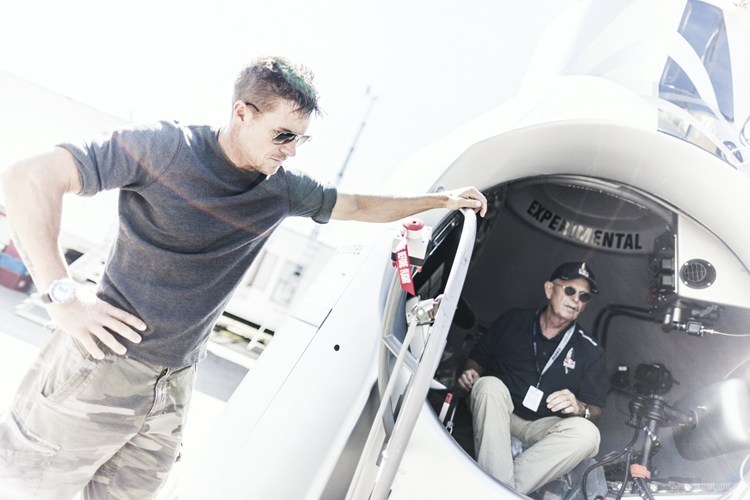 Pilot Felix Baumgartner stands next to the capsule during the preparation of the final manned flight for Red Bull Stratos in Roswell, New Mexico, USA on October 5, 2012.
Understanding the need to coordinate his activities with those of other crew members, Baumgartner participated too, undergoing a medical check, getting suited up and entering the capsule using the same activation plan that will be implemented at the final launch. “You cannot do this without a team to support you,” the Austrian noted.
Baumgartner will launch with the largest manned balloon in history: 550 feet/ 168 meters high at the start with a volume of 30 million cubic feet/ 850.000 cubic meters.
You can watch the jump, either here on SkiddMark, or perhaps better still over at the Red Bull Stratos Mission site.